
 Worksheets
Diversity Unit 1
Total questions: 121
Worksheet time: 1hrs 4mins
______ are the remains or traces of once-living organisms.
fossils
rocks
skeletons
sediments
Which of these conditions might prevent a dead organism from being preserved?
being trapped in tree sap
being eaten or decompoosing
being dissolved by water
being buried by sediments
The remains of less than one percent of all the species that ever lived fossilized.
true
false
Fossils form most often when an organism's remains are _____ buried by sediment.
slowly
quickly
Which type of organisms are more likely to be fossilized?
land animals
water-dwelling organisms
What type of fossil is formed when an organism's tissues are replaced by minerals from water?
permineralized fossil
amber fossil
cast fossils
trace fossils
What type of fossils are formed when an organism is quickly buried and flattened by the enormous pressure of sediments built up above it?
permineralized fossil
carbonized fossils
mold fossils
tar pit fossils
What type of fossils are formed when an organism's tissue decomposes and an impression of it's body shape is left in sediment?
cast fossils
mold fossils
amber fossils
carbonized fossils
What type of fossil is a record of the activity of an organism?
amber fossil
cast fossil
mold fossil
trace fossil
What type of fossils are formed from minerals in the water that seep in and fill impressions?
mold fossils
cast fossils
trace fossils
carbonized fossils
What type of fossils are formed when an organism is stuck in sticky tree sap and becomes sealed as the sap covers its body?
amber fossil
carbonized fossil
cast fossils
trace fossils
What type of fossils are formed when trapped animals are covered in tar?
carbonized fossils
permineralized fossils
tar pit fossils
cast fossils
As long as the surrounding area stays frozen, an organism that dies and is quicky frozen will remain frozen.
true
false
What is the assumption that the geologic events that happen today also happened in the past and that they apply to everywhere in nature?
law of superposition
uniformitarianism
relative dating
geologic timing
What law states that in a sequence of undisturbed sedimentary rocks, the oldest layers are at the bottom and the youngest ones are at the top?
law of conservation of space
law of superposition
law of existing layers
law of conservation of momentum
What refers to whether a rock layer is older or younger than other rock layers?
relative dating
absolute dating
geologic dating
radiometric dating
The rock layer at the top of the Grand Canyon is the ______.
youngest
oldest
The rock layer at the top of the Grand Canyon was deposited ____.
most recently
in the distant past
Layers in the middle of the Grand Canyon are _____ than the surface layer.
younger
older
The layer farthest down in the Grand Canyon is the _______.
youngest
oldest
The layer farthest down in the Grand Canyon was deposited ______.
most recently
the earliest
What is used to compare the relative ages of rock layers in different areas?
geologic columns
radioactive decay
half-life
radiometric dating
What is an ordered arrangement of rock layers that is based on the relative ages of the rocks, with the oldest rocks at the bottom of the column?
geologic column
sedimentary column
radioactive decay
radiometric dating
Certain unstable particles that make up matter in rocks and living organisms change into different stable particles at a constant rate. This is called _____.
radioactive decay
radiometric decay
radiometric dating
half-life decay
What is the amount of time needed for half of a sample of a radioactive substance to decay?
half-life
radioactive decay
geologic decay
fossilization
Each radioactive substance has a specific half-life.
true
false
What is the method of finding the absolute age of rocks based on comparing the amounts of unstable, radioactive particles to stable particles in a sample?
radioactive decay
radiometric dating
relative dating
absolute dating
To be an index fossil, a fossil must meet which criteria?
must have lived during a relatively short geologic timespan
must be relatively common
must be found over a large area on Earth
must have features that make them easy to distinguish from other fossils
What is used to help make sense of the vast amount of time of Earth's history?
geologic column
radiometric dating
geologic timescale
geologic calendar
The geologic timescale is divided into intervals of time defined by
hours
years
major events
yards
What is the collection of all known fossils and their placement in order from earliest to most recent?
fossil record
rock record
geologic timescale
fossil timescale
All organisms that have lived on Earth are represented in the fossil record.
true
false
_______ is when all members of a species die out.
Extinction
Expiration
What are possible reasons for past mass extinction?
volcanic eruptions
climate warming
climate cooling
meteorite impacts
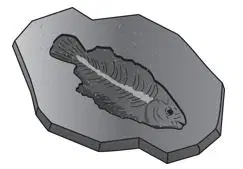
The figure shows one type of physical evidence that scientists use to understand Earth’s past. Imagine that you found this evidence on a mountaintop. What could you conclude from your discovery?
This organism is now extinct.
This fossil is older than the mountaintop.
The mountaintop is made of metamorphic rock.
The rocks on this mountaintop were once at the bottom of an ocean.

Many fossils are found only during certain periods in the geologic record. Scientists use these fossils to determine the relative ages of rock layers. The diagram shows relative ages of four fossils. Which statement is true of a rock layer that contains Fossil F?
It could also contain Fossil G.
It was formed in Periods 1, 2, and 3.
It is older than the rock layers that contain Fossil H.
It is younger than the rock layers formed in Period 4.
Which best describes a fossil that was discovered in rock at the base of a cliff?
It is most likely an index fossil.
It is likely younger than a fossil discovered halfway up the cliff.
It is likely younger than a fossil discovered in rock at the top of the cliff.
It is likely older than a fossil discovered in rock at the top of the cliff.
Which is not an accurate statement about the fossil record?
The fossil record represents less than one percent of all of the species that ever lived.
Land organisms are more likely to fossilize than aquatic organisms.
It is rare for the remains of a soft-bodied organism to become a fossil.
Most fossils are found in sedimentary rock.
How does relative dating help determine the age of a fossil?
It gives us the exact date an organism lived.
It allows us to study the radioactive elements to determine the age.
It determines whether a fossil formed before or after another fossil.
It compares a fossil with its current living relatives and studies the differences.
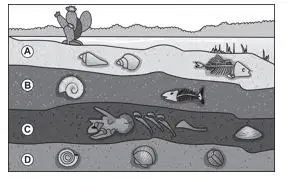
The diagram shows a portion of the fossil record in sedimentary rock. Different rock layers and fossils are clearly visible. Which statement is true of the fossils and rock layers shown in the diagram?
Layer A contains the most recently formed rocks and fossils.
Layer B contains the second-oldest rocks and fossils.
The rocks and fossils in layer B are older than those in layer D.
The rocks and fossils in layer D are the most recently formed.
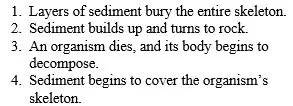
Juan is studying fossils. His teacher wrote the following statements on the board and asked the students to put them in the correct order to describe how fossils are formed. Which is the correct order of events for fossil formation?
1 3 2 4
2 3 4 1
3 2 1 4
3 4 1 2
Which of these conditions might prevent a dead organism from being preserved?
being trapped in tree sap
being eaten or decomposing
being dissolved by water
being buried by sediments
The rock layer on the top of the Grand Canyon is the _____ because it was deposited _______.
youngest, in the distant past
youngest, most recently
oldest, in the distant past
oldest, most recently
A scientist compares a fossil to a very similar living organism. What might the scientist be able to infer based on this comparison?
absolute age of the fossil
when the fossil organism likely lived
what the fossil organism likely ate
environment the fossil organism likely lived in
Which of these is not a significant discovery that Charles Walcott made in the Burgess Shale?
well-preserved land organisms
soft tissues of organisms preserved in great detail
fossils over 500 million years old
the remains of an ancient ocean
Scientists use evidence from their findings to support theories of life on earth. Which of these findings could not be used to provide supporting evidence that life on earth has changed over time?
increasing complexity of fossils in younger rock layers
increasing diversity of fossils in rock layers following an extinction
transitional fossils
rock layers with no fossils
What method was used by scientists to find the absolute age of nearby igneous rock layers?
radiometric dating
relative dating
What method was used by scientists to determine that the Burgess Shale fossils are over 500 million years old?
radiometric dating
relative dating
At one time, several kinds of camels lived in Florida. The evidence comes from fossils found in Florida. Which object would be a fossil that shows that camels once lived in Florida?
a sinkhole formed by a retreating glacier
sedimentary rock that formed a long time ago
a crystal formation suspended from the ceiling of a cave
remains of an organism preserved by geologic processes
Which of these best describes the tiny leg bones that some whales have, which do not aid in their movement or serve any other function?
structures that grow and improve in function as they are used
structures that will become adaptations when the environment changes
structures that are a remnant of the adaptations that the whale’s ancestors needed to survive on land
structures that function at certain times of the year or under certain conditions
Evidence of earliest cells was found in rock samples with high levels of a type of carbon only found in living things.
true
false
Were fossilized cells found in the rock that contained chemical evidence of life?
yes
no
An area where a particular plant has thrived for 50 million years suffers a 100-year-long drought. What evidence of the drought might be found in the fossil record?
Fossils of the plant are abundant right up until the present day.
Fossils of the plant appear in recent rock layers but not in older ones.
Fossils of the plant are present in older rocks but disappear at a point in the fossil record.
It is impossible for the fossil record to show evidence of the drought.
Which event marks the beginning of the Cambrian Era?
formation of Earth
extinction of dinosaurs
first animals with exoskeletons appear
largest mass extinction event in Earth's history
What is a single-celled life form that makes its own food by photosynthesis?
cyanobacteria
stromatolites
arthropods
cambrians
What is a group of invertebrate animals that have segmented bodies?
cyanobacteria
stromatolites
arthropods
cambrians
Which event has scientists proposed can be attributed to volcanic eruptions, a drop in sea levels and a possible large asteroid or comet strike?
formation of Earth
extinction of the dinosaurs
end of the last glacial period
early human ancestors appear
What are fossils of organisms that have body structures that are found both in an ancestral species and in its descendants?
cambrian fossils
transitional fossils
core fossils
anatomical fossils
Similarities in structures of two different species provide evidence that the species evolved from a common ancestor. This type of evidence includes similar structures that have different functions. Which pair of features have a similar structure but a different function in each organism?
a dolphin fin and a shark fin
the front leg of a cat and the wing of a bat
human fingernails and monkey fingernails
the wing of a bumblebee and the wing of a bird
Which property of fossils allows scientists to determine the relative ages of rock layers?
Fossils show change over time as species evolve.
Fossils form from the remains of living organisms.
Fossils are usually found only in sedimentary rock.
Fossils can be analyzed to determine their exact age.
Scientists want to find the causes of mass extinctions. What should they analyze?
rock layers before an extinction event
rock layer during an extinction event
rock layers after an extinction event
What material was found in one rock layer in many different places that provided evidence to infer that a very large meteorite struck Earth?
carbon
cyanobacteria
iridium
sulphur
Which of the following are true statements?
Large animal species were affected the most by meteorites.
Nearly all dinosaurs disappeared from the fossil record at the time of meteorites.
Fossil evidence shows that all small mammals disappeared at the time of meteorites.
Surviving species were contained to one area.
How do scientists use fossils to determine the relative ages of rock layers?
by comparing all the fossils in one rock layer
by comparing fossils in many different rock layers
by determining the positions of fossils in many different rock layers
by locating other areas of the world where the same fossils are found
Which of these answers best describes a fossil?
thick layers of rock
organism from which other organisms are descended
body of an organism that died recently but has not decomposed
remains of a once-living organism found in layers of rock, ice, or amber
Sometimes a fossil is formed as a result of the movement of an organism in soft sediment. Which of these are two kinds of trace fossils?
shells and bones
tracks and burrows
a bee and a beetle in amber
petrified and mummified fossils
Which of these is not considered evidence of evolution?
similar genetic information in different species
similar patterns of development in different species
similarity among organisms that are members of the same species
fossils of organisms with body structures similar to those of modern organisms
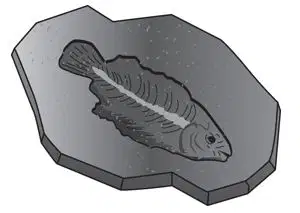
The figure shows one type of physical evidence that scientists use to understand Earth’s past. What type of physical evidence is shown in this figure?
fossil
ice core
coprolite
tree rings
Which of these choices is an example of the way an evolutionary biologist would use relative dating?
determining the minerals that make up rocks
classifying rocks as igneous, sedimentary, or metamorphic
placing fossil-containing rock layers in order from oldest to youngest
using radioactive isotopes to determine the exact age of fossils found in rock samples
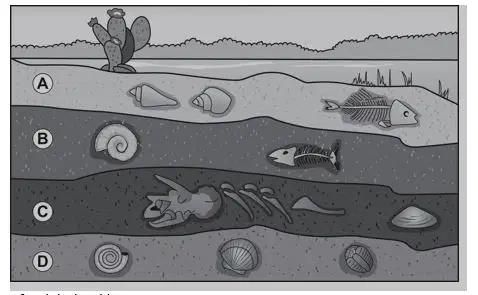
The diagram shows a portion of a fossil record in sedimentary rock. Different rock layers and fossils are clearly visible. Which layer of rock is the oldest?
Layer A
Layer B
Layer D
They are all the same age.
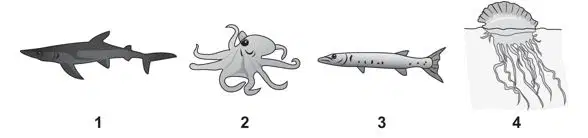
Four types of sea organisms are shown in the picture. Which of these would you most expect to be true if these organisms were classified by their physical characteristics only?
Organisms 2 and 4 would be in the same genus.
Organisms 1 and 3 would be in the same species.
Organisms 1 and 3 would be more closely related than organisms 2 and 4.
Organisms 2 and 4 would be more closely related than organisms 1 and 3.
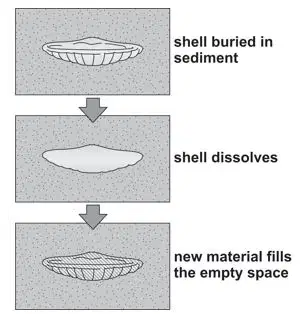
The fossil record provides evidence of evolution. Look at the series of illustrations. They show one way in which a fossil forms, providing a record of an organism. What kind of fossil is being formed?
cast
mold
imprint
footprint
William discovered that two modern-day species have very similar DNA. He concludes that the two species are closely related. In addition to genetic evidence, what other types of evidence can William use to support his conclusion?
food preferences
habitat similarities
extinction patterns
anatomical similarities
A team of geologists compared the rock layers found in Florida to those found in northwest Africa. They placed all of the rock layers from the two regions in order from youngest to oldest. What did the team make?
a fossil record
a geologic record
a geologic column
a topographic map
Which property of fossils allows scientists to determine the relative ages of rock layers?
Fossils show change over time as species evolve.
Fossils form from the remains of living organisms.
Fossils are usually found only in sedimentary rock.
Fossils can be analyzed to determine their exact age.
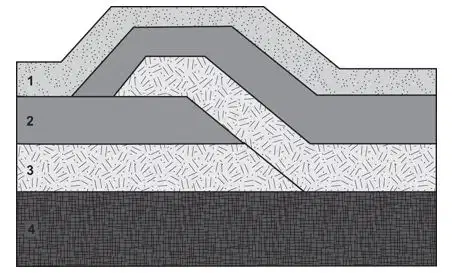
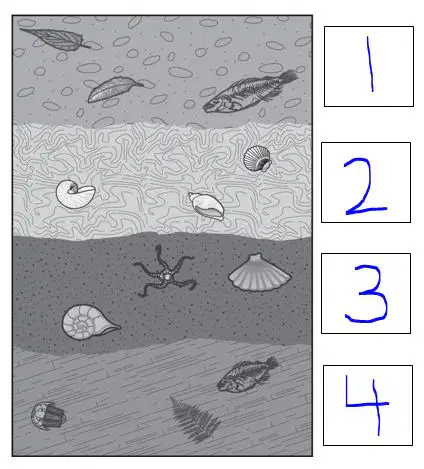
The diagram shows a cross section of different rock layers. According to the law of superposition, the rock layer above another rock layer is younger than the one below. According to the law of superposition, which numbered layer is the youngest?
layer 1
layer 2
layer 3
layer 4
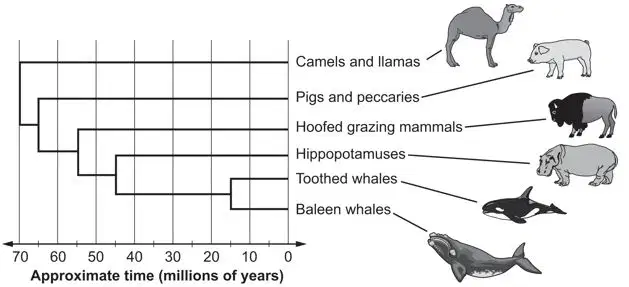
The diagram shows a model of the proposed relationships among some groups of mammals. Which organism is most closely related to whales?
pig
bison
camel
hippopotamus
Which of these cases provides embryological evidence that two species share a common ancestor?
two species with very similar DNA
two species with different body structures
two species with different structures that have similar functions
two different species with similar patterns of early development
Two species might have similar skeletal structures that have different functions. What do these types of structures suggest about the relationship between the two species?
Common structures with different functions suggest that the species live in the same habitat.
Common structures with different functions suggest that the species do not share a common ancestor.
Common structures with different functions suggest that one of the species never learned how to use the structure properly.
Common structures with different functions suggest that the species share a common ancestor that also had a similar structure.
Snakes have traces of leglike structures that are not used for movement. Which inference is supported by this fact?
Snakes do not have ancestors.
Snakes are an example of transitional fossils.
Snakes share a common ancestor with animals that have legs.
Snakes and animals that have legs are part of the same species.
Tara is comparing the embryos of parrotfish and salamanders. Although the adult organisms look very different, the embryos follow similar developmental pathways. What does this suggest?
that parrotfish and salamanders are found in the fossil record
that parrotfish and salamanders have the same genetic makeup
that parrotfish and salamanders likely share a common ancestor
that parrotfish and salamanders use their organs for different functions
Which of these is least likely to be used to infer evolutionary relationships?
similarities in habitats
similarities among embryos of organisms
similarities at the genetic and molecular level
similarities between living and fossilized organisms
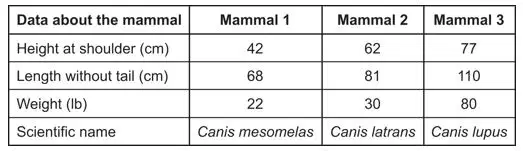
The table shows data about three types of mammals. Based on the information in the table, which conclusion about the relatedness of these organisms is the most reasonable?
The organisms share a common ancestor.
The organisms all belong to a different genus.
The organisms lack any shared genetic material.
The organisms all belong to the domain Archaea.
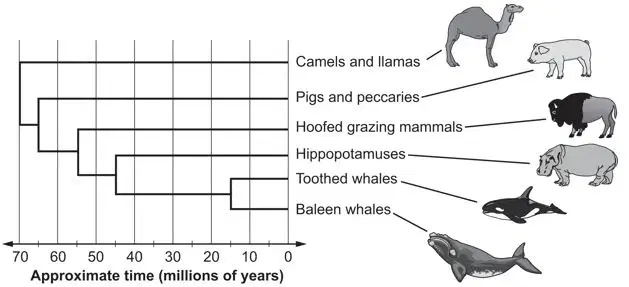
The diagram shows a model of the proposed relationships between some groups of ancient and modern mammals. How long ago did whales and pigs have a common ancestor?
about 15 million years
about 45 million years
about 55 million years
about 65 million years
What is the process of biological change by which populations become different from their ancestors over many generations?
anatomy
embryology
evolution
speciation
Whales share a more common ancestor with land animals than they do with fish.
true
false
Which of the following are ways scientists learn about evolutionary relationships?
by studying fossil evidence
by analyzing body structures
by analyzing genetic evidence
by guessing what will evolve next
What is an organism's body structure and its structural traits?
embryology
anatomy
symmetry
evolution
What is the study of the development of unborn or unhatched organisms?
embryology
anatomy
symmetry
evolution
Similarities and differences in anatomy are used to make inferences about evolutionary relationships among living and extinct organisms.
true
false
Gill slits are structural features in cat embryos that _____ found in a fully developed cat. The presence of gill slits is evidence that cats share a common ancestor with chickens and other organisms that have gill slits ______.
are, as adults
are, during embryo development
are not, as adults
are not, during embryo development
Which of the following observations provides evidence of evolutionary relatedness among organisms? Select all that apply.
similarities in body structures
similarities in molecular structures
similarities in embryological development
similarities in the foods that organisms eat
Which description best explains what scientists do if new evidence is found about evolutionary relationships that is different from evidence already gathered?
Scientists discard earlier ideas about the evolutionary relationships.
Scientists revise their understanding about evolutionary relationships.
Scientists rarely change their ideas even if new evidence is found.
Scientists change evidence to fit existing ideas of evolutionary relationships.
Which piece of evidence could be used to show that woolly mammoths and modern elephants are directly related to each other and share a common ancestor?
They both eat only plants.
They share similar anatomical features, such as long trunks.
They both produce one large offspring at a time, usually in the spring.
Their social behavior includes traveling in herds for warmth and protection.
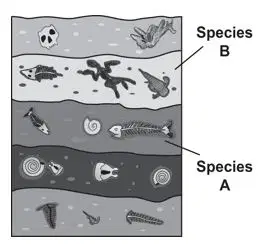
A scientist studies a fossil record as shown. He concludes that Species A is older than Species B. Which of these statements supports his conclusion?
Species in this record are less complex than in other fossil records.
Fossils found with Species A are less complete than those found with Species B.
This fossil record was discovered many years ago before the invention of radioactive dating.
Sediments in this record are made of layers where older sediment is deposited in lower layers.
Scientists have found several remains of woolly mammoths in the Arctic tundra. Scientists want to recreate the fossilization event in order to understand how the animals died. Which of these experiments would most closely model the process by which a woolly mammoth would have been fossilized?
freezing a specimen in the freezer and then embedding it in ice
submerging a specimen in epoxy glue and then hardening the glue
placing a specimen in wet cement and then removing it to leave an imprint
covering a specimen in sand and then exposing it to tremendous pressure
When scientists studied geological columns from different parts of the world, they discovered something interesting: the fossils of dinosaurs and many groups of reptiles and marine invertebrates disappeared at the top of the Mesozoic section. What is the most likely explanation of this evidence?
The organisms evolved very quickly into new organisms.
Organisms likely migrated to different parts of the world.
An extinction event caused many of the organisms to die off.
The areas no longer had the conditions needed for fossilization.
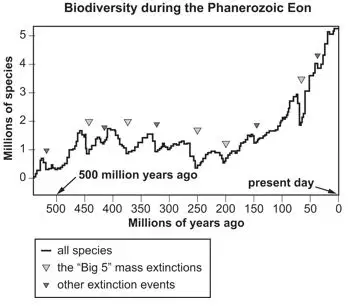
The graph shows how biodiversity of marine organisms has changed over the past 500 million years. What is the overall trend that can be seen in the data?
The number of species has decreased over time.
The number of species has increased over time.
The number of species has remained the same over time.
The number of species has shown great fluctuations over time.
A scientist conducts a geological survey of an area and discovers fossils of Tropites in the sediment. Based on the evidence, approximately how many million years ago did the Tropites live?
145
180
240
541
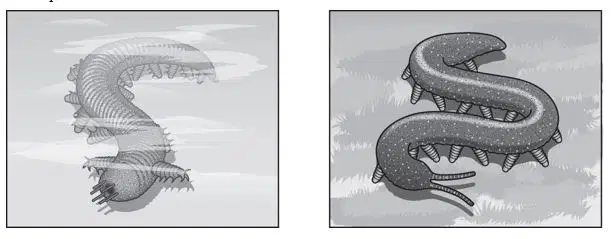
The first picture shows an artist’s drawing of the extinct worm Aysheaia, based on fossil evidence. The second picture shows a modern velvet worm. Based on the images, which statement identifies a characteristic that would cause scientists to think the two organisms might be related?
They are about the same size.
They eat the same kind of food.
They live in the same types of habitats.
They have very similar body structures.

This illustration shows forelimb development in mouse and bat embryos. What conclusions can be drawn from the evidence presented here?
Bats and mice share a common ancestor.
As embryos mature, they develop characteristics unique to their species.
The adaptation of wings suggests that bats are more closely related to birds than to mice.
Similarities in embryonic development indicate that bats and mice are actually the same species.
Sometimes a fossil is formed as a result of the movement of an organism in soft sediment. Which of these are two kinds of trace fossils?
shells and bones
tracks and burrows
a bee and a beetle in amber
petrified and mummified fossils
Which of these is not considered evidence of evolution?
similar genetic information in different species
similar patterns of development in different species
similarity among organisms that are members of the same species
fossils of organisms with body structures similar to those of modern organisms
Which of these choices is an example of the way an evolutionary biologist would use relative dating?
determining the minerals that make up rocks
classifying rocks as igneous, sedimentary, or metamorphic
placing fossil-containing rock layers in order from oldest to youngest
using radioactive isotopes to determine the exact age of fossils found in rock samples
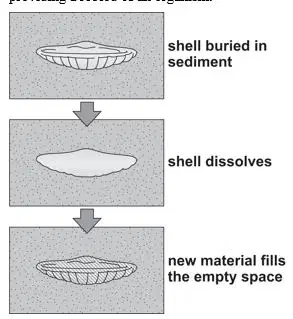
The fossil record provides evidence of evolution. Look at the series of illustrations. They show one way in which a fossil forms, providing a record of an organism. What kind of fossil is being formed?
cast
mold
imprint
footprint
A team of geologists compared the rock layers found in Florida to those found in northwest Africa. They placed all of the rock layers from the two regions in order from youngest to oldest. What did the team make?
a fossil record
a geologic column
a geologic record
a topographic map
Which property of fossils allows scientists to determine the relative ages of rock layers?
Fossils show change over time as species evolve.
Fossils form from the remains of living organisms.
Fossils are usually found only in sedimentary rock.
Fossils can be analyzed to determine their exact age.

This fossil is about 50 million years old. What might this fossil provide evidence for? Select all that apply.
the existence of flowering plants 50 million years ago
the extinction of flowering plants 50 million years ago
similarities in structure between ancient and modern flowering plants
a common ancestor of certain types of modern flowering plants
Most fossil evidence of flowering plants is limited to grains of pollen. Why might it be rare for a complete plant fossil, such as this one, to form? Select all that apply.
There were not many plants 50 million years ago.
Wind or water can carry soft plant parts away before they fossilize.
Dry environments cause plants to decay too slowly to fossilize.
Flower parts are delicate and rarely experience the conditions needed to fossilize.
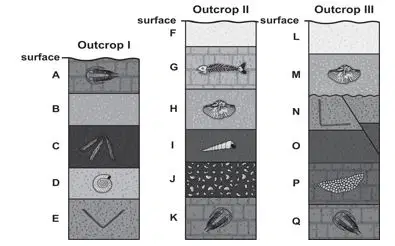
Based on the data, it appears that Layer ____ is the oldest rock layer.
E
K
L
Q
When sediment layers are deposited, the oldest layers are deposited _____ and are found on the _______.
first, bottom
last, bottom
first, top
last, top
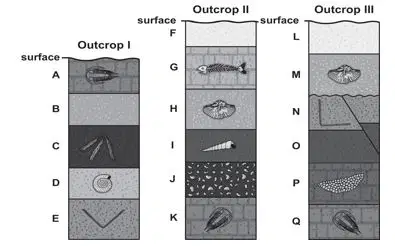
Since the same fossils are found in layers, layers ______ are the same age.
B, F, and N
A, K, and Q
D, H, and M
E, K, and Q
Scientists observe that many fossils are the result of organisms dying near or in water. What could be the cause of this observation?
Bodies naturally decompose, and soft tissues like skin and eyes will decompose the fastest. The tissues that last the longest have the best chance to become fossils.
Earth’s layers are produced by depositing new layers of sediment on top of old ones.
Water carries and deposits sediment. Objects underneath water are likely to be covered by new layers of earth more quickly than objects on land.
When organisms evolved into new forms, the new forms could join the fossil record. When the species evolved further, died off, or migrated, that specific form would no longer be found.
Scientists observe that fossils are more likely to be of hard body structures such as bones, teeth, and shells. Why is this?
Bodies naturally decompose, and soft tissues like skin and eyes will decompose the fastest. The tissues that last the longest have the best chance to become fossils.
Earth’s layers are produced by depositing new layers of sediment on top of old ones.
Water carries and deposits sediment. Objects underneath water are likely to be covered by new layers of earth more quickly than objects on land.
When organisms evolved into new forms, the new forms could join the fossil record. When the species evolved further, died off, or migrated, that specific form would no longer be found.
Scientists observe that fossils are more likely to be of hard body structures such as bones, teeth, and shells. Why is this?
Bodies naturally decompose, and soft tissues like skin and eyes will decompose the fastest. The tissues that last the longest have the best chance to become fossils.
Earth’s layers are produced by depositing new layers of sediment on top of old ones.
Water carries and deposits sediment. Objects underneath water are likely to be covered by new layers of earth more quickly than objects on land.
When organisms evolved into new forms, the new forms could join the fossil record. When the species evolved further, died off, or migrated, that specific form would no longer be found.
Older fossils are found in lower rock strata while more recent fossils are found closer to the surface. Why?
Bodies naturally decompose, and soft tissues like skin and eyes will decompose the fastest. The tissues that last the longest have the best chance to become fossils.
Earth’s layers are produced by depositing new layers of sediment on top of old ones.
Water carries and deposits sediment. Objects underneath water are likely to be covered by new layers of earth more quickly than objects on land.
When organisms evolved into new forms, the new forms could join the fossil record. When the species evolved further, died off, or migrated, that specific form would no longer be found.
Organisms of the same species can appear in the fossil record all around the same time and then disappear around the same time. Why?
Bodies naturally decompose, and soft tissues like skin and eyes will decompose the fastest. The tissues that last the longest have the best chance to become fossils.
Earth’s layers are produced by depositing new layers of sediment on top of old ones.
Water carries and deposits sediment. Objects underneath water are likely to be covered by new layers of earth more quickly than objects on land.
When organisms evolved into new forms, the new forms could join the fossil record. When the species evolved further, died off, or migrated, that specific form would no longer be found.
Which organism belongs in box 1?
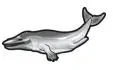
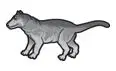
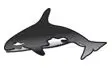
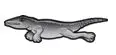
Which organism belongs in box 2?
Which organism belongs in box 3?
Which organism belongs in box 4?

