wayground logo

Free Printable Worksheets

Font size

S
M
L
XL
Worksheets

Physical Science Spring Final Review

Total questions: 120

Worksheet time: 24hrs 0mins

Name
Class
Date
1.
1. To change Li to Li⁺, you need to:
a)
add one electron
b)
remove one electron
c)
remove one proton
d)
add one neutron
2.
3. ¹⁴₆C and ¹²₆C are examples of carbon:
a)
ions
b)
isotopes
c)
molecules
d)
valences
3.
What is the symbol for an ion which has 8 protons and 10 electrons?
a)
N³⁻
b)
O²⁻
c)
F⁻
d)
O³⁻
4.
9. How many protons, neutrons, and electrons does ⁷₄Be²⁺ have?
a)
4,3,2
b)
4,3,6
c)
4,3,4
d)
4,6,3
5.
What is the overall charge of this atom?
a)
+3
b)
-3
c)
0
d)
+1
6.

Which of the following elements is most likely to have similar properties to those of sodium (Na)?

a)

Magnesium (Mg)

b)

Sulfur (S)

c)

Francium (Fr)

d)

Titanium (Ti)

7.

If an element has 117 protons which group will it be in on the periodic table?

a)

1

b)

7

c)

11

d)

17

8.

Two elements that have similar physical and chemical properties are most likely in the same...

a)

period

b)

row

c)

group

9.

Which element is located in period 4 and group 5?

a)

Vanadium (V)

b)

Zirconium (Zr)

c)

Niobium (Nb)

d)

Titanium (Ti)

10.

Which element is most likely to have six electrons in its 4th energy level?

a)

Oxygen (O)

b)

Selenium (Se)

c)

Krypton (Kr)

d)

Potassium (K)

11.

In which group would an element that is not reactive most likely be located?

a)

1

b)

2

c)

16

d)

18

12.

In which group would an element that is very reactive most likely be located?

a)

1

b)

5

c)

15

d)

18

13.

Which of the following elements is most likely a metal?

a)

W

b)

X

c)

Y

d)

Z

14.

Which of the following elements is most likely a poor conductor of electricity?

a)

Beryllium (Be)

b)

Gold (Au)

c)

Phosphorus (P)

d)

Copper (Cu)

15.

What is the atomic mass of an element with 16 protons, 13 neutrons, and 16 electrons?

a)

13 amu

b)

16 amu

c)

29 amu

d)

45 amu

16.
Which of these elements has the greatest atomic radius? 
a)
H
b)
N
c)
Cl
d)
Cs
17.
All elements found on the left side of the Periodic Table of the Elements have what properties in common?
a)
They conduct heat and electricity 
b)
They are all gases 
c)
They are brittle and dull
d)
They are radioactive
18.
The number of valence electrons in an element affects the reactivity of that element. Which element listed has the fewest valence electrons?
a)
beryllium (Be)
b)
sodium (Na) 
c)
oxygen (O) 
d)
neon (Ne)
19.
According to the Periodic Table of the Elements, which set of elements has similar properties?
a)
H, C, I
b)
He, H, Al
c)
He, Ne, Ar
d)
Na, Ca, Al
20.
How many Valance electrons does Iodine Have?
a)
6
b)
16
c)
7
d)
17
21.
Which of the following will have a larger radius than Zinc?
a)
Gallium
b)
Aluminum
c)
Magnesium
d)
Strontium
22.
As you move down the periodic table atoms get bigger.  This is because ____________.
a)
The atoms have more mass.
b)
The atoms have more protons.
c)
The atoms have more energy levels
d)
The atoms have more neutrons
23.

To change Li to Li⁺, you need to:

a)

add one electron

b)

remove one electron

c)

remove one proton

d)

add one neutron

24.

Fe²⁺ and Fe³⁺ are different iron:

a)

ions

b)

elements

c)

isotopes

d)

atoms

25.

¹⁴₆C and ¹²₆C are examples of carbon:

a)

ions

b)

isotopes

c)

molecules

d)

valences

26.

Li⁺ and Cu²⁺ are examples of:

a)

anions

b)

isotopes

c)

cations

d)

molecules

27.

What is the nuclear symbol for the isotope of oxygen which has 9 neutrons?

a)

¹⁶₈O

b)

¹⁷₈O

c)

¹⁸₈O

d)

¹⁸₉O

28.

Li⁺ has how many electrons? (hint: the atomic number of lithium is 3)

a)

0

b)

1

c)

2

d)

3

29.

How many protons, neutrons, and electrons does ⁷₄Be²⁺ have?

a)

4,3,2

b)

4,3,6

c)

4,3,4

d)

4,6,3

30.
Ions are: 
a)
atoms with a positive or negative charge
b)
atoms with no charge
c)
atoms with ONLY a positive charge
d)
atoms with ONLY a negative charge
31.
Ionic bonds form between two ions that have 
a)
ionic compounds
b)
negative charges
c)
positive charges
d)
opposite charges 
32.

Potassium-39 has how many neutrons?

a)

19

b)

18

c)

20

d)

21

33.

12 protons and 13 neutrons

a)

Mg-12

b)

Mg-13

c)

Mg-25

d)

Mg-24.305

34.

Covalent compounds, like water, can conduct electricity as they share their electrons freely with other atoms.

a)

true

b)

false

35.

Most non metals exist as solids at room temperature

a)

true

b)

false

36.

Ionic compounds can never conduct electricity

a)

true

b)

false

37.

Can an ionic compound conduct electricity in the solid state?

a)

yes

b)

no

38.

What keeps the ions in an ionic lattice together?

a)

the electrons, which glue the structure together

b)

the neutral nature of the ions

c)

the opposite charges of the ions

d)

the difference in size of the various ions

39.

An ionic compound is always between

a)

two or more metals

b)

metals and non metals

c)

two or more non metals

40.

Hydrogen would have _________ when sharing electrons with oxygen

a)

8 electrons in its outer shell

b)

no electrons in its outer shell

c)

a full outer shell

41.
Does not normally conduct Electricity
a)
Ionic
b)
Covalent
42.
Electrically Reactive; Conducts Electricity when Dissolved in Water
a)
Ionic
b)
Covalent
43.
High Melting & Boiling Points
a)
Ionic
b)
Covalent
44.
Solids at Room Temperature
a)
Ionic
b)
Covalent
45.
Liquids & Gases at Room Temperature
a)
Ionic
b)
Covalent
46.
Hard & Brittle
a)
Ionic
b)
Covalent
47.

Which of the following compounds would have the lowest melting point?

a)

aluminum oxide

b)

potassium chloride

c)

dihydrogen monoxide

d)

sodium chloride

48.
Total Transfer of Electrons
a)
Ionic
b)
Covalent
49.
Strong Bonds
a)
Ionic
b)
Covalent
50.
Metal to Non-Metal Bonding
a)
Ionic
b)
Covalent
51.
Non-Metal to Non-Metal Bonding
a)
Ionic
b)
Covalent
52.
Weak Bonds
a)
Ionic
b)
Covalent
53.
phosphorus trichloride
a)
KCl3
b)
PCl3
c)
K3Cl
d)
P3Cl
54.
diphosphorus pentoxide
a)
P2O5
b)
PO5
c)
P5O2
d)
P2O6
55.
SiCl4
a)
silicon tetrachloride
b)
silicon quadchloride
c)
monosilicon tetrachloride
d)
silicon chloride
56.
The chemical formula of sulfur hexabromide is
a)
SBr₆
b)
S₆Br
c)
S(VI)Br
d)
S6Br
57.
The name of P₄S₁₀ is
a)
phosphorous sulfide
b)
phosphorus sulfide
c)
tetraphosphorus decasulfide
d)
phosphorus (X) sulfide
58.
The chemical formula of tetraphosphorus heptaoxide is
a)
F₄O₁₀
b)
P₄O7
c)
PO
d)
P₁₀O₄
59.
The chemical formula of dinitrogen textroxide is
a)
Ni₂O₄
b)
NiO
c)
N₂O₄
d)
NiO₂
60.
The name of SO₃ compound is
a)
sulfate
b)
sulfur oxide
c)
sulfur trioxide
d)
monosulfur trioxide
61.
What's the formula for chlorine dioxide
a)
ClO2
b)
CLO
c)
ClO3
d)
HClO2
62.
What is the formula for Hexaboron Monosilicide
a)
B6Si
b)
BSi
c)
BSi6
d)
B6Si6
63.
BrO3
a)
bromine oxide
b)
monobromine trioxide
c)
bromine trioxide
d)
bromine (III) oxide
64.
What is the formula for Tricarbon Octahydride?
a)
Ca3O
b)
C2H8
c)
C3H8
d)
Ca3H8
65.
What is the correct name for NO?
a)
Mononitrogen Monoxide
b)
Nitrogen Monoxide
c)
Mononitrogen Dioxide
d)
Nitrogen Oxide
66.
What is the correct chemical formula for Nitrogen Triiodide?
a)
NI3
b)
N3I3
c)
NOI
d)
NeI3
67.
Which of the following is NOT an ionic compound:
a)
CaO
b)
NaOH
c)
BaCl2
d)
Br2
68.
Ionic compounds are bonds between
a)
Metals and Metals
b)
Metals and Nonmetals
c)
Nonmetals and Nonmetals
d)
None of the above
69.
 Li2O
a)
Dilithium oxideDilithium oxide
b)
Lithium oxide
c)
Lithium dioxide
70.
MgS 
a)
Magnesium sulfide
b)
Monomagnesium monosulfide
c)
Magnesium monosulfide
71.

Na2S

a)

Disodium sulfide

b)

Sodium sulfide

c)

Sodium monosulfide

d)

Disodium monosulfide

72.
What is a cation?
a)
positive ion
b)
Neutral atom
c)
Two additional protons
d)
negative ion
73.
Name this compound: 
NaBr
a)
Bromide sodide
b)
Sodium bromide
c)
Sodium bromate
d)
Sodium bromite
74.
Name this compound: 
KF
a)
Potassium fluoride
b)
Potassium fluorite
c)
Fluorine potasside 
d)
Potassium fluorate
75.
What is the correct formula for Sodium Oxide?
a)
NaO
b)
NaO2
c)
Na2O
d)
Na2O2
76.
In a reaction A + B ----> C,  reactant A has 5g and product  C has 9g. How many grams does reactant B should have? 
a)
4g
b)
5g
c)
9g
d)
14g
77.
The number in front of a compound or element is a 
a)
Subscript
b)
Coefficient
c)
Superscript
d)
Charge
78.
Which is Chemical Equation is Balanced?
a)
CH₄+O₂------CO₂+2H₂O
b)
H₂+O₂-----2H₂O₄
c)
4Al+3O₂-----2Al₂O₃
79.
How many oxygen atoms are in this chemical formula?
a)
6 oxygen atoms
b)
2 oxygen atoms
c)
3 oxygen atoms
d)
4 oxygen atoms
80.
Bob puts 200 grams of ice into a pitcher with 900 grams of water. He gets distracted and comes back later to find that the ice has melted in the water. How many grams of water does Bob now have in the pitcher?
a)
200 g
b)
700 g
c)
1,100 g
81.
What is the law of conservation of mass?
a)
The amount of matter changes when reacted or changed.
b)
The mass of all reactants are changed during a physical or chemical change
c)
The mass of the reactants equals the mass of the products
d)
The mass of the products is different than the mass of the reactants.
82.
Students react baking soda & vinegar.
Which of the following would provide the evidence that the number of atoms present before a chemical reaction is equal to the number of atoms present after the chemical reaction?
a)
The mass of the plastic bag, baking soda, and vinegar before the reaction was equal to the mass after the reaction.
b)
Bubbles were produced during the reaction, which meant that a gas was being produced.
c)
The plastic bag did not change in any way, indicating that it was not involved in the reaction.
d)
The mass of the baking soda was exactly equal to the mass of the vinegar used to create the chemical reaction.
83.
When CaCO3 is heated, it forms CaO and CO2. Which of these statements best describes the mass of the products if 100 g of CaCO3 is heated?
a)
The difference in the products’ masses is equal to the mass of the CaCO3
b)
The sum of the products’ masses is less than the mass of the CaCO3
c)
The mass of each product is equal to the mass of the CaCO3
d)
The sum of the products’ masses equals the mass of the CaCO3
84.
What will weigh more when a chemical change is complete?  The reactants before the chemical reaction, or the product after the reaction is complete?
a)
They both will weigh the same
b)
The product always weighs more than the reactant
c)
The reactant will weigh more than the product
d)
They both will loose mass after the reaction
85.
Suppose a reaction were to happen in an open container in a lab.  During the reaction, the scientist observes the chemicals bubble, and produce a gas.   During the analysis the scientist notices that the reactants weighed 20 g when he started, and the product weighed 18 g.  Explain what happened.  
a)
His chemical reaction defied the law of conservation of mass
b)
The product destroyed mass during the reaction
c)
The reactants created matter during the reaction
d)
The gas that was produced was not able to be weighed since the container was open.  
86.
What is a coefficient?
a)
The small number on the right of the chemical symbol.
b)
The large number to the left of a formula.
87.
A replacement occurs when...
a)
Two formulas combine.
b)
A formula breaks apart.
c)
An atom is replaced during a reaction.
88.
Which problem is balanced?
a)
PbO2 + 2H2
b)
SO2 + H20 --> H2SO4
c)
2Na + 2H2O --> 2NaOH + H2
89.
How would this equation be classified?
O2 + 2H2 --> 2H2
a)
Synthesis
b)
Decomposition
c)
Combustion
d)
Single Displacement
90.
Balance this equation:
MgCl2 --> Mg4+ Cl2
a)
It's already balanced.
b)
4MgCl2 --> Mg4+ 4Cl2
c)
4MgCl2 --> Mg4+ 5Cl2
91.
Balance this equation:
FeS + 2HCl -->
FeCl2 + H2O
a)
FeS2 + 2HCl --> FeCl2 + H2O
b)
It's already balanced
c)
FeS2 + 2HCl --> FeCl2 + H4O
d)
None of these
92.
Balance this equation:
 2Li + Cl2 -> LiCl
a)
2Li + Cl2 -> 4LiCl2
b)
2Li + Cl2 -> LiCl2
c)
2Li + Cl2 -> 2LiCl
93.
What is the right ratio of chemicals for the BCE (Balanced Chemical Equation)?__FeCl3 + __Ca(OH)2 --> __Fe(OH)3 + __CaCl2
a)
4,3--> 2,1
b)
3,2 --> 3,1
c)
2,3 --> 2,2
d)
2,3 --> 2,3
94.
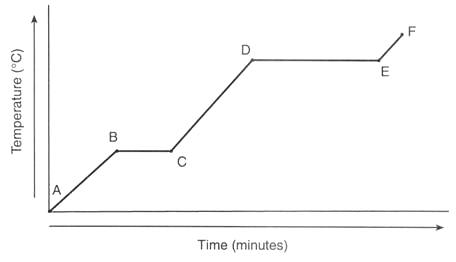
What line segment represents only the solid state?
a)
A-B
b)
B-C
c)
C-D
d)
D-E
95.
Between which points is the temperature of the substance remaining constant?
a)
A-B only. 
b)
A-B, C-D, E-F
c)
B-C only. 
d)
B-C, D-E
96.
A substance's heating curve is shown in the graph.  What is its boiling point?
a)
100 C
b)
60 C
c)
80 C
d)
20 C
97.
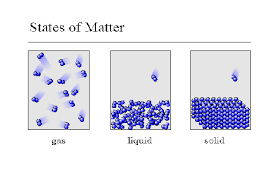
At higher temperatures
a)
particles in an object have less energy
b)
particles in an object move faster
c)
a gas contracts
98.
What does Boyle's law relate to?
a)
Temperature and Volume
b)
Volume and Pressure
c)
Temperature and Pressure
99.
When the temperature of matter increases the particles...
a)
speed up and move closer
b)
speed up and move farther apart
c)
slow down and move closer together
d)
slow down and move farther apart
100.
What type of relationship is Charles' Law?
a)
Inverse
b)
Direct
c)
Not enough information
d)
#goals
101.
What type of relationship to pressure and volume have?
a)
direct
b)
inverse
c)
no relationship
d)
I don't know
102.
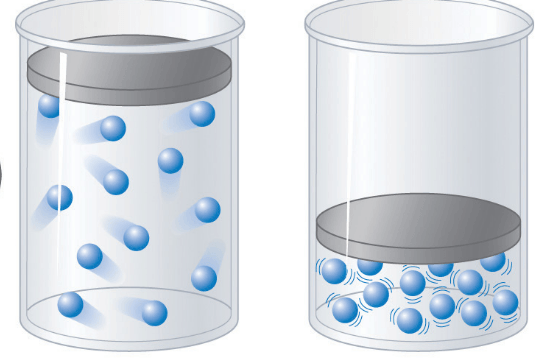
Which container will have a lower pressure?
a)
left
b)
right
c)
they both have the same pressure
d)
I don't know
103.
Which is an example of a solvent?
a)
Salt
b)
Egg whites
c)
Water
d)
Sugar
104.

What is the substance being dissolved in a solution called?

a)

solution

b)

solute

c)

solvent

d)

mixture

105.

What is the substance in which a solute is dissolved called?

a)

solution

b)

solvent

c)

alloy

d)

mixture

106.
The concentration of a mixture can be increased in which of the following ways?
a)
Heating the mixture
b)
Adding more water “solvent”
c)
Adding more powder “solute”
d)
Stirring the mixture
107.
In the above picture, a powder is about to be poured into the liquid. Which of the following should be done to make this powder dissolve faster?

a)
stir the powder in the liquid
b)
freeze the mixture
c)
add more powder to the liquid
d)
store the mixture in a dark place
108.

Classify the following:


H2SO4

a)

acid

b)

base

c)

neither

109.

Classify the following:


NaOH

a)

acid

b)

base

c)

neither

110.

What happens when an acid and a base are mixed together?

a)

they explode

b)

nothing will happen

c)

a salt & water are formed

d)

a weaker base & stronger acid are formed

111.

If a piece of litmus paper is exposed to an ACID, what color will it be?

a)

red

b)

blue

c)

white

d)

yellow

112.

If a piece of litmus paper is exposed to a BASE, what color will it be?

a)

red

b)

blue

c)

white

d)

yellow

113.

Lemon juice has a pH of 2. What is it best classified as?

a)

acid

b)

base

c)

neutral

114.

Milk of magnesia has a pH of 10. What is it best classified as?

a)

acid

b)

base

c)

neutral

115.
Nuclear power uses ____ for fuel.
a)
steel
b)
coal
c)
uranium
d)
hydrogen
116.
Nuclear energy uses _____ to turn turbines to power a generator.
a)
wind
b)
water
c)
steam
d)
solar
117.
Splitting a uranium atom is called - 
a)
fission
b)
fusion
118.
After the third half-life, how much of the sample is left?
a)
1/2
b)
1/3
c)
1/16
d)
1/8
119.
If 10 mg of iodine 131 is given to a patient, how much is left after 24 days? The half-life of iodine-131 is 8 days.
a)
1.25mg
b)
1.25g
c)
10g
d)
10mg
120.
If the half-life of uranium-232 is 70 years, how many half-lives will it take for 10 g of it to be reduced to 1.25 g?
a)
1 half-life
b)
2 half-lives
c)
3 half-lives
d)
4 half-lives