wayground logo

Free Printable Worksheets

Font size

S
M
L
XL
Worksheets

8th Grade Life Science Review FL

Total questions: 116

Worksheet time: 1hrs 13mins

Name
Class
Date
1.
Cells are the basic unit of life
a)
true
b)
false
2.
When a collection of similar cells group together, they form what is called _________.
a)
Organs
b)
Tissue
c)
Organ system
d)
Organism
3.
A collection of tissue that is grouped together forms an ___________
a)
tissue
b)
organ system
c)
organism
d)
organ
4.
A collection of organs forms what?
a)
Organ system
b)
organism
c)
cell
d)
tissue
5.
Prokaryotes are a unicellular organism
a)
true
b)
false
6.
What is the difference between cells in a multicellular organism and a unicellular organism?
a)
The cells in a unicellular organism are dependent on each other.
b)
The cells in a multicellular organism are dependent on each other.
c)
The cells in a multicellular organism are not alive
7.
In a prokaryote, where is the DNA stored?
a)
nucleus
b)
cytoplasm
c)
mitochondria
d)
vacuole
8.
In a multicellular organism where is DNA stored?
a)
Nucleus
b)
cytoplasm
c)
chlorophyll
d)
chloroplast
9.
Rank from simplest to most complex
a)
cell, organ, organ system, tissue, organism
b)
organism, tissue, cell, organ, organ system
c)
cell, tissue, organ, organ system, organism
d)
organism, organ system, organ, tissue, cell
10.

What part is missing in the hierarchy?

a)

cell

b)

organ

c)

tissue

d)

organism

11.

Which level of organization in the human body does the diagram best represent?

a)

cell

b)

tissue

c)

organ system

d)

atom

12.

______ is keeping conditions in the cell balanced. (This will be a matching question on the test)

a)

Homeostasis

b)

Response

c)

Metabolism

d)

Nutrition

13.

Which choice is NOT part of the cell theory.

a)

All organisms are composed of cells.

b)

Cells are the basic unit of life.

c)

All cells come from previous cells.

d)

Cells are always the same size and shape.

14.
The second part of Cell Theory states: "All living organisms are made up of cells."
a)
True
b)
False
c)
I don't know
d)
If you say so
15.
All cells come from___________ cells.
a)
pregnant
b)
pre-existing
c)
paternal
d)
pin size
16.
Which of the following is NOT one of the basic points of Cell Theory?
a)
All living things are made of cells.
b)
The cell is the smallest living thing that can perform all the functions of life.
c)
Cells are too small to see without a microscope.  
d)
All cells must come from pre-existing cells.
17.
Which of the following is NOT the system that regulate the blood sugar level?
a)
Circulatory system
b)
Muscle system
c)
Endocrine system
d)
Digestive system
18.
After nerve impulse is sent to the respiration control centre and cardiovascular centre, nerve impulse is sent to the following target EXCEPT
a)
cardiac muscle
b)
skeletal muscle
c)
diaphragm
d)
intercostal muscle
19.
If the environment gets cold, we will often shiver in order to:
a)
keep body temperature the same as the external temperature
b)
decrease body temperature
c)
increase body temperature
d)
regulate blood pressure
20.

Homeostasis

a)

allows for a wildly fluctuating internal environment

b)

is impossible in vertebrates

c)

is the maintenance of a relatively stable internal environment and often incorporates a form of feedback regulation

21.

Which of the following is not regulated by homeostasis?

a)

body temperature

b)

blood sugar

c)

blood pH

d)

body movements

22.

Identify the initiation event.


Scenario: A person begins to exercise which causes their body temperature to increase. The temperature change is noticed and the person begins to sweat and their body temperature decreases.

a)

temperature change is noticed

b)

person begins to sweat

c)

body temperature decreases

d)

person begins to exercise

23.

Which of the following is an example of a response to an internal stimulus?

a)

you are tired

b)

you are hot

c)

you eat food

d)

you are scared

24.
Which body system gets oxygen from the environment and removes carbon dioxide and other wastes from the body?
a)
Circulatory
b)
Respiratory
c)
Digestive
d)
Skeletal
25.
Which system transports materials from the digestive system and respiratory system to the cells?
a)
circulatory
b)
respiratory
c)
digestive
d)
skeletal
26.
Which of these 3 systems work together to get the body the oxygen and sugar that it needs to make ATP(energy)?
a)
Digestive - Cardiovascular -Urinary
b)
Cardiovascular - Respiratory - Reproductive
c)
Respiratory - Digestive - Lymphatic
d)
Cardiovascular - Digestive - Respiratory
27.

What 2 systems: Absorb and deliver the digested nutrients to the cells

a)

Digestive and muscular

b)

Muscular and lymphatic

c)

Digestive and circulatory

d)

Nervous and skeletal

28.

What 2 systems: Allows for movement

a)

Muscular and Skeletal

b)

Endocrine and Skeletal

c)

Nervous and Circulatory

d)

Integumentary and Reproductive

29.

Which set of Organs belongs to the Excretory System?

a)

Heart, blood vessels

b)

Trachea, larynx, pharynx, and lungs

c)

Kidneys, urinary bladder

d)

Brain, spinal column

30.

What is the purpose of the Nervous System?

a)

Transports oxygen and nutrients

b)

Removes extra water and wastes

c)

Supports and protects the body and produces blood

d)

Collects, transfers and processes information

31.

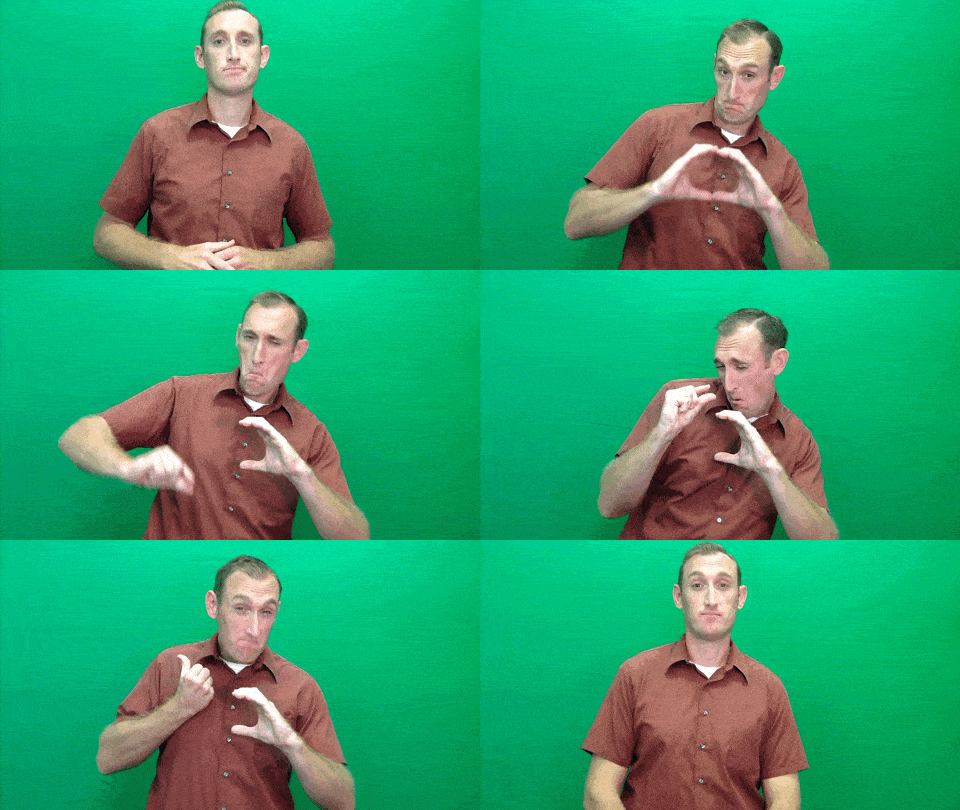
Which of the following best describes homeostasis?

a)

An ongoing process in living organisms that leads to an unbalanced, unstable system

b)

An ongoing process in living organisms that leads to a balanced, stable system
c)

A one-time occurrence that leads to an unbalanced, unstable system

d)

A one-time occurrence that leads to a balanced, stable system

32.
The ___________ is the basic unit of life
a)
organ
b)
cell
c)
atom
d)
tissue
33.
Directs all cell activities through the DNA located there.
a)
Lysosomes
b)
Nucleus
c)
ribosomes
d)
Mitochondria
34.
What is the name of the genetic material that is inside the nucleus?
a)
ER
b)
ATP
c)
YOLO
d)
DNA
35.
I am the outer most layer of an animal cell. What am I?
a)
cell wall
b)
nucleus
c)
cell membrane 
d)
cell skin
36.
What organelle is called the "powerhouse" of a cell?

a)
Endoplasmic Reticulum
b)
Nucleus
c)
Mitochondria
d)
Nucleolus
37.
What structure is in plant cells but not animal cells?
a)
Cell Membrane
b)
Mitochondria
c)
Cell Wall
d)
Vacuole
38.

Organelles where photosynthesis occurs, are green due to chlorophyll pigment found in them.

a)

Chloroplasts

b)

Cell Wall

c)

Cell Membrane

d)

Cytoplasm

39.

Saclike structures that store materials such as water, salts, proteins, and carbohydrates.

a)

Nucleus

b)

Ribosomes

c)

Organelles

d)

Vacuoles

40.

Which structures do plant cells have that animal cells do NOT have?

a)

cell wall

b)

large central vacuole

c)

chloroplasts

d)

all of these

41.
Animal and Plant cells are both this type of cell.
a)
Eukaryote
b)
Prokaryote
42.

Process that makes energy or ATP for all cells

a)

Photosynthesis

b)

Chloroplast

c)

Mitochondria

d)

Cellular respiration

43.

Process that makes glucose and oxygen from water and carbon dioxide

a)

Photosynthesis

b)

Chloroplast

c)

Mitochondria

d)

Cellular respiration

44.

Is a microbe that needs a person or animal to survive. It contains genetic material. Sometimes theses cannot be killed. It causes diseases like flu, common cold, herpes, rabies and ebola.

a)

Bacteria

b)

Virus

c)

Parasite

d)

Fungi

45.

Is a single celled microbe that causes diseases such as strep throat, meningitis, TB, cholera and staph infection. Can multiple quickly in the body. There are good and bad types of these in the body.

a)

Bacteria

b)

Virus

c)

Parasite

d)

Fungi

46.

A microbe that lives in or on another organism of another species (its host) and benefits by taking nutrients from the host. Examples include head lice and tapeworms.

a)

Bacteria

b)

Virus

c)

Parasite

d)

Fungi

47.
Which of the lists below has all of the levels of classification in the correct order?
a)
Kingdom class phylum genus order species family
b)
Class Phylum Kingdom Species Family Order Genus
c)
Kingdom Family Class Order Phylum Genus Species
d)
Kingdom Phylum Class Order Family Genus Species
48.
Scientific names are written using which two levels of classification?
a)
Kingdom phylum
b)
Kingdom class
c)
Species genus
d)
Genus species
49.

the largest classification category

a)

Kindgom

b)

Phylum

c)

Order

d)

Species

50.

the smallest, most specific classification category

a)

Genus

b)

Phylum

c)

Order

d)

Species

51.

The science of naming and classifying organisms is:

a)

binomial nomenclature

b)

genus

c)

species

d)

taxonomy

52.
Which of the following is NOT an example of natural selection? 
a)
People selectively breeding hamsters.
b)
Insect populations developing resistance to certain pesticides.
c)
Bacteria becoming resistant to antibiotics.
d)
Male birds of certain species developing colorful feathers to attract female mates.
53.
The environment around Manchester, England, changed during the Industrial Revolution.  How did this change affect peppered moths living in the area?
a)
Natural selection favored moths with dark wings because predators could not see them on the soot-colored trees.
b)
Natural selection favored moths with white wings that were easy for predators to see.
c)
Natural selection favored moths with white wings because predators could not see them on the soot-colored trees.
d)
Natural selection caused moths with white wings to become extinct.
54.
When an organism completely dies out, it is called.....
a)
Adaption
b)
Extinction
c)
Fossilization
d)
Mutation
55.
Mutations are important because they bring about
a)
death of the organism in which they develop
b)
genetic variation needed for a population to evolve
c)
benefits for the individual, not for the population
d)
Hardey-Weinberg equilibrium within a population
56.
What is a change in an organism that allows for it to survive in its environment?
a)
homologous
b)
vestigial
c)
variation
d)
adaptation
57.
What is this an example of?
a)
vestigial structures
b)
fossil record
c)
homologous structures
d)
embryology
58.
Which sentence is TRUE?
a)
Acquired traits are passed from parents to offspring
b)
Inherited traits are passed from parents to offspring
c)
Behaviors are never inherited
d)
Behaviors are always inherited 
59.
A mother dog and her puppy both have curly fur. Which best explains this?
a)
in dogs, curly fur is more common than straight fur
b)
in dogs, curly fur is an acquired trait
c)
the mother dog acquired curly fur and passed on that trait to her puppy
d)
the mother dog inherited curly fur and passed on that trait to her puppy
60.
Which of these is a learned behavior for a human?
a)
sleeping
b)
laughing 
c)
playing violin 
d)
having brown eyes 
61.

What is a trait?

a)

A physical characteristic passed down from your mom

b)

A behavioral characteristic passed down from your dad

c)

A physical or behavioral characteristic passed down from your parents

d)

A behavioral characteristic passed down by your mom

62.

What is an allele?

a)

A trait

b)

Different forms of a gene

c)

DNA

d)

Different types of parents

63.

What is a genotype?

a)

Pair of alleles that determine a specific trait

b)

Observable physical trait

c)

A trait that is observed with only one copy of an allele

64.

What is a phenotype?

a)

Pair of alleles that determine a trait

b)

Observable physical trait

c)

Different forms of a gene

65.

What is a dominant gene?

a)

A trait that is observed when there are one OR two copies of the allele

b)

A trait that is observed only when there are two copies of the allele

c)

A trait that can be hidden in a generation

66.

A person who is homozygous for a trait can have a genotype of....

a)

AA, Aa

b)

Aa, aa

c)

AA, aa

d)

aa

67.

If a person is heterozygous for a trait, their genotype can be...

a)

Aa

b)

AA, aa

c)

AA, Aa

d)

AA

68.

If "B" is brown and "b" is blond, what is the phenotype of someone who's genotype is "bb"

a)

Brown Hair

b)

Blond Hair

c)

Red Hair

69.

If a person is heterozygous for brown hair, what is their genotype?

a)

BB

b)

Bb

c)

bb

70.

What is the missing pairing?

a)

AA

b)

Aa

c)

aa

71.
T - tall and t = short
In the punnett square below, what belongs in the missing square
a)
tt
b)
Tt
c)
Bb
d)
TT
72.
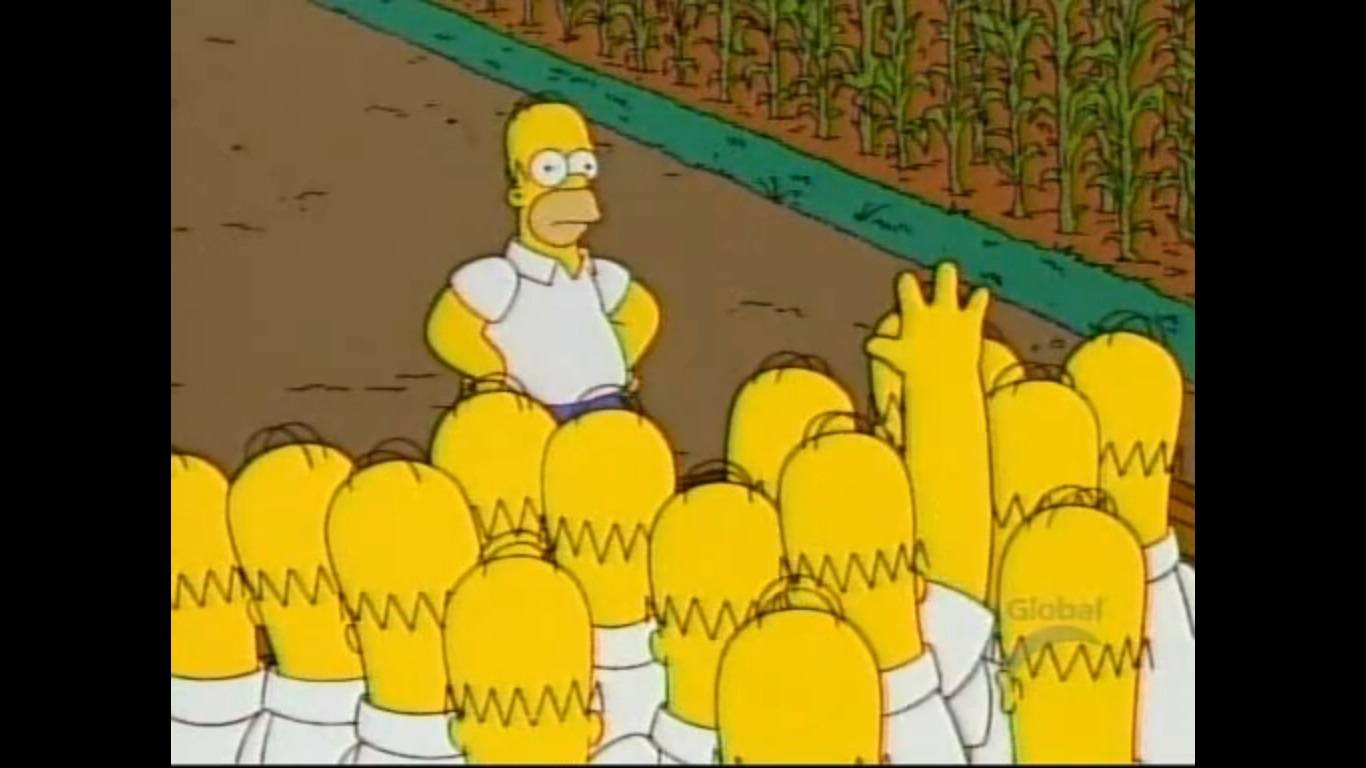
B = brown fur  b = white fur
In the punnett square, what is the probability for white fur? 
a)
0%
b)
25%
c)
50%
d)
75%
73.
Where does an off spring get its traits in asexual reproduction?
a)
From both parents
b)
From only one parent
c)
From neither parent
d)
There are no traits handed down
74.
Sexual reproduction requires _____ parents and asexual reproduction requires ___ parents
a)
1,1
b)
2,2
c)
2,1
d)
1,2 
75.

All of the offspring of an organism have the same genetic material, which is identical to the parent organism. From this, we can conclude that this organism -

a)

makes its own food

b)

is unicellular

c)

live in a marine habitat

d)

reproduces asexually

76.

California blackworms, also known as mudworms, are able to break apart. Each body section that broke apart is able to become an identical new worm. What type of reproduction does this example represent?

a)

Sexual reproduction

b)

Asexual reproduction

77.

Penguins lay 1-2 fertilized eggs that the male and female take turns incubating on their feet. What type of reproduction does this example represent?

a)

Sexual reproduction

b)

Asexual reproduction

78.

Reproducing asexually will produce offspring ...

a)

genetically different from each other

b)

genetically identical to the parent

79.
What is a disadvantage of asexual reproduction?
a)
New species of organisms cannot come into being.
b)
The offspring does not multiply rapidly.
c)
The offspring does not live for long.
d)
All of these
80.

This is any close relationship between any two different species in an ecosystem

a)

symbiosis

b)

parasitism

c)

mutualism

d)

commensalism

81.

Both species benefit

a)

symbiosis

b)

parasitism

c)

mutualism

d)

commensalism

82.

One species benefits, the other is unaffected

a)

symbiosis

b)

parasitism

c)

mutualism

d)

commensalism

83.

One species benefits, the other species is harmed

a)

symbiosis

b)

parasitism

c)

mutualism

d)

commensalism

84.

Ostriches and gazelles feed next to each other. They both watch for predators. Because the visual abilities of the two species are different, they can each identify threats that the other animal may not see as readily.

a)

symbiosis

b)

parasitism

c)

mutualism

d)

commensalism

85.

Mistletoe extracts water and nutrients from the spruce tree to the detriment (ill effect) to the spruce

a)

symbiosis

b)

parasitism

c)

mutualism

d)

commensalism

86.

Honey guide birds alert and direct badgers to bee hives. The badgers then expose the hives and feed on the honey first. Next the honey guide birds eat.

a)

symbiosis

b)

parasitism

c)

mutualism

d)

commensalism

87.

Epiphytes are a class of plants that grow in the crooks of tree branches. They simply use the tree branches as a way to be higher—closer to the sunlight needed for photosynthesis. The trees aren’t affected by this relationship.

a)

symbiosis

b)

parasitism

c)

mutualism

d)

commensalism

88.

E. Coli is a bacteria that lives in the gut of humans. The human provides the ideal habitat for e coli reproduction and the e coli provides the extra vitamin K that we use.

a)

symbiosis

b)

parasitism

c)

mutualism

d)

commensalism

89.

Oxpeckers (bird) feed on the ticks found on a rhinoceros. The oxpecker gets food and the rhino gets rid of a parasite

a)

symbiosis

b)

parasitism

c)

mutualism

d)

commensalism

90.
What is a producer?
a)
Organism that makes its own energy
b)
Organism that breaks down dead organisms
c)
Organism that eats other organisms for food & energy
91.
What is a decomposer?
a)
Organism that makes its own energy
b)
Organism that breaks down dead organisms
c)
Organism that eats other organisms for food & energy
92.
What is a consumer?
a)
Organism that makes its own energy
b)
Organism that breaks down dead organisms
c)
Organism that eats other organisms for food & energy
93.
The ___% rule states that only ____% of energy is transferred to the next trophic level.
a)
10%
b)
25%
c)
50%
d)
100%
94.
What are "trophic levels"?
a)
Levels in a food web/food chain
b)
Levels of land in a mountain
c)
Animal diets
95.

Which of the following organisms is a primary consumer?

a)

grass

b)

rabbit

c)

fox

d)

snake

96.

Which of the following organisms in competition with the weasel for their food source?

a)

grass

b)

rabbit

c)

fox

d)

snake

97.

What would happen to the rabbit population if the fox population moved out of the area represented by the food web?

a)

The rabbit population would increase

b)

The rabbit population would decrease

c)

The rabbit population would neither increase nor decrease

98.
Limiting factors are sometimes helpful because they can keep the population from getting too large.
a)
True
b)
False
99.
Food, water, sunlight, shelter, and space are resources that are  __________.
a)
limiting factors
b)
wet
c)
messy
d)
found in rocks
100.
If the population of a certain predator increases, there is often _______ its prey
a)
a decrease the population of
b)
an increase of the population of 
c)
great news for its prey of
d)
no  impact found on
101.
What process occurs when light energy is captured in autotrophs and converted into sugar?
a)
Photosynthesis
b)
Cellular Respiration
102.
Which gas is removed from the atmosphere during photosynthesis?
a)
hydrogen
b)
oxygen
c)
nitrogen
d)
carbon dioxide
103.
What are the products of photosynthesis?
a)
water and carbon dioxide
b)
oxygen and glucose
c)
oxygen and carbon dioxide
d)
oxygen and water
104.
Which of the following is not needed for photosynthesis to occur?
a)
sunlight
b)
carbon dioxide
c)
water
d)
oxygen
105.

Oxygen (O2) is a reactant material of which process?

a)

Photosynthesis

b)

Cellular Respiration

106.
Cellular respiration is a cellular process that occurs in the cells of –
a)
plants
b)
Plants and Animals
c)
Animals
d)
None
107.

Which of the following best explains the purpose of cell respiration?

a)

In cell respiration, sunlight is used to make sugar

b)

In cell respiration, sunlight is used to make ATP

c)

In cell respiration, glucose is used to make energy

d)

In cell respiration, oxygen is used to make sugar

108.
What are the products of photosynthesis?
a)
water and carbon dioxide
b)
oxygen and glucose
c)
oxygen and carbon dioxide
d)
oxygen and water
109.
Which of the following is not needed for photosynthesis to occur?
a)
sunlight
b)
carbon dioxide
c)
water
d)
oxygen
110.
What does NOT produce carbon dioxide?
a)
Photosynthesis
b)
Burning Fossil Fuels
c)
Animal respiration
d)
Plants decaying
111.
Combustion is another word for __________.
a)
Transportation
b)
Respiration
c)
Fossil Fuels
d)
Burning
112.
TRUE or FALSE?
All of the carbon in existence is continually recycled in the carbon cycle.
a)
True
b)
False
113.
Carbon can be found in...
a)
The atmosphere
b)
Soil
c)
Fossil fuels
d)
All of the above
114.
Which of the following removes carbon from the atmosphere?
a)
Combustion
b)
Respiration
c)
Photosynthesis
d)
Death
115.
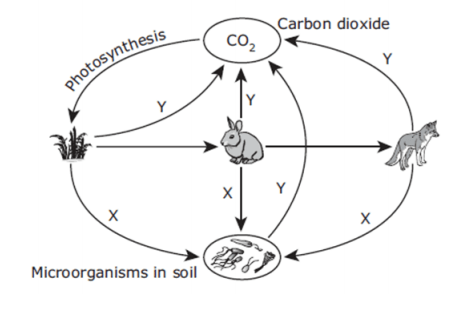
The diagram shows the flow of organic molecules through an ecosystem. What two processes are identified by the labels X and Y?
a)
X : Respiration
Y : Predation
b)
X : Adaptation
Y : Decomposition
c)
X : Fermentation
Y : Nitrogen Fixation
d)
X : Decomposition
Y : Respiration
116.

How do animals get carbon?

a)

By eating plants and or other animals.

b)

They absorb it from the atmosphere.

c)

From the ground

d)

They do not get carbon from anywhere.