
 Worksheets
8th Grade Science OST Review
Total questions: 116
Worksheet time: 2hrs 38mins


The Crust is a thin layer of about
8 to 75 km
100 to 200 km
2000 km
more than 3000 km

What kind of waves travel through Earth's Interior?
ocean waves
time waves
sound waves
seismic waves
Which seismic waves are the fastest?
p waves
s waves
surface waves
Secondary waves can pass through __________.
solids
liquids
gases
all
Primary waves can pass through ___________.
solids
liquids
gases
all

Which of the following statements is TRUE?
The inner core is less dense than the outer core.
The continental crust is denser than the oceanic crust.
The oceanic crust is denser than the continental crust.
The lower mantle is less dense than the asthenosphere.
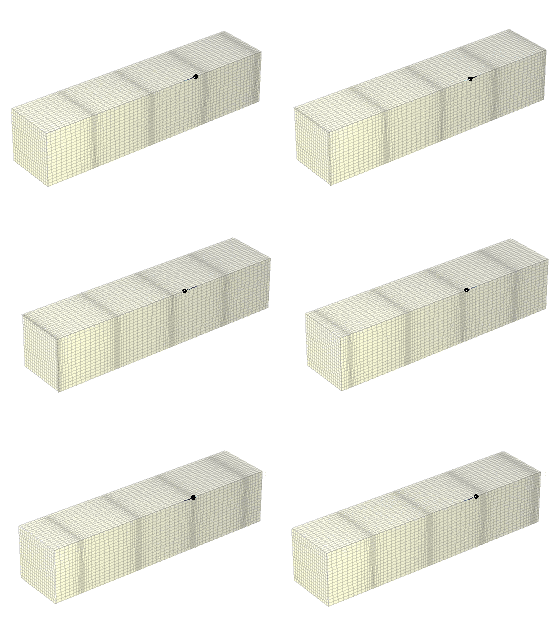
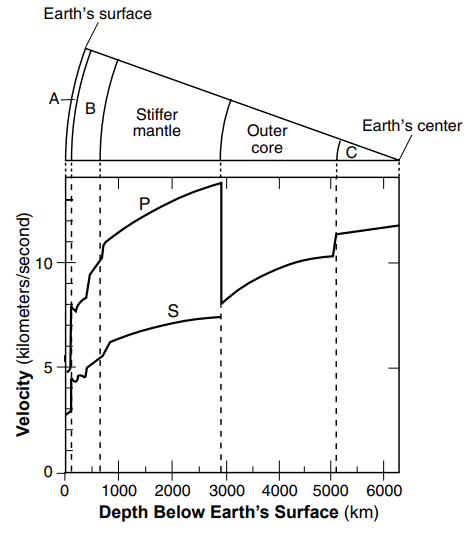
Primary (P) Waves can pass through...
solids only
liquids only
gases only
solids, liquids, and gases
How many children does Mrs. Obaugh have?
2
3
4
5
6
Which is the geologic process that breaks down rock?
weathering
erosion
deposition
destruction
Which is the geologic process that moves broken material from one location to another?
weathering
erosion
deposition
destruction
Which is the geologic process which deposits material to form a landform?
weathering
erosion
deposition
destruction
What does the theory of continental drift state?
The continents were once joined in a super-continent and have moved slowly to their current locations
Continents are stationary and do not move
The Earth is broken into lithospheric plates that move due to convection currents
none of the above
What is the correct order (starting from the surface) of Earth’s layers?
crust, outer core, inner core, mantle
mantle, outer core, inner core, crust
crust, mantle, outer core, inner core
outer core, inner core, crust, mantle
What is Pangaea?
the name of a German scientist
the name of the supercontinent that existed millions of years ago
another name for continental drift
the name of an ancient fossil
Which type of evidence was NOT used by Alfred Wegener to support his continental drift hypothesis?
evidence from landforms
evidence from fossils
evidence from human remains
evidence from climate
Most geologists rejected Alfred Wegener’s idea of continental drift because _______
they were afraid of a new idea.
Wegener was interested in what Earth was like millions of years ago.
Wegener used several different types of evidence to support his hypothesis.
Wegener could not identify how, when or why the continents moved apart.
In sea-floor spreading, molten material rises from the mantle and erupts _______
along the edges of all the continents.
along mid-ocean ridges.
in deep-ocean trenches.
at the north and south poles.
Magma that turns into rock at the mid ocean ridge, has iron crystals that record...
Earth's magnetism
Earth's gravity
Earth's history
Earth's cosmic rays
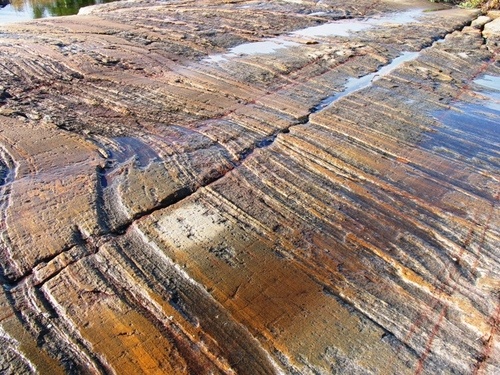
Process by which new ocean crust forms.
Seafloor spreading
Continental drift
Mid-ocean ridge
Rift
Oceanic crust near the mid-ocean ridge is YOUNGER than oceanic crust farther away from the ridge.
True
False
Harry Hess proposed an idea suggesting a process called what?
Continental Drift
Subduction
Seafloor Spreading
Mid-Ocean Ridges
New oceanic lithosphere (crust) forms as a result of
sea-floor spreading.
normal polarity.
reverse polarity.
continental drift.
Underwater mountain chains running through Earth’s ocean basins are called
sea-floor spreading.
mid-ocean ridges.
magnetic reversal.
continental drift.
The fact that similar fossils are found on both sides of the ocean is evidence of
global positioning.
magnetic reversal.
continental drift.
oceanic drifts.
Magnetic reversals have helped to support
the theory of Pangaea.
the age of the Earth.
sea-floor spreading.
the theory of Gondwana.
Which of the following are evidence for continental drift?
Puzzle-like fit
Fossils
Rocks
Climate Clues
All of the Above
The fact that many of the continents look like they fit together is called the
cool continent clue
puzzle-like fit
Wegner hypothesis
Hess Theory
Fossils are evidence for continental drift because
there were the same fish fossils on many continents
there were different fossils on different continents
there were fossils of the same land animal on separate continents
there were no fossils on the continents
Climate clue are evidence for continental drift because
there is glacial evidence in tropical areas
there are fossils of tropical plants in arctic areas
all of the above
none of the above
Rocks and mountains are evidence for continental drift because
no rock evidence is found
rocks layers do not match on any continents
there are matching rock layers on separate continents
there are matching fossils on separate continents
This is a segment of DNA on a chromosome
trait
gene
genotype
phenotype
These are the genes an organism has - it's genetic makeup.
trait
gene
genotype
phenotype
The study of heredity.
selective breeding
Mendel's Laws
Law of Independent Assortment
genetics
Having two of the same alleles for a given trait.
heterozygous
doubling
homozygous
tripling
This principle/law states that each parent passes only one allele for a trait to its offspring.
Principle of Segregation
Principle of Dominance
Law of Independent Assortment
Law of Genetics
This principle/law states that the alleles for one trait have no effect on the alleles for another trait.
Principle of Segregation
Principle of Dominance
Law of Independent Assortment
Law of Genetics
This is another term for when an organism has two different alleles for a trait.
purebred
hybrid
mutation
cloned
This is another term for when an organism has two of the same alleles for a trait.
purebred
hybrid
mutation
cloned
This principle/law states that only one form of a trait is expressed in the phenotype even when both alleles are present.
Principle of Dominance
Law of Segregation
Law of Independent Assortment
Law of Genetics
This is the tool used to predict the probability of certain traits in offspring.
law of independent assortment
selective breeding
mutation
Punnett Square
This is having two different alleles for a given trait.
homozygous
dominant
heterozygous
recessive
The youngest rocks on the ocean floor are located ____.
near continents
at mid-ocean ridges
far from mid-ocean ridges
near Asia
The result of plate movement can be seen at ____.
abyssal plains
ocean margins
plate centers
plate boundaries
The hypothesis that continents have slowly moved to their current locations is called ____.
continental drift
continental slope
magnetic reversal
convection
Plates move apart at ____ boundaries.
convergent
stable
divergent
transform
Plates slide past one another at ____.
subduction zones
transform boundaries
convection currents
divergent boundaries
The boundary between two plates moving towards each other is called a ____.
divergent boundary
convergent boundary
transform boundary
lithosphere
The Great Rift Valley in Africa is a ____.
mid-ocean ridge
divergent boundary
convergent boundary
transform boundary
The Andes mountain range of South America was formed at a ____.
convergent boundary
divergent boundary
hot spot
transform boundary

A person is standing in the middle of a boxcar on a train moving 100 km per hour. If the motion of the boxcar
, where in the boxcar will the person most likely land after he jumps straight up?


Force Q is equal to Force S and Force R is equal to Force T.
Force Q is less than Force S and Force R is equal to Force T.
Force Q is equal to Force S and Force R is greater than Force T.
Force Q is less than Force S and Force R is greater than Force T.

Which bar magnet will experience the greatest magnetic attraction?
Magnet 1
Magnet 2
Magnet 3
Magnet 4
There are two ends of a magnet.
What are they called?
North and East
North and West
North and South
South and East
Which illustration correctly shows how the spheres will behave?


Which diagram shows the gymnast's potential energies?


In which direction will the box move?
A. in the direction arrow P is pointing
B. in the direction arrow Q is pointing
C. in the direction arrow R is pointing
D. in the direction arrow S is pointing
Which term is an example of force?
weight
energy
work
mass

Which person has gained the most gravitational potential energy ?
a. a 50kg person who lives on the second floor
b. a 50kg person who lives on the third floor
c. a 100kg person who lives on the second floor
d. a 100kg person who lives on the third floor

How does the elastic potential energy in the bow change as the archer fires an arrow?
It decreases from Step1 to Step 2, then increases to Step 3.
It increases from Step1 to Step 2, then decreases to Step 3.
It remains constant from Step1 to Step 2, then increases to Step 3.
It remains constant from Step1 to Step 2, then decreases to Step 3.

What happens to Box X and Box Y as a result of the forces?
A. Box X starts moving, speeding up, and Box Y remains at rest.
B. Box X starts moving at constant speed, and Box Y remains at rest.
C. Box X starts moving at constant speed, and Box Y starts moving, speeding up.
D. Box X starts moving, speeding up, and Box Y starts moving at a constant speed.

Which bunny will fall fastest?
Bunny 1
Bunny 2
Bunny 1 and Bunny 2 will fall at the same time.

How does the elastic potential energy change for each of the springs?
The elastic potential energy of both springs will increase.
The elastic potential energy of both springs will decrease.
The elastic potential energy of the spring in set-up A will decrease and the elastic potential energy of the spring in setup B will increase.
The elastic potential energy of the spring in set-up A will increase and the elastic potential energy of the spring in setup B will decrease.
As you are riding in your car down the road, how do the light poles appear to move?
A. forward
B. backward
C. They are stationary and do not move
D. In the same direction as you
A student is riding her bicycle down the street. She passes the mailman pulling mail from the corner mailbox. To the mailman, how does the student appear to move?
A. forward
B. backward
C. She does not appear to be moving
D. In the same direction as the mailman

Click on each action that will reduce the rate at which the speed of the basket changes.
Pull with less force
Pull with more force
Add an apple to the basket
Take an apple out of the basket
Roughen the surface to increase friction
An object moves at a constant speed.
What will happen to this object’s motion over time if no new forces are applied?
It will change direction.
It will increase in speed.
It will decrease in speed.
It will maintain a constant speed.

What type of potential energy is released from a hand warmer?
elastic potential energy
gravitational potential energy
chemical potential energy
kinetic energy
A scientist runs an electric current along a wire. A magnetic compass is placed near the wire.. The scientist observes that whenever the current is turned on, the compass needle moves.
Why does the compass needle move?
The current creates an electric field around the wire.
The current creates a magnetic field around the wire
The current adds electric charge to the compass needle.
The current increases the forces of gravity on the compass needle.

When there is movement, potential and gravitational energy changed to _________ Energy.
chemical
potential
elastic
kinetic

