wayground logo

Free Printable Worksheets

Font size

S
M
L
XL
Worksheets

Waves Grade 8

Total questions: 117

Worksheet time: 3hrs 53mins

Name
Class
Date
1.

What do all waves transfer?

a)

Matter

b)

Heat

c)

Electricity

d)

Energy

2.

Which of the following can waves transfer energy through?

a)

solid

b)

liquid

c)

gas

d)

empty space

e)

all of the above

3.

What are the two types of waves?

a)

longitudinal and transverse

b)

sound and light

4.

What is the number of complete waves passing a fixed point in a given amount of time?

a)

Amplitude

b)

Intensity

c)

Wavelength

d)

Frequency

5.

The highest part of a transverse wave is

a)

the crest

b)

the trough

c)

the wave point

d)

the hotel transylvania

6.

The lowest part of a transverse wave are the

a)

crests

b)

troughs

c)

wave points

d)

low nodules

7.

The distance between two corresponding parts of a wave is its

a)

amplitude

b)

frequency

c)

wavelength

d)

velocity

8.

The height of the wave from its resting point is called its

a)

wavelength

b)

amplitude

c)

velocity

d)

frequency

9.

A wave that needs a medium to travel is called a(n)

a)

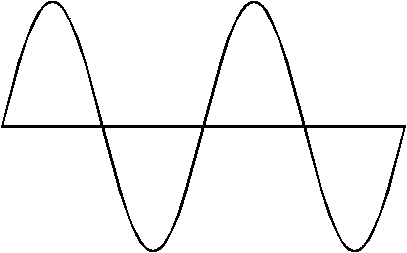
electromagnetic wave

b)

mechanical wave

c)

ocean wave

d)

any way can do this

10.

A wave that can travel with or without a medium is called a(n)

a)

electromagnetic wave

b)

mechanical wave

c)

surface wave

d)

all waves can travel in any way

11.

Longitudinal waves have:

a)

crests and troughs

b)

crests and compressions

c)

compressions and rarefactions

d)

troughs and rarefactions

12.

Transverse waves have:

a)

crests and troughs

b)

troughs and rarefactions

c)

compressions and contractions

d)

rarefactions and crests

13.

How often a wave occurs is the wave's

a)

frequency

b)

amplitude

c)

wavelength

d)

velocity

14.

Transverse waves move mediums

a)

at a right angle

b)

in a circle

c)

and matter too

d)

at an acute angle

15.

Longitudinal waves move:

a)

at a right angle compared to the direction the wave is traveling

b)

in a circle compared to the direction the wave is traveling

c)

matter

d)

in the same direction as the wave is traveling

16.

Particles in water in an ocean wave move

a)

in a square

b)

in a right angle

c)

in a circle

d)

in a dodecahedron

17.

True or False: Amplitude can increase or decrease wavelength

a)

True, amplitude can increase or decrease wavelength

b)

False, frequency can increase or decrease wavelength

c)

False, crests can increase or decrease wavelength

18.

What is the amplitude of this wave?

a)

3

b)

-3

c)

6

d)

4

19.

What is the wavelength of this wave?

a)

3

b)

10

c)

4

d)

8

20.

What happens to the frequency of a wave when the amplitude is tripled?

a)

the frequency is tripled

b)

the frequency is a third of what it was

c)

amplitude does not affect frequency

21.

What would happen to the wavelength if the frequency was doubled?

a)

the wavelength would be halved

b)

the wavelength would be doubled

c)

the wavelength would stay the same

d)

frequency does not affect wavelength

22.

What would happen to the frequency is the wavelength was tripled?

a)

the frequency would be a third of what it was

b)

the frequency would be 3 times larger

c)

the frequency would stay the same

d)

the wavelength does not affect the frequency of a wave

23.

What is the amplitude of this wave?

a)

3

b)

-3

c)

6

d)

4

24.

What is the wavelength of this wave?

a)

3

b)

8

c)

10

d)

4

25.

A wave is a disturbance that transfers ________ from one place to another.

a)

Matter

b)

Mass

c)

Energy

26.

What types of waves can travel through empty space AND mediums?

a)

Longitudinal

b)

Mechanical

c)

Electromagnetic

27.

Which 2 types of waves require a medium to travel?

a)

Electromagnetic

b)

Mechanical

c)

Light

d)

Sound

28.

Which of the following is a mechanical wave?

a)

X-ray

b)

Infrared

c)

Radio waves

d)

Sound

29.

What medium do sound waves travel fastest through?

a)

Solids

b)

Liquids

c)

Gases

30.

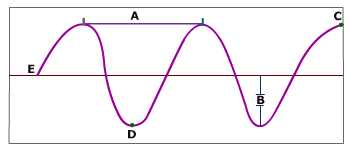
The height of a wave from its resting point (B).

a)

Frequency

b)

Wave speed

c)

Wavelength

d)

Amplitude

31.

The length of a wave, from crest to crest or trough to trough. (D)

a)

Frequency

b)

Wave speed

c)

Wavelength

d)

Amplitude

32.

The number of waves passing a given point each second is:

a)

Frequency

b)

Wave speed

c)

Wavelength

d)

Amplitude

33.

What is the correct formula for wave speed?

a)

Wave speed = frequency x wavelength

b)

Wave speed = amplitude x wavelength

c)

Wave speed = amplitude x period

d)

Wave speed = frequency x period

34.

As wavelength decreases, the crests of the wave:

a)

become wider

b)

become shorter

c)

get closer together

d)

get farther apart

35.

If a wave has a long wavelength, it will have __________ energy.

a)

High

b)

Medium

c)

Low

36.

If a wave has a short wavelength, it will have __________ energy.

a)

High

b)

Medium

c)

Low

37.

If a wave has a high frequency, it will have __________ energy.

a)

High

b)

Medium

c)

Low

38.

If a wave has a high amplitude, it will have __________ energy.

a)

High

b)

Medium

c)

Low

39.

What does a wave carry from place to place?

a)

energy

b)

matter

c)

people

40.

The highest point on a transverse wave is the

a)

compression

b)

crest

c)

rest position

d)

trough

41.

The lowest point on a transverse wave is the

a)

compression

b)

crest

c)

rest position

d)

trough

42.

The number of waves that pass somewhere in a second is:

a)

amplitude

b)

frequency

c)

wavelength

43.

A wave that can travel through matter and empty space is a:

a)

electromagnetic wave

b)

longitudinal wavy

c)

transverse wave

44.

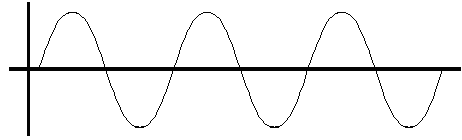
What kind of wave is this?

a)

electromagnetic

b)

longitudinal

c)

transverse

45.

Waves that require a material to travel though are called

a)

electromagnetic waves

b)

mechanical waves

c)

ocean waves

d)

transverse waves

e)

I do not know and do not wish to answer.

46.

This picture is an example of which type of wave?

a)

transverse wave

b)

compression wave

c)

ocean wave

47.

#1 refers to the

a)

wavelength

b)

amplitude

c)

crest

d)

trough

48.

#2 refers to the

a)

wavelength

b)

amplitude

c)

crest

d)

trough

49.

#3 refers to the

a)

wavelength

b)

amplitude

c)

crest

d)

trough

50.

#4 refers to the

a)

wavelength

b)

amplitude

c)

crest

d)

trough

51.

Which are properties of a mechanical wave?

a)

can be longitudinal or transverse

b)

can move through space

c)

must have matter to move

d)

carries energy

52.

Compared to wave A, which wave has the same wavelength but a smaller amplitude?

a)

only B

b)

only C

c)

only D

d)

both B & C

53.
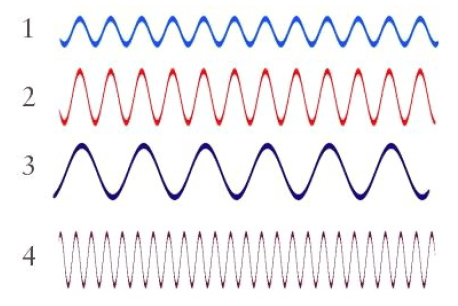
Which wave in the diagram has the greatest frequency?
a)
1
b)
2
c)
3
d)
4
54.

Which image represents a longitudinal wave?

a)

A

b)

B

55.
Which part of a longitudinal wave is where particles are packed closely together?
a)
compression
b)
rarefaction
c)
crest 
d)
amplitude
56.
Which letter represents wavelength?
a)
A
b)
B
c)
C
d)
D
57.
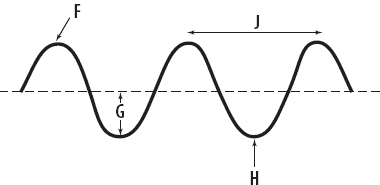
Which letter is a trough?
a)
F
b)
G
c)
H
d)
J
58.
What part of the wave is B?
a)
Compression
b)
Rarefaction
c)
Wavelength
d)
Amplitude
59.
____________________  is the number of waves that move past one spot in a second
a)
energy
b)
amplitude
c)
wavelength
d)
frequency
60.
 A wave has frequency of 50 Hz and a wavelength of 10 m. What is the speed of the wave?
a)
500 m/s
b)
50 m/s
c)
5 m/s
d)
0.5 m/s
61.
 A wave has frequency of 5 Hz and a speed of 25 m/s. What is the wavelength of the wave?
a)
25 m
b)
125 m
c)
5 m
d)
25 m/s
62.
A wave has wavelength of 10 m and a speed of 340 m/s. What is the frequency of the wave?
a)
34 m/s
b)
3400 Hz
c)
3400 m/s
d)
34 Hz
63.

If the wavelength of a wave increased, what would happen to the frequency?

a)

decrease

b)

increase

c)

stay the same

64.

Transverse waves have:

a)

crests and troughs

b)

troughs and rarefactions

c)

compressions and contractions

d)

rarefactions and crests

65.

The measurement for Frequency is...

a)

Cycle

b)

Meters

c)

Hertz

d)

Seconds

66.
Which letter represents the wavelength of a wave?
a)
A
b)
B
c)
C
d)
D
67.
Which letter represents the amplitude of the wave?
a)
A
b)
B
c)
C
d)
D
68.
Which letter(s) represent the crest of the wave?
a)
A
b)
B & D
c)
B & F
d)
F
69.
Which letter(s) represent the trough of the wave?
a)
A
b)
B & D
c)
D
d)
C & G
70.
The image above shows a student using a Slinky to create a wave. The slinky is stretched at one end and the resulting wave travels back and forth. This is an example of a...
a)
Superposition Wave
b)
Refracted Wave
c)
Longitudinal Wave
d)
Transverse Wave
71.
Imagine one end of a rope is tied to a door handle. The other end is caused to vibrate vertically(up & down). The wave that travels along the rope is an example of a(n)...
a)
Electromagnetic Wave
b)
Microwave
c)
Transverse Wave
d)
Longitudinal Wave
72.
A mechanical wave cannot travel through...
a)
a vacuum(empty space).
b)
water.
c)
air. 
d)
glass.
73.
When the frequency of a wave increases, what happens to the wavelength?
a)
The wavelength is not directly affected by the frequency of a wave.
b)
The wavelength increases.
c)
The wavelength decreases.
d)
More specific information is needed to form a conclusion about the wavelength.
74.
Which of the following best explains the difference between transverse and longitudinal waves?
a)
Only transverse waves vibrate.
b)
Only longitudinal waves can travel through a solid.
c)
Particles only travel in a circular pattern along a longitudinal wave.
d)
Particles only travel perpendicular to the direction the energy travels in a transverse wave.
75.
Which vocabulary term is used to identify the distance between points C & G?
a)
Amplitude
b)
Crest
c)
Frequency
d)
Wavelength
76.
Which vocabulary term is used to identify point A on the diagram?
a)
Amplitude
b)
Crest
c)
Frequency
d)
Trough
77.
Which wave in the diagram has the greatest frequency?
a)
1
b)
2
c)
3
d)
4
78.
Which wave in the diagram has the greatest wavelength?
a)
1
b)
2
c)
3
d)
4
79.
How would you describe the movement of a longitudinal wave?
a)
Up and down
b)
Back and forth
c)
In zigzags
d)
Linear
80.
How would you describe the movement of a transverse wave?
a)
Up and down
b)
Back and forth
c)
In zigzags
d)
Linear
81.
Sound is an example of which type of wave?
a)
Transverse
b)
Longitudinal
c)
Both
d)
Neither
82.
Light is an example of which type of wave?
a)
Transverse
b)
Longitudinal
c)
Both
d)
Neither
83.
Which wave can travel in both a medium and a vacuum?
a)
Transverse
b)
Longitudinal
c)
Both
d)
Neither
84.
Which wave can only travel using a medium?
a)
Transverse
b)
Longitudinal
c)
Both
d)
Neither
85.
Which wave travels perpendicular in relation to a medium?
a)
Transverse
b)
Longitudinal
c)
Both
d)
Neither
86.
Which wave travels parallel in relation to a medium?
a)
Transverse
b)
Longitudinal
c)
Both
d)
Neither
87.
How would you describe the amplitude of a transverse wave?
a)
From centerline to crest or trough
b)
Density of the compression
c)
From centerline to compression
d)
Density of rarefaction
88.
How do you measure the wavelength of a longitudinal wave?
a)
Crest to crest
b)
Middle of compression to middle of next compression
c)
You cannot measure the wavelength.
d)
It does not have a wavelength.
89.
How do you measure the wavelength of a transverse wave?
a)
Crest to crest
b)
Middle of compression to middle of next compression
c)
You cannot measure the wavelength.
d)
It does not have a wavelength.
90.
How would you describe the amplitude of a longitudinal wave?
a)
From centerline to crest or trough
b)
Density of the compression
c)
From centerline to compression
d)
Density of rarefaction
91.
What are the parts of a longitudinal wave?
a)
Compressions and rarefactions
b)
Crests and troughs
c)
Compressions and crests
d)
Rarefactions and troughs
92.
What are the parts of a transverse wave?
a)
Compressions and rarefactions
b)
Crests and troughs
c)
Compressions and crests
d)
Rarefactions and troughs
93.
Which wave is pictured?
a)
Transverse
b)
Longitudinal
c)
Both
d)
Neither
94.
Which wave is pictured?
a)
Transverse
b)
Longitudinal
c)
Both
d)
Neither
95.
How many waves are in this picture?
a)
1
b)
2
c)
3.5
d)
4
96.
What type of wave moves by pushing together and spreading apart in a parallel direction to the way the wave travels?
a)
longitudinal
b)
transverse
c)
ocean 
d)
radio 
97.
What type of wave must have a medium to vibrate?
a)
Mechanical
b)
Electromagnetic
c)
Infrared
d)
Radio
98.
What type of wave can travel without a medium? It can travel through a vacuum or empty space.
a)
Mechanical
b)
Electromagnetic
c)
Longitudinal
d)
Seismic 
99.
What is another word we use to describe empty space?
a)
Medium
b)
Vacuum
c)
Water
d)
Speed
100.
What do we call the vibrations that transfer or move energy from place to place?
a)
Waves
b)
Vibrations
c)
Medium
d)
Force
101.
What do we call a material through which waves can travel? It can be a solid, liquid, or gas.
a)
Medium
b)
Vacuum
c)
Vibrations
d)
Amplitude
102.
What do we call a wave where the particles move back and forth perpendicular to the direction the wave travels?
a)
Transverse
b)
Longitudinal
c)
Sound
d)
Primary Seismic
103.
Which one of the following is an example of a mechanical wave?
a)
radio
b)
seismic
c)
infrared
d)
ultraviolet
104.
Which one of the following is an example of an electromagnetic wave?
a)
ocean
b)
seismic
c)
sound
d)
ultraviolet
105.

What type of wave is sound?

a)

mechanical longitudinal

b)

mechanical transverse

c)

electromagnetic longitudinal

d)

electromagnetic transverse

106.

What type of wave is a primary seismic wave?

a)

mechanical longitudinal

b)

mechanical transverse

c)

electromagnetic longitudinal

d)

electromagnetic transverse

107.

What type of wave is a secondary seismic wave?

a)

mechanical longitudinal

b)

mechanical transverse

c)

electromagnetic longitudinal

d)

electromagnetic transverse

108.
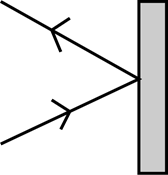
The illustration shows a light ray striking an object.
In the illustration, the light ray striking the object is-
a)
absorbed
b)
stopped
c)
reflected
d)
refracted
109.
A student placed a pencil in a cup of water.  The pencil appears broken because light-
a)
always travels in a straight line
b)
bends when it passes through water
c)
makes the water in the glass evaporate
d)
reflects the pencil on the water's surface
110.
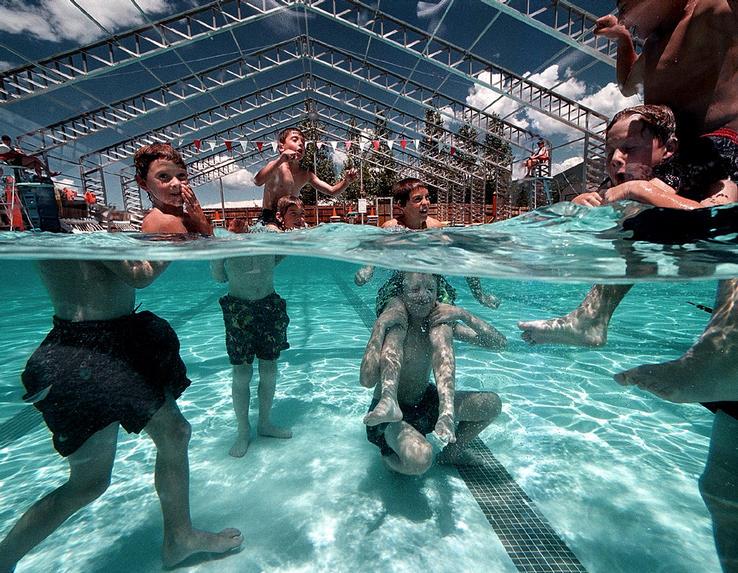
Why does the lower part of the child appear so much different in size from the upper part?
a)
The light rays that travel through water and then into air are refracted.
b)
The light rays that travel through water and then into air are enlarged.
c)
The light rays that travel through air and then into water are reflected.
d)
The light rays that travel through air and then into water are reduced.
111.
a)
Reflection
b)
Refraction
112.
Visible light is an example of 
a)
Transverse Waves
b)
Longitudinal Waves
c)
Compression Waves
d)
Beach Waves 
113.
______________ is when light bends due to a change in speed as it travels through a certain type of medium.
a)
Reflection
b)
Refraction
c)
Absorption
d)
Scattering 
114.
Which letter shows reflection? 
a)
Pathway A
b)
Pathway B
c)
Pathway C
d)
Pathway D
115.
When a wave bends around a barrier or passes through an opening, it is called
a)
Diffraction
b)
Reflection
c)
Refraction
d)
Interference
116.
Which term explains the path of the light ray in this diagram?
a)
Convection
b)
Scattering
c)
Absorption
d)
Refraction
117.
What do you see when water droplets refract and diffract sunlight?
a)
thunderstorm
b)
eclipse
c)
rainbow
d)
clouds