
 Worksheets
Grade 8 Semester Test 2 - Review
Total questions: 115
Worksheet time: 58mins

___________ are the smallest unit of an element that maintains the properties of that element.
Atoms
Elements
Compounds
Mixtures
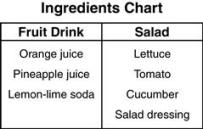
Using the information in the chart, which statement is the BEST description of the drink and salad?
The amount of space that matter occupies:
Mass
Volume
Weight
Density
What does a chemical change result in?
A phase change (ex. solid to liquid)
A change in the way atoms are bonded together
A change in how close together atoms are
A change in size
Which of the following is an example of a physical change?
Baking a birthday cake
Burning a piece of paper
A glass falling and shattering on the floor
Baking soda and vinegar mixing together

Does the following picture represent a chemical or physical change?
Chemical
Physical
Both
What is Sublimation?
Solid—>Liquid
Liquid—>Solid
Air—>Solid
Solid—>Air
What causes a change in the states of matter?
Light
Energy
Pressure
If a liquid turns into a gas, what is happening to the amount of energy in the liquid?
It is decreasing
It stays the same
It is increasing
If a liquid turns into a solid, what is happening to the energy in the liquid?
It is decreasing
It stays the same
It is increasing
The atom is mostly large empty space with a small, dense nucleus at the center
Dalton
Thomson
Rutherford
Bohr

What scientist proposed this atomic model?
Dalton
Thomson
Rutherford
Bohr
What is the atomic number?
the number of protons in the nucleus
the number of neutrons in the nucleus
the number of protons and neutrons in the nucleus
the number of protons in the energy levels
What is the mass number?
the number of protons in the nucleus
the number of neutrons in the nucleus
the number of protons and neutrons in the nucleus
the number of protons and electrons in the atom
If an atom has 12 positively charged subatomic particles, which of the following must it also have to be considered a neutral atom?
12 neutrons
12 protons
12 electrons
24 protons and neutrons
Which elements have the most similar chemical properties?
(use your periodic table)
K and Na
K and Cl
K and Ca
K and S
How are elements ordered on the Periodic Table?
Alphabetical Order
By their atomic mass.
By their color.
By their atomic number.
Rows on the period table are called _____ while columns are called _____.
groups, families
periods, groups
groups, periods
families, groups
Metals generally have the following properties EXCEPT for being:
Shiny
Malleable
Non-conductors
Ductile
Nonmetals do NOT have which of the following characteristics:
Shiny
Brittle
Many are gasses
Good insulators

A push or pull that causes an object to move, stop, or change direction.
force
friction
gravity
weight
The ability to do work or cause change
motion
energy
force
power
The change in position relative to another object
work
force
motion
power
The formula for work is
Work = force x distance
Work = power x distance
Work = force x time
Work = power x time
The rate at which one form of energy is transformed into another.
energy
work
force
power
The formula for power is
Power = Force x time/work
Power = Force x distance/time
Power = Work x time
Power = Work x distance
Power is measure in
Joules
Watts
Newton-meters
Joules-meters
In which scenario is work = 0 J ?
Pushing a stationary wall
Pulling a trolley car
Pushing a book across the table
Dropping a set of keys from a height, h.


At which point is potential energy greatest?
W
X
Y
Z

Where would this baseball have the greatest amount of kinetic energy?
W
X
Y
Z
Where would this baseball have the least amount of kinetic energy?
W
X
Y
Z

Which point has the most potential energy?
G
F
B
A

At which point of the roller coaster is potential energy the greatest?
W
X
Y
Z
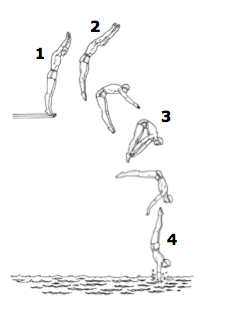
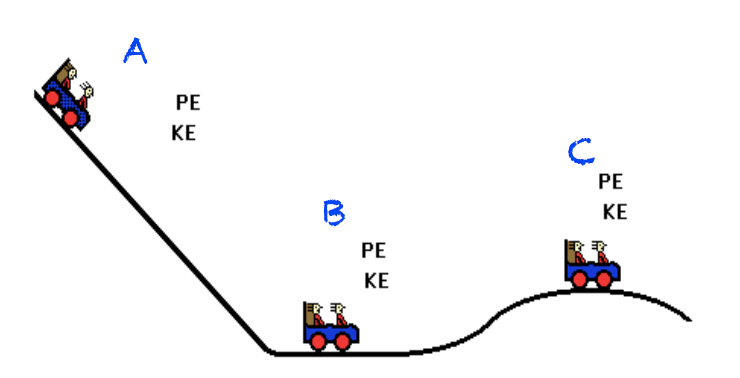
The coaster at B is at -
Maximum PE, Minimum KE
Minimum PE, Minimum KE
Minimum PE, Maximum KE
Maximum PE, Maximum KE

A form of potential energy that is stored in chemical bonds between atoms
Chemical Energy
Thermal Energy
Electromagnetic Radiation
Mechanical Energy

(a) the material through which a wave travels

Potential Energy + Kinetic Energy = (a)

The transfer of energy into the thermal energy of an object is called?
Energy
Heat
Motion
Force
What three factors affect mechanical energy?
water, wind, and fire
solids, liquids, and gases
position, velocity, and acceleration
motion, position, and shape
Select two: What are the two types of nuclear energy?
nuclear confusion
nuclear fusion
nuclear fission
nuclear fizzing
What happens to the thermal energy of a substance when its particles’ kinetic energy increases?
thermal energy increases
thermal energy decreases
thermal energy stays the same
thermal energy goes away
What is sound energy?
the total kinetic energy of the particles of a substance
energy carried by sound waves due to the vibration of an object
the energy of electric charges
the energy transferred through an area by electromagnetic waves
1. A ball has a 17 J of kinetic energy and its mechanical energy is 25 J. If the ball has a mass of 3.2 kg, what is its height above the ground?
0.26 m
0.52 m
5.2 m
25 m
Then how much work is done if it takes 20N to move a box 10 meters
Difference between initial position and final position of an object.
displacement
motion
position
reference point
Starting point you choose to describe the location, or position, of an object
reference point
position
motion
displacement
Speed at a specific instant in time
instantaneous speed
average speed
constant speed
Your speed at any given point, for example what you read on your speedometer is your ____________.
Instantaneous speed
Average speed
Velocity
Constant speed
On a distance vs time graph, the slope indicates the _________.
the time it took for the object to travel
the acceleration
the speed of the object
the total distance traveled
Acceleration is rate of change of _________ over time
Reference Point
Time
Position
Velocity
How can an object accelerate?
Speeding up
Slowing down
Changing direction
All of the above
How do you calculate average speed?
total distance / total time
total time / total distance
total distance x total time
total distance x total time
An object with constant velocity has
a positive acceleration
a negative acceleration
zero acceleration
changing direction

This graph represents an object moving at a _________ speed, __________ from the reference point
increasing , away
constant , away
increasing , towards
constant , towards

In this graph, the object is
slowing down
speeding up
no moving
moving at a constant speed

In this graph, the object is ___________.
slowing down
speeding up
moving at a constant speed
no moving
A school bus leaves school and heads east for 2 miles before making its first stop. It then turns left and heads north 3 miles before making another stop. What is the total distance traveled by the school bus?
3 miles
5 miles
1 mile
3.61 miles

An ostrich can run at a speed of 43 miles per hour. How much distance can an ostrich run if it runs at this speed for 0.25 hours?
173 miles
43 miles
10.75 miles
0.005 miles
A helicopters speed increases from 25 m/s to 60 m/s in 5 seconds. What is the acceleration of this helicopter?
-7 m/ss
7 m/s2
35 m/s2
-35 m/s2

If a soccer player runs after his opponent 70 meters north, then turns around and chases him 20 meters south, what is his displacement?
90 m
50 m
20 m
10 m
Which statement about acceleration is correct?
It is related to the changing speed of an object.
It is the distance an object travels in one second.
It is the force acting on an object divided by the distance it travels in one second.
It is the force acting on an object when it is near to the Earth.
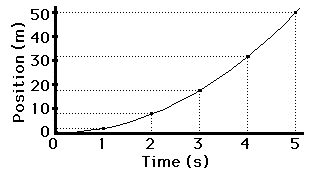
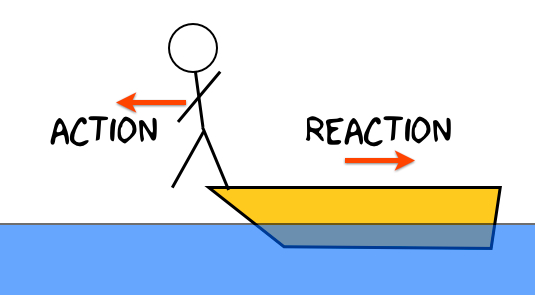
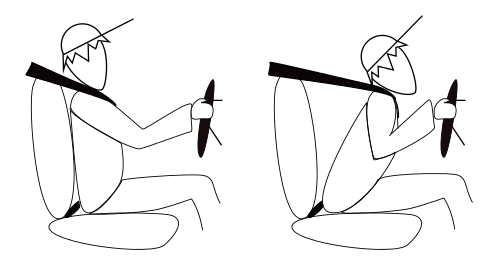
The English Scientist who developed three laws of motion was called:
Sir Isaac Newman
Sir Isaac Newton
Albert Einstein
Mr. Fig Newton
If Mrs. Dircks dropped her Pepsi bottle, what is the force that pulls the bottle to the ground?
motion
friction
air resistance
gravity

What example best represents Newton's 2nd Law of Motion?
An apple fell to the floor.
He rode the bicycle downhill.
The car hit a wall and stopped, but the girl still went forward.
The boy rode his bicycle downhill.
When a popsicle melts, the particles in the popsicle _____.
gain thermal energy and speed up
there are no particles in popsicles
lose thermal energy and slow down
stay the same

Boiling Water (a)

Cold Pack on Person
Heat is transferred from the cold pack to the person.
Heat is transferred from the person to the cold pack
The cold pack is getting warmer. The person is getting colder.
The cold pack is getting colder. The person is getting warmer.
What is a transfer of heat energy by electromagnetic waves? (a)
conduction
ironing a shirt
convection
a radiator heating a cold room
radiation
a microwave heating food

