
 Worksheets
Electricity and Magentism
Total questions: 123
Worksheet time: 2hrs 6mins
The tendency for a material to oppose the flow of electrons is _____.
current
resistance
conductor
voltage
Items with opposite charges _____ each other.
attract
repel
move
none of the above
Items with like charges _____ each other.
attract
repel
move
none of the above
Clothes clinging together and lightning are examples of _____.
current electricity
circuit electricity
alternating electricity
static electricity
Resistance is measured in a unit called _____.
ampere
ohm
volt
coulomb
Potential difference is measured in a unit called _____.
ampere
ohm
volt
coulomb
Electric current is measured in a unit called _____.
ampere
ohm
volt
coulomb

Is the symbol for _____.
Light bulb
Resistor
Battery
Switch

Is the symbol for _____.
Light bulb
Resistor
Battery
Switch
A good conductor is a material that does not allow electricity to flow through it.
True
False
A battery is a source of alternating current.
True
False
In a series circuit, all parts of the circuit are connected in a single path.
True
False
Select the items needed to have a complete circuit.
Energy source (battery)
Wires
Energy user (lightbulb)
Voltmeter
Switch
Which of the following are examples of conductors?
Copper
Plastic
Glass
Aluminum foil
Pencil lead
Which of the following are examples of insulators?
Copper
Plastic
Glass
Aluminum foil
Pencil lead
Electricity that flows in only one direction is called _____.
Alternating current (AC)
Direct current (DC)
Electricity that changes direction as it flows is called _____.
Alternating current (AC)
Direct current (DC)
Which of the following charge pairs would repel each other? (Choose all that apply)
positive and negative
negative and negative
positive and positive
negative and positive

What type of circuit is this?
Series
Parallel
Simple
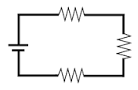
In a series circuit, how is the brightness of a light bulb affected when another bulb is connected?
It gets brighter
It stays the same
It gets dimmer
It goes out
Select the materials that are electrical conductors.


Select the materials that are electrical insulators.


The accumulation of excess electric charge on an object is called
Static Electricity
Electric Discharge
Resistance
Current Electricity

Two balloons are hanging from a stick.
Both balloons have a positive charge.
How would you expect the balloons to move?
there would be no movement
towards each other
away from each other

Two balloons are hanging from a stick.
One balloon has a positive charge and the other has a negative charge.
How would you expect the balloons to move?
there would be no movement
towards each other
away from each other

The ball on the string is being repelled (pushed away) by the metal bar.
What must be the charge on the ball?
positive
neutral
negative
An area over which an electric charge is exerted is called an
conductor
insulator
circuit
electric filed

The comb has been rubbed with a piece of wool fabric and placed next to some scraps of paper.
Some paper moves toward the comb. The movement of the paper is caused by
static electricity
mechanical energy
chemical energy
magnetic attraction
Materials that electrons do NOT flow through such as cloth, rubber, plastic
conductors
insulators
chargers
electrodes
Materials through which electrons flow easily
conductors
insulators
electrodes
chargers
A steady flow of electrons
circuit
current
discharge
oxidation
A continuous conducting path for current.
electrode
circuit
voltaic pile
axon
Electrons move towards the point of ________________ potential.
higher
lower
When dealing with batteries, the negative side is the higher potential.
True
False


A region around a charged particle that can exert a force on another charged particle is called an
electric force.
electric pulse.
electric field.
electric charge.
Charging by ____ occurs when electrons are transferred from one object to another by DIRECT contact.
conduction
induction
friction


The entire region surrounding a magnet is known as the:
Magnetic Domain
Lodestone
A Compass
Magnetic Field
Which metal can be attracted to magnets?
Copper
Aluminum
Iron
Gold

Which type of magnet loses magnetism outside of a magnetic field?
a strong magnet
a temporary magnet
a permanent magnet
an electromagnet

Two like poles are held close to one another within each other's force field. Which statements are TRUE? SELECT ALL THAT APPLY.
The poles will repel when released
The poles will attract when released
The poles have high PE before being released
The poles have low PE before being released
Magnetic field lines that are drawn closer to each other show ___.
a decrease in polarity
an increase polarity
a smaller magnetic force
a greater magnetic force

Which answer describes the pictures correctly?
Both drawings show attraction of magnetic forces.
The left drawing shows repulsion and the right drawing shows attraction of magnetic forces.
Both drawings show repulsion of magnetic forces.
The left drawing shows attraction and the right drawing shows repulsion of magnetic forces.
A magnetic field is a field of force that is produced by moving ________ charges.
northern
positive
gravitational
electric

The magnetic ____________ around a bar magnet is shown above.
legs
flowers
field
direction
The Earth produces its own ________ field.
spectrum
electric
magnetic
progressive
A permanent magnet is a material that produces a ___________________ field without any ___________________ magnetic field being present.
electronic, internal
magnetic, internal
magnetic, external
electronic, external
Every magnet has both a _________ pole and a __________ pole.
North, South
East, West
Positive, Negative
Positive, South
Some objects that normally aren't magnetic can become magnetized when connected to a circuit. Items that are magnetized in this way are called ________.
electromagnets
electrons
electrochromic devices
permanent magnets
Probably the most useful thing about electromagnets is that they can be turned ________ and ________.
on, off
positive, negative
north, south
on, negative
If two magnets are close together, the magnetic force will be ________.
smelly
weak
strong
positive

The compass is a special tool made by elves that can always find Santa.
Their movement creates an electric current and causes each ___________to act like a microscopic magnet.
proton
neutron
electron
crouton
Moving a magnet next to a wire causes ____________.
the wire to catch fire
nonmetals to be repelled
a gravity wave
an electric current
The Earth’s magnetic shield protect life from _____________.
gravity waves
asteroid impacts
aliens
harmful solar radiation

Are like poles or opposite poles facing each other?
like
opposite

Which image has the most potential energy in the system of magnets?
A
B
C
D

Which image has the most potential energy in the system of magnets?
A
B
C
D
When the current stops running through the wire of an electromagnet, the magnetic field that is created
will remain the same
will end
will increase in strength
will stay forever
Which of the following will not make an electromagnet stronger?
a stronger current in the wire
more loops of wire
a switch
wrapping the wire around an object made of iron
A series circuit has ____ path(s) that the electric current can take.
One
Two
More than one
Electricity is the flow of _________.
Protons
Neutrons
Electrons


Which statement is true?
Lights in the series circuit are brighter than the parallel.
Lights in the parallel circuit are brighter than the series.
Both circuits have the same brightness
Neither circuit will light the bulbs

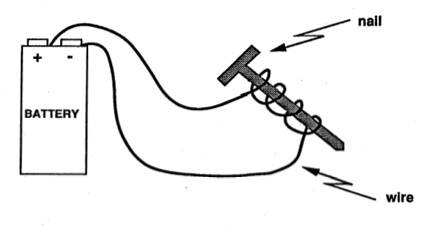
What THREE ways are electromagnets different from permanent magnets?
they can be turned off and on
they can increase in strength by increasing the current in the wire
they are smaller in size
they can change which is the north and south pole
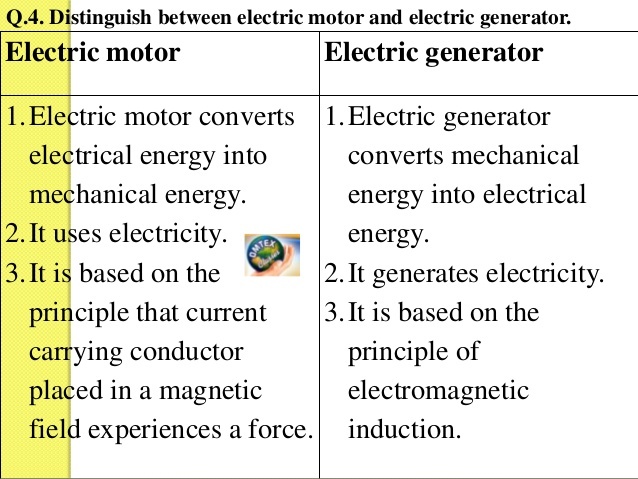
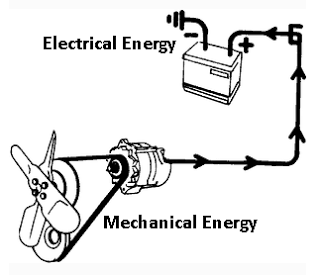
What is the transfer of energy in when you plug in a motor and it spins?
chemical to mechanical
electrical to mechanical
mechanical to electrical
physical to potential

If one of the bulbs in the picture stops working, what will happen?
All of the bulbs will stop working.
The other 2 bulbs will continue to work.
The other bulbs will become brighter.
A device used to open and close a circuit
Button
Switch
Operator
All of the Above
The region in which a magnetic force acts is called a
line of force
pole
magnetic field
field of attractio
An example of a ferromagnetic material is
copper
wood
cheese
nickel
A coiled wire, that carries current is called
an electromagnet
a solenoid
a compass
a ferromagnet
Earth acts like a magnet because its core contains
molton carbon
solid nickel and iron
rocks
molten nickel and iron
Conduction is the transfer of electric charges by
interaction of electric fields
direct contact
rubbing
jumping
An example of static discharge would be
using a compass
an elecromagnet
a lightning bolt
rain

Which position of the two magnets results in the greatest attraction between them?
A
B
C
D
Charging by rubbing is called
friction
induction
conduction
polarization
Current, or the flow of charge through a wire is measured in
volts
amps
Joules
Newtons
This is a measure of electrical resistance
Current
Volt
Ohms
Ampere

Students attached both ends of a long wire to the poles of a battery and wrapped the wire around a spoon. In this arrangement, the spoon is able to pick up five paper clips. The students wrap more wire around the spoon and want to determine if the strength of the magnetic force has increased. Which of the following observations would indicate that wrapping more wire has increased the strength of the electromagnet?
More wire was needed to wrap around the spoon.
The spoon now picks up seven paper clips.
Eventually, the battery runs out of energy.
The ends of the wire must touch the battery's poles.
Students want to investigate how the amount of electric energy delivered to a motor affects its speed. Which of the following procedures will most likely produce the data students need to answer their question?
Measure the rotations per second of a motor when it is connected to one battery, two batteries, and three batteries.
Add larger and larger motors to a battery to determine the size of the largest motor the battery is able to run
Closely observe the rotation of the motor to see if the direction of spin reverses when the poles of the battery are switched
Connect a series of motors to the same battery to figure out how many motors can be run off the same battery.

The illustration shows a hand generator. Turning the handle of the generator spins a magnet and creates an electric current that lights the bulb. Which of the following observations can be used to indicate the strength of the current created by the generator?
The brightness of the bulb
The size of the magnet
The length of the handle
The mass of the generator
What is a current?
A directional flow of electrical charge through an object or medium
Attraction or repulsion that arises between electrically charged particles because of their motion
The size or quantity of something
Attractive or repulsive interactions between any two charged objects
Peter’s teacher tells him that he should not place his electric stereo near the edge of a pool because the water in the pool is a conductor. What does she mean when she says that the water is a conductor?
Water is a type of electrical energy.
Water damages electric circuits.
Electric charges cannot flow without water.
Electric charges move through the water in the pool.
When Bethany walks across a carpet, her socks pick up many negative electric charges. Later in the day, these negative charges are no longer present on her socks. What most likely happened to the negative charges?
The charges disappeared.
The charges transferred to another object.
The charges switched from negative to positive.
The charges broke apart into smaller positive and negative particles.

Current flows from ____potential energy to ____ potential energy.
lower, higher
higher, lower
girl here who
glow her her I
_____ do not allow charge/current to flow.
Coconut Drs
Insulators
Insult oars
Conductors
_____ allow the charge/current to flow.
Coconut Drs
Insulators
Latin sours
Conductors


electrons are transferred as clothes rub against each other in the dryer
a magnet sticking to a metal refrigerator door
a ceiling fan turning on after you flip the wall switch
a dry cell battery lighting up a light bulb

This circuit is...
Series
Parallel
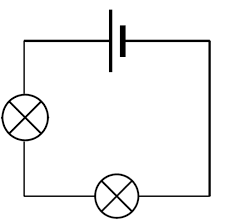
If one of the bulbs in this circuit breaks, the other one will...
Go off
Stay on

