Worksheets
REVIEW: Chemistry (Matter and Reactions)
Total questions: 116
Worksheet time: 2hrs 14mins
The amount of space something takes up.
mass
density
volume
temperature
Anything that has mass and takes up space.
weight
properties
matter
mass
Characteristics used to describe matter.
weight
properties
matter
mass
The amount of matter in something.
weight
properties
matter
mass
The measure of the energy of the particles in matter.
mass
density
volume
temperature
A substance with a definite volume, but no definite shape; this substance takes the shape of its container.
solid
liquid
gas
A substance that does not have a definite shape or volume.
solid
liquid
gas
Mass divided by volume.
mass
density
volume
temperature
A substance with a definite shape and a definite volume.
solid
liquid
gas
The particles are far apart and move very quickly.
solid
liquid
gas
The particles vibrate and are tightly packed together.
solid
liquid
gas
The particles slide by each other, but are still mostly connected.
solid
liquid
gas
slicing bread
chemical change
physical change
baking a pie
chemical change
physical change
evaporating water
chemical change
physical change
melting ice
chemical change
physical change
shredding paper
chemical change
physical change
bicycle rusting
chemical change
physical change
chopping wood
chemical change
physical change
digesting food
chemical change
physical change
rotting strawberries
chemical change
physical change
5 grams of orange drink is mixed with 100 grams of water. What would you expect the new solution to weigh?
95 grams
105 grams
500 grams
What science tool would be used to measure mass?
a scale
a thermometer
a meter stick
water displacement
A description of objects that can be measured and observed.
gas
boiling point
physical properties
melting point
What can causes ice to transform from a solid to a liquid?
Air
Cold Temperature
Shape
Heat
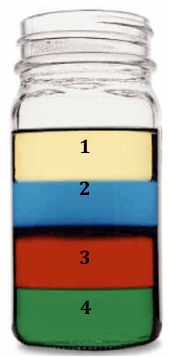

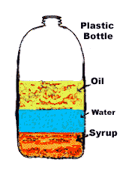
An object that is thrown into water and floats has...
Less density than water
Greater density than water
Delicious flavor
Less mass


Jack has a rock. The rock has a mass of 14g and a volume of 2cm3. What is the density of the rock? (NOTE: D=M/V)
7 mL
7 g/cm3
28 g/cm3
1/7 g/cm3
If an object has a density of .6 g/mL and you put it into water, will it sink or float? (Density of Water = 1.0 g/mL)
sink
float
Frank has an eraser. It has a mass of 4g, and a volume of 2cm3. What is its density? (NOTE: D=M/V)
8 g/cm3
2 g/cm3
1/2 g/cm3
24 g/cm3
During a physical change, matter always retains its
chemical makeup
state
size
shape
In a solid, the molecules
are widely spaced, move quickly (high energy), no definite volume or shape.
are closely spaced, vibrate in place, definite volume and definite shape.
are spread wider apart, in constant contact, medium amount of energy, have a definite volume but no definite shape.
In a gas, the molecules
are widely spaced, move quickly (high energy), no definite volume or shape.
are closely spaced, vibrate in place, definite volume and definite shape.
are spread wider apart, in constant contact, medium amount of energy, have a definite volume but no definite shape.
In order for a solid to melt, or change into a liquid, thermal (heat) energy must ___________.
increase
decrease
stay the same
When heat is added to molecules, the energy of the molecules in a substance
increase
decrease
stay the same
100 mL of castor oil weighs 96.9g. Does castor oil float in water? (Density of water = 1.0 g/mL)
no
it has neutral buoyancy
yes
it dissolves
In a solid, the molecules
are widely spaced, move quickly (high energy), no definite volume or shape.
are closely spaced, vibrate in place, definite volume and definite shape.
are spread wider apart, in constant contact, medium amount of energy, have a definite volume but no definite shape.
In a liquid, the molecules
are widely spaced, move quickly (high energy), no definite volume or shape.
are closely spaced, vibrate in place, definite volume and definite shape.
are spread wider apart, in constant contact, medium amount of energy, have a definitevolume but no definite shape.
In a gas, the molecules
are widely spaced, move quickly (high energy), no definite volume or shape.
are closely spaced, vibrate in place, definite volume and definite shape.
are spread wider apart, in constant contact, medium amount of energy, have a definite volume but no definite shape.
When heat is added to substance, the density of the substance
increases
decreases
stays the same
When energy is added to molecules, the temperature of the molecules in a substance
decreases
increases
stays the same
Volume, density, melting point, boiling point and freezing point are all examples of _______
pure substances
physical properties
matter
chemical properties
The amount of matter an object contains is known as ___________________.
volume
density
mass
atom
Which of the following shows heat being taken away from a substance?
Solid ---> liquid ---> gas
gas ---> liquid ---> solid
mass ---> volume ---> density
During a lab, you are given two substances to identify. They are white cubes of the same shape and size. Which of the following would be the best physical property to use to determine their identities
density
color
shape
taste
If you poured three liquids (that do not mix completely) into a beaker, how could you tell which one is the densest liquid?
a. The liquid that is floating on top is the densest liquid.
b. The liquid that settles to the bottom is the densest liquid
c. The liquid with the deep red color is the densest liquid.
d. There is no way to tell which liquid is densest from the description.
Hailey measured the mass of 1 cup of water and found that it was 150g. She then measured the mass of ¼ of a cup of salt and found that it was 53g. She poured the salt into the water and stirred it until she could no longer see the salt. If Hailey measured the mass of the water again after, what should she find?
97g
150g
203g
53g
Lorena placed a cup with a stick of butter in it on one side of a balance and a melted stick of butter of the same size on the other side of the balance. Which picture correctly shows what the balance would look like?


Athena mixed yeast, sugar, and water in a bowl and observed a bubbly foam begin to spill over the bowl. Describe the type of change that occurred and what evidence you have to support that claim.
A physical change occurred because bubbles form.
A chemical change occurred because the substance stayed the same.
A physical change occurred because a new substance was not created
A chemical reaction occurred because foam formed which indicates the creation of a gas when there was not a gas to begin with.




What is physical change?
How two chemicals react with one another when combined
A property that we can measure or observe with our 5 senses or other tools
When two chemicals react with one another to form a new substance
When a change occurs but it does not result in the formation of a new substance
What is chemical change?
How two chemicals react with one another when combined
A property that we can measure or observe with our 5 senses or other tools
When two chemicals react with one another to form a new substance
When a change occurs but it does not result in the formation of a new substance
When you increase the energy by heating a liquid what happens to the motion of the molecules
They slow down
They speed up
Heat doesnt change the motion of the molecules
Which of the following is an indication of chemical change
Melting
Freezing
Burning
Evaporating
Thermal energy (heat) is released or absorbed during the reaction explains the _________________
Change in color
Change in temperature
Change in gas

Which of the following examples represents a physical change?


Which of the following is evidence of a physical change?
New substance
Shape Change
Light produced
Gas released.
A teacher is demonstrating physical and chemical changes to her class. Which action should they use to demonstrate a chemical change?
Cutting a piece of paper with scissors.
Folding a piece of paper into an airplane.
Ripping a piece of paper with their hands.
Burning a piece of paper with a match.

Properties that describe how a substance looks, feels, or its state of matter, etc. are __________________.
Chemical properties
Physical properties


Why does the image best represent an example of a physical change?
The pencil can no longer be used.
The pencil is a different size.
The materials making up the pencil did not change.
The materials making up the pencil are different.