
 Worksheets
Year In review Math to use
Total questions: 117
Worksheet time: 2hrs 34mins
Name
Class
Date
1.
Particles in an atom that are neutral and have no charge are
a)
negatrons
b)
electrons
c)
neutrons
d)
protons
2.
all matter is made of what
a)
energy
b)
atoms
c)
electrons
d)
compounds
3.
If an atom has 3 electrons, how many protons does it have?
a)
1
b)
2
c)
4
d)
3
4.
What is the atomic number?
a)
the number of protons
b)
the number of protons and neutrons
c)
the number of neutrons
d)
the number of protons and electrons
5.
What is the mass number?
a)
the number of protons
b)
the number of protons and neutrons
c)
the number of neutrons
d)
the number of protons and electrons
6.
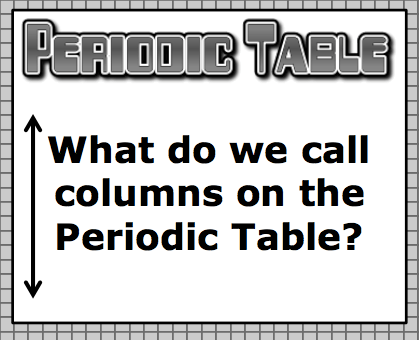
a)
Periods
b)
Groups
7.
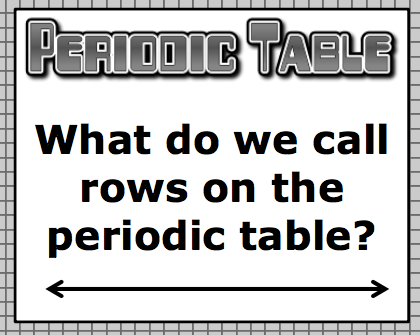
a)
Periods
b)
Groups
8.

a)
energy levels
b)
valence electrons
c)
protons
d)
neutrons
9.
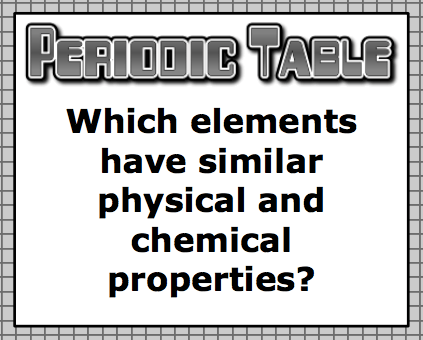
a)
Same group
b)
Same period
10.
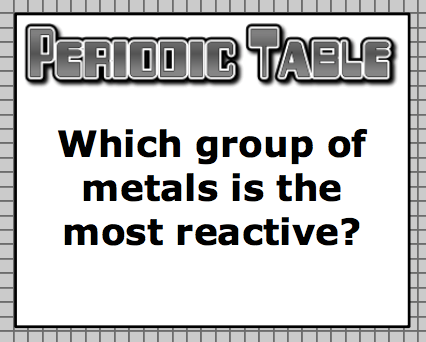
a)
Group 1
b)
Group 17
c)
Group 18
d)
Group 2
11.
How many elements are in C6H12O6?
a)
1
b)
2
c)
3
d)
4
12.
Element or compound?
H2O
H2O
a)
element
b)
compound
13.
How many atoms of carbon (C) are in C6H12O6?
a)
3
b)
6
c)
12
d)
24
14.
The substances listed on the right side of a chemical equation are the
a)
Yields
b)
Reactants
c)
Products
d)
Precipitates
15.
In chemical reactions, what does the principle of conservation of mass mean?
a)
Matter is not created or destroyed.
b)
The total mass of the reactants is greater than the total mass of the products.
c)
The total mass of the reactants is less than the total mass of the products.
d)
Matter is not changed.
16.
How many molecules of Carbon are in the following formula? 3C2H6
a)
3
b)
6
c)
12
d)
18
17.
What is speed?
a)
how far you go
b)
how much distance is covered over a period of time
c)
how fast you accelerate
d)
the change in the location of a object
18.
A runner races in the 100 meter dash. It takes her 10 seconds to finish. What is her average speed?
a)
10 m/s
b)
1000 m/s
c)
100 seconds
d)
10 seconds
19.

What is the person doing from 5 seconds to 10 seconds?
a)
Walking
b)
Running
c)
Standing Still
d)
Walking Fast
20.

A wheeled cart is moving to the right at a constant speed. Two forces of equal magnitude are acting upon the cart. Which of the following best describes the forces and motion of the cart?
a)
Balanced Forces, Constant Speed
b)
Balanced Forces, Acceleration
c)
Unbalanced Forces, Constant Speed
d)
Unbalanced Forces, Acceleration
21.

What is the net force?
a)
30 N left
b)
25 N right
c)
5 N left
d)
55 N right
22.
Which could be an example of an unbalanced force?
a)
A plate sitting on a dining table
b)
A ball at the top of a hill that is not moving
c)
Earth orbiting the Sun
d)
A baseball that has been thrown to home plate.
23.

Calculate the Net Force.
a)
40N, Left
b)
40N, Right
c)
0N, Balanced
d)
75N, Right
24.

A magician pulls a tablecloth out from under dishes and glasses on a table without disturbing them.
a)
Newton's 1st Law
b)
Newton's 2nd Law
c)
Newton's 3rd Law
25.

Rockets are launched into space using jet propulsion where exhaust accelerates out from the rocket and the rocket accelerates in an opposite direction.
a)
The Law of Inertia
b)
The Law of Acceleration
c)
The Law of Conservation of Momentum
26.

I crack an egg on the edge of a bowl. The force applied to the egg is the same as the force applied to the bowl.
a)
Law of Inertia
b)
Law of Acceleration
c)
Law of Conservation of Momentum
27.

Pushing a child on a swing is easier than pushing an adult on the same swing, because the adult has more mass and requires more force to accelerate.
a)
Newton's 1st Law
b)
Newton's 2nd Law
c)
Newton's 3rd Law
28.

This person bought coffee and put it on the seat next to them. If they stopped quickly and the coffee spilled which law would that represent?
a)
Newton's 1st Law
b)
Newton's 2nd Law
c)
Newton's 3rd Law
29.

When you step on a Lego. You push on the Lego and the Lego pushes back on you.
a)
Newton's 1st Law
b)
Newton's 2nd Law
c)
Newton's 3rd Law
30.

What Moon phase is this?
a)
Old Moon
b)
Far Side of the Moon
c)
New Moon
d)
Waxing Gibbous
31.

What Moon phase is this?
a)
Waning Crescent
b)
Waxing Crescent
c)
Waxing Gibbous
d)
Waning Gibbous
32.

What Moon phase is this?
a)
Full Moon
b)
Waxing Gibbous
c)
New Moon
d)
Half Moon
33.

What Moon phase is this?
a)
Waxing Crescent
b)
Waning Gibbous
c)
Waning Crescent
d)
Waxing Gibbous
34.

The line up for a solar eclipse is:
a)
Sun-Earth-Moon
b)
Earth-Sun-Moon
c)
Sun-Moon-Earth
d)
Earth-Moon-Mars
35.
A[n] ______________ tide occurs when the sun is at right angles to the line between Earth and the moon.
a)
high
b)
neap
c)
low
d)
spring
36.
A[n] ___________ tide occurs when the sun, Earth, and the moon are nearly in a line.
a)
spring
b)
high
c)
low
d)
neap
37.
The bulge of water on the side of the Earth closest to the moon produces ___________.
a)
high tide
b)
low tide
c)
neap tide
d)
spring tide
38.
A large celestial body that is composed of gas and that emits light.
a)
star
b)
black hole
c)
element
d)
big bang
39.
A large cloud of gas and dust in interstellar space; a region in Space where stars are born.
a)
Protostar
b)
Nebula
c)
Galaxy
d)
Star
40.
A small, hot, dim star that is the leftover center of an old sunlike star
a)
Red Dwarf
b)
White Dwarf
c)
Main Sequence
d)
Giant
41.
Which of the following is the largest?
a)
star
b)
universe
c)
cluster
d)
galaxy
42.

In the diagram given, what happens as we move to the left?
a)
Stars Get Larger
b)
Stars get Colder
c)
Stars get hotter
43.

Which star is the coldest?
a)
Yellow Star
b)
Red Star
c)
Orange Star
d)
Blue Star
44.
A wave with a large wavelength will have a ______ frequency and _____ energy
a)
high, low
b)
high, high
c)
low, high
d)
low, low
45.
Select the correct order of waves on the EMS
a)
Radio, Micro, Infra, Visible, Ultra, X-ray, Gamma
b)
Gamma, X-ray, Ultra, Vis, Infra, Micro, Radio
c)
Vis, Micro, Infra, Ultra, X-ray, Gamma, Radio
d)
Micro, Radio, Vis, Infra, Ultra, X-ray, Gamma
46.
Which has the LONGEST wavelength and, therefore, the lowest frequency/energy
a)
Gamma Rays
b)
Radio Waves
c)
Visible Light
d)
Infrared rays
47.
The type of plate boundary where two plates come together is a .....
a)
Convergent Boundary
b)
Divergent Boundary
c)
Transform Boundary
d)
Plate Boundary
48.

What type of event will occur at this boundary?
a)
Earthquake
b)
Volcano Eruption
c)
Tornado
d)
Mountain Building
49.
A divergent boundary occurs when plates ....
a)
Pull apart
b)
Come together
c)
Slide past each other
d)
subducting
50.
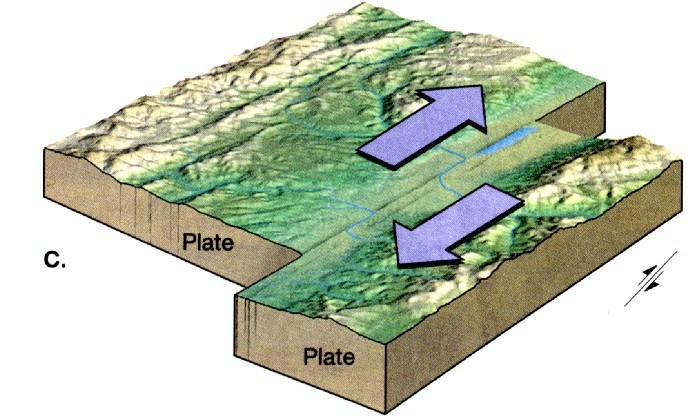
What type of plate boundary is this?
a)
Transform
b)
Convergent
c)
Divergent
d)
Plate
51.
The theory that says Earth's continents once made up an ancient supercontinent, and have been drifting apart ever since, is called the theory of...
a)
Pangea
b)
Plate Tectonics
c)
Natural Selection
d)
Gravity
52.

What is the elevation of point B?
a)
800 ft
b)
850 ft
c)
900 ft
d)
1000 ft
53.

In which direction is Mill River flowing?
a)
Southeast
b)
Southwest
c)
Northeast
d)
Northwest
54.

What is the elevation of A?
a)
10 meters
b)
20 meters
c)
40 meters
d)
120 meters
55.
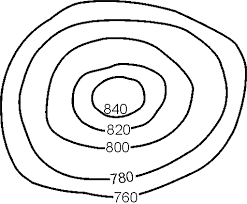
Determine the contour interval:
a)
5 m
b)
10 m
c)
15 m
d)
20 m
56.
What do contour lines that are farther apart represent?
a)
waterfall
b)
steep area
c)
gentle slope
d)
river
57.
Maps that show shape and elevation of the Earth's surface
a)
physical map
b)
topographic map
c)
road map
d)
historical map
58.
Which one heats and cools fastest?
a)
land
b)
sea
c)
both are the same rate
d)
air
59.
The cycle that powers the ocean currents, weather, and tectonic plates it called
a)
conduction current
b)
radiation
c)
condition current
d)
convection current
60.
The transmission of energy by two objects touching is called
a)
conduction
b)
convection
c)
contraction
d)
radiation
61.
The main reason that we have currents in the ocean and air is
a)
the sun heats the air and ocean evenly everywhere
b)
the heat inside the earth heats the ocean and the ocean heats the air
c)
the sun cannot heat both the air and water, so one must heat the other
d)
the sun heats air and water more at the equator because it receives more direct sunlight
62.
Energy for convection on the Earth comes from...
a)
The sun
b)
The moon
c)
Solar winds
d)
The ocean
63.
In convection, COOL air
a)
Rises
b)
Sinks
64.
In convection, WARM air
a)
Rises
b)
Sinks
65.
The Earth's axis is tilted _____ degrees.
a)
23.5
b)
25.3
c)
30.2
d)
24
66.

What happens when the area in which you live tilts away from the sun?
a)
It is summer.
b)
It is spring.
c)
It is winter.
d)
It is fall.
67.
The term equinox means....
a)
equal amount of day light and equal amount of night
b)
Equal amount of winter and summer
c)
Equal amounts of hot dogs for everyone
d)
The longest day of the year
68.
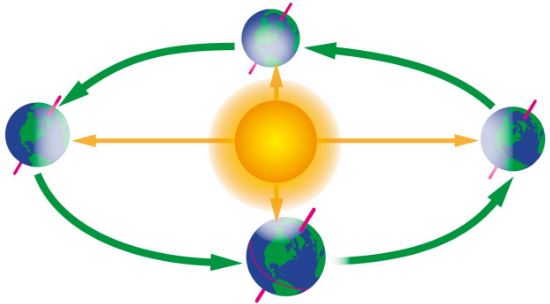
In spring/summer, the axis of the earth is pointed away or toward the sun?
a)
towards
b)
Neither away or toward
c)
away
69.

Which season is taking place in the Southern Hemisphere in Position 1?
a)
Winter
b)
Spring
c)
Summer
d)
Fall
70.
Located at the leading edge of a temperature drop off. Bring heavy thunderstorms, rain, and hail. Cool, fair weather is likely to follow.
a)
Warm Front
b)
Cold Front
c)
Occluded Front
d)
Stationary Front
71.
Located at the leading edge of a warm air mass. Brings gentle rain or light snow, followed by warmer, milder weather.
a)
Warm Front
b)
Cold Front
c)
Occluded Front
d)
Stationary Front
72.

This is the symbol for a...
a)
Cold Front
b)
Warm Front
c)
Stationary Front
d)
Occluded Front
73.

This is the symbol for a...
a)
Occluded Front
b)
Stationary Front
c)
Warm Front
d)
Cold Front
74.

Identify the type of front that is shown in the image.
a)
Occluded Front
b)
Cold Front
c)
Stationary Front
d)
Warm Front
75.

Which best describes what a food chain shows you?
a)
Energy flow through an ecosystem
b)
Food flowing through an ecosystem
c)
Consumers going into other consumers
d)
Who eats who
76.

What are the organisms that break down dead stuff?
a)
Producers
b)
Consumers
c)
Decomposers
d)
Organisms
77.

Which is the correct food chain order?
a)
Plant-->1st Consumer--> 2nd Consumer
b)
Plant <-- 1st Consumer <-- 2nd Consumer
c)
2nd consumer --> 1st consumer --> Plant
d)
1st Consumer --> 2nd consumer --> Plant
78.

Which of the following organisms is a herbivore.
a)
butterfly
b)
snake
c)
fox
d)
ladybird
79.

Which of the following organisms is a carnivore.
a)
greenfly
b)
titmouse
c)
mouse
d)
buzzard
80.

How many carnivores are shown in this food web?
a)
6
b)
4
c)
5
d)
3
81.

Which of the following would be the most likely effect, if there were a sudden increase in the cricket population?
a)
There would be a decrease in the small bird population.
b)
There would be a decrease in the grass/flowers population.
c)
There would be a decrease in the mice population.
d)
There would be an increase in the grass/flowers population.
82.
An organism that hunts and feeds on another organism is a ______________________.
a)
prey
b)
producer
c)
predator
d)
decomposer
83.
An animal that is hunted as food
a)
prey
b)
predator
c)
decomposer
d)
producer
84.

Coloring or another physical characteristic that help an organism blend in with its environment
a)
mimicry
b)
camouflage
c)
hibernation
d)
migration
85.

The role an organism plays in its ecosystem
a)
niche
b)
behavior
c)
structure
d)
function
86.

What is the difference between biotic and abiotic?
a)
Biotic are non-living things
b)
Abiotic are living organisms
c)
Biotic is life,
Abiotic is non-living
Abiotic is non-living
d)
Biotic is non-living, Abiotic is living
87.

What does biodiversity mean?
a)
Only one species in an area.
b)
The different amount of species in an area
c)
All abiotic life
d)
Nitrogen fixation
88.
What is a watershed?
a)
Land that collects and channels water froma small body of water to a larger body of water
b)
the shape of the land determined by elevation
c)
A natural stream of water of considerable volume
d)
a river and all its tributaries
89.
The use of pesticides and fertilizers must be carefully monitored
because of the effect they can have on the environment.
Which of the following is a possible negative effect of the use
of these chemicals on the environment?
because of the effect they can have on the environment.
Which of the following is a possible negative effect of the use
of these chemicals on the environment?
a)
Runoff carries these chemicals into lakes and streams.
b)
Theses chemicals cannot be purchased in large bulk.
c)
These chemicals are expensive to produce.
These chemicals are expensive to produce.
d)
Storage space for these chemicals is limited.
90.
Groundwater flow takes place through layers called___________
a)
aquicludes
b)
the zone of saturation
c)
aquifers
d)
saturated materials
91.
Which best explains why runoff is important?
a)
It returns water to other locations on Earth
b)
It increases the chance of flooding
c)
It makes evaporation occur faster
d)
It increases condensation
92.

Which order correctly completes the water cycle shown in the image?
a)
precipitation, evaporation, absorption
b)
evaporation, absorption, precipitation
c)
evaporation, precipitation, absorption
d)
precipitation, absorption, evaporation
93.
What is the power behind the water cycle?
a)
gravity
b)
the Sun
c)
evaporation
d)
condensation
94.
This system carries food, gases and wastes throughout the body
a)
circulatory system
b)
respiratory system
c)
nervous system
95.
This system allows the body to take in oxygen and excrete, or get rid of waste gases.
a)
Nervous System
b)
Muscular System
c)
Respiratory System
96.
This system protects the body's organs, provides support for the body.
a)
Nervous System
b)
Skeletal System
c)
Respiratory System
97.
This system is made up of stretchy tissue called muscles.
a)
Nervous System
b)
Skeletal System
c)
Muscular System
98.
This system is responsible for getting food into the body, getting solid waste out of the body, and breaking food down into usable parts.
a)
Nervous System
b)
Digestive System
c)
Muscular System
99.
Which system detects information from the environment and directs the way your body responds to this information?
a)
excretory
b)
circulatory
c)
respiratory
d)
nervous
100.
Which system fights disease?
a)
excretory
b)
nervous
c)
immune
d)
digestive
101.
Which system includes the kidneys, ureters, urinary bladder, urethra, lungs and skin?
a)
digestive
b)
excretory
c)
circulatory
d)
muscular
102.
Which of the following is the smallest unit of life that can carry out all life functions?
a)
the mitochondria
b)
the vacuoles
c)
the nucleus
d)
the cell
103.
Which structures are found in every living cell?
a)
cell membrane and cytoplasm
b)
chloroplasts and mitochondria
c)
a cell wall and nucleus
d)
chloroplasts and cell wall
104.
What is one basic function of the vacuoles?
a)
circulating oxygen
b)
producing food
c)
controlling cell processes
d)
storing water
105.
Chloroplasts in plant cells allow the plant to perform a function that animal cells cannot do. What is the main function of the chloroplasts found in plant cells?
a)
to absorb light energy and manufacture food
b)
to remove waste materials by active transport
c)
to manufacture chemical energy from food
d)
to control the shape of the cell
106.
All cells need energy to function. Which cell organelle is responsible for producing energy in the cell?
a)
chloroplasts
b)
mitochondria
c)
nucleus
d)
vacuoles
107.
Cells with a nucleus and membrane-bound organelles are called ____________________.
a)
prokaryotes
b)
eukaryotes
c)
bacteria
d)
protists
108.
Which of the following is not part of the cell theory?
a)
cells must contain DNA
b)
all living things are made from cells
c)
cells can only come from other cells
d)
cells are the basic unit of life
109.
A homozygous dominant dog with brown fur is crossed with a heterozygous dog with brown fur. What are the percentages of the possible genotypes?
a)
100% BB
b)
75% BB and 25%Bb
c)
50 % BB and 50% Bb
d)
50% Bb and 50% bb
110.
Which of the following is a phenotype?
a)
BB
b)
Bb
c)
bb
d)
Blue eyes
111.
the passing of genetic traits from parent to offspring.
a)
heredity
b)
trait
c)
gene
d)
allele
112.
having two of the same genes for the trait (sometimes called purebred).
a)
homozygous
b)
hetrozygous
c)
protein
d)
chromosome
113.
One form of a gene is called_______________
a)
a DNA
b)
a Phenotype
c)
a trait
d)
an allele
114.
Where, in the eukaryotic cell, is DNA located?
a)
ribosomes
b)
nucleus
c)
E.R.
d)
cytoplasm
115.

what did Charles Darwin observe in finch populations of the Galapagos Islands off the coast of South America?
a)
different species on different islands
b)
all species on one of the islands
c)
identical species on all the islands
d)
the same species as North America
116.
Which statement best describes the process of evolution?
a)
Populations can survive in different locations on earth
b)
Environmental conditions limit the number of species on Earth
c)
Populations grow when resources are abundant
d)
The traits of a species can change over time
117.
Natural selection can also be referred to as:
a)
Survival of the weakest
b)
Survival
c)
Survival of the fittest
d)
Artificial selection
100 %

