wayground logo

Free Printable Worksheets

Font size

S
M
L
XL
Worksheets

Final Exam Review

Total questions: 115

Worksheet time: 2hrs 20mins

Name
Class
Date
1.
A mineral is a living object
a)
True
b)
False
2.
All rocks contain at least one mineral.
a)
True
b)
False
3.
Which mineral is ranked highest on the Mohs scale? 
a)
Talc
b)
Calcite
c)
Quartz
d)
Diamond
4.
What do all rocks have in common?
a)
same size
b)
same color
c)
contain minerals
d)
same shape
5.
Minerals have different properties to help scientists identify them.  Which is NOT a property used to identify minerals?
a)
color
b)
hardness
c)
size
d)
luster
6.
The property of luster means..
a)
the hardness of a mineral
b)
the color of the mineral
c)
the streak the mineral leaves
d)
how the mineral reflects light
7.
What mineral is the softest?
a)
quartz (7)
b)
mica (2)
c)
feldspar (6)
d)
talc (1)
8.

What is the purpose of the scratch test?

a)

to find if the rock contained calcite

b)

to find the hardness of the mineral

c)

to find the color

9.
Using the Mohs Hardness Scale (click the text to see the Scale), name two minerals harder than Fluorite.
a)
Talc and Calcite
b)
Gypsum and Quartz
c)
Quartz and Feldspar
d)
Diamond and Talc
10.
A mineral that registers a "1" on the Mohs scale would be very...
a)
hard.
b)
soft.
11.
A mineral that registers a "10" on the Mohs scale would be very...
a)
hard.
b)
soft.
12.
Luster is a property that helps identify minerals. What tool would be helpful to determine if a mineral has luster?
a)
Nail
b)
Flashlight
c)
Penny
d)
Ceramic Tile
13.
This rock is formed from lava and you would most likely find it near a volcano.
a)
Sedimentary Rock
b)
Metamorphic Rock
c)
Igneous Rock
14.
This rock is changed by heat and pressure.  It is formed in layers.
a)
Sedimentary Rock
b)
Metamorphic Rock
c)
Igneous Rock
15.
What is the difference between a rock and a mineral?
a)
A rock is an inconsistent mixture of minerals, while a mineral is "pure" and made up of a precise combination of chemicals.
b)
A mineral is an inconsistent mixture of minerals, while a rock is "pure" and made up of a precise combination of chemicals.
c)
A rock is harder than all minerals.
d)
Minerals contain fossils while rocks do not.
16.
You can identify a mineral by only one property.
a)
true
b)
false
17.

1. Rock sediments that travel down a mountain, sand being blown across the beach, and mud sliding down a hill are all examples of

a)

pressing and cementing

b)

erosion

c)

part of the rock cycle

d)

fossil formation

18.
What property of rock is being observed when looking for what color is left after scratching it on a ceramic plate?
a)
hardness
b)
color
c)
cleavage
d)
streak
19.

Hot, molten rock inside the earth is called ...

a)

lava

b)

magma

c)

igneous rock

d)

minerals

20.

Once magma reaches the earth's surface, it is called __________.

a)

a vent

b)

minerals

c)

igneous rocks

d)

lava

21.

Rocks that are buried deep in the earth can be changed into an entirely new rock when it goes through what?

a)

weathering and erosion

b)

pressing and cementing

c)

heat and pressure

d)

cooling and hardening

22.
An igneous rock containing large crystals is most likely a(n)
a)
Chemical Rock
b)
Foliated Rock
c)
Extrusive Rock
d)
Intrusive Rock
23.
As lava cools and crystallizes, what type of rock will form?
a)
Sedimentary
b)
Metamorphic
c)
Extrusive Igneous
d)
Intrusive Igneous
24.
The three groups of rocks are classified by
a)
How they form
b)
Color
c)
Grain size
d)
Chemical Composition
25.

Which is the process that breaks up rock on Earth’s surface?

a)

deposition

b)

melting

c)

compaction

d)

weathering

26.

Geologists have classified rocks into three major groups of rocks which are:

a)

inorganic, organic and chemical rocks

b)

igneous, sedimentary and metamorphic rocks

c)

metamorphic, chemical and non chemical rocks

d)

sedimentary, inorganic and igneous rocks

27.

A rock that forms from many small fragments of other rocks is a(n)

a)

igneous rock

b)

metamorphic rock

c)

sedimentary rock

d)

extrusive rock

28.

The process by which metamorphic rock changes to igneous rock begins with

a)

melting

b)

erosion

c)

deposition

d)

crystallization

29.

A naturally occurring solid that can form by inorganic processes and that has a crystal structure and a definite chemical composition.

a)

It´s a rock

b)

It´s a crystal

c)

It´s a mineral

d)

It´s a substance

30.

To be classified as a mineral, a substance must satisfy this

requirement

a)

have a definite chemical composition

b)

naturally occurring

c)

be a solid

d)

all the above

31.
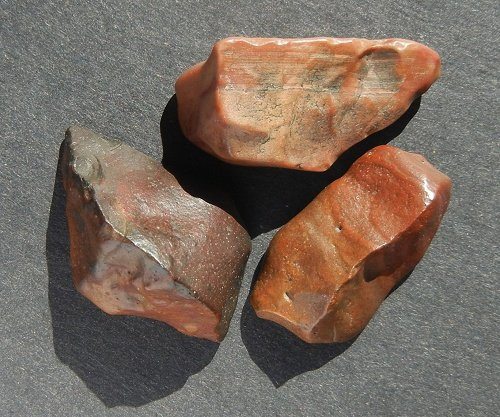
This rock was another type of rock that was heated and compressed over time. What type of rock is this?
a)
Sedimentary
b)
Igneous
c)
Metamorphic
32.
This rock started as molten magma. What type of rock is this?
a)
Sedimentary
b)
Igneous
c)
Metamorphic
33.
This rock was formed by smaller pieces of rock that settled at the bottom of a lake millions of years ago. What type of rock is this?
a)
Sedimentary
b)
Igneous
c)
Metamorphic
34.
Why are trees a natural resource?
a)
The leaves are green
b)
We use them to make paper, lumber, and other products.
c)
They are beautiful
d)
They grow back after they are cut down.
35.
All of the following are nonrenewable resources EXCEPT
a)
Coal
b)
animals
c)
petroleum (oil)
d)
natural gas
36.
Which of the following means of transportation uses a renewable resource for its energy source?
a)
solar powered car
b)
coal powered steam train
c)
natural gas car
d)
gasoline truck
37.
A farmer decides that he is going to produce his own energy on the farm by using a type of renewable energy. The renewable energy could come from--
a)
setting up wind turbines
b)
having a coal furnace
c)
using natural gas
d)
burning oil
38.
Which of the following is a way a person could conserve natural resources?
a)
recycling waste materials like plastic, glass, paper, and aluminum
b)
limiting water use when showering, brushing teeth, and shaving
c)
using rechargeable batteries
d)
all of the above are good conservation practices
39.
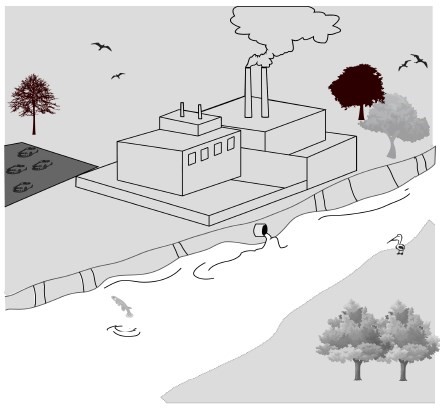
If the factory in this diagram was NOT practicing good environmental conservation, what effect would be produced?
a)
air and water pollution
b)
good fishing for recreation
c)
plentiful animals in the river
d)
purified drinking water
40.
A way the factory could help conserve the river water as a natural resource is to--
a)
filter the water before dumping into the river
b)
remove all of the animals from the area for their protection
c)
set up nets down river to remove contaminated fish
d)
post signs of "No swimming in the river"
41.
Which of the following natural resources are nonrenewable?
a)
Water
b)
Animals
c)
Natural gas
d)
Wind
42.
What does conserving resources mean?
a)
Use as much of the resources as you can
b)
Only use the resources at school
c)
Protecting the resource so it does not run out
43.
Any useful material that is found in nature:
a)
Natural Resource
b)
Human Resource
c)
Plants
44.
The Jones family cares about the environment. They run their dishwasher only when it is completely full. Which of the following BEST explains why they do this?
a)
To save money
b)
To recycle dish soap
c)
To reduce sewage
d)
To conserve water
45.
These are all examples of...
a)
renewable resources
b)
nonrenewable resources
c)
fossil fuels
d)
alternative energy
46.
This type of renewable energy converts the power of the wind to electricity.
a)
steam engines
b)
solar power
c)
wind turbines
d)
nuclear power
47.
Fossil fuels are all examples of...
a)
renewable energy
b)
nonrenewable energy
c)
clean energy
d)
solar energy
48.
Energy sources that are not easily replenished are called...
a)
renewable resources
b)
nonrenewable resources
49.
True or False:
Most of the energy used comes from renewable resources.
a)
True
b)
False
50.
Hydroelectric plants perform which type of energy conversion?
a)
Water to Electricity
b)
Electricity to Water
c)
Wind to Electricity
d)
Wind to Chemical
51.
Which of the following natural resources are nonrenewable?
a)
Water
b)
Animals
c)
Natural gas
d)
Wind
52.
Fossil fuels are nonrenewable because...
a)
they are used to produce heat
b)
they take a long time to form
c)
they can be found underground
53.
Which of the following is NOT a Natural Resource?
a)
Oil
b)
Natural Gas
c)
Plastic
d)
Water
54.
Renewable resources 
a)
can be replenished.
b)
cannot be replenished.
c)
are limited.
d)
are fossil fuels.
55.

Which of the following natural resources are nonrenewable?

a)

Water

b)

Animals

c)

Nuclear

d)

Wind

56.

Atlanta often has smog warnings during the summer. The city cautions citizens against being outside too long when smog levels are high. How can the city of Atlanta reduce smog levels?

a)

by increasing the use of fossil fuels

b)

by decreasing the use of solar power

c)

by decreasing the number of individual cars and increasing the number of buses

d)

by increasing the number of individual cars and decreasing the number of buses

57.
What is the greenhouse effect?
a)
warming of the earth due to gases in our atmosphere.
b)
cooling of the earth due to gases in our atmosphere
58.
Why is the increase of Greenhouse gasses a big issue?
a)
It causes climate change and increase in the global temerature 
b)
It can lead to a major increase in Greenhouses 
c)
It leads to more factories
d)
It causes a major decrease in people
59.
The gradual increase in the temperature of the atmosphere is known as ________________.
a)
Greenhouse Effect
b)
Global Warming
c)
Carbon Dioxide Gases
d)
Methane
60.
How can global warming cause sea levels to rise? Choose the best answer.
a)
by causing it to rain more often
b)
by melting glaciers and ice caps
c)
by increasing the number of undersea volcanic eruptions
d)
by creating bigger and more powerful hurricanes
61.
Why does cutting down trees increase global warming?
a)
trees soak up carbon dioxide
b)
trees provide shade which counteracts global warming
c)
trees absorbs the sun's energy without radiating back into the atmosphere
d)
trees drain greenhouse gases like methane from soil
62.
Burning fossil fuels is one of the main causes for global warming.
a)
True
b)
False
63.
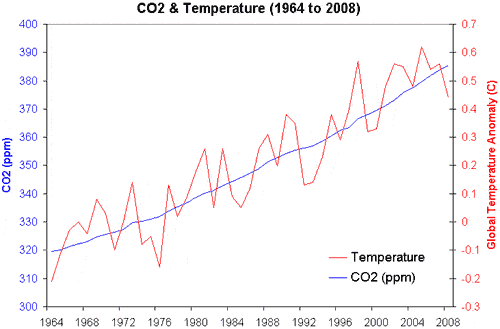
The graph below shows CO2 emissions and temperatures from 1909 to 1949.  What conclusion is best supported by the graph?
a)
There is no relationship between carbon dioxide concentrations and temperatures
b)
As carbon dioxide concentrations increase, temperatures increase
c)
As carbon dioxide concentrations increase, temperatures decrease
d)
As carbon dioxide concentrations decrease, temperatures increase
64.
How does freezing water cause the weathering of rocks?  The freezing water—
a)
keeps the rocks in place
b)
makes the rocks last longer
c)
expands cracks and breaks rocks
d)
causes rocks to fall in landslides
65.
The process that breaks down rocks and other materials on Earth's surface is called
a)
weathering
b)
erosion
c)
soil conservation
d)
decomposition
66.
What is mechanical weathering?
a)
Process through which rocks are physically broken into smaller pieces.
b)
Rocks are broken down through chemical changes.
c)
Rocks are worn away from acid in plant roots.
d)
Rocks broken down by machinery.
67.
Which type of climate will have faster chemical weathering?
a)
Hot and Wet
b)
Cold and Dry
c)
Hot and Cold
d)
Cold and Wet
68.
Rain washing away soil from a hillside
a)
Weathering
b)
Erosion
c)
Deposition
69.
Caves being formed by acid rain dissolving underground limestone
a)
Weathering
b)
Erosion
c)
Deposition
70.
Deltas forming at the mouths of rivers
a)
Weathering
b)
Erosion
c)
Deposition
71.
Wind blowing sand from one location to another
a)
Weathering
b)
Erosion
c)
Deposition
72.
All of the following are causes of physical weathering except...
a)
plant growth
b)
wind
c)
acid rain
d)
running water
73.
Rocks being made smooth by tumbling across a streambed
a)
Weathering
b)
Erosion
c)
Deposition
74.
Plants prevent soil erosion by-
a)
holding dirt in place with their roots
b)
providing food for herbivores
c)
the process of photosynthesis
d)
releasing water into the atmosphere through transpiration
75.
Which of the following is NOT one of the three layers of soil?
a)
topsoil
b)
undersoil
c)
subsoil
d)
bedrock
76.
Humus is.....
a)
the dead parts of plants and animals in soil.
b)
A food we eat with pretzels.
c)
The tiny particles inside of soil
d)
The roots that come off of a plant and live in soil.
77.
What is soil a mixture of?
a)
dirt and leaves
b)
rocks and water
c)
air and food
d)
rock particles, minerals,decayed organic material, air and water
78.

How are weathering and erosion different?

a)

Weathering breaks rocks and erosion moves them somewhere else

b)

Erosion breaks rocks and weathering moves them somewhere else

c)

Weathering and Erosion are the same thing

79.

What landforms can be created by river erosion and deposition?

a)

Sea stacks and sand dunes

b)

Canyons and deltas

c)

Arches and beaches

d)

Lakes and Moraines

80.

Which of these landforms is NOT created by ocean wave erosion?

a)

Beaches

b)

Barrier Islands

c)

Sea stacks

d)

Valleys

81.

Which of these is NOT an example of chemical weathering?

a)

CO2 in water dissolves rock

b)

Oxygen causes rocks to rust

c)

Water freezes in cracks in rocks

d)

Acid rain damages stone statues

82.

Which layer of soil is made of solid rock?

a)

Topsoil

b)

Subsoil

c)

Parent Material

d)

Bedrock

83.

Which layer of soil has the MOST humus?

a)

Topsoil

b)

Subsoil

c)

Parent Material

d)

Bedrock

84.

Which layer of soil has only a little bit of humus?

a)

topsoil

b)

subsoil

c)

bedrock

85.

Humus is made up of

a)

organic matter

b)

minerals

c)

water

d)

rock

86.

In which layer of soil do plant roots grow?

a)

humus

b)

topsoil

c)

subsoil

d)

bedrock

87.
This type of weathering occurs when rock is physically broken down into smaller pieces of rock.
a)
mechanical weathering
b)
chemical weathering
c)
erosion weathering
d)
deposition
88.
This type of weathering occurs when rocks weaken then break down due to chemical changes in the composition of the rock.
a)
mechanical weathering
b)
chemical weathering
c)
erosion weathering
d)
deposition
89.
These rocks were made smooth by wind blowing smaller rock particles across their surface.  This is an example of:
a)
ice wedging
b)
chemical weathering
c)
acid rain
d)
abrasion
90.
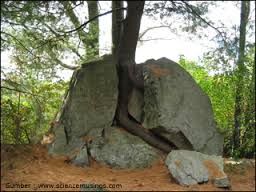
These rocks were broken apart from the continuous freeze/thaw of water in the cracks of the rocks. This is an example of:
a)
ice wedging
b)
acid rain
c)
permeability
d)
abrasion
91.
How do plants weather rocks?
a)
During photosynthesis
b)
When roots grow into cracks of rocks and expand the rock breaks.
c)
When the plant moves water from the roots to the leaves, the rock breaks.
d)
Plants don't weather rocks.
92.
Deposited material at the end of a river is called?
a)
landform
b)
delta
c)
canyon
93.

What is the force that moves the continents?

a)

Human Activity

b)

Convection Currents

c)

Conveyor Belts

d)

Scrat the Squirrel from Ice Age

94.
What type of plate is thicker?
a)
continental 
b)
oceanic
95.

Where does the heat come from that creates convection currents in the mantle?

a)

Earth's core

b)

Earth's weather

c)

Earth's magnetic field

d)

The Sun

96.

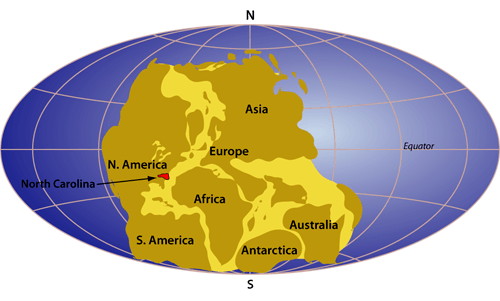
What is this a picture of?

a)

plate tectonics

b)

continental drift

c)

pangaea

d)

glacier scaring

97.

What does the theory of continental drift state?

a)

The continents were once joined in a super-continent and have moved over time

b)

The continents were made of many small plates that have clumped together over time

c)

The continents are solid rock and do not move

d)

The continents move rapidly due to human activity

98.

Which layer of the earth is the THICKEST?

a)

Crust

b)

Mantle

c)

Outer Core

d)

Inner Core

99.

Which layer of the Earth has CONVECTION CURRENTS?

a)

Crust

b)

Mantle

c)

Outer Core

d)

Inner Core

100.
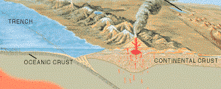
What type of event will occur at this boundary?
a)
Earthquake
b)
Volcano Eruption
c)
Tornado
d)
Mountain Building
101.
What type of plate boundary is this?
a)
Plate
b)
Divergent
c)
Convergent
d)
Transform
102.
A divergent boundary occurs when plates ....
a)
Pull apart
b)
Come together
c)
Slide past each other
d)
subducting
103.

What geologic feature/event would you most likely to find at a divergent boundary between two pieces of oceanic crust?

a)

A mountain range

b)

New ocean floor

c)

A volcano

d)

A rift valley

104.

What geologic feature/event would you most likely to find at a convergent boundary between two pieces of continental crust?

a)

Volcano

b)

Mountain range

c)

Rift valley

d)

New ocean floor

105.

As you travel toward the inner core, how would temperature and density of the material change?

a)

Temperature will increase; density will decrease

b)

Temperature will decrease; density will increase

c)

Both temperature and density will increase

d)

Both temperature and density will decrease

106.

The diagram shows what can occur when two tectonic plates collide. Why did the Indian plate move UNDER the Eurasian plate?

a)

The Indian plate is denser.

b)

The Indian plate is thicker.

c)

The Indian plate is hotter.

d)

The Indian plate is moving faster.

107.

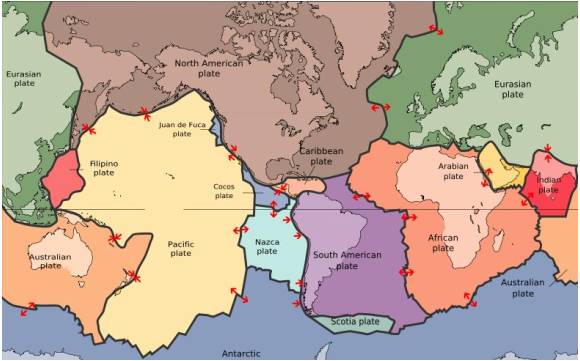
The map in the picture shows tectonic plate boundaries. This map would be useful in predicting the location of future

a)

droughts

b)

hurricanes

c)

earthquakes

d)

tornadoes

108.
What geological forces might be responsible for this range of mountains?
a)
diverging tectonic plates
b)
erosion of the land by the ocean
c)
converging tectonic plates
d)
deposition of sediments by the ocean
109.

Where would sea floor spreading most likely occur?

a)

At convergent boundaries (oceanic vs. oceanic)

b)

At convergent boundaries (oceanic vs. continental)

c)

At divergent plate boundaries (oceanic vs. oceanic)

d)

At transform plate boundaries

110.

What is subduction?

a)

When two plates move next to each other.

b)

When two plates move apart from each other.

c)

When a plate is not moving at all.

d)

When one plate moves underneath another plate.

111.

Which of the following shows the layers of the earth in order of INCREASING TEMPERATURE?

a)

Inner core, outer core, mantle, crust

b)

Mantle, outer core, inner core, crust

c)

Crust, mantle, outer core, inner core

d)

Crust, mantle, inner core, outer core

112.
What is it called when two oceanic plates move apart and new crust is formed?
a)
crustal integrating
b)
sea-floor spreading
113.
Who first proposed the theory of continental drift'?
a)
Galileo
b)
Wegener
c)
Hess
114.
True or False: When liquid gets hot, it becomes less dense.
a)
true
b)
false
115.
During convection currents, _____ dense material rises, and _______ dense material sinks.
a)
less, more
b)
more, less