wayground logo

Free Printable Worksheets

Font size

S
M
L
XL
Worksheets

Density, Periodic table, Chem/Phis changes, Minerals, Rocks

Total questions: 113

Worksheet time: 3hrs 37mins

Name
Class
Date
1.
Which units of measurement are used for volume?
a)
grams
b)
centimeters
c)
grams/milliliter
d)
milliliter
2.
Which lab tool might you use to measure the volume of a liquid?
a)
electric scale
b)
bunsen burner
c)
test tube
d)
graduated cylinder
3.
What is the volume of Object X?
a)
10.0 cm3
b)
15.0 cm3
c)
20.0 cm3
d)
25.0 cm3
4.
True or False:  The density of a specific type of material never changes.  
a)
True
b)
False
5.
I have two objects with the same volume but different masses.  Which object will be more dense?
a)
The object with less weight.
b)
The object with more weight.
c)
The object with more mass.
d)
The object with less mass.
6.
What is the formula for density?
a)
density = mass x volume
b)
density = mass / volume
c)
density = mass + volume
d)
density = mass - volume
7.
The tool used to measure the mass of a substance or object is a ______________.
a)
balance
b)
graduated cylinder
c)
ruler
d)
thermometer
8.

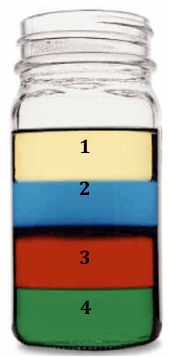
Which statement is supported by the student’s observations?

a)

The mass of liquid 2 is greater than the mass of liquid 3.

b)

The density of liquid 3 is greater than the density of liquid 2.

c)

The density of liquid 2 is less than the density of liquid 1.

d)

The mass of liquid 3 is greater than the mass of liquid 2.
9.
Put the liquids in order from most dense to least dense?
a)
4, 3, 2, 1
b)
1, 2, 3, 4
c)
3, 4, 2, 1, 
d)
4, 3, 1, 2
10.
An object with which of the following densities will float on water?
a)
0.7 g/cm3
b)
1.2 g/cm3
c)
3.5 g/cm3
d)
11.4 g/cm3
11.
A student knows the mass of an object. What other variable does the student need to know to calculate the object's density?
a)
Color
b)
Weight
c)
Volume
d)
Length
12.
Which would be the most useful for identifying an unknown liquid?
a)
Weight
b)
volume
c)
mass
d)
density
13.
This is a measurement of the amount of matter, or 'stuff', in an object or substance.
a)
volume
b)
density
c)
mass
d)
length
14.
What is the volume of the fish?
a)
18.0 cm3
b)
6.0 cm
c)
38.0 cm3
15.
A can of Coke will sink in a bowl of water.  A can of Diet Coke will float in a bowl of water.  What does this tell you about the density of the Diet Coke?
a)
it is bigger than 1
b)
it is smaller than 1
c)
it is equal to 1
d)
it is equal to -1
16.
Why do ice cubes float in a  glass of water?
a)
the ice cubes are more dense than the water
b)
the water is more dense than the ice cubes
c)
the water is more dense than the glass
d)
the ice is more dense than the glass
17.
Which property of matter is determined by dividing its mass by its volume?
a)
elasticity
b)
buoyancy
c)
density
d)
viscosity
18.
The following liquids are poured together in a beaker: alcohol (density=0.79), corn syrup (density=1.38), water (density=1.0), and cooking oil (density=0.93).  Which of these liquids will sink to the bottom of the beaker?
a)
alcohol
b)
corn syrup
c)
water
d)
cooking oil
19.
Will an object with a density of 1.01 g/cm3 float or sink?
a)
float
b)
sink
20.
A brick sinks in water while a wooden block of the same size floats.  This is because the brick has a
a)
lower volume than the wooden block
b)
lower density than the wooden block
c)
higher volume than the wooden block
d)
higher density than the wooden block
21.
What is the density of water?
a)
0 g/ml
b)
1 g/ml
c)
10 g/ml
d)
100 g/ml
22.
Why do some substances float on water?
a)
they are warmer than water
b)
they are cooler than water
c)
they are more dense than water
d)
they are less dense than water
23.
Which liquid has the highest density? 
a)
corn syrup
b)
lamp oil
c)
rubbing alcohol
d)
honey
24.
What does the scale read?
a)
9.4 g
b)
9.6 g
c)
49.4 g
d)
49.6 g
25.
What is the volume of Object X?
a)
10.0 cm3
b)
15.0 cm3
c)
20.0 cm3
d)
25.0 cm3
26.
Which will float in water (density= 1 g/mL)?
Corn syrup  1.37 g/mL
Vegetable oil  0.91 g/mL
Honey  1.42 g/mL
Lamp oil  0.81 g/mL
a)
Corn syrup and Honey
b)
Vegetable oil and Lamp oil
c)
Corn syrup and vegetable oil
d)
Honey and Lamp oil
27.
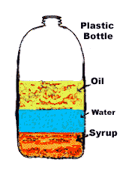
Which liquid is the least dense?
a)
oil
b)
water
c)
syrup 
d)
plastic bottle
28.
Which box has a greater density?  
a)
Box A
b)
Box B
29.
Archimedes used density to discover if the crown of gold was real because
a)
Substances have their own unique densities
b)
Substances can change densities depending on their size
c)
Substances can change densities depending on their mass
d)
Substances can change densities depending on their volume
30.
What is the volume of Spongebob Squarepants based on the displacement of the water in the graduated cylinder. 
a)
50mL
b)
52mL
c)
102mL
d)
2mL
31.

I am shiny and a good conductor of heat

a)

Metal

b)

Metalloid

c)

Non Metal

32.

I am an insulator and have a dull luster.

a)

Metal

b)

Metalloid

c)

Non Metal

33.

I am a bad conductor of electricity and heat.

a)

Metal

b)

Metalloid

c)

Non Metal

34.

I am malleable, but do not have a shiny luster.

a)

Metal

b)

Metalloid

c)

Non Metal

35.

I am a good conductor of electricity and am malleable.

a)

Metal

b)

Metalloid

c)

Non Metal

36.

I am not shiny and not malleable.

a)

Metal

b)

Metalloid

c)

Non Metal

37.

I am malleable and have a shiny luster.

a)

Metal

b)

Metalloid

c)

Non Metal

38.

I have properties of both metals and nonmetals

a)

Metals

b)

Metalloids

c)

Non Metals

39.
The table shows the properties of four elements. Which element in the table is classified as a metal?
a)
Manganese
b)
Sulfur
c)
Silicon
d)
Neon
40.
´Elizabeth was examining elements and their physical properties. She described an element is her science journal as having no shine, an insulator, and  very brittle. What would this element be a metal, nonmetal, or metalloid?
a)
metal 
b)
nonmetal 
c)
metalloid
41.
What properties are used to classify elements as metals, nonmetals or metalloids?
a)
Color, smell, texture
b)
Luster, conductivity, malleability
c)
Location on periodic table, smell, luster
d)
Malleability, physical state, texture
42.

Students are looking at a element and the properties were: Dull, malleable and semiconductor, where will the element be found?

a)

1

b)

2

c)

3

d)

4

43.

Which statement describes the locations of the elements shown below.

a)

Elements 1 and 2 are nonmetals, 3 is a metalloid and 4 is a metal

b)

Elements 1 and 2 are metals and 3 and 4 are nonmetals

c)

Elements 1 and 4 are metals, 3 is a metalloid and 4 is a nonmetal

d)

Elements 1 and 4 are metals, 2 is a metalloid and 3 is a nonmetal
44.
Which of the following tells you that a chemical change may have occurred?
a)
Change Shape
b)
Melting
c)
Vaporizing
d)
Change in color
45.
What happens in ALL chemical changes?
a)
Change in state of matter
b)
A new substance is formed
c)
Bubbles are produced
d)
An explosion
46.
Is wood burning a physical or chemical change?
a)
Physical 
b)
Chemical
47.
Is milk going sour a physical or chemical change?
a)
Physical 
b)
Chemical
48.
Is Gatorade powder dissolving in water physical or chemical change?
a)
Physical 
b)
Chemical
49.
Is mold growing on cheese a physical or chemical change?
a)
Physical 
b)
Chemical
50.
Is making orange juice a physical or chemical change?
a)
Physical 
b)
Chemical
51.
Is sharpening a pencil a physical or chemical change?
a)
Physical 
b)
Chemical
52.
Is copper tarnishing a physical or chemical change?
a)
Physical 
b)
Chemical
53.

Which of the following is not a clue that a chemical reaction has taken place?

a)

Changing size

b)

Changing color

c)

A gas being formed

d)

Formation of a precipitate

54.
Which of the following IS a clue that a chemical change has occurred? 
a)
State of matter change
b)
Size Change
c)
Change in temperature
d)
Shape change
55.

The way in which a mineral reflects light

a)

streak

b)

luster

c)

hardness

56.

A measure of the ability of a mineral to resist scratching

a)

hardness

b)

luster

c)

streak

57.

The color of the powder of a mineral

a)

hardness

b)

streak

c)

luster

58.

The _______________________ of a mineral can be metallic or nonmetallic.

a)

luster

b)

color

59.

When testing the ________________________of a mineral, we can use the white or black plate and look at the color of the powder the mineral left behind.

a)

hardness

b)

streak

60.

The scale that measures the hardness of a mineral

a)

Linear scale

b)

bathroom scale

c)

Moh's scale

61.
How do you test the hardness of a mineral? 
a)
Throw it against a wall
b)
Step on it
c)
Scratch Test
d)
Kick it until it breaks
62.
A naturally occurring, inorganic solid with a crystal structure and a definite chemical composition is referring to
a)
density
b)
streak
c)
mineral
d)
non silicate mineral
63.
A mineral's resistance to being scratched is called?
a)
streak
b)
luster
c)
hardness
d)
heft
64.
What are the two types of luster? 
a)
Metallic and Metallic
b)
Nonmetallic and Shiny
c)
Metallic and Nonmetallic
d)
Shiny and Dull
65.
True or False: Minerals make up rocks. 
a)
True
b)
False
66.
Using this scale, which mineral can scratch fluorite?
a)
Talc 
b)
Gypsum 
c)
Apatite 
d)
Calcite 
67.
Can a penny scratch fluorite?
a)
Yes 
b)
No 
68.
Which of these minerals is softer than glass?
a)
Topaz 
b)
Corundum 
c)
Calcite 
d)
Orthoclase 
69.
Hardness is a property that helps identify minerals. Scientists use a scale of 1-10 to show the hardness of a mineral. What number would be given to the softest?
a)
1
b)
3
c)
5
d)
10
70.
Hardness is a property that helps identify minerals. Scientists use a scale of 1-10 to show the hardness of a mineral. What number would be given to the hardest?
a)
1
b)
5
c)
6
d)
10
71.
Which BEST describes the rock cycle?
a)
New rocks form from older rocks.
b)
Lunar rocks change into terrestrial rocks.
c)
Rocks in the ocean become rocks on land.
d)
Layers of rock are broken by faults.
72.
How are sedimentary rocks, such as shale and sandstone, formed?
a)
Particles are changed into liquids.
b)
Particles are compressed into layers.
c)
Particles are melted together by magma.
d)
Particles are heated by the Sun.
73.
In order for sediments to become rock, the sediments are generally
a)
liquefied.
b)
compacted.
c)
returned to their origins.
d)
mixed with organic material.
74.
Which processes must occur in order for an igneous rock to change into a metamorphic rock?
a)
heating and pressure
b)
compaction and cementation
c)
melting and cooling
d)
uplift and erosion
75.
Which process forms both metamorphic and sedimentary rock?
a)
recrystallization
b)
heating
c)
weathering
d)
compacting
76.
When buried sediments are subjected to pressure, the mineral grains are squeezed together. This causes
a)
layers to rise to the surface
b)
new rock to be formed
c)
earthquakes
d)
volcanoes
77.
Which processes change magma into igneous rock?
a)
weathering and erosion
b)
heat and pressure
c)
compaction and cementation
d)
cooling and crystallization
78.
Which statement is true about rocks?
a)
Magma is made of solid rock.
b)
Rocks are made of one or more minerals.
c)
Crystals are made of rocks.
d)
Minerals are made of one or more rocks.
79.
Minerals are made of one or more
a)
minerals.
b)
sediments.
c)
elements.
d)
rocks.
80.
Which sentence BEST describes a process in the rock cycle?
a)
Sedimentary rocks can melt to become metamorphic rocks.
b)
Volcanoes can deposit sedimentary rock to form mountains.
c)
Metamorphic rocks can form by the weathering process.
d)
Igneous rocks can become metamorphic and sedimentary rocks.
81.
Which type of rock is formed when particles are compacted and cemented together?
a)
igneous
b)
metamorphic
c)
sedimentary
d)
metallic
82.
Sedimentary rock forms when rock is first
a)
broken down by weathering.
b)
melted into liquid magma.
c)
exposed to great temperature.
d)
crystallized into natural glass.
83.

Which of these minerals has the highest metallic lustre?

a)
b)
c)
d)
84.

According to this chart, will garnet scratch fluorite?

a)

Yes

b)

No

85.

Using the table, which mineral will scratch Creedite but will NOT scratch Spectrolite?

a)

Alabaster

b)

Boracite

c)

Ekanite

d)

Moissanite

86.
According to Moh's scale, which is true about feldspar? 
a)
It can scratch quartz
b)
It can be scratched by topaz but not fluorite
c)
It can be scratched by apatite
d)
It is harder than corundum
87.

A rock deep within the Earth experiences extreme temperature and pressure. After a long period of time it becomes which rock?

a)

Magma

b)

Igneous

c)

Metamorphic

d)

Sedimentary

88.

Rocks and sediment change as they move through the rock cycle. Which change involves turning into melting?

a)

Lava to rock

b)

magma to lava

c)

rock to magma

d)

rock to sediment

89.

What must happen to a metamorphic rock before it becomes a sedimentary rock rock?

a)

It must be broken down into sediment

b)

It must be melted into magma

c)

Its minerals must dissolve in water

d)

It must be exposed to high temperature and pressure
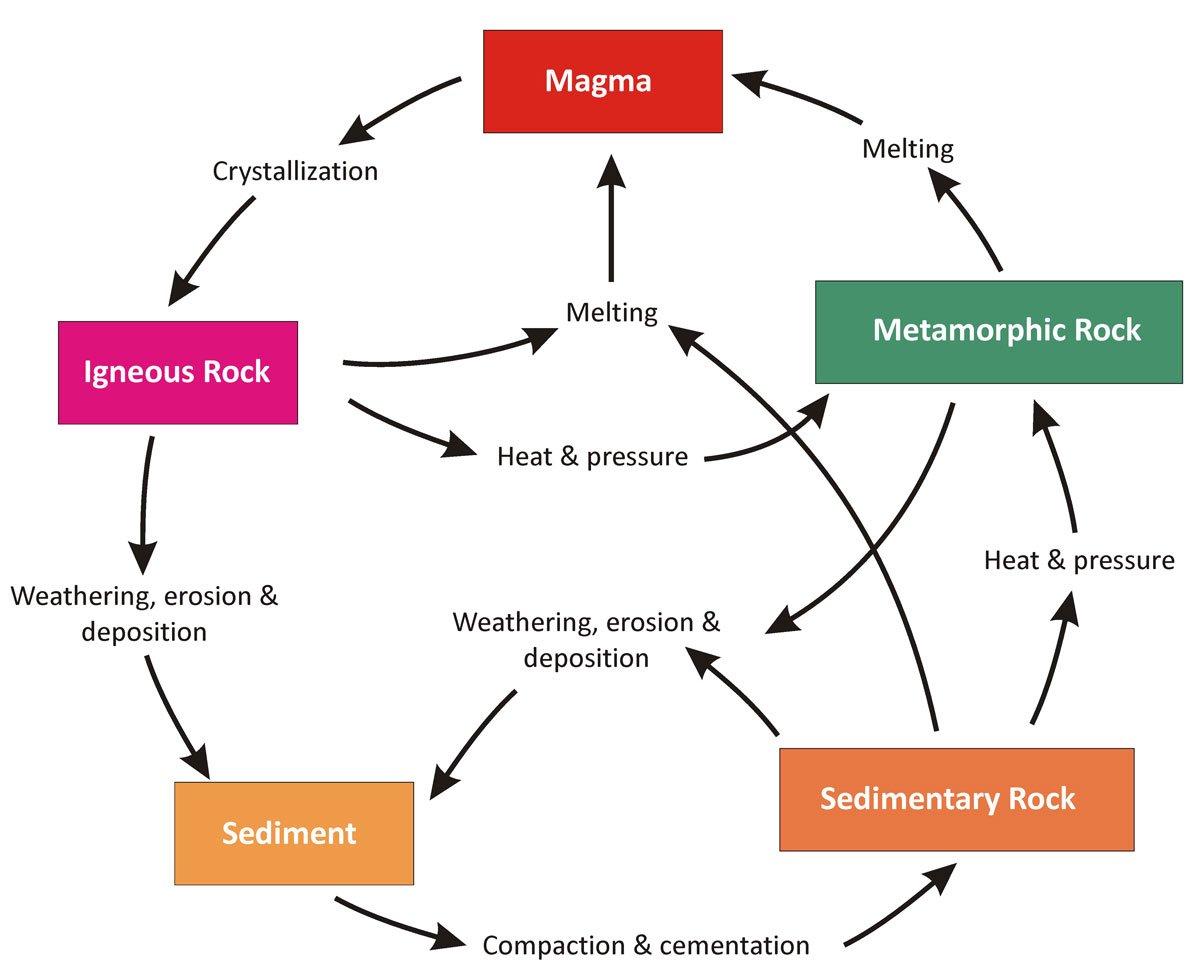
90.
Formed by heat and pressure
a)
Sedimentary
b)
Metamorphic
c)
Extrusive Igneous
d)
Intrusive Igneous
91.
Formed by cooling & solidification of lava
a)
Sedimentary
b)
Metamorphic
c)
Extrusive Igneous
d)
Intrusive Igneous
92.
Formed by compacting & cementing of sediments
a)
Sedimentary
b)
Metamorphic
c)
Extrusive Igneous
d)
Intrusive Igneous
93.
Formed by weathering & erosion
a)
magma
b)
sediments
c)
sedimentary rock
d)
intrusive igneous
94.

How do sedimentary rocks form?

a)

Lava or magma cools and hardens

b)

Sand, mud and pebbles settles into layers and get squeezed together.

c)

Extreme heat or pressure turn old rocks into new rocks

d)

Under trampolines

95.

__________________ rocks form when lava or magma cools and hardens.

a)

METAMORPHIC

b)

IGNEOUS

c)

SEDIMENTARY

d)

WEIRD

96.

What type of rock would you expect to find near a volcano?

a)

METAMORPHIC

b)

IGNEOUS

c)

SEDIMENTARY

d)

BROKEN

97.

What is needed for a metamorphic rock to form?

a)

HEAT

b)

PRESSURE

c)

HEAT AND PRESSURE

d)

WIFI

98.

When an animal dies it’s skeleton settles on the ocean floor and is buried by __________________.

a)

SEDIMENT

b)

BONES

c)

WATER

d)

DIRT

99.

Which of the following is considered an element?

a)

CO

b)

N

c)

NaCl

d)

HCl

100.

How many different elements make up the compound FeO?

a)

1

b)

2

c)

3

d)

4

101.

What elements make up NaCl (Salt)?

a)

Sodium and Carbon

b)

Sodium and Chlorine

c)

Nitrogen and Carbon

d)

Nitrogen and Chlorine

102.

Which characteristics describe elements?

a)

cannot be broken down into other substances

b)

two or more elements chemically combined

c)

pure substance represented by chemical symbols

d)

carbon dioxide, salt and water are examples

103.

What is a compound?

a)

A compound consists of two or more substances chemically bonded in a set ratio

b)

A compound consists of only one type of atom.

104.

The diagram represents?

a)

Element

b)

Compound

c)

Mixture of Elements

d)

Mixture of Elements and Compounds

105.

Which example represents a pure element?

a)

A

b)

B

c)

C

106.

Which picture is an example of a mixture?

a)

First picture

b)

Middle picture

c)

Last picture

107.

What elements are in the compound K2CO3?

a)

Keratin,Copper,Oxygen

b)

Potassium,Copper,Oxygen

c)

Potassium,Carbon,Oxygen

d)

Keratin,carbon,Oxygen

108.

What elements are in the compound NH4Cl?

a)

Nitrogen,Hydrogen,Carbon,lithium

b)

Nitrogen,Hydrogen,Chlorine

c)

Nitrogen,Oxygen, carbon

d)

Hydrogen, Carbon,Chlorine

109.

Which of the substances shown are elements?

a)

Hydrogen Gas

b)

Solid Sulfur

c)

Table Salt

d)

Ozone

110.
Which of the following is not a compound?
a)
HCl
b)
Cl
c)
NaCl
d)
CO2
111.
Which of the following represents an element?
a)
H2O
b)
H2
c)
NaCl
d)
CaCO3
112.
How many elements are represented in the compound?
Na2CO3
a)
1
b)
2
c)
3
d)
4
113.
Ductility is ___________
a)
A.  the capability of being hammered out thin.  
b)
A.  the way light is reflected off a surface.
c)
A.  the capability of being drawn out into thin wires or threads.
d)
A.  how well a piece of matter conducts electricity.