

wayground logo

Free Printable Worksheets

Font size

S
M
L
XL
Worksheets

7th Grade Science Final Exam Review

Total questions: 113

Worksheet time: 1hrs 5mins

Name
Class
Date
1.
Every living organism is made up of one or more cells
a)
True
b)
False
2.
A cell is...
a)
the basic unit of structure and function in living organism
b)
an organism
c)
a basic part of everything that we see
d)
found only in animals, not plants
3.
Which of the following are NOT found in animal cells
a)
chloroplasts and cytoplasm
b)
chloroplasts and cell wall
c)
cell wall and cell membrane
d)
mitochondria and nucleus
4.
The nucleus is like the ____________ of the cell.
a)
foot
b)
hand
c)
stomach
d)
brain
5.

Which of the following converts food into energy for the cell?

a)

vacuole

b)

mitochondria

c)

cytoplasm

d)

cell membrane

6.

The fluid that surrounds the organelles is... (hint... "Try to pull a fast one and..."

a)

chloroplast

b)

cytoplasm

c)

vacuole

d)

cell wall

7.
What do vacuoles do? 
a)
They actually do not have an important role
b)
They protect the cell
c)
They are the brain of the cell
d)
storage area for cells; water storage in plants 
8.

Which organelle takes in "sun showers" and helps plants with the process or photosynthesis?

a)

Vacuole

b)

Mitochondria

c)

Cytoplasm

d)

Chloroplast

9.
If you were some bad guy trying to sneak into an animal cell, who would be there to stop you?
a)
nucleus
b)
mitochondria
c)
cell membrane
d)
cell wall
10.
Which of the following, found ONLY in plant cells, provides structure?
a)
cell wall
b)
chloroplast
c)
mitochondria
d)
vacuole
11.
Dominant or recessive?
tt
a)
Dominant 
b)
Recessive
12.
Dominant or recessive?
Dd
a)
Dominant
b)
recessive
c)
neither
d)
homozygous
13.
Emily has brown hair. Which is most likely a true statement about Emily?
a)
Emily’s favorite color is brown.
b)
Emily has a parent with brown hair.
c)
Emily’s older brother has brown hair. 
14.
What should students use to identify the percent chance of a trait being passed down from a parent to its offspring?
a)
a graph
b)
a flow chart
c)
a data table
d)
a Punnett square
15.
Which statement best supports why many offspring look similar to their parents?
a)
Offspring inherit characteristics from one parent.
b)
Offspring inherit characteristics from both parents.
c)
Parents choose which characteristics to pass on to their offspring.
d)
Parents choose to change their appearance to match that of their offspring.
16.
Bob is a tall, slender young man with red hair and blue eyes. Which couple would most likely be Bob’s parents?
a)
a slender, red-haired father and a tall, blue-eyed mother
b)
a tall green-eyed father with long brown hair and a short, brown-haired mother
c)
a short, green-eyed, black-haired father and a tall, brown haired, brown-eyed mother
d)
a short, plump brown-haired father with freckles and a short, blue-eyed red-haired mother
17.
What are the possible combinations of a pea plant with the alleles PP and a male pea plant with the alleles pp.
P= purple
p= white
a)
all Pp
b)
all PP
c)
Pp,PP,Pp,PP
d)
all pp
18.
When the allele combination is a dominate and a recessive trait together which trait will be seen?
a)
Dominate
b)
Recessive
c)
none
d)
both
19.
Homozygous is when...
a)
the alleles are the same
b)
the alleles are different
c)
the alleles are absent
d)
the alleles are present
20.
B = brown fur  b = white fur
In the punnett square, what is the probability for white fur? 
a)
0%
b)
25%
c)
50%
d)
75%
21.
Aa is
a)
homozygous (purebred)
b)
heterozygous (hybrid)
22.
What is a phenotype?
a)
The expression of a trait; physical appearance.
b)
refers to the genetic makeup of an individual
c)
An organism that has the same genes for a trait (ex. TT or tt)
d)
the passing of traits from parent to offspring
23.
This means Different Gene
a)
Dominant
b)
Recessive
c)
Homozygous
d)
Heterozygous
24.
Homozygous or heterozygous?
BB
a)
Homozygous
b)
Heterozygous
25.
Which of the following is a phenotype?
a)
Aa
b)
red hair
c)
heterozygous
d)
DNA
26.

What are the alleles of highlighted box?

(a)  

27.

What are the alleles of highlighted box?

(a)  

28.

What are the alleles of highlighted box?

(a)  

29.

What are the alleles of highlighted box?

(a)  

30.

What are the alleles of highlighted box?

(a)  

31.

What are the alleles of highlighted box?

(a)  

32.

What are the alleles of highlighted box?

(a)  

33.

What are the alleles of highlighted box?

(a)  

34.

What are the alleles of highlighted box?

(a)  

35.

What is the missing allele for this parent?

(a)  

36.

What are the alleles for this parent?

(a)  

37.

AA

a)

Dominant

b)

Recessive

38.

mm

a)

Dominant

b)

Recessive

39.

ee

a)

Dominant

b)

Recessive

40.

Phenotype or Genotype? HH

a)

Phenotype

b)

Genotype

41.

Phenotype or Genotype? Blue eyes

a)

Phenotype

b)

Genotype

42.

Phenotype or Genotype? Brown skin

a)

Phenotype

b)

Genotype

43.

Phenotype or Genotype? The combination of alleles/letters

a)

Phenotype

b)

Genotype

44.

Phenotype or Genotype? The physical expression/appearance of a gene

a)

Phenotype

b)

Genotype

45.

Phenotype or Genotype? bb

a)

Phenotype

b)

Genotype

46.

Your shoulder muscle is called your

a)

Hamstring

b)

Deltoid

c)

Gastrocnemius

d)

Tibialis Anterior

e)

Quadriceps

47.

The front of your thigh is called your

a)

Hamstring

b)

Deltoid

c)

Gastrocnemius

d)

Tibialis Anterior

e)

Quadriceps

48.

The back of your thigh is called your

a)

Hamstring

b)

Deltoid

c)

Gastrocnemius

d)

Tibialis Anterior

e)

Quadriceps

49.

Your calf muscle is called your

a)

Hamstring

b)

Deltoid

c)

Gastrocnemius

d)

Tibialis Anterior

e)

Quadriceps

50.

A main muscle alongside your tibia (shin) is called your

a)

Hamstring

b)

Deltoid

c)

Gastrocnemius

d)

Tibialis Anterior

e)

Quadriceps

51.

Your Rectus Abdominus muscles are also called your

a)

Abs

b)

Abdominals

c)

Stomach muscles

d)

All the above

52.

Your Biceps Brachii are located in the anterior section of your upper

a)

Arm

b)

Leg

c)

Neck

d)

Back

53.

The muscle in the back (posterior) of your upper arm is called your...

a)

Pectoralis Major/Minor

b)

Rectus Abdominus

c)

Triceps Brachii

d)

Biceps Brachii

54.

Your chest muscle is called your...

a)

Latissimus Dorsi

b)

Pectoralis Major/Minor

c)

Rectus Abdominus

d)

Tibialis Anterior

55.

Your Latissimus Dorsi is one of the muscles on the....

a)

Lateral sides of your upper torso

b)

Back

c)

All the above

56.

Your Trapezius muscle is also called your

a)

Abs

b)

Pecs

c)

Traps

d)

Lats

e)

Calves

57.

Your Obliques are located on the lateral section of your

a)

Rectus Abdominus

b)

Latissimus Dorsi

c)

Quadriceps

d)

Gastrocnemius

58.

The muscle in the center of your back is/are called your...

a)

Tibialis Anterior

b)

Rhomboids

c)

Pectoralis Major

d)

Infraspinatus

59.

Your muscle that is located on top of (superficial to) your shoulder blade, and is used to rotate your humerus, is/are called your...

a)

Latissimus Dorsi

b)

Obliques

c)

Infraspinatus

d)

Quadriceps

60.

Your Orbicularis Oculi is located around your

a)

Eyes

b)

Kneecaps

c)

Wrists

d)

Mouth

61.

Your Orbicularis Oris is located around your

a)

Nose

b)

Ears

c)

Mouth

d)

Eyes

62.

Your mandible (jaw) muscle that allows you to chew is called your:

a)

Sternocleidomastoid

b)

Gastrocnemius

c)

Masseter

d)

Infraspinatus

63.

Where is your sternocleidomastoid located?

a)

In your legs

b)

In your arms

c)

In your stomach

d)

In your neck

64.

Where is are you Gluteus muscles located?

a)

Tops of your hamstrings (your backside)

b)

Your stomach muscles

c)

Your forehead

d)

Forearm muscles

65.

The muscles in the lower part of your arms are called your:

a)

Forearm muscles

b)

Shoulder muscles

c)

Upper arm muscle

d)

Back muscles

66.
Bears do this in the winter to avoid the cold
a)
eat
b)
mimicry
c)
camouflage
d)
hibernate
67.
When one living thing looks like another living things it is called
a)
hibernate
b)
mimicry
c)
camouflage
d)
tropism
68.
This causes a living thing to react
a)
adaptation
b)
accomodation
c)
stimulus
d)
tropism
69.
Traits that help an organism survive in its environment
a)
accomodations
b)
adaptations
c)
stimulus
d)
tropism
70.
how an animal responds to change is called
a)
accomodation
b)
adaptation
c)
stimulus
d)
tropism
71.
An animal that has died out
a)
tropism
b)
stimulus
c)
extinct
d)
mimicry
72.
How a plant responds to light, water, and gravity
a)
stimulus
b)
extinct
c)
camouflage
d)
tropism
73.
Animals that blend in with their surroundings
a)
mimicry
b)
hibernate
c)
camouflage
d)
endangdered
74.
If there are very few of this animal left the animal is ...
a)
extinct
b)
endangered
c)
tropism
d)
mimicry
75.
When trees and shrubs are cut down or destroyed
a)
deforestation
b)
tropism
c)
extinct
d)
endangered
76.
Which is an example of mimicry?
a)
a bear fining a cave to sleep in all winter
b)
an insects body is shaped like a thorn
c)
a lizard looks like its surroundings
d)
a wolf attacks a rabbit
77.
Plants respond to stimuli by 
a)
changing their pattern of growth
b)
dying 
c)
moving to a new location
d)
getting more sun
78.
After a big flood, a mouse starts to eat food that it normally would not eat. this is an example of 
a)
adaptation
b)
extinct
c)
accomodation
d)
stimulus
79.
Why are pandas endangered?
a)
Other animals have eaten to many of them
b)
they are not eating the food provided for them
c)
people have destroyed their food supply
d)
they are not reproducing
80.
Which is NOT an example of a camels adaptation to desert life?
a)
Camels cary water in their humps 
b)
Camels have hooves that make it easier to walk through sand
c)
camels have a clear eyelid so they can walk in the desert without getting sand in their eyes
d)
Camels migrate to cooler climates during the summer
81.
How might a plat respond to getting sunlight?
a)
it will turn towards the light
b)
it will face away from the light
82.
How might a plant respond to gravity?
a)
its roots will grow down
b)
its stem will grow crooked
c)
The leaves will turn brown
d)
the flower will always be green
83.
How might camouflage help an animal survive?
a)
the pray will see the predator coming 
b)
the pray can blend in with its surroundings so that the predator will not see it
c)
the predator will be seen by the pray
d)
the pray can use it to attack the predator
84.
How do plants adapt to cold winters?
a)
Some trees loose their leaves so they use less enerygy
b)
some keep their flowers on all year long
c)
some will die and grow again
85.
How is a brightly colored flower an example of an adaptation?
a)
it is really pretty
b)
the brighter the flower the nicer they smell
c)
the bright flower will attract more insects to pollinate it
d)
the stem will grow longer so less animals will eat it
86.

Cannot make its own energy and must eat other living things.

a)

producer

b)

consumer

c)

carnivore

d)

omnivore

87.

Gets energy from eating only animals.

a)

carnivore

b)

omnivore

c)

producer

d)

herbivore

88.

Gets energy from eating both plants and animals.

a)

producer

b)

consumer

c)

omnivore

d)

carnivore

89.

Makes its own energy.

a)

consumer

b)

producer

c)

carnivore

d)

omnivore

90.

Gets energy from eating only plants.

a)

producer

b)

carnivore

c)

herbivore

d)

consumer

91.

An organism is

a)

All living thing

b)

All of the living things in an ecosystem

c)

A living thing that only eats meat

d)

A living thing that only eats plants

92.

An ecosystem is

a)

A community of living things and its nonliving environment

b)

All of the living and nonliving things that make up one’s surroundings

c)

A straight line diagram that shows which living things are eaten by others

d)

A diagram that combines different food chains to show all of the foods that living things eat

93.

A food Chain is

a)

A community of living things and its nonliving environment

b)

All of the living and nonliving things that make up one’s surrounds

c)

A straight-line diagram which living things are eaten by others

d)

A diagram that combines different food chains to show all of the food that living things eat

94.

A Food Web is

a)

A community of living things and its nonliving environment

b)

All of the living and nonliving things that make up one’s surrounds

c)

A straight-line diagram which living things are eaten by others

d)

A diagram that combines different food chains to show all of the food that living things eat

95.
What are the products of photosynthesis?
a)
oxygen and carbon dioxide
b)
oxygen and glucose
c)
carbon dioxide and water
d)
water and glucose
96.
In which organelle does photosynthesis occur?
a)
mitochondria
b)
cell membrane
c)
nucleus
d)
chloroplasts
97.
What is the chemical formula for glucose?
a)
C6H12O6
b)
C6H6O12
c)
C12H6O12
d)
C6O2H6
98.
What is the chemical formula for water?
a)
H2O
b)
HO2
c)
CHO2
d)
CO2H
99.
What is the chemical formula for carbon dioxide?
a)
H2O
b)
CO2
c)
CHO2
d)
CO2H
100.
What is the chemical formula for oxygen?
a)
H12O2
b)
C6O2
c)
O3
d)
O2
101.

Why do plants need sunlight for photosynthesis?

a)

The light creates heat needed for photosynthesis to occur

b)

The light provides the energy needed to power photosynthesis

c)

Plants can't absorb carbon dioxide in darkness

d)

Plants can't absorb water in darkness

102.

Why are plants usually green?

a)

Because the chlorophyll reflects green light

b)

Because the chlorophyll absorbs green light

c)

Because the accessory pigments combine to make green

d)

Because the accessory pigments only absorb green light
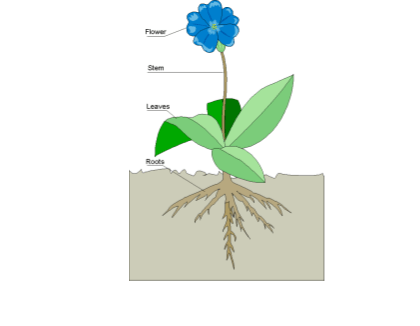
103.
What are the products of photosynthesis?
a)
water and carbon dioxide
b)
oxygen and glucose
c)
oxygen and carbon dioxide
d)
oxygen and water
104.
Plants need ________ for photosynthesis
a)
oxygen
b)
soil
c)
carbon dioxide
d)
sugar
105.
What is photosynthesis?
a)
The process in which humans eat their food
b)
When a photographer takes a photo.
c)
To get your pictures from the photo lab.
d)
The process in which plants make their food.
106.
Which plant part absorbs water and nutrients?
a)
Leaf
b)
Stem
c)
Roots
d)
Flower
107.
____________________ provides the energy necessary for photosynthesis.
a)
water
b)
sunlight
c)
glucose
d)
soil
108.

If plants breathe in carbon dioxide, what do they breathe out?

a)

Nitrogen

b)

Oxygen

c)

Carbon monoxide

d)

Helium

109.

What 3 things do plants need for the process of photosynthesis?

a)

Sunlight, oxygen and sugar.

b)

Water, soil and oxygen.

c)

Sunlight, carbon dioxide and water.

d)

Sunlight, soil and water.

110.

The plants gets its nutrients from sugar, called __________.

a)

Galactose

b)

Fructose

c)

Sugar

d)

Glucose

111.

Carbon dioxide enters the plant through pores called_________.

a)

Stomata

b)

Eukaryote

c)

Eczema

d)

Stratus

112.

Where does photosynthesis occur?

a)

Leaves

b)

Roots

c)

Stem

d)

Xylem

113.
The plant tissue that carries food DOWNWARD from the leaves to the rest of the pant is the ______.
a)
Phloem
b)
Stomata
c)
Chlorophyll
d)
Xylem
