
 Worksheets
Plate Tectonics, Erosion, and Deposition Unit Review
Total questions: 108
Worksheet time: 36mins
This mechanical weathering agent weathers a rock by grinding it down
abrasion
erosion
ice wedging
cracking
Ice wedging causes mechanical weathering of rock by means of
heating and cooling
plant growth
animal action
freezing and thawing of water
The most important factors in determining the rate of weathering are
carbon dioxide and acid rain
abrasion and acids from plant roots
animal actions and oxygen
rock type and climate
In soil, decomposers
store moisture in the soil
break down and digest the remains of dead organisms
break down bedrock
burrow deep below the topsoil
Plowing removed the grass from the Great Plains and exposed the soil. What effect did this have when a drought struck the Great Plains during the 1930s?
It had no effect
It increased the soil's fertility
It helped to cause the Dust Bowl
It prevented sod from developing
What term describes the management of soil to prevent its destruction?
soil exhaustion
soil decomposition
soil conservation
soil fertility
The practice of plowing fields along the curves of a slope is called
drought plowing
contour plowing
no-till plowing
sod plowing
The type of soil called loam is made up of
pure humus
mostly clasy
nearly equal amounts of silt, sand, and clay
sand and gravel
A marble statue is left exposed to the weather. Within a few years, the details on the statue have begun to weather away. This weathering probably is caused by:
oxygen in the air.
acid rain
lichens
abrasion
Which activity demonstrates chemical weathering?
freezing of water in the cracks of a sandstone sidewalk
abrasion of a streambed by tumbling rocks
grinding of talc into a powder
dissolving of limestone by acid rain

The diagram below shows the stump of a tree whose root grew into a small crack in bedrock and split the rock apart.
The action of the root splitting the bedrock is an example of
chemical weathering.
deposition.
erosion.
mechanical weathering.

The diagram below shows a soil profile formed in an area of granite bedrock. Four different soil horizons, A, B, C, and D, are shown.
Which soil horizon contains the greatest amount of material formed by biological (plant & animal) activity?
A
B
C
D
Rapid chemical weathering can be caused by a type of rain combined with pollutants. What is this type of rain called?
abrasion
acid rain
oxidation
sulfuric acid
Humus makes soil rich in nutrients that plants need to grow. What is soil called when it is rich in nutrients?
carbon dioxide
fertile
oxidation
sterile
Wind Weathering
Chemical
Mechanical
River Weathering
Chemical
Mechanical
Acid Rain
Chemical Weathering
Mechanical Weathering
Lichens producing acid on rocks
Mechanical Weathering
Chemical Weathering
Dark organic material in soil
Hummus
Humus
Living plants and animals
Rocks
Which environment causes weathering to happen faster?
hot, dry
hot, wet
cold, dry
cold, wet
pH is the measure of _____.
phosphorus
nitrogen
acidity
potassium
all of these
Soil is a(n) _______________________ because it is something in the environment that humans use.
uncommon resource
synthetic resource
man made resource
natural resource
A farmer who practices _____________ plants different crops in a particular field each year.
conservation plowing
crop rotation
preservation plowing
contour plowing
When soil loses its fertility, the value of the soil is ___________________.
increased
not changed
rotated
decreased
Cotton is one crop that takes large amounts of ________________ from the soil.
organisms
air
enzymes
nutrients
Legumes such as peanuts are plants that _______________ soil fertility.
destroy
restore
separate
contain
____________________ weathering occurs when abrasion and other natural agents physically wear away rock.
Oxidation
Chemical
Erosion
Mechanical
Rocks that are _____________ are full of connected air spaces and weather more easily.
carbonic
permeable
frozen
metallic
Earthquakes most often occur
in the middle of plates
near plate boundaries
where thunderstorms are
along the coast


Which station was closest to the earthquake's epicenter?
Station A
Station B
Station C
This type of wave travels along Earth's crust and can be very destructive.
P wave
S wave
Surface wave
EM waves


What is a tracing of an earthquake's motion that is created by a seismometer?
Seismograph
Seismogram
Seismologist
Elastic Rebound
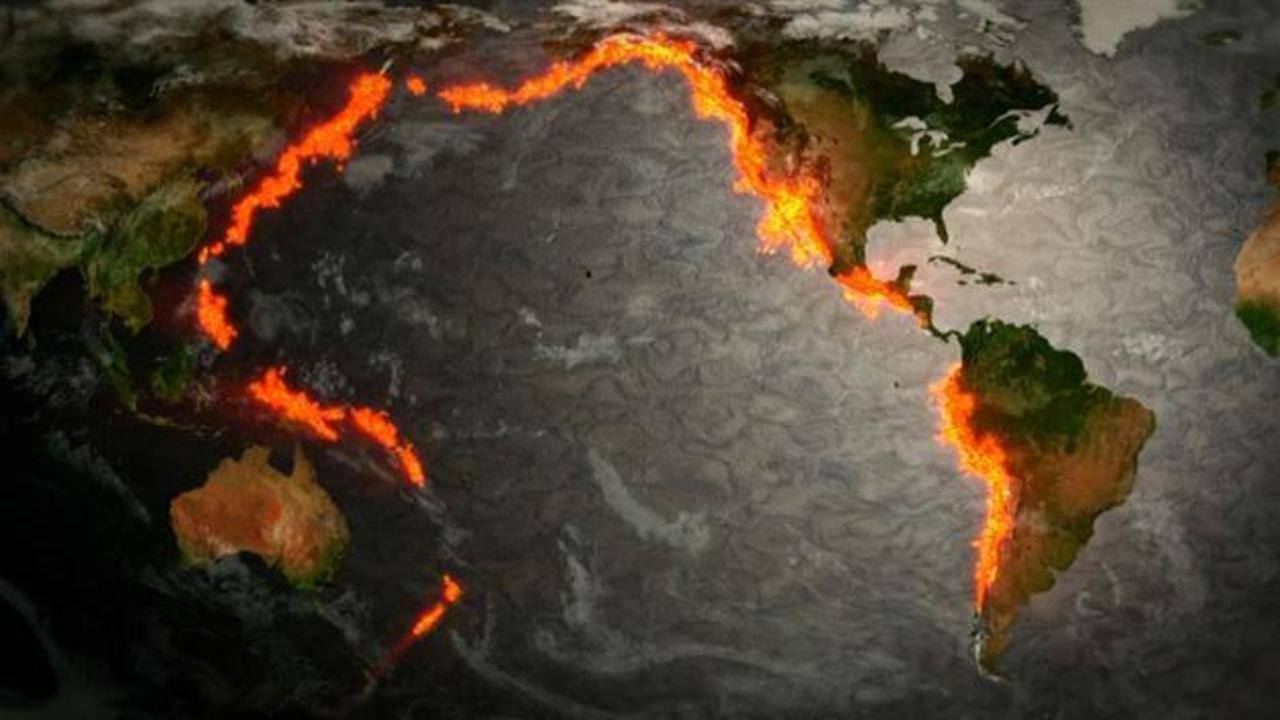
Second waves to arrive in an earthquake
P waves
S waves
Surface waves
What is the minimum number of seismograph stations needed to locate an earthquake epicenter?
1
2
3
5
Measures the magnitude or size, of an Earthquake
epicenter
focus
Richter scale
Mercalli Scale

Transform boundaries have shearing stress and _______________________ faults.
strike-slip
normal
reverse
In these faults, the block above the fault slides down relative to the other block.
Normal
Reverse
Strike-Slip
Convergent boundaries have compression stress and ___________________ faults.
reverse
normal
strike-slip
A force that acts on rock to change its shape or volume.
stress
seismic waves
tsunami

Which is an example of a transform plate boundary?
the Himalayas
the East African Rift
the Hawaiian Islands
the San Andreas Fault

When does a divergent plate boundary form?
when a denser plate sinks below a more buoyant plate
when two plates slide past each other
when two plates separate
when two plates collide

What is Pangaea?
an ice sheet which covered several continents
the fossil of a fern found on different continents
a mountain belt linking two continents
a supercontinent that contained all the continents

What happens as the seafloor spreads apart?
The older oceanic crust folds into the mid-ocean ridge.
The newer oceanic crust is pushed under the mid-ocean ridge.
The older oceanic crust moves away from the mid-ocean ridge.
The newer oceanic crust moves toward the mid-ocean ridge.
Which can be used as an indicator of past climate?
fossils
lava flow
mountain ranges
tides
What is the best definition for lithosphere?
The gaseous space extending to the limits of earth's atmosphere
The areas of the world occupied by water
The outermost layers of the earth's crust and mantle
The space where life exists beyond the surface of the planet
Who came up with the theory of Pangaea?
Werner
Wegener
Newton
Darwin
When one layer of crust (usually oceanic) sinks back into the mantle because of differences in density, it is called:
subtraction
density
volcanoes
subduction
At this type of boundary, plates move away from each other
convergent
divergent
transform
At this type of boundary, plates slide past each other
convergent
divergent
transform
At this type of boundary, plates collide with each other
convergent
divergent
transform
This causes plate tectonics
conduction in the mantle
radiation from the Sun
convection in the outer core
convection in the mantle
This forms at a divergent boundary on land:
deep-ocean trench
rift valley
mid-ocean ridge
mountains
When two plates meet at a convergent boundary and subduction does NOT happen, it tends to form
mountains
earthquakes
volcanoes
rift valleys

What type of boundary is shown
convergent
divergent
transform
The evidence is in ______________________, where coastlines and mountain ranges appear to fit together like a puzzle all over the world
Continental drift
Plate Tectonics
The Rock Cycle
Divergent boundaries
Other evidence include __________________ that plate tectonics does occurr in the crust of the Earth.
Rock formation, weather, fossils
Mountain formation, fossils, climate
Land features, fossils, climate
Valleys, Ocean trenches, climate
The __________________ are chains of undersea mountains.
Mid-Ocean Ridges
Ocean Trench
Divergent boundary
Transform boundary
A theory explaining the structure of the earth's crust is called _________________
Pangea
Plate Tectonics
The Rock Cycle
Sea-floor spreading

Which of these events can ONLY happen on a DIVERGENT BOUNDARY?
Rift Valley
Mountain
A peninsula
An Insanely complex, long answer that you will click out of instinct.
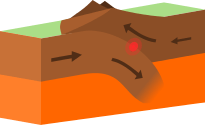
Why does the continental crust rise over the oceanic crust?
The continental crust is less dense.
The oceanic crust is thinner.
The continental crust is not made of granite.
The oceanic crust is younger.

divergent boundary
convergent boundary
transform boundary

divergent boundary
convergent boundary
transform boundary
What is the motion of Earth's plates like?
Slow and in stages
Fast and in stages
Slow and constant
Fast and constant
Which process is sediment laid down?
Mountain Formation
Erosion
Deposition
Weathering
In which type of mass movement can soils behave like a liquid and start flowing?
slump
creep
landslide
mudslide
Slump is an example of ________________.
sediment
mass movement
creep
a landslide
Sediment may consist of pieces of rock or soil, or the remains of _______________.
fossils
organisms
ruins
volcanic rock
A(n) _________________ is a meander that has been cut off from the river.
oxbow lake
alluvial fan
peninsula
bend
A(n) ____________________ forms when sediment gets laid down where a river flows into an ocean.
alluvial fan
oxbow lake
bend
delta
What is a channel with continually flowing water that flows into a larger river called?
gully
flood plain
rill
tributary
What is a meander?
a bend in a river
the wide area of land along a river
a fan-shaped sediment deposit
a large groove in the soil
What makes up till?
clay only
sand only
silt and sand only
clay, silt, gravel, and boulders
Which landform is formed by glacial deposition?
moraine
cirque
horn
arete
By which process does a glacier pick up rocks?
abrasion
plucking
melting
deposition
Glaciers gouge and scratch bedrock through the process of __________________.
abrasion
plucking
cirque
arete
A small depression called a(n) ________________ forms when a chunk of ice is left in glacial till.
kettle
cirque
arete
glacial lake
During the ice ages, ______________ glaciers covered large parts of Earth's surface.
valley
continental
drumlin
fjord
A glacier is any large mass of ice that moves ___________ over land.
quickly
slowly
sporadically
suddenly
A glacier deposits sediment when it ________________.
freezes
melts
erodes
reaches an ocean
Sometimes, when a sea arch collapses, a _________ remains.
sea cave
wind-cut cliff
headland
sea stack
Where coastal rock is softer, waves erode the land______________
faster
slower
just as much as hard rock
there is no soft coastal rock
Waves erode the land by abrasion and ____________.
erosion
wave impact
chemical weathering
deposition
In the process called __________________, beach sediment gets moved down a beach with the current.
longshore drift
sea stack layering
tilling
deposition
As waves approach the shore and change direction, on which landform is the most of the waves' energy concentrated?
headlands
beaches
sandbars
sea caves
Which landform is a long, narrow island parallel to the coast?
sandbar
barrier beach
headland
spit
______________ is a deposit of windblown sand.
sand dune
loess
deflation
weathering
________________ is a wind-formed deposit made of fine particles of clay and silt.
sand dune
loess
deflation
weathering
______________ is the process by which wind removes surface materials.
sand dune
loess
deflation
weathering

