
 Worksheets
RP6 Science Review
Total questions: 124
Worksheet time: 3hrs 0mins
The 6-Kingdom classification system is organized in order as: kingdom > _____ > class > order > family > genus > species.
vertebrates
protists
nucleus
phylum
Algae is an organism that belongs to which kingdom?
protista kingdom
plantae kingdom
archaebacteria kingdom
eubacteria kingdom
Which are unicellular, do not have a nucleus, and are able to make their own food?
archaebacteria
animals
plants
fungi
Match the following pictures of organisms to the kingdom to which they belong.

Fungi Kingdom

Protists Kingdom

Plant Kingdom

Animal Kingdom

Archaebacteria Kingdom
A Species is the smallest, most specific group of organisms. Which is the largest group of organisms?
class
kingdom
phylum
order
The 6-Kingdom classification system is organized in order as: kingdom > _____ > class > order > family > genus > species.
vertebrates
protists
nucleus
phylum
These are unicellular organisms without a nucleus that can cause disease or be beneficial to humans.
(a)
Algae is an organism that belongs to which kingdom?
protista kingdom
plantae kingdom
archaebacteria kingdom
eubacteria kingdom
Which are unicellular, do not have a nucleus, and are able to make their own food?
archaebacteria
animals
plants
fungi
Organize these animals into the correct groups.

snail


Match the following pictures of organisms to the kingdom to which they belong.
Fungi Kingdom
Protists Kingdom
Plant Kingdom
Animal Kingdom
Archaebacteria Kingdom
Drag the classification to the correct location it falls in the order of the 6-Kingdom classification system (Kingdom → Species)
Phylum
Class
Family
Genus
Which is NOT a vascular plant?
ferns
flowering plants
mosses
conifers
Organisms in the (a) kingdom are single-celled organisms (b) a cell nucleus. They live in (c) , make their own food, and are (d) for other animals.
(a) that have a spinal cord belong to the phylum (b) .
Select ALL that do NOT have a cell nucleus.
Protists
Archaebacteria
Eubacteria
Fungi
Which TWO kingdoms of life contain cells WITHOUT a nucleus?
You must choose two answers.
Archaea
Bacteria
Plants
Animals
Which kingdom of life does a yeast cell belong to?
Bacteria
Protist
Fungi
Plant
Which of the following words describes the animal kingdom?
Multicellular
Autotrophs
Prokaryotic
A scientist discovers a multicellular organism that is autotrophic, does not move from place to place, and has chloroplasts and a cell wall.
What is it?
A plant
An animal
A bacterium
A fungus
Which of the following describes archaea?
There is more than one correct answer!
Has a nucleus
Multicellular
Lives in extreme environments
Unicellular
Which of the following have cell walls?
Make sure you choose all the answers that are correct.
Bacterial cell
Plant cell
Fungus cell
Animal cell
Which of the following kingdoms is capable of locomotion (moving from place to place)?
Animal
Plant
Fungi
A pine tree is a member of which kingdom?
Archaea
Plant
Fungi
Protist
Which of the following are members of the animal kingdom?
Choose all answers that are correct.
jellyfish
amoeba
mushroom
dog
Which of the following organisms is a protist?
Algae
Bread Mold
Sea Star
Corn
Which of the following is a TRUE statement about bacteria?
ALL bacteria are harmful to humans.
ALL bacteria are beneficial to humans.
Bacteria can be BOTH harmful and beneficial to humans.
Bacteria and humans NEVER interact.
Which of the following kingdoms contains BOTH unicellular and multicellular organisms?
Bacteria
Protist
Plant
Animal
TRUE or FALSE? There are autotrophic bacteria known as cyanobacteria.
True
False
Which TWO kingdoms of life contain cells WITHOUT a nucleus?
You must choose two answers.
Archaea
Bacteria
Plants
Animals
Which kingdom of life does a yeast cell belong to?
Bacteria
Protist
Fungi
Plant
Which of the following words describes the animal kingdom?
Multicellular
Autotrophs
Prokaryotic
A scientist discovers a multicellular organism that is autotrophic, does not move from place to place, and has chloroplasts and a cell wall.
What is it?
A plant
An animal
A bacterium
A fungus
Which of the following describes archaea?
There is more than one correct answer!
Has a nucleus
Multicellular
Lives in extreme environments
Unicellular
Which of the following have cell walls?
Make sure you choose all the answers that are correct.
Bacterial cell
Plant cell
Fungus cell
Animal cell
Which of the following kingdoms is capable of locomotion (moving from place to place)?
Animal
Plant
Fungi

The picture shows a paramecium. It is a member of which kingdom of life?
Bacteria
Plant
Animal
Protist
Which FOUR kingdoms are members of the domain Eukarya?
You must choose four answers.
Bacteria
Protist
Fungi
Plant
Animal
A pine tree is a member of which kingdom?
Archaea
Plant
Fungi
Protist
Which of the following are members of the animal kingdom?
Choose all answers that are correct.
jellyfish
amoeba
mushroom
dog
Which of the following organisms is a protist?
Algae
Bread Mold
Sea Star
Corn
Which of the following is a TRUE statement about bacteria?
ALL bacteria are harmful to humans.
ALL bacteria are beneficial to humans.
Bacteria can be BOTH harmful and beneficial to humans.
Bacteria and humans NEVER interact.

This is Pyrococcus furiosis. It is unicellular, does NOT have a nucleus, and likes to live in extremely hot temperatures.
What kingdom is it a part of?
Archaea
Plant
Fungi
Protist
Which of the following describe Fungi?
There is more than one correct answer!
They are heterotrophs.
They CANNOT move from place to place.
They do NOT have a nucleus.
They have cell walls.
Which kingdom is most likely to contain cells with contractile vacuoles?
Bacteria
Protist
Plant
Animal
Which of the following is a member of the bacteria kingdom?


Which of the following kingdoms contains BOTH unicellular and multicellular organisms?
Bacteria
Protist
Plant
Animal
TRUE or FALSE? There are autotrophic bacteria known as cyanobacteria.
True
False
There are six kingdoms of life. How many DOMAINS of life are there?
two
three
four
five
Due to the fact that plants can make their own food using photosynthesis, what are plants considered in food chains?
omnivores
consumbers
producers
carnivores
What would a rabbit be considered in a food chain if it ONLY EATS PLANTS?
herbivore
omnivore
carnivore
producer
What would a lion be considered in a food chain if they ONLY EAT MEAT?
producer
herbivore
carnivore
omnivore
In a food chain, what breaks down dead material and helps turn it into nutrients in the soil?
producers
decomposers
animals
water
Which choice below shows the correct order of a food chain?
sun -> rabbit -> tomato plant -. decomposer -> hawk
tomato plant -> decomposer -> sun -> rabbit -> hawk
sun -> tomato plant -> rabbit -> hawk -> decomposer

A producer gets energy from the (a)
A producer is a living thing that makes it's own (a) .
What is the difference between the biotic and abiotic factors?
Biotic factors are living things and abiotic factors are nonliving things.
Biotic factors are nonliving things and abiotic factors are living things.
What is a example of a abiotic factor?
Panda
Bacteria
Butterfly
Weather


Using food web which of the following is a secondary consumer?
snake
worm
butterfy
squirrel


Using the food web what would happen if the eagle became extinct?
The frog population would decrease.
The frog population would increase.
The butterfly population would increase.
The snake population would decrease.
Which is the primary source of energy for plants?
producer
consumer
decomposer
sun

Which of the following would be the most likely effect, if there were a sudden increase in the cricket population?
There would be a decrease in the small bird population.
There would be a decrease in the grass/flowers population.
There would be a decrease in the mice population.
There would be an increase in the grass/flowers population.


Using the food web which of the following is a primary consumer?
butterfy
snake
fox
frog


Using the food web which of the following is a tertiary consumer?
frog
bird
eagle
worm
Decomposers get energy from...
the sun
eating plants
eating animals
dead things and waste

Arrows in a food web represent...
eating
sunlight
energy
matter
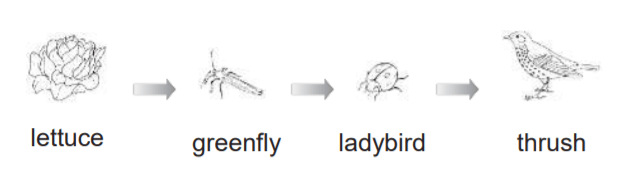
Who is the producer?
lettuce
greenfly
ladybird
thrush

Which type of organism should replace the X in the food web?
an omnivore
an herbivore
a carnivore
a producer
What organisms can take energy from the sun to create its own energy in the form of glucose?
Primary consumers
Primary producers
Secondary consumers
Tertiary consumers

The primary consumer in this image is the....
Hawk
Grass
Grasshopper
How much energy is transferred from one trophic level to the next?
10%
100%
90%
1%
How much energy is lost as heat as you move through the trophic levels?
1%
10%
90%
100%

The omnivores in this diagram are the .....
Grass
Rabbits
Snakes
Hawk
An animal that only eats secondary consumers would be a....
Primary producer
primary consumer
Secondary consumer
Tertiary consumer
Select the organisms that eat primary producers
Primary producers
Primary consumers
Secondary consumers
Tertiary consumers
If a primary producer has 1,000 Joules of energy, then how much energy would a primary consumer get?
100 J
10 J
1 J
10,000 J
Which organisms go through photosynthesis?
Primary producers
Primary consumers
Secondary consumers
Tertiary consumers
If a tertiary consumer had 20 Joules of energy, then how much energy would a secondary consumer have?
200 J
2,000 J
20,000 J
2 J
Secondary consumers are also known as...
Herbivores
Omnivores
Carnivores

The following are example of ....
Primary producers
Primary consumers
Decomposers
Secondary consumers
Which organism eats every other organism on the trophic levels?
Tertiary consumers
Decomposers
Primary producers
Primary consumers

How do the oceans contribute to the amount of Oxygen in the Earth's atmosphere?
Fish in the ocean produce oxygen.
Phytoplankton in the ocean produce oxygen through the process of respiration.
Phytoplankton in the ocean produce oxygen through the process of photosynthesis.
Which of the following is NOT a source of pollution in the ocean?
Fertilizers used on land.
Sand drifting along the bottom of the ocean floor.
Oils found on city streets.
Emissions from gas-burning vehicles.

What happens when a fertilizer runoff happens? (a)

What is one way humans are trying to positively impact the ocean? (a)

An artificial reef is a man made structure that may mimic some of the characteristics of a natural reef. (a)
How can you help impact the environment in a positive way (a)

Coral reefs are endangered by (a)
The largest source of pollution in the ocean comes from (a) .
How are phytoplankton similar to small trees?
Both are at the top of the food chain
Both conduct photosynthesis
Which of the following is associated with dead zones in the ocean? (a)
Humans depend on the ocean for: (a)

Coral Reefs provide what to marine life? (a)
How do humans destroy reefs? (a)

Which of the following is harmful to marine life? (a)
People depend on the oceans for __________________.
Natural resources
Food and water
Transportation
All of the above.
How do the oceans contribute to the amount of Oxygen in the Earth's atmosphere?
Fish in the ocean produce oxygen.
Phytoplankton in the ocean produce oxygen through the process of respiration.
Phytoplankton in the ocean produce oxygen through the process of phtosynthesis.
There is no oxygen production in the ocean.
How do the oceans contribute to the amount of Oxygen in the Earth's atmosphere?
Fish in the ocean produce oxygen.
Phytoplankton in the ocean produce oxygen through the process of respiration.
Phytoplankton in the ocean produce oxygen through the process of phtosynthesis.
There is no oxygen production in the ocean.
The use of light energy by organisms to convert CO2 and H2O into organic molecules is
chemosynthesis
consumption
photosynthesis
decomposition
Which of the following is NOT a source of pollution in the ocean?
Fertilizers used on land.
Sand drifting along the bottom of the ocean floor.
Oils found on city streets.
Emissions from gas-burning vehicles.
What is a fertilizer runoff?
When fertilizer runs into a body of water.
When water makes fertilizer.
When algae grows rapidly.
The industrial production of fertilizers.
What happens when a fertilizer runoff happens?
Fish get bigger.
Algae grow rapidly.
The water becomes very clear.
The oxygen level in the water increases.
Which of the following is the cause of dead zones in the ocean?
An increase in the number of fish.
An increase in runoff from fertilizer
An increase in oxygen
A decrease in oxygen
Fisheries renew themselves naturally each year, but __________________ has caused a shortage of fish in some areas.
Aquaculture
Fishing regulations
Overfishing
Global warming

Review the graph showing marine fishing rates.If the fishing rate in Asia continues to grow, what will most likely happen as a result?
The fish population will continue to rise.
A wide range in ocean temperatures will be seen worldwide.
The U.S. human population will decline.
The overfishing will cause an imbalance in marine ecosystems.

Why is the coral reefs so important?
source of food and new medicines.
protect coastlines from storms and erosion
people depend on reefs for food and income
serve as a habitat and protecton for organisums
Corals die because of ________________
boat anchors that destroy or break the corals.
the gradual warming of the ocean's temperature
irresponsible divers that kick the corals.
All of the above
What is one way humans are trying to positively impact the ocean?
Fishing
Drilling for oil and natural gas
Creating artificial reefs
Transporting goods in ocean vessels
How can you help impact the environment in a positive way
recycle
drive less, creating less pollution
save water
all of the above
Coral Reefs provide what to marine life? (a)
How do humans destroy reefs? (a)

What's his name?
Phillip
Oakley
Sir Oakley from Edinburg the Fourth
Ben

