wayground logo

Free Printable Worksheets

Font size

S
M
L
XL
Worksheets

Semester 2 Review

Total questions: 120

Worksheet time: 2hrs 52mins

Name
Class
Date
1.
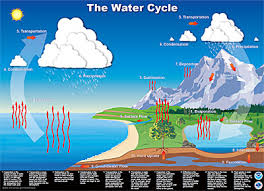
What is it called when plants give off water vapor as a waste product?
a)
condensation
b)
evaporation
c)
sublimation
d)
transpiration
2.
During which stage do clouds form?
a)
condensation
b)
evaporation
c)
precipitation
3.
What is the process during which water cools and turns from a gas to a liquid?
a)
Codensation
b)
Runoff
c)
Precipitation
d)
Evaporation
4.
The ________ is the driving force of the earth's surface.
a)
sun
b)
moon 
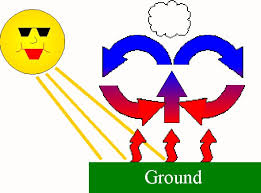
c)
stars
5.
Precipitation occurs because 
a)
the droplets evaporate in the air
b)
the droplets are too light for the air to hold
c)
the droplets are too heavy for the air to hold
6.
What is a layer of rock or sediment that holds water?
a)
glacier
b)
well
c)
aquifer
d)
natural spring
7.
Rain soaks into the ground
a)
Infiltration
b)
Condensation
c)
Throughflow
d)
Surface runoff
8.
_________________ is precipitation that did not evaporate or get absorbed into soil.
a)
Inflitration
b)
Condensation
c)
Sublimation
d)
Runoff
9.
Water that is beneath earth's surface 
a)
groundwater 
b)
infiltration
c)
runoff
d)
transpiration 
10.
Some of the water that precipitates does not runoff into the rivers and is absorbed by the plants or gets evaporated. It moves deep into the soil. What is this process called?
a)
Sublimation
b)
Transpiration
c)
Runoff
d)
Infiltration
11.

About _______ of the Earth is FRESH water?

a)

55%

b)

25%

c)

71%

d)

3%

12.

The measure of dissolved salts in water

a)

acidity

b)

oxygenation

c)

salinity

d)

saturation

13.
What percentage of water on Earth is salt water?
a)
55
b)
71
c)
84
d)
97
14.
Most of Earth's fresh water is found
a)
Frozen in glaciers
b)
Underground
c)
In the Great Lakes
d)
In Oceans
15.
Which represents the distribution of water on Earth?
a)
3% freshwater, 97% salt water
b)
97% freshwater, 3% salt water
c)
71% freshwater, 29% salt water
d)
29% freshwater, 71% salt water
16.

What is the most abundant salt found in ocean water?

a)

Calcium Sulfate

b)

Potassium Sulfate

c)

Sodium Chloride

d)

Magnesium Chloride

17.

Which word means the concentration of dissolved salts in water?

a)

Water

b)

Ocean

c)

Salinity

d)

Sonde

18.
How does salt go into the ocean.
a)
Salt from the bottom of the ocean floats up.
b)
Hardened salt in holes and under water caves dissolve and go into the ocean, the salt dissolve and go into the ocean and it breaks apart.
c)
Rain that falls into land gathers salt from the ground that is then dissolved and evaporated and is then taken by a river that leads into the ocean
19.
As Density  increases
a)
Temperature decreases
b)
Temperature increases
20.
Temperature  increases
a)
Density increases
b)
Density decreases
21.
Ocean depth  increases & Salinity  increases then
a)
Temperature decreases because cold water is more dense and sinks
b)
Temperature increases because cold water is more dense and sinks
22.
True or False Salinity increases as ocean depth increases.
a)
True
b)
False
23.
Briefly describe the overall relationship between temperature and density.
a)
Lower temperature water has higher density, warmer water has lower density
b)
Lower temperature water has lower density, warmer water has higher density
24.
What causes tides?
a)
The sun and moons gravitational pull.
b)
plate movement.
c)
local winds.
25.
What type of tides would this arrangement of earth-moon-sun create?
a)
neap tide
b)
spring tide
c)
new moon tide
d)
full moon tide
26.
What type of tide would this arrangement of earth-moon-sun create?
a)
full moon tide
b)
new moon tide
c)
neap tide
d)
spring tide
27.
Deep ocean currents are a result of
a)
Global Wind Patterns
b)
Earth's Rotation
c)
Density
d)
All of the above
28.
What is the periodic rise and fall of the water level in the oceans?
a)
Tide
b)
Tidal range
c)
Spring Tide
d)
Neap Tide
29.
The picture shows the movement of what?
a)
waves
b)
currents
c)
tides
d)
wind
30.
Which statement BEST describes why warm ocean currents are usually surface currents?
a)
Warm water is less dense than cold water.
b)
Ocean tides bring warm water to the surface.
c)
Warm water contains more salt than cold water.
d)
Ocean water loses heat to the air at the surface.
31.
What is the primary source of energy that generates most ocean waves?
a)
earthquakes
b)
wind
c)
asteriods falling in the ocean
d)
volcanic eruptions
32.
Keeping the water running when you brush your teeth wastes a lot of water.
a)
True
b)
False
33.
Which of the following uses less water? 
a)
Taking a 5 minute shower 
b)
Taking a bath 
34.
Why do we need to conserve water?
a)
It is an unlimited resource. 
b)
It is a limited resource. 
c)
There is a lot of water. 
d)
There is no need to conserve water.
35.
How long should you shower for?
a)
5 seconds
b)
5 minutes
c)
15 seconds
d)
15 minutes
36.
Why is clean water important?
a)
All life on Earth depends on clean water to live and grow.
b)
We need clean water for recreational activities.
c)
We need bodies of water for transportation
d)
We need water to regulate the temperature on Earth.
37.
Where you will find the ozone layer.
a)
stratosphere
b)
thermosphere
c)
exosphere
d)
mesosphere
38.
Where weather occurs.
a)
stratosphere
b)
thermosphere
c)
troposphere
d)
mesosphere
39.
Where we live.
a)
stratosphere
b)
thermosphere
c)
troposphere
d)
mesosphere
40.
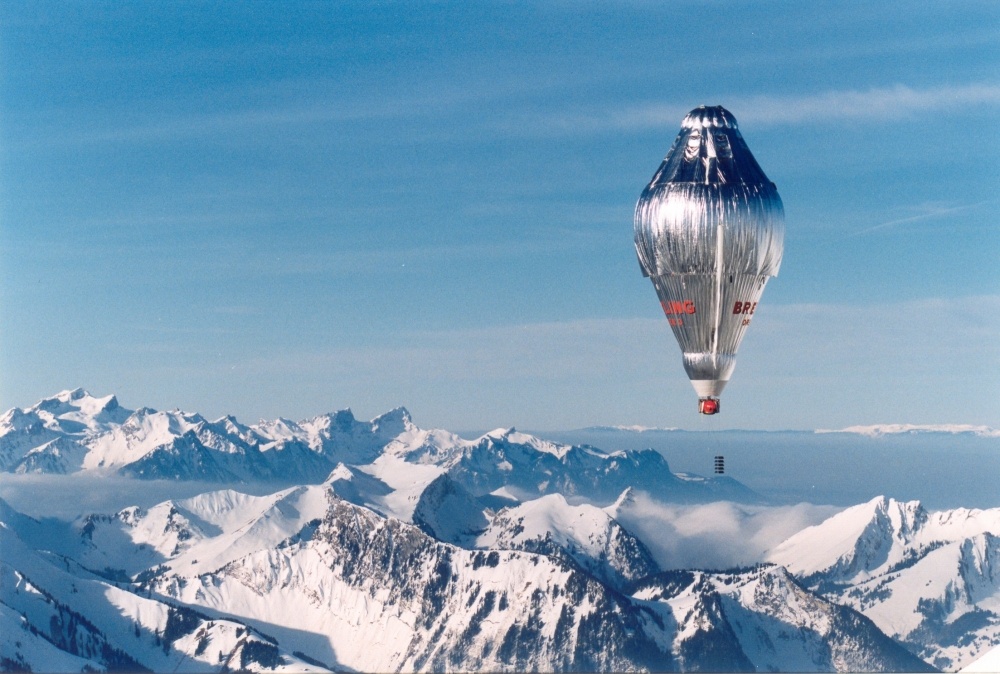
Which order is correct from the earth to space?
a)
thermosphere
 troposphere
 exosphere
mesosphere
stratosphere
 ionosphere
b)
thermosphere
 troposphere
 stratosphere
 exosphere
mesosphere
 ionosphere
c)
exosphere
ionosphere
thermosphere
mesosphere
 stratosphere
troposphere
d)
troposphere
thermosphere
 troposphere
 stratosphere
 exosphere
mesosphere
41.
The hottest layer.
a)
troposphere
b)
thermosphere
c)
exosphere
d)
mesosphere
42.
What two gases are found throughout all layers of the atmosphere?
a)
Nitrogen and carbon dioxide
b)
Nitrogen and oxygen
c)
Oxygen and carbon dioxide
d)
Trace gases and water vapor
43.
What is the function of the ozone layer?
a)
to allow UV rays to get to Earth
b)
to block UV rays from getting to Earth
c)
To keep oxygen in
d)
to allow meteors to get to Earth
44.
This is the layer where most commercial jet airliners fly.
a)
Troposphere
b)
Stratosphere
c)
Mesosphere
d)
Thermosphere
45.
The higher you go, the air becomes _____ _____.
a)
More dense
b)
Less dense 
46.
Temperature decreases as altitude increases in the Troposphere.
a)
True
b)
False
47.
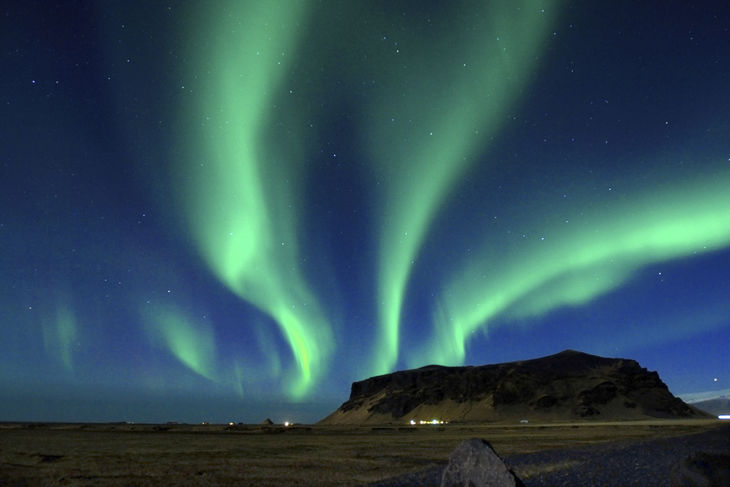
The auroras happen when solar winds interact with ions in what layer of the atmosphere
a)
troposphere
b)
stratosphere
c)
ionosphere
d)
ozonosphere
48.
What is the definition of CONVECTION
a)
When heat transfers through waves.
b)
When heat transfers from objects that are touching.
c)
a  hot liquid or air that  expands, becomes less dense, and rises or becomes more dense, and sinks.
d)
Heat traveling from the sun
49.
What is the definition of CONDUCTION?
a)
When heat is transferred from objects like rays of light or electromagnetically.
b)
a  hot liquid or air that  expands, becomes less dense, and rises or becomes more dense, and sinks.
c)
When heat transfers from objects that are touching.
d)
When heat transfers through the heater or AC in your house.
50.
Which of the following is an example of convection?
a)
A hair dryer is drying up your hair.
b)
When the AC or heater changes the temperature.
c)
When a car engine turns hot after being turned on.
d)
When you are making soup and the water is rising and lowering.
51.
What kind of heat transfer happens when the sun is heating your body?
a)
Conduction
b)
Radiation
c)
Convection
d)
Density
52.
What heat transfer happens when you burn your hand by touching a fire?
a)
Radiation
b)
Conduction
c)
Convectio
d)
I don't know!!!!!!!!!!!
53.
Warm air rises and the cool air sinks demonstrates this type of heat transfer. 
a)
conduction
b)
convection
c)
radiation
d)
Insolation 
54.
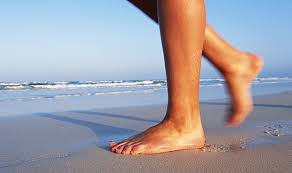
Walking on the warm sand sand with your bare feet demonstrates this type of heat transfer. 
a)
conduction
b)
convection
c)
radiation
55.
The cause of weather systems on earth is
a)
conduction
b)
convection
c)
radiation
56.
What is the movement of air from areas of high pressure to areas of low pressure?
a)
Wind
b)
Convection
c)
Monsoon
d)
Coriolis effect
57.
What characteristic do global winds and local winds share?
a)
They are both wind.
b)
They are both created by unequal heating of the Earth’s surface.
c)
They both occur in small areas.
d)
They both occur in small areas.
58.
The transfer of heat energy through the movement of matter.
a)
Radiation
b)
Conduction
c)
Convection
d)
Condensation
59.
During the day, warm air rises over the land then cools and falls over water in a continuous cycle.
a)
Land breeze
b)
Sea breeze
60.
At night, warm air rises over water then cools and falls over the land in a continuous cycle.
a)
Land breeze
b)
Sea breeze
61.
The Coriolis effect is the curving of wind across Earth. What causes winds to curve?
a)
Earth's revolution
b)
Earth's magnetic field
c)
Earth's rotation
d)
Earth's gravitational pull
62.
Steady winds that flow from east to west between 30°N latitude and the equator and 30°S latitude and the equator.
a)
Prevailing westerlies
b)
Horse latitudes
c)
Trade winds
d)
Polar easterlies
63.
Steady winds that flow from west to east between latitude lines 30°N and 60°N and 30°S and 60°S.
a)
Doldrums
b)
Prevailing westerlies
c)
Polar easterlies
d)
Trade winds
64.
Cold winds that blow from east to west between latitude lines 60°N and the North Pole and 60°S and the South Pole.
a)
Prevailing westerlies
b)
Trade winds
c)
Horse latitudes
d)
Polar easterlies
65.
Which statement correctly defines wind?
a)
Wind is the movement of air from areas of low pressure to areas of high pressure
b)
Wind is the movement of air to a colder area in the atmosphere.
c)
Wind is the movement of air from areas of high pressure to areas of low pressure.
d)
Wind is the movement of air pushed around and bouncing off Earth's surface.
66.
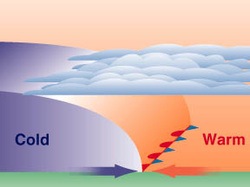
What type of storm front is this? 
a)
warm front
b)
cold front
c)
stationary front
d)
occluded front
67.
When a warm air mass gently slides on top of a cold air mass, and you have drizzly rain and then warmer weather, what type of front is it?
a)
warm front
b)
cold front
c)
occluded front
d)
stationary front
68.
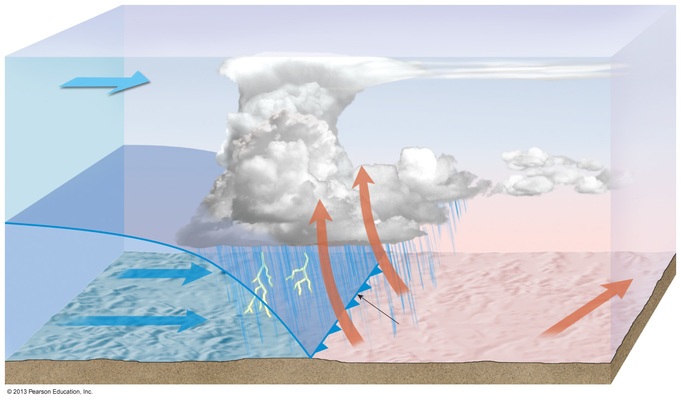
A rapidly moving cold air mass runs into a warm air mass. The cold air slides under the warm air. This is called a(n)  .....
a)
cold front
b)
warm front
c)
stationary front
d)
occluded front
69.
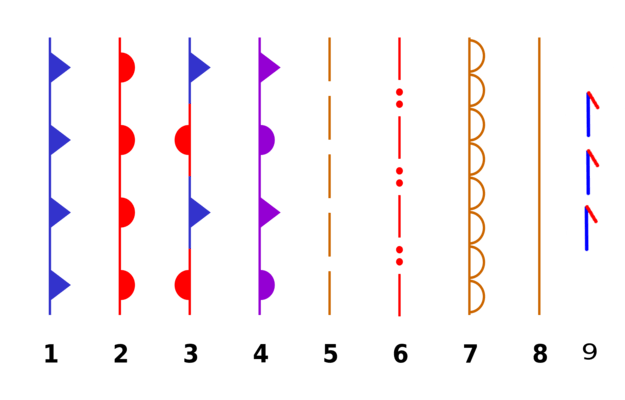
What does symbol # 3 mean?
a)
stationary front
b)
occluded front
c)
warm front
d)
cold front
70.
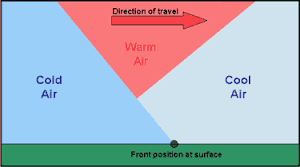
Which type of front is pictured?
a)
Cold front
b)
Warm front
c)
Occluded front
d)
Stationary front
71.
Which type of front is pictured?
a)
Cold front
b)
Warm front
c)
Occluded front
d)
Stationary front
72.
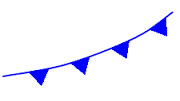
What symbol is this?
a)
warm front
b)
cold front
c)
stationary front
d)
occluded front
73.
What type of air mass is the highlighted arrow?
a)
cold/dry
b)
cold/humid
c)
warm/dry
d)
warm/humid
74.
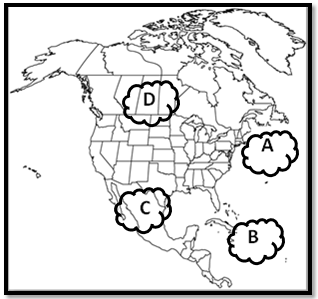
Which type of air would you find at air mass C?
a)
cold, dry
b)
warm, humid
c)
warm, dry
d)
cold, humid
75.
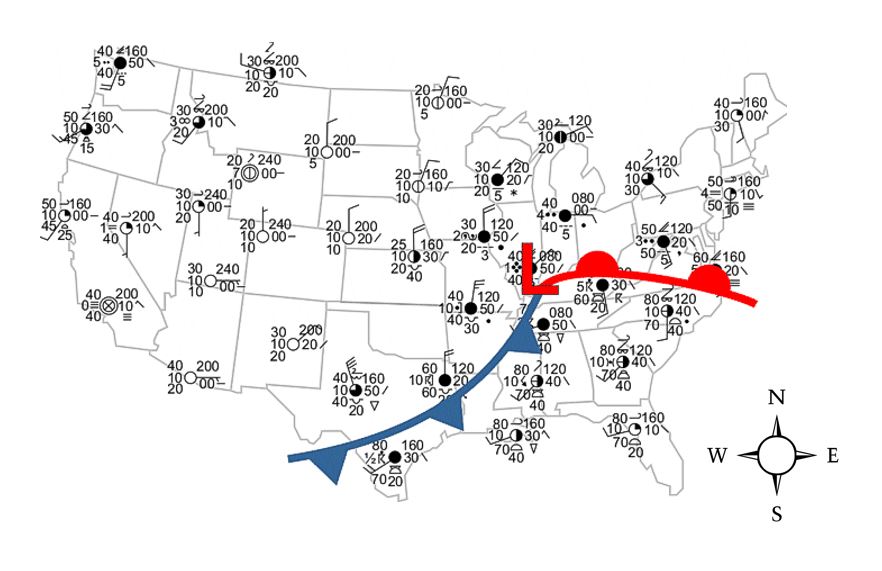
What direction is the warm front moving on the map? 
a)
North
b)
South
c)
East
d)
West
76.
What direction is the cold front moving on the map? 
a)
Southwest
b)
Northwest
c)
Southeast
d)
Northeast
77.
In a high pressure area, the weather will likely be
a)
cooler and clear skies
b)
warm but cloudy
c)
cold and rainy
d)
snowy and clear
78.
Which pressure system can produce storms?
a)
low pressure system
b)
high pressure system
79.
Which type of pressure system produces clear/fair/sunny weather?
a)
low pressure system
b)
high pressure system
80.
warm, humid air 
a)
High Pressure System
b)
Low Pressure System
81.

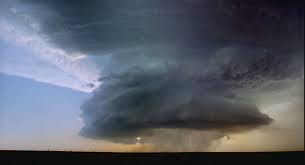
Where do tornadoes start?

a)

Over the ocean near the equator

b)

In the clouds that create blizzards

c)

In the clouds of severe thunderstorms

d)

Any time that it rains

82.

In what areas of the world do hurricanes form?

a)

Warm ocean waters

b)

Polar ocean waters

c)

On lakes and rivers

d)

Over the central plains of the U.S

83.

How many categories of hurricanes exist?

a)

2

b)

3

c)

4

d)

5

84.

Where do most hurricanes develop?

a)

Middle of the United States

b)

Near the Equator

c)

Near Canada and Alaska

d)

Antarctica

85.

Where is Tornado Alley located?

a)

Near the equator of the Earth

b)

Near the North Pole

c)

South Central Los Angeles

d)

Middle states of United States

86.
Which best describes the conditions in a hurricane’s eye?
a)
The winds are strong, and there is heavy rain.
b)
The winds are strong, and there is no rain.
c)
The winds gentle, and there is heavy rain.
d)
The winds are gentle, and there is no rain.
87.
A violent rotating column from the thunderstorm to ground.
a)
Thunderstorm
b)
Tornado
c)
Tsunami
d)
Hurricane 
88.
What model is where the earth is in the middle of our universe?
a)
Heliocentric Model
b)
Geocentric Model
c)
Moon phases
d)
Tidal Phases
89.
This image shows the:
a)
Geocentric Solar System
b)
Heliocentric Solar System
90.

What is the biggest difference between the Geocentric Model and the Heliocentric Model?

a)

the shape of the planets' orbits

b)

the movement of the moon

c)

the center of the solar system

91.
What is a common characteristic of the inner planets?
a)
Large
b)
Gaseous
c)
Rings
d)
Rocky Surface
92.
What is NOT a common characteristic of the outer planets?
a)
Gaseous
b)
Giant
c)
Rings
d)
Smaller than Earth
93.
Which planet is the smallest?
a)
Mercury
b)
Venus
c)
Earth
d)
Mars
94.
Which planet is the largest?
a)
Jupiter
b)
Saturn
c)
Uranus
d)
Neptune
95.
Planets that are closer to the sun
a)
take more time to orbit
b)
take less time to orbit
96.
Which planets have 0 moons?
a)
Earth & Mars
b)
Jupiter & Saturn
c)
Mercury & Venus
d)
Uranus & Neptune
97.

 
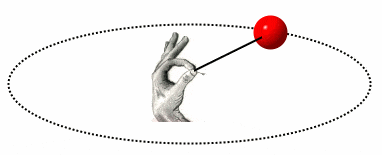
Which force in the Solar System is similar to the tension in the string?
a)
Friction
b)
Inertia
c)
Force
d)
Gravity
98.
What forces cause a planet to orbit?
a)
gravity and orbit
b)
gravity and inertia
c)
gravity and mass
d)
gravity and weight
99.
What kind surfaces do the outer planets have?
a)
rocky surfaces
b)
gas surfaces
c)
water surfaces 
100.
What is the layer that surrounds the nucleus of the comet called?
a)
Coma
b)
Hydrogen Cloud
c)
Outer nucleus
d)
Asteroid
101.
Asteroids are made out of...
a)
Stone and metals like Iron
b)
Gases like hydrogen and helium
c)
Rocks and Ice
d)
Coma, helium cloud, nucleus
102.
The belt between Mars and Jupiter
a)
Comets
b)
Asteroids
c)
Meteors
d)
Stars
103.
Objects made of ice, gas and dust and orbit our sun are called:
a)
Asteroids
b)
Comets
c)
Meteroids
d)
Meteors
104.

Which one is the largest?

a)

Planet

b)

Solar System

c)

Universe

d)

Galaxy

105.

Which one is the smallest?

a)

Solar System

b)

Universe

c)

Planet

d)

Galaxy

106.
During the phases of the Moon, the Moon appears to change shape.  This change in appearance is due to the Moon...
a)
physically changing size and shape.
b)
moving closer and then farther away from Earth.
c)
reflecting a different amount of light due to alignment with Earth and the Sun.
d)
having craters on its surface.
107.
As the moon's shape appears to get smaller, we say that the moon is _.
a)
swelling
b)
waxing
c)
waning
d)
disappearing
108.
Which of the following words describe the phases of the moon?
a)
none, quarter, half, three quarters, full
b)
new, crescent, quarter, gibbous, full
c)
dark, light, half, quarter, blue
d)
first quarter, second quarter, third quarter, fourth quarter
109.
What phase comes AFTER this one?
a)
Waxing Crescent
b)
Waning Gibbous
c)
Waxing Gibbous
d)
Third Quarter
110.
What phase comes BEFORE this one?
a)
New Moon
b)
Third Quarter
c)
Waxing Crescent
d)
Full Moon
111.
What phase comes BEFORE this one?
a)
Full Moon
b)
Third Quarter
c)
New Moon
d)
First Quarter
112.
What happens when the area in which you live tilts away from the sun?
a)
It is summer.
b)
It is spring.
c)
It is winter.
d)
It is fall.
113.
What are the reasons for the seasons?
a)
Earth's tilt and rotation.
b)
Earth's rotation and revolution.
c)
Earth's tilt and revolution.
d)
Earth's tilt and resolution
114.
What season is it in the Southern Hemisphere when it is fall in the Northern Hemisphere?
a)
winter
b)
spring
c)
summer
d)
fall
115.
Solar eclipses occur during which Moon phase?
a)
New Moon
b)
Waning Crescent
c)
Waxing Crescent
d)
Waning Gibbous
116.
Which type of eclipse is shown in the diagram?
a)
Solar Eclipse
b)
Lunar Eclipse
c)
Total Eclipse
d)
Partial Eclipse
117.
Which type of eclipse is shown in this picture?
a)
Solar Eclipse
b)
Orbit
c)
Lunar Eclipse
d)
Total Eclipse
118.
Which season is taking place in the Southern Hemisphere in Position 1?
a)
Winter
b)
Spring
c)
Summer
d)
Fall
119.
Which season is taking place in the Northern Hemisphere in Position 2?
a)
Winter
b)
Spring
c)
Summer
d)
Fall
120.
Differences in the moon's and sun's pull on different sides of the Earth cause _________.
a)
gravity
b)
lunar phases
c)
tides
d)
dabbing