
 Worksheets
Q2 ULTIMATE EXAM REVIEW- 8th GRADE 25-26
Total questions: 126
Worksheet time: 5hrs 30mins
In a neutralization reaction, an acid and a base neutralize each other. Water is one of the two products that are produced from the neutralization reaction. What is the other product?
a gas
a salt
a metal
a protein
How do the particles in an object at 40°C compare to the particles of an object at 0°C?
The particles at 40°C are moving faster than the particles at 0°C.
The particles at 0°C are moving faster than the particles at 40°C.
The particles at 40°C are moving at the same speed as the particles at 0°C.
Neither the particles at 40°C or the particles at 0°C are moving.
Which of the following statements is correct when you think about the particles in a liquid?
They are closer together and lower in energy than those in a solid.
They are closer together and lower in energy than those in a gas.
They are farther apart and higher in energy than those in a gas.
They are farther apart and lower in energy than those in a solid.
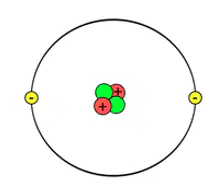
Which of the following statements is true about the diagram?
This is an atom with 2 protons, 1 electron and 3 neutrons
This is an atom with 2 electrons and 4 protons and 0 neutrons
This is an atom with 6 electrons, 0 protons and 0 neutrons
This is an atom with 2 protons, 2 neutrons and 2 electrons.
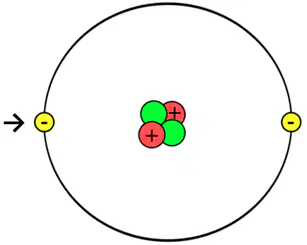
Which subatomic particle is the arrow pointing to in the figure below?
Proton
Neutron
Electron
atom
John discovered that sodium (Na) is found in Group 1 on the Periodic Table. Where should John look for another element that has similar properties?
in the same period
in the same group
on the opposite side of the periodic table
for names that begin with the letter “N”
What can you predict from an element’s location in the Periodic Table?
its chemical symbol
its chemical name
its physical properties
when it was discovered
Which is the smallest unit of matter?
compound
mixture
atom
element
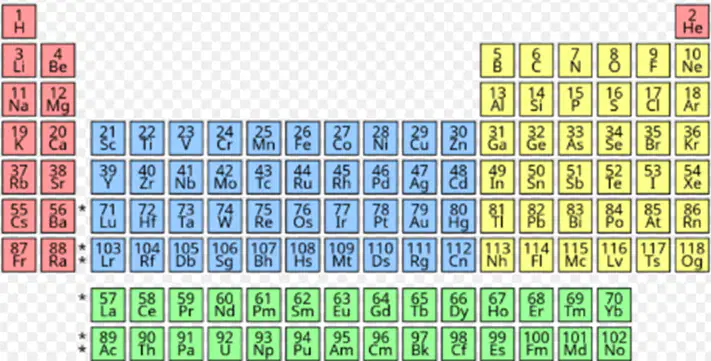
Using the Periodic Table, scientists can predict the properties of elements. Using the periodic table below or a copy of the one you have been using in class, which of the following pairs of elements have properties that are the least similar?
He and Xe
Cl and F
N and P
Al and Si
Which of the following is a compound?
water
oxygen
gold
carbon
Which of the following statements is correct about matter?
Compounds combine to form elements.
Elements combine to form compounds.
Compounds combine to form atoms.
Elements combine to form atoms.
A solution has a pH of 2.4. How would this solution be classified?
acid
base
neutral
salt
Normal rainwater has a pH between 5.5 and 6. Which of the following is most likely to be the pH of rainwater that is classified as acid rain?
pH of 6
pH of 7
pH of 5
pH above 7
Which of the following is the definition of a solution?
A mixture containing two or more substances that has the same properties throughout.
A single kind of matter that has a specific makeup.
A compound containing two or more substances that are chemically combined.
A substance that cannot be broken down into any other substances.
Solids have a definite shape. Solids also have a definite volume. Which statement BEST explains why solids have both a definite shape and volume?
The particles of a solid have very weak attractive forces between them.
The particles of a solid remain in fixed positions and are very close together.
The particles of a solid move fast enough to overcome some of the attractive force between them.
The particles in a solid move fast enough to overcome almost all of the attractive forces between them.
Gary measured 100mL of water in a graduated cylinder. He poured the water into various containers. Gary notices that the water always took the shape of the container into which it was poured. He also knew that the volume of the water never changed. Why can liquids, such as water, change shape?
The particles in a liquid can move past each other.
The particles in a liquid so not move fast enough to spread apart.
The particles in a liquid are very far away from one another.
The particles in a liquid cannot leave their fixed positions.
In a chemical reaction, 300 grams of hydrogen peroxide are combined with 200 grams of manganese dioxide. According to the Law of Conservation of Mass, what will be the mass of the product?
500 g
300 g
200 g
100 g
Jane performed an experiment in which one substance (X) underwent a chemical change to form two new substances (Y and Z). According to the Law of Conservation of Mass, which statement is correct about the chemical change?
The mass of X increased to create the mass of Y and Z.
The mass of X is more than the mass of Y and Z together.
The mass of Y and Z together is more than the mass of X.
The mass of Y and Z together is the same as the mass of X.
In which of the following situations does the Law of Conservation of Mass apply?
Only in a chemical change
In both chemical and physical changes
In neither chemical nor physical changes
Only in physical changes
Which one of the following is NOT an example of a chemical change?
Gas burning on a stove
Rust forming on an iron fence
Sugar dissolving in a glass of water
Baking a cake
When a candle is lit, the wick burns, the wax melts, the candle changes shape, and the air around the candle heats up. Which of the following is an example of a chemical change?
The air around the candle heating up
The candle changing shape
The wax melting
The wick burning
Tina and Jenni put some ice cubes in a glass of water, and the ice cubes melted. What is the best evidence they can use to show that the melting of the ice is a purely physical change and NOT a chemical change?
When liquid water is put into the freezer and cooled long enough, it will change into a solid form.
Even though the ice and the liquid water look different, they can be shown to be made of the same molecules.
She did not need to add any extra heat in order to get the ice to melt in the glass of water.
Although ice is more difficult to see through than liquid water, it does not change color when it melts.
Which of the following would definitely increase the rate of a reaction?
Decrease the size of the container
Increase the size of the container
Decrease the temperature
Increase the temperature
Jamie has 3 glow sticks. She puts one in boiling water, another in ice water and another in room temperature water. Which of the following situations is correct?
The glow stick placed in the boiling water will be brightest but will last less time than the other glow sticks.
The glow stick placed in the ice water will be the brightest but will last less time than the other glow sticks.
The glow stick placed in the room temperature water will be the brightest and will last more time than the other glow sticks.
All three glow sticks will have the same brightness for the same amount of time.
Increasing the temperature of a chemical reaction increases the reaction rate. Which of the following statements explain why?
Faster moving particles come in contact less often, which gives more chances for a reaction to happen.
Faster moving particles come in contact more often, which gives more chances for a reaction to happen.
Slower moving particles come in contact more often, which gives more chances for a reaction to happen.
Slower moving particles come in contact less often, which gives more chances for a reaction to happen.
Which of the following examples demonstrates replication?
Joseph conducts his own experiment 25 times.
Juanita conducts her experiment 1 time.
Sarah is following another student’s written procedures for an experiment that was already performed.
Matt writes the procedures of his experiment carefully and carries out his experiment.
Which of the following examples shows an experiment that has been designed and conducted using repeated trials and replication?
Rashawn is conducting an experiment using tennis balls. He completes 30 trials and has 2 of his friends complete the experiment by following his procedures.
Addison is conducting an experiment using water. She completes 30 trials, then after the experiment, she has a friend read over the procedure.
Amanda is conducting an experiment using aluminum foil. She completes her experiment 1 time and makes adjustments to her procedures. She then completes 20 trials of her experiment.
Julian is conducting an experiment using rubber bands. He completes 10 trials then begins work on a different experiment.
Which of the following shows repeated trials in an experiment?
Samuel writes his own procedures and then has a friend complete 20 trials.
Leslie writes her own procedures for her group to follow.
Joshua’s classmate asked him to conduct her experiment ten times to make sure it was valid.
Katelyn conducts an experiment that requires her to throw an object at a target 20 times.
Jessica did an investigation about the states of matter. As part of the investigation, Jessica wanted to change a liquid into a solid. What must she do to bring about this change in state?
Place the liquid in a different container.
Stir the liquid as quickly and thoroughly as possible.
Increase the energy of the liquid so that its particles move faster.
Remove energy from the liquid so that its particles slow down.
An atom contains electrons surrounding the nucleus of protons and neutrons. Which statement is true about the mass of an atom?
The mass of an atom is evenly distributed among its subatomic particles.
The mass of an atom depends on the number of electrons it has.
The mass of an atom is determined by the number of subatomic particles in its nucleus.
The mass of an atom is unrelated to the number of protons or neutrons it has.

Jim is studying bacteria in science class. He states the following hypothesis: Bacterial populations grow more rapidly in warm temperatures. He decides to test his hypothesis by calculating how much time is needed for a bacterial population to double in size when placed in different temperatures. He organizes the data he gathers in the table shown. Which of the following statements best summarizes the relationship between Jim’s data and his hypothesis?
The data supports the hypothesis because the amount of time needed for the bacterial population to double in size decreased as temperature increased.
The data do not support the hypothesis because the amount of time needed for the bacterial population to double in size increased as temperature increased.
The data supports the hypothesis because the amount of time needed for the bacterial population to double in time increased only at certain temperatures.
The data proves that Jim’s hypothesis is right.
The atom contains electrons surrounding a nucleus of protons and neutrons. Which of the following subatomic particles has a negative charge?
neutron
electron
nucleus
proton
Audra is looking at a diagram of an atom. Which particle(s) does she see inside the nucleus?
electrons only
protons only
electrons and protons
protons and neutrons
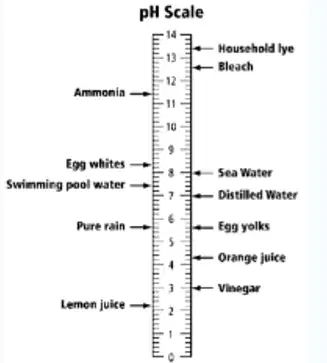
Look closely at the illustration of the pH of various common substances. A food scientist spilled a quantity of basic solution all over the floor. Which of the substances shown on the illustration would be the MOST acidic compound they could safely use to carefully neutralize their spill?
lemon juice
orange juice
distilled water
household lye
After dinner, Hector demonstrated to his parents a process that he learned in science class that day. He poured a small amount of sugar into a cup of water and then stirred it until the sugar dissolved. Which process did Hector demonstrate?
how to separate components of a solution
how substances dissolve in water to produce a pure substance
how two pure substances can be combined to form a solution.
how dissolving a substance in water is an example of a chemical reaction.
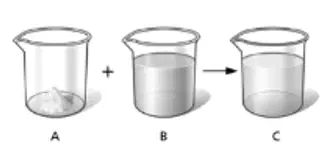
Ricardo prepared the drawing shown below to illustrate the steps in preparing a solution. Which of the following correctly identifies each of the components in the preparation of a solution?
A-solvent; B-solute; C-solution
A-solute; B-solution; C-solvent
A-solution; B-solvent; C-solute
A-solute B-solvent; C-solution
According to the Atomic Theory, elements are made up of small units. What is the name for the smallest unit of an element that can still be classified as that element?
atom
mixture
molecule
compound
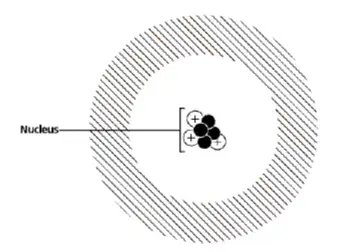
The illustration is a model of an atom.
Which two subatomic particles make up the nucleus of an atom?
neutron and proton
electron and neutron
ion and proton
proton and electron
What part of the atomic model contains almost all of the mass?
electron cloud
protons
neutrons
nucleus
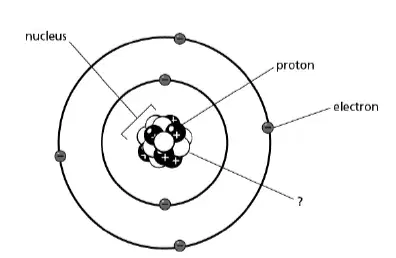
While Elisa and Carmen were studying together for science class, Elisa created a drawing of an atom as shown.
Elisa decided to test Carmen’s knowledge of subatomic particles by asking her to fill in the missing label in her drawing. Which of the following should Carmen choose for the missing label?
element
electron
neutron
isotope
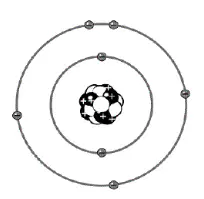
The illustration is a model of an atom.
How many electrons are found in this atom?
7
6
5
2

The illustration shows two subatomic particles and their relative charges.
Starting from the left, which of the following labels should be added to this illustration to correctly identify each subatomic particle?
electron and nucleus
proton and neutron
proton and electron
electron and neutron
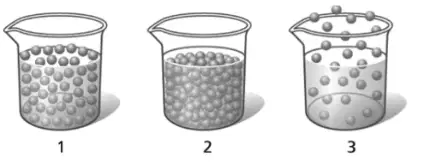
Melinda drew an illustration of the three states of matter. The illustration shows what she drew.
Melinda wanted to replace the numbers with labels identifying the correct state of matter. How should she change the labels?
1 --> solid; 2 --> liquid; 3 --> gas
1 --> liquid; 2 --> gas; 3 --> solid
1 --> liquid; 2 --> solid; 3 --> gas
1 --> gas; 2 --> liquid; 3 --> solid
Mr. Renaldo wants the students in his class to demonstrate the action and arrangement of the particles in a solid. What should he tell the students to do?
remain seated in their seats and wiggle slightly
slide their chairs slowly past one another
form two lines against opposite walls
move quickly about the room
Atoms and molecules are constantly in motion. The more energy an atom or molecule contains, the faster it moves about. In which state of matter do the atoms and molecules have the most energy?
in a gas
in a liquid
in both a liquid and a solid
in a solid
Elements in the periodic table are grouped into columns and rows. What is the name given to rows in the periodic table?
stages
periods
groups
clusters
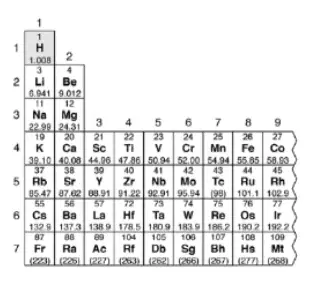
A part of the Periodic Table is shown below.
The elements in the periodic table are ordered according to which of the following?
atomic size
atomic number
melting point
color
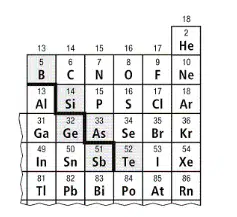
Most versions of the periodic table contain a zigzag line that runs down and to the right as on the part of the table shown below.
This zigzag line separates this part of the periodic table into two sections. Aluminum (Al) and tin (Sn) are on the left side of the line, while oxygen (O) and helium (He) are on the right side. What is the purpose of the line?
to separate magnetic elements from nonmagnetic elements
to separate the metals from the nonmetals
to separate the solids from the liquids
to separate the gases from the solids
Solids have a definite shape. Solids also have a definite volume. Which of the following statements best explains why solids have both a definite shape and volume?
The particles in a solid move fast enough to overcome almost all of the attractive forces between them.
The particles of a solid have very weak attractive forces between them.
The particles of a solid move fast enough to overcome some of the attractive force between them.
The particles of a solid remain in fixed positions and are very close together.
Gary measured 100 mL of water in a graduated cylinder. He then poured the water into various containers. Gary noticed that the water always took the shape of the container into which it was poured. He also knew that the volume of the water never changed. Why can liquids, such as water, change shape?
The particles in a liquid move fast enough to escape the container.
The particles in a liquid can move past each other.
The particles in a liquid cannot leave their fixed positions.
The particles in a liquid are very far away from one another.
To inflate a balloon, you can use a gas such as helium. What property of a gas makes it more suitable than a solid for inflating a balloon?
The movement of the gas particles causes the gas to have a definite shape.
The particles of a gas move freely and take the shape of their container.
The particles that make up the gas have very little energy.
The movement of the particles cause the gas to occupy the smallest possible volume.
Elements are grouped in the periodic table according to the similarities of their properties. For example, the metals are grouped together. Where are the metals located on the periodic table?
on the right and in the center
on the left and in the center
across the bottom of the periodic table
across the top of the periodic table
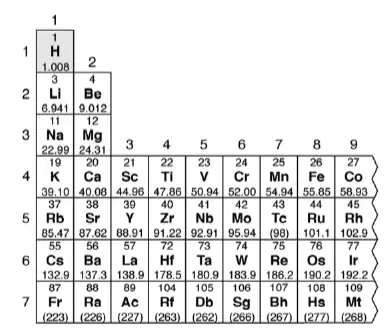
Look closely at a part of the periodic table shown.
What element is located in Period 5, Group 4?
V
Nb
Zr
Ti
Mario discovered that sodium (Na) is found in Group 1, Period 3 on the periodic table. Where should Mario look for another element that has similar properties?
in Group 1
in Period 3
on the opposite side of the periodic table
for any other element that begins with the letter N
Scientific investigations have certain standards, including the ability to be replicated. What is the best reason for scientists to replicate an investigation?
Replicating an investigation proves that the hypothesis was correct.
Other scientists need to verify the results to make sure the investigation is valid.
A scientist might need to conduct multiple trials to ensure that results are accurate.
Other scientists need to review the method by which results were communicated.
Sasha keeps her pet snake in an aquarium. Sasha has just completed an investigation to test how the strength of the light bulb she uses in the aquarium affects how much the snake eats. Which of the following procedures would be a repetition of Sasha’s investigation?
Sasha repeats the investigation following the same steps as her initial investigation.
Marcus repeats the investigation following the same steps as Sasha’s initial investigation.
Sasha repeats the investigation using stronger light bulbs.
Sasha repeats the investigation using an additional snake in the cage.
Native to Australia, wombats are burrowing animals about the size of a small pig. They are the only known animal in the world to produce cube-shaped feces (poop). A scientist recently conducted research to determine why wombat poop is cubic. Which statement best describes the use of replication to verify the results of a scientific discovery?
Several scientists observe one scientist conduct experiments and compare their notes on the results obtained.
Several scientists perform the same experiment separately and compare their results with the original experiment results.
One scientist repeats the same experiment multiple times and compares the results obtained.
One scientist performs several of his other experiments and compares the results obtained.
Which of the following statements does not describe replication?
A scientist shares their procedure with another scientist who then does the exact experiment.
A scientist reads a journal article, and then does the experiment exactly as it was described.
Frank conducts an experiment already done by Karen on soil bacteria.
Susan makes a baked pasta recipe for the second time.
Repetition and replication are important methods for validating scientific results. Which of the following statements best describes why?
Repeating and replicating investigations can show if scientists make errors.
Repeating and replicating investigations allows the public to decide if the results are valid.
Repeating and replicating investigations takes time and effort, but are necessary.
Repeating and replicating investigations give more scientists a chance to work.
Which of the following statements describes repetition?
A chemist measures the timing of a chemical reaction several times.
One scientist tells another scientist about the results of an experiment.
A scientist looks at data from an experiment and interprets it in a new way.
An experiment is conducted by a team of scientists.
Ten identical plants were grown in identical conditions. Five plants received fertilizer and water while the other five only received water. The plants that received fertilizer and water grew faster. Which best describes why the experiment cannot be replicated?
The experiment cannot be replicated because all plants did not have identical conditions.
The experiment cannot be replicated because the procedure and results were not explained in detail.
The experiment cannot be replicated because no two plants are exactly the same.
The experiment cannot be replicated because the results were included.
When a physical or chemical change occurs, the Law of Conservation of Mass always applies. What happens to matter during a chemical change according to this law?
matter is created
matter is destroyed
matter is transformed
matter is changed into charged particles
Which of the following best demonstrates a chemical change?
Bending a steel bar
Splitting a wooden board into two pieces
Baking cookies
Slicing carrots
When sugar is added to water to make a solution, a physical change occurs. According to the Law of Conservation of Mass, what prediction can be made about this physical change?
The sugar solution will have the same mass as the sugar and water.
The sugar solution will have less mass than the sugar and water.
The sugar solution will have more mass than the sugar and water.
The sugar solution will have the same volume as the water in the beaker.
It is not always clear when a substance undergoes a chemical change. Which of the following is most likely evidence of a chemical change?
A substance gets smaller.
A substance gives off heat.
A substance can go back to the way it was before the change.
A substance changes state.
Temperature influences chemical reactions. Glow sticks use chemical reactions to produce light. One kind of glow stick produces light for about 4 hours on a summer night. What will most likely happen to this kind of glow stick when one is used on a very cold winter night?
It will not change.
It will be brighter and last longer.
It will be dimmer and not last very long.
It will be dimmer and last longer.
Steve fills a jar with water and adds Epsom salts and ammonia. After five minutes, he observes that white particles have formed and settled at the bottom of the jar. Steve is unable to change these particles back to any of the three original substances by heating or stirring the solution. He isolates the white particles and finds that they have properties that are very different from any of the three starting materials. Which statement best explains Steve's observation?
A chemical change occurred because a solid substance formed.
A chemical change occurred because a new substance formed.
A physical change occurred because no color change was observed.
A physical change occurred because stirring did not change the solution.
Chemical changes are influenced by temperature. Which one of the following statements about temperature and chemical changes is correct?
Reactions happen slower when it is cold.
Reactions happen faster when it is cold.
Reactions can only happen when it is hot.
Reactions can be controlled more when it is hot.
A mass of 200 grams (g) of solid iron is heated at a high temperature until the iron has completely melted. What is the mass of the liquid iron after heating?
100g
150g
200g
250g
Temperature plays a significant role in influencing chemical reactions. Which of the following statements regarding the effect of temperature on chemical processes is accurate?
All metals exist at low temperatures.
All chemical reactions occur spontaneously at room temperature.
The freezing point of all substances is below room temperature.
A beaker containing hot acid will cause a metal to corrode more rapidly than a beaker containing cold acid.
In art class, Paula created a figure of a dog using modeling clay. Which of the following occurred when Paula created the clay figure?
She had less clay to work with so she made a smaller clay figure.
She changed the chemical properties of the clay.
She physically changed the clay.
She created new atoms in the clay.
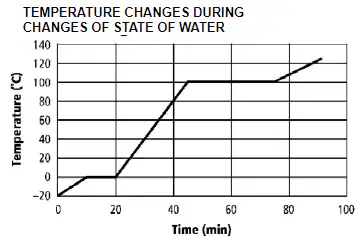
Jorge conducted an experiment, and included the graph shown as part of his lab report. Jorge’s experiment involved which of the following?
A chemical change
A physical change
The formation of a new substance
A change in the chemical properties of a substance
Alfie’s cat purrs when he scratches its chin. He states this hypothesis: Scratching a cat’s chin causes the cat to purr. Which of these results “fails to support” his hypothesis?
Alfie scratches the chins of ten cats that belong to his friends and observes that all of the cats purr when he does so.
Alfie scratches the chin of several different cats, but only some of them purr.
Alfie scratches his cat’s chin ten different times and the cat purrs each time.
Alfie does not observe his cat purring unless he scratches its chin.
Lateesha’s bicycle rusted when she rode it through saltwater. It did not rust when it got wet with rainwater. She believes that saltwater causes metal to rust faster than rainwater. Which of the following should take place before Lateesha can conclude that her hypothesis is supported?
Lateesha should conduct one controlled experiment that produces results that support her hypothesis.
Lateesha should conduct several controlled experiments and throw out any results that fail to support her hypothesis.
Lateesha should conduct several controlled experiments that prove that her hypothesis is true.
Lateesha should conduct several controlled experiments and obtain results that consistently support her hypothesis.
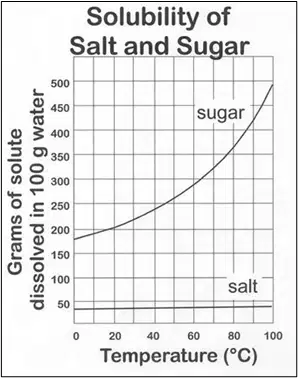
The graph below shows information about the solubility of two compounds, sugar and salt. What can you conclude from this graph?
All substances dissolve in water, sugar and salt dissolve at the same rate.
Salt dissolves faster in water than sugar.
At 80°C, 300g of sugar will dissolve in 100g of water.
As the temperature of the water increases, the solubility of sugar increases.
Human blood has a pH between 7.38 and 7.42. What can you conclude about human blood?
it is highly acidic
it is exactly neutral
it is slightly acidic
it is slightly basic
Which of the following substances is the strongest acid?
orange juice, pH 4
bleach, pH 12.5
lemon juice, pH 2
oven cleaner, pH 13
Which statement below best describes the difference between mixtures and pure substances?
Pure substances can be physically separated but mixtures cannot be physically separated.
Mixtures can be physically separated but pure substances cannot be physically separated.
Mixtures are made of a single kind of matter but a pure substance is two or more substances that are chemically bonded.
Pure substances are not created through a chemical reaction and mixtures are the result of a chemical reaction.
Lemonade consists of several substances that are not chemically combined. How would lemonade therefore be classified?
element
compound
mixture
pure substance
Kelsey plays soccer and gets grass stains on her shorts. She uses several types of laundry detergent to try to remove the stains, but none of them work. She makes the hypothesis that laundry detergents are not able to remove grass stains from clothing. Which best describes the evidence that fails to support the hypothesis?
The stain is removed when a different type of laundry detergent is used.
The stain is removed when it is treated with a stain remover before it is washed using laundry detergent.
The stain does not go away after being repeatedly laundered in water with no laundry detergent.
The stain fades when the clothing is hung outdoors and exposed to sunlight.
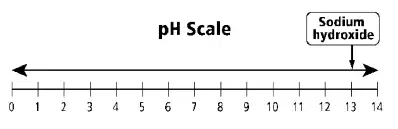
Look closely at the illustration below showing where the compound sodium hydroxide falls on the pH scale. What type of compound is sodium hydroxide?
salt
base
acid
neutral
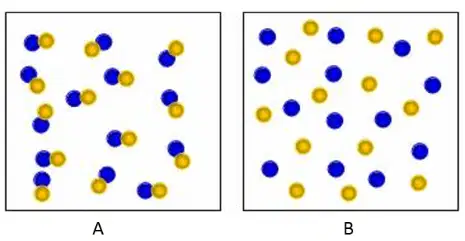
Which diagram represents a pure substance? Choose the best answer and reasoning.
Diagram A is a pure substance, because it is a compound and cannot be separated by physical means.
Diagram A is a pure substance, because it is more evenly spread out.
Diagram B is a pure substance, because it is more evenly spread out.
Diagram B is a pure substance, because it is a compound and cannot be separated by physical means.
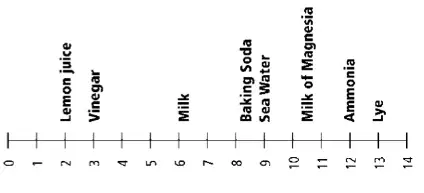
The illustration lists the pH of various substances. Using the pH scale above which substance is closest to neutral?
vinegar
milk
sea water
baking soda
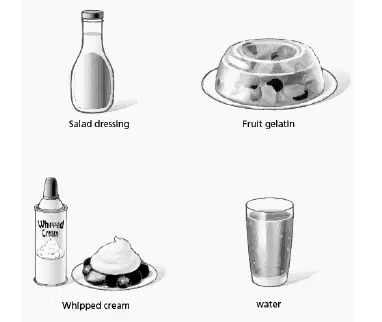
A pure substance is made up of one type of particle, such as an element or compound. The illustration shows several common household items. Which of the following items in this illustration is a pure substance?
salad dressing
fruit gelatin
whipped cream
water
Compounds are made up of different kinds of atoms that are chemically combined. What do compounds have in common?
They have the same color.
They can be broken down into simpler substances.
They cannot combine with one another to form more complex substances.
They have the same melting point.
Which of the following statements is correct about atoms?
All elements contain several types of atoms.
An atom is the smallest unit of an element.
Atoms are only found in nonliving objects.
Atoms can be separated into elements.
Marsha observes that ants are attracted to a spilled soft drink. She makes a hypothesis that ants are attracted to sweet liquids. She places small samples of five different sweet liquids on the ground along with five equal-sized samples of water and observes the ants. She notices ants at the sites where the sweet liquids were placed, but not at the sites where the water was placed. Which of the following provides the best conclusion based on these observations?
Marsha’s observations prove that her hypothesis is correct because the ants are found only at the sites of the sweet liquids.
Marsha’s observations fail to support her hypothesis because she did not use enough samples.
Marsha’s observations fail to support her hypothesis because she used five different types of sweet liquids but only one type of “unsweetened” liquid.
Marsha’s observations support her hypothesis because ants are found at all of the sites with the sweet liquids but at none of the sites containing water.

Matthew reads that the density of water is 1 g/cm³. He plans to conduct an experiment to determine if the density of a material plays a role in whether or not the material floats or sinks in water. He calculates and records the densities of several materials. Next, he places each material in water, observes whether the material sinks or floats, and records his observations. Matthew organizes all of the data he collects in the table shown. Which hypothesis do the results of Matthew’s experiment support?
The ability of an object to float or sink in water is unrelated to density.
Materials less dense than water sink in water, while those that are denser than water float.
Materials less dense than water float in water, while those that are denser than water sink.
Solid objects will sink in water while liquid objects will float.
Atoms combine in many different ways to form different substances. Iron is an element. Brass is not an element, instead brass is a combination of two elements. What is the difference between iron and brass?
Iron, but not brass, consists of atoms.
Brass, but not iron, is a metallic substance.
Iron is a compound, brass is not.
Brass is a compound, iron is not.
In a science lab, two students use a scale to measure the mass of a box containing a small crystal. The mass of the box is 12 grams (g). One of the students accidentally drops the box when removing it from the scale, and the crystal breaks into many pieces. What happens to the mass of the box and crystal after the crystal is broken?
The mass cannot be determined.
The mass increases.
The mass remains the same.
The mass decreases.
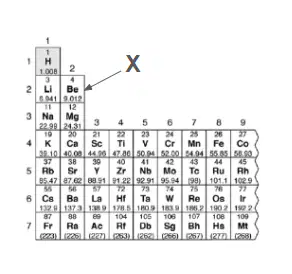
Examine the periodic table. What does X represent?
compound
mixture
element
atom
Mixtures can be divided into two categories: homogeneous and heterogeneous. Which of the following describes the main difference between these two categories of mixtures?
In homogeneous mixtures, the ingredients are so evenly mixed that they cannot be visibly distinguished, while in heterogeneous mixtures, the ingredients are visible.
In homogeneous mixtures, the ingredients are chemically bonded together, while in heterogeneous mixtures, the ingredients are physically held together.
In heterogeneous mixtures, the ingredients are so evenly mixed that they cannot be visibly distinguished, while in homogeneous mixtures, the ingredients are visible.
In heterogeneous mixtures, the ingredients are chemically bonded together, while in homogeneous mixtures, the ingredients are physically held together.

Students in science class were asked to conduct an experiment to illustrate the Law of Conservation of Matter. Group 1 chose to complete the reaction of baking soda + vinegar using a flask and a balloon and a balance. How does Group 1 know this is a chemical change?
The vinegar and baking soda are each pure substances, and substances ALWAYS change chemically when added together.
The vinegar and baking soda react to create MORE mass than before mixing.
The vinegar and baking soda react to create a GAS, which is evidence of a new substance.
The vinegar and baking soda react to create LESS mass than before mixing.

Which of the following images represent a pure substance?
W only
X only
Y and Z
X and Y and Z

Which of the following images represents a single element?
W only
X only
Y and Z
X and Y and Z

Which of the following images represents a mixture?
W only
X only
Y and Z
X and Y and Z
Gary measured 100 mL of water in a graduated cylinder. He then poured the water into various containers. Gary noticed that the water always took the shape of the container into which it was poured. He also knew that the volume of the water never changed. Why can liquids, such as water, change shape?
The particles in a liquid are very far away from one another.
The particles in a liquid do not move fast enough to spread apart.
The particles in a liquid can move past each other.
The particles in a liquid cannot leave their fixed positions.
Jessica did an investigation about the states of matter. As part of the investigation, Jessica wanted to change a liquid into a solid. What must she do to bring about this change in state?
Place the liquid in a different container.
Stir the liquid as quickly and thoroughly as possible.
Increase the energy of the liquid so that its particles move faster.
Remove energy from the liquid so that its particles slow down.
The atom contains electrons surrounding a nucleus of protons and neutrons. Which of the following subatomic particles has a negative charge?
neutron
electron
nucleus
proton
Audra is looking at a diagram of an atom. Which particle(s) does she see inside the nucleus?
electrons only
protons only
electrons and protons
protons and neutrons
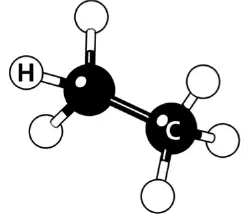
The model represents a structure of a form of matter. Which of the following does the model represent?
an atom
a nucleus
an element
a compound
An element is also a pure substance. What is the reason for this?
An element contains only one type of atom.
An element can combine with another element.
Different elements have different properties.
There are many ways that elements can combine.
Elements are grouped in the periodic table according to the similarities of their properties. For example, the metals are grouped together. Where are the metals located on the periodic table?
toward the top of the periodic table
on the right and in the center
on the left and in the center
toward the bottom of the periodic table
Elements in the periodic table are grouped into columns and rows. What is the name given to columns in the periodic table?
groups
clusters
periods
stages
In a neutralization reaction, an acid and a base neutralize each other. Water is one of two products that are produced from the neutralization reaction. What is the other product?
a gas
a salt
a metal
a protein
Acids can be strong or weak. Which pH value represents the STRONGEST acid?
pH=12
pH=7
pH=5
pH=1
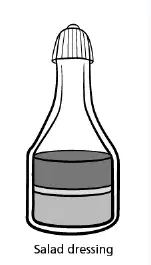
The illustration shows a homemade salad dressing that contains oil and vinegar. Based on the illustration, what conclusion can you make about salad dressing?
Salad dressing is a mixture.
Salad dressing is a solution.
Salad dressing is a pure substance.
Salad dressing is a compound made of elements.
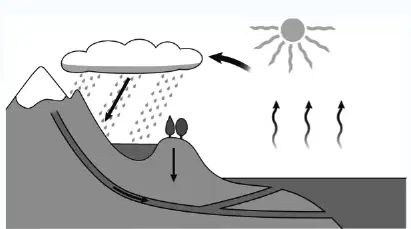
The illustration shows Earth’s water cycle. Which of the following does Earth’s water cycle demonstrate?
Physical Changes
Chemical Changes
chemical reactions
changes in chemical identity
Mrs. Flores asked her class to describe a chemical change. Which of the following descriptions is correct?
A chemical change does not affect the composition of a substance.
A chemical change can occur without changing the molecules of the substances.
A chemical change occurs whenever a substance is undergoing a change in its state.
A chemical change produces new substances with different properties than the original substances.
Temperature influences chemical changes. Why does a baker need high temperatures to make bread?
to burn away unwanted ingredients
to be sure that chemical reactions occur in the ingredients
to slow down the molecules in the ingredients
to mix the ingredients together
Chemical changes are influenced by temperature. Which of the following statements about temperature is correct?
Raising the temperature of a chemical reaction results in a slower reaction rate.
All chemical reactions can occur at room temperature.
All chemicals have freezing points below room temperature.
A beaker of hot acid will corrode a metal faster than a cold beaker of the same acid.
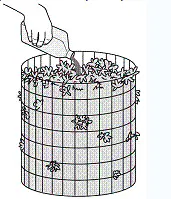
The illustration shows a gardener adding expired fruit juice to compost pile. Gardeners and farmers build compost piles containing living things like bacteria and worms which breaks down material such as dead plants and food waste and then converts it to fertilizer. During which season will a typical compost pile be most productive?
spring
summer
winter
fall
The Law of Conservation of Mass states that mass can neither be created nor destroyed. In which of the following situations does this law apply?
only in physical changes
only in chemical changes
in both chemical and physical changes
in neither chemical nor physical changes
According to the law of conservation of mass, what happens in a closed system?
Mass may be created and accumulated.
Mass may change in quantity over time.
Mass may be rearranged, but not destroyed.
Mass may decompose and eventually disappear.
In a science lab, two students use a balance to measure the mass of a box containing a small crystal. The mass of the box is 12 grams (g). One of the students accidentally drops the box when removing it from the balance, and the crystal breaks into 20 pieces. What happens to the mass of the box and crystal after the crystal is broken?
The mass remains the same.
The mass cannot be determined.
The mass increases by a factor of 20.
The mass decreases by a factor of 20.
Samuel conducts an experiment. He makes many observations and measurements and records each very carefully. At the conclusion of the experiment he discovers that the data he collected did not support his hypothesis. What should he do?
Change the data so that they support his hypothesis.
Change his hypothesis to one that is supported by the data.
Report his observations and conclusions honestly, clearly stating that the data did not support the hypothesis.
Throw all of his data and observations away and repeat the experiment.
Which of the following statements best defines a hypothesis?
It is an educated explanation about a natural phenomenon that can be proven or disproven by results of a scientific investigation.
It is an educated guess about the answer to a scientific question that can be tested to determine if data support or fail to support it.
It is an explanation about the results of a scientific investigation, such as a controlled experiment.
It is an educated explanation about a natural phenomenon that, when proven correct, becomes a scientific theory
How do replication and repeated trials compare?
During both processes, the original investigator does the experiment again.
During both processes, a different investigator does the experiment again.
During replication, a different investigator does the experiment again. During repeated trials, the original investigator does the experiment again.
During replication, the original investigator does the experiment again. During repeated trials, a different investigator does the experiment again.
Michaela wants to know which brand of rechargeable battery lasts longest. She buys four batteries made by different companies. She then puts the batteries into four identical flashlights and turns them on. She checks on the flashlights twice a day and records how long it takes for each flashlight to go out. Which of the following procedures would be a repeated trial of Michaela’s investigation?
Michaela runs the trial again, using a toy instead of a flashlight.
Michaela runs the whole trial, without changes, two more times.
Michaela’s friend runs the whole trial, without changes, two more times.
Michaela runs the trial again, changing her hypothesis so it will be supported.
Turner combines baking soda and vinegar into a 2 Liter bottle, and records how long it takes for the reaction to occur. Which of the following could Turner do in order to speed up the chemical reaction?
Increase the temperature in the bottle so that the particles move faster and collide more frequently.
Increase the volume of the bottle so that the particles move faster and collide more frequently.
Decrease the pressure in the bottle so that the particles slow down and collide less frequently.
Decrease the concentration of baking soda in the bottle so that there is less particles to collide.

Natural sugars are made of only three (3) elements - carbon, hydrogen, and oxygen. Despite this there are many types of natural sugars. Which two sugars make up agave, table sugar and high-fructose corn syrup?
naturlose and sucrose
fructose and glucose
fructose and sucrose
glucose and naturlose

Consider the following scenario:
You are asked to help a local middle school create a health flyer for students titled "Smart Choices for Sweet Snacks." Based on the article, which of the following statements supports the advice that should be included in the flyer, and why?
Replace sugar with agave nectar whenever possible, because it is plant-based and therefore healthier than other sweeteners.
Choose “sugar-free” products with artificial sweeteners like Splenda instead of sugar, because they are always a healthier option with no negative health effects.
Use all sweeteners in moderation, whether they are natural or artificial, because overconsumption of any sweetener — especially those with fructose — can cause health problems.
Avoid all sweeteners completely, including natural ones like agave and fruit juice, because they all contain fructose and fructose is toxic to your liver.
Which of the following statements best explains how replication and repetition of experiments can help determine whether sucralose is a better low-calorie sweetener for people with diabetes compared to agave syrup, erythritol, and honey?
Repetition and replication are only necessary when comparing artificial sweeteners, not natural ones like honey or agave syrup.
Replication and repetition help reduce the sweetness level of the sweeteners tested, making results easier to interpret.
Using replication and repetition allows researchers to avoid having to test more than one sweetener at a time.
Repeating and replicating experiments ensures that results are consistent and reliable, helping confirm that sucralose has less impact on blood sugar and calorie intake than the other sweeteners.

