
 Worksheets
Rocks and Plate Tectonics Review
Total questions: 121
Worksheet time: 1hrs 22mins

What happens where an oceanic plate converges with a continental plate?
The denser oceanic plate slides on top of the less dense continental plate.
The denser oceanic plate slides under the less dense continental plate.
The less dense oceanic plate slides past the denser continental plate.
The less dense oceanic plate slides under the denser continental plate.

At what type of plate boundary are most high continental mountains formed?
convergent boundary
hotspots
divergent boundary
transform boundary
mid-ocean ridges

What kind of plate movement created the Himalayan Mountains?
convergence of oceanic crust with continental crust.
divergence between two continental crustal plates.
transform movement between oceanic and continental crustal plates.
convergence of two plates composed of continental crust.

What type of boundary occurs where two plates move together, causing one plate to descend into the mantle beneath the other plate?
transform fault boundary
convergent boundary
divergent boundary
hotspots

Deep ocean trenches are associated with:
mid-ocean ridge systems.
transform fault boundaries.
subduction zones.
rift zones.

Rift valleys, like the Great African Rift Valley, form as a result of:
crustal compression.
divergent boundaries
convergent boundaries
subduction zones

A mid-ocean ridge is an example of what type of plate boundary?
convergent zone
divergent zone
transform zone
subduction zone

The youngest rocks on the ocean floor are typically located near what feature?
a mid-ocean ridge
a subduction zone
on an island arc
a deep-sea trench

A rift valley is evidence of which kind of plate boundary?
convergent boundary
transform boundary
divergent boundary
hotspot

What kind of plate boundary occurs where two plates grind past each other without destroying or producing new lithosphere?
divergent boundary
hotspots
convergent boundary
transform boundary

Which type of plate boundary is in the southern California region?
passive margin
divergent boundary
convergent boundary
transform boundary
What does the theory of Continental Drift explain?
Ocean currents move continents around the planet
Convection works deep within the asthenosphere
Mid-ocean ridges force tectonic plates to move
Continents were once together and slowly drifted to where they are today
Tectonic plates are made of?
The mantle
Continental and oceanic lithosphere
The outer core
The mesosphere
Where are the youngest rocks on Earth found?
Along mid-ocean ridges
Along transform boundaries
On the edges of the continents
Near ocean trenches
Who was the scientist who proposed the theory of continental drift?
Alfred Powell
Harry Hess
Alfred Wegener
Ernest Rutherford
How far do tectonic plates move each year?
Meters per year
Centimeters per year
Kilometers per year
Feet per year
Where does seafloor spreading take place?
Convergent boundaries
The continentals shelves
Transform boundary
Mid-ocean ridges
What is the driving force behind the movement of the tectonic plates?
Gravity
Convection
Wave motion
Seismic activity
The super continent that existed when all continents were together was named
Gondwana
Laurasia
Eurasia
Pangea
What is the process of convection?
The process of hot material rising and cooler material sinking in circular patterns
The process of hot rock solidifying and forming new crust
The process of explaining what goes up must come down
Strong ocean currents moving tremendous amounts of material
This type of boundary creates rift zones and shallow earthquakes
Transform
Continental-Continental Convergent
Divergent
Oceanic-Continental Convergent
At this boundary plates slide past one and other and earthquakes are created
Transform
Continental-Continental Convergent
Divergent
Oceanic-Continental Convergent
At this boundary, old crust is destroyed and deep earthquakes occur
Transform
Continental-Continental Convergent
Divergent
Oceanic-Continental Convergent
Mountains are created along
Transform boundaries
Continental-Continental Convergent
Divergent
Oceanic-Continental Convergent
Volcanoes are created along
Divergent and Convergent boundaries
Transform and Convergent boundaries
Divergent and Transform boundaries
The boundary between Illionois and Wisconsin
Subduction zones occur along
Transform boundaries
Continental-Continental boundaries
Divergent boundaries
Oceanic-Continental boundaries
Ocean trenches are found along
Transform boundaries
Continental-Continental boundaries
Divergent boundaries
Oceanic-Continental boundaries
Earthquakes can happen along
All boundaries
Divergent and transform boundaries
Convergent and divergent boundaries
Transform and Convergent boundaries
How do the plates move along a divergent boundary?
They move towards one another
They move away from one another
They move past one another
One move up the other moves down
How do the plates move along convergent boundaries?
They move towards one another
They move away from one another
They move past one another
One moves up and one moves down
How do the plates move along transform boundaries?
They move towards one another
They move away from one another
They move past one another
one moves up and one moves down
When comparing the lithosphere to the asthenosphere, which statement is correct?
The asthenosphere is part of the crust, and the lithosphere is part of the mantle.
The lithosphere is a layer of flowing hot magma that supports the solid thin layer of the asthenosphere.
The lithosphere is brittle and rigid, and the asthenosphere is plastic-like and flowing.
The asthenosphere is a thin layer that sits on top of the lithosphere.
Which statement is true regarding the movement of the continents on the opposite sides of the Atlantic Ocean?
They are drifting closer together.
They have remained the same distance apart.
They drifted further apart and then drifted closer together.
They are drifting farther apart.
What causes the Earth's crustal plates to move?
convection currents in the Earth's mantle
revolution of the Earth around the Sun
volcanism within the Earth's lithosphere
the rotation of the Earth on its axis
Which layer of the Earth is described as "plastic and flowing"?
asthenosphere
atmosphere
lithosphere
troposphere
When parts of the upper mantle collide with each other, the force causes changes on the surface like volcanoes and fractures. Why does the collision not impact the asthenosphere?
The asthenosphere is plastic and brittle.
The asthenosphere is plastic and flowing.
The asthenosphere is rigid and flowing.
The asthenosphere is rigid and brittle.
Which statement is supported by the Theory of Continental Drift?
Present-day continents of South America and Africa are moving toward each other.
Continents move due to changes in the Earth's orbit around the Sun.
Present-day continents of South America and Africa once fit together like a jigsaw puzzle.
Continents move due to changes in the tilt of the Earth's axis.
What is the point on the Earth's surface that lies directly above the site where an earthquake occurred?
seismic wave
fault line
focus
epicenter
Where does most present-day faulting of rock occur?
crustal plate boundaries
interior areas of continental crustal plates
polar regions of the Earth
interior areas of oceanic crustal plates
Which statement is true according to the theory of plate tectonics?
Lithospheric plates are destroyed at the mid-ocean ridges.
Continents drift because they rest on lithospheric plates that move.
Lithospheric plates move because the inner core of the Earth is liquid.
Transform boundaries form when two lithospheric plates collide.
The continents on Earth today are not in the same location as they were 300 million years ago. What concept provides the best explanation for the drifting of the continents?
global warming
law of conservation of mass
seismic probability
theory of plate tectonics
Geologists believe that millions of years ago all the continents were united and formed which supercontinent?
Gondwanaland
Pangaea
Eurasia
Atlantis
Where do earthquakes most likely occur?
the interior of an oceanic crust plate
boundary between the core and mantle
near a fault zone
near the equator
In 1912, Alfred Wegener proposed the theory of continental drift, stating that all the continents were once joined together and slowly moved apart. However, his theory was not widely accepted in his time. In 1962, the discovery of sea floor spreading (sea floor being forced apart by the formation of new crust) eventually led to a more modern and widely accepted theory of plate tectonics.
Why did the theory of plate tectonics improve upon Wegener’s theory of continental drift?
The theory of plate tectonics was a less complete theory because it failed to provide complete reasons and mechanisms for why the plates and continents moved.
The theory of plate tectonics was a more complete theory because it provided a reason and mechanism for why the plates and continents moved.
The theory of plate tectonics was a more complete theory because it failed to provide reasons and mechanisms for why the plates and continents moved.
The theory of plate tectonics was a less complete theory because it provided a reason and mechanism for why the plates and continents moved.
How do rock samples collected from the sea floor provide evidence of tectonic plate movement?
Older rocks are found near the deep-ocean trenches.
Older rocks are near the center of mid-ocean ridges.
Younger rocks are near the deep-ocean trenches.
Younger rocks are mixed with older rocks at mid-ocean ridges.
Where is the thickest part of the Earth's crust?
under the oceans
under deserts
under mountain ranges
under swamps
Which statement is true about the Earth's crust?
Earth's crust is thinnest under oceans.
Earth's crust is uniform in thickness.
Earth's crust is thinner under the poles and thicker at the equator.
Earth's crust is thinnest under mountainous regions.
Which statement is true about subduction zones?
They occur when a less dense plate is pushed below a more dense oceanic plate.
They result in mountains formed when two continental plates collide.
They always result in sea-floor spreading.
They always occur at convergent plate boundaries.
The San Andreas Fault in California is caused by the Pacific Plate sliding horizontally along the North American Plate. Many earthquakes occur along this fault. What type of fault results from this type of plate boundary movement?
convergent
divergent
subduction
transform
Which statement is true regarding the movement of the continents on the opposite sides of the Atlantic Ocean?
They have been drifting farther apart.
They have been drifting closer together.
They have remained the same distance apart.
They drifted further apart and then drifted closer together.
The vast majority of earthquakes and volcanic eruptions occur near plate boundaries, but there are some exceptions. The Hawaiian Islands, which are entirely of volcanic origin, have formed in the middle of the Pacific Ocean in the middle of the Pacific Plate.
Regions exist below the plates which provide localized sources of high heat energy to sustain volcanism. What are these regions called?
subduction zones
hot spots
convection centers
asthenosphere thermals
What happens when oceanic crust subducts beneath continental crust?
A volcanic island arc and an ocean trench will form.
A non-volcanic mountain range will form.
An on-shore volcanic arc and an ocean trench will form.
A rift valley will form.
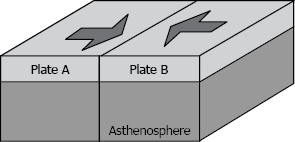
A student prepares a model to show a convergent boundary between two plates, A and B.
What would happen if Plate A is a continental plate, and Plate B is an oceanic plate?
Plate A would subduct beneath Plate B, forming an oceanic volcano.
Plate B would subduct beneath Plate A, forming a deep trench.
Plates A and B would collide, forming an oceanic ridge and a volcanic arc.
Plates A and B would thrust rocks upward, forming a fold mountain.
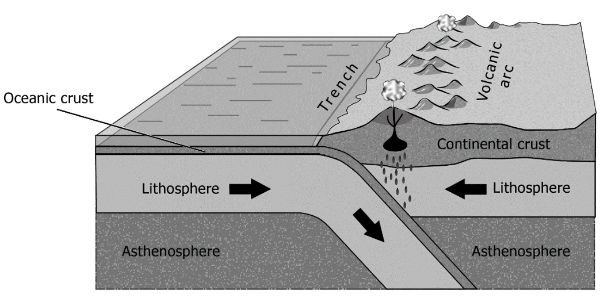
The diagram shows a type of tectonic plate boundary.
What type of plate boundary is shown?
oceanic-oceanic divergent plate boundary
continental-continental divergent plate boundary
continental-continental convergent plate boundary
oceanic-continental convergent plate boundary
What is the name of the 225 million year old super continent?
Pancake
Pangea
Super Continent Sam
Albert Einstein
How first identified the theory of plate tectonics and Pangea?
Albert Einstein
Patrick Henry
Alfred Wegener
Mr. Harris
What are two pieces of evidence that support the theory of plate tectonics?
Matching rocks/fossils on different continents
Landscapes that look alike
The same species live in different areas today
Seafloor Spreading
The lithosphere is one smooth, solid shell around the Earth.
True
False
In convection currents, hot material ______ and then cool material _____.
1) Rises
2) Sinks
1) Sinks
2) Rises
Convergent boundaries occur when:
Two plates pull apart
Two plates collide
Two plates scrape/slide past each other
Divergent boundaries occur when:
Two plates pull apart
Two plates collide
Two plates scrape/slide past each other
Transform boundaries occur when:
Two plates pull apart
Two plates collide
Two plates scrape/slide past each other
Subduction zones occur when:
Two plates collide at and convergent boundary and one sinks
Two plates collide at a convergent boundary and they push each other up
Two plates pull apart at a divergent boundary
Seafloor spreading occur when:
Two plates collide at and convergent boundary and one sinks
Two plates collide at a convergent boundary and they push each other up
Two plates pull apart at a divergent boundary
Mountain building occurs when:
Two plates collide at and convergent boundary and one sinks
Two plates collide at a convergent boundary and they push each other up
Two plates pull apart at a divergent boundary
Alfred Wegener's Theory of Plate Tectonics was laughed at initially, but is now believed by the scientific community.
True
False


What type of event will occur at this boundary?
Earthquake
Volcano Eruption
Tornado
Mountain Building
Mountains are created when....
Two continental plates collide
Two oceanic plates pull apart
An Oceanic plate subducts under a Continental Plate
Two continental plates pull apart

Which of these events can ONLY happen on a DIVERGENT BOUNDARY?
Rift Valley
Mountain
A peninsula
An Insanely complex, long answer that you will click out of instinct.
Rising magma that results from subduction may produce...
fossil layers
volcanic island arcs
deep-sea sediment
seafloor spreading
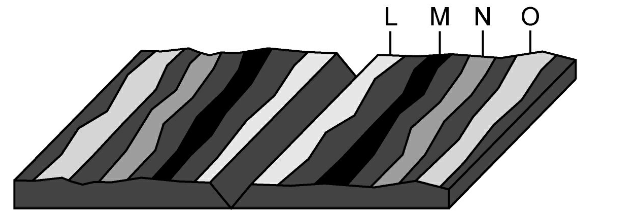

Which type of boundary involves the plates moving horizontally, side by side?
convergent
divergent
transform
When a divergent boundary occurs on land, which landform does it create?
mid-ocean ridge
rift valley
new ocean floor
subduction zone
What are transform boundaries known for?
earthquakes
volcanoes
mid-ocean ridges
rift vallies
The process when one crust goes under another is called
sea floor spreading
convergency
subduction
rifting
Which of the following does not occur at a continental-oceanic convergent boundary?
volcano
deep ocean trench
mountain
When 2 oceanic crusts collide, which one subducts?
The older crust
The newer crust
can not tell from information given
What is formed when a continental crust collides with another continental crust?
volcanoes
earthquakes
deep ocean ridges
mountains

