
 Worksheets
Electromagnetism
Total questions: 123
Worksheet time: 2hrs 54mins

If you are a scientist, what is your conclusion?
Did we do any lab that shows the interaction between electricity and magnetic field? What is it?
(a)
A magnet will pick up an object that is made of...
plastic
iron or steel
glass
copper

Which sides of the magnet repel each other?
A) North and North Pole
B) South and South Pole
C) The North and South Pole
D) A and B
E) A, B,C
What happens when an electric current flows through a wire?
The wire begins to spin.
Nothing happens.
A field of gravity is created around the wire.
A magnetic field is created around the wire.
How do you describe electromagnetism?

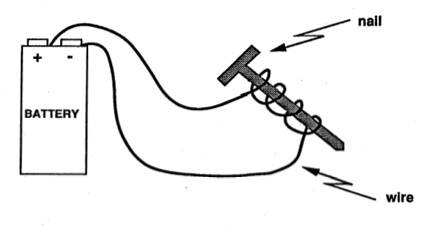
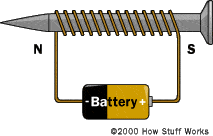
The diagram shows a device made up of a battery, some wire, and an iron core. Which type of device is shown?
an electric generator
a permanent bagnet
a bar magnet
an electromagnet

Which machine uses magnetism to produce electricity?
electromagnet
electric generator
motor
compass
Which objects would you combine to build an electromagnet?
compass, source of electric current, copper wire
battery, generator, steel screw
copper wire, source of electric current, steel screw
battery, light bulb, plastic straw
What will happen if a bar magnet is moved through a coil of wire?
The bar magnet will lose its magnetism.
An electric current will be generated in the wire.
The wire will become an electromagnet.
An electric current will be generated in the magnet.
Which diagram best identifies how an electric current is produced?


In an electromagnet, a current is passed through loops of wire that surround a core. Which material would be best to use as the core of an electromagnet?
aluminum paper clip
pen
piece of chalk
an iron nail
A student coils a copper wire around a bar magnet. Which action will cause the device to generate electricity?
The student connects the copper wire to a light bulb.
The student insulates the copper wire with plastic.
The student uses a horseshoe magnet instead of a bar magnet.
The student moves the bar magnet through the copper wire coils.
Which diagram best represents the lines of the magnetic field that pass through Points 1 and 2 of the electromagnet?


Which diagram represents a magnet creating an electric current?


Which statement best compares a permanent magnet and an electromagnet?
A permanent magnet has a north pole and a south pole, but an electromagnet only has a south pole.
A permanent magnet has a fixed magnetic field strength but the magnetic field strength of an electromagnet can be changed.
A permanent magnet requires an external source of energy, but an electromagnet produces its own energy.
The magnetic field lines from a permanent magnet emerge from the north pole, but they emerge from the south pole of the electromagnet.

The strongest parts of the magnet are ...
fronts
backs
poles
middle
Which of the following is not a subatomic particle that makes up an atom?
neutron
proton
nucleon
electron
Protons have a ____________ charge.
negative
neutral
positive
Electrons have a ____________ charge.
negative
neutral
positive

Why does the compass needle move at different locations?
Because the needle is attracted to the magnetic field produced by the magnet
Because north is up
Because it is being attracted to the Magnetic North Pole
Because north is down

These magnetic domains are:
strongly magnetized
slightly magnetized
unmagnetized


To make this electromagnet stronger you could:
use less wire
have fewer wire coils around the nail
have more wire coils around the nail
use a plastic core

When running a current through a wire, what do the blue lines represent?
The wire spinning
A magnetic field that was created
Electrons leaving
Electricity

Which one represents the magnetic field lines of magnets repelling?
A
B
Which one represents the magnetic field lines of magnets attracting?
A
B

This picture best illustrates the construction of a(n)
magnet
electromagnet
series circuit
parallel circuit
Particles with opposite charges (a) and particles with same (or like) charges (b) .
The relationship between electricity and magnetism is called _____________.
Electricity
Law of Conservation of Energy
Electromagnetism
Magnetism

A _______________ is a coil that carries an electric current.
Solenoid
Simple Electric Motor
Electromagnet
Generator
What can be done to increase the number of magnetic objects that an electromagnet picks up?
Make the wire longer
Remove the nail from the center of the wire
Increase the number of coils in the solenoid
Spread the coils out across the nail
Which of these is not a way to increase the magnetism of an electromagnet
Increase the length of the wire.
Increase the thickness of the wire.
Decrease the distance to the power source.
Increase the distance to the power source.
Which of these is not an example of an electromagnet.
Refrigerator Magnet
Speakers
Computer Hard Drive
Generators
(Choose all that apply) Which of these would decrease the power of an electromagnet?
Decrease the distance to the power source.
Decrease the thickness of the wire.
Decrease the amount of current running through the wire.
Decrease the length of the wire.
(True of False) An electromagnet is still a magnet when there is not current running through it.
True
False

How can you increase the magnetic field strength in an electromagnet?
Increase the number of coils.
increase the voltage
increase the current by reducing the resistance of the coil
all of the above
If you brought an unknown pole of a magnet near a North magnetic pole and they repel what is the unknown pole?
North
South
Neutral
not enough information
Magnetic field lines around a bar magnet
(a)

Every magnet, regardless of its shape, has two
(a)

Magnetic poles that are unlike
(a)

What is one difference between a galvanometer and an electric motor?
An electric motor causes something to move.
A galvanometer uses an electric current.
In an electric motor, the armature spins continuously.
An electric motor uses electrical energy.

To reverse the direction of current in a motor, current is conducted
(a)

The type of current produced by a battery is
(a)

You can increase the strength of an electromagnet’s field by
(a)

As Earth’s magnetic poles move, the magnetic declination in a given location will
(a)
An electric current produces
(a)

Electric current from a generating plant is
(a)

A maglev train floats above its rails due to (a) .
When a wire moves up or down repeatedly in a(n) (a) , an alternating current is induced in the wire.
A step-up transformer is a transformer that increases (a) .
A(n) (a) is a strong magnet that can be turned on and off.

A magnetic pole is the part of a magnet where the magnetic effect is (a) .

A compass behaves as it does because (a) acts as a giant magnet.

A DC generator is like an AC generator, except that it contains a(n) (a) instead of slip rings.

Increasing the number of loops in a solenoid will cause the strength of its magnetic field to (a) .

Magnets attract (a) .

According to the diagram, the upper loop of the wire will move (a) .

if the direction of the current were reversed, the wire move (a) .

What common electrical device is shown in the diagram?
an electric motor
a DC generator
a galvanometer
an AC generator

Look at the circular arrow in the diagram. The side of the loop closest to the (a) magnetic pole is moving up.
Describe two ways of causing the loop to rotate in the opposite direction in the diagram.
Electron
Has a positive charge
Has a negative charge
The gain of electrons
The loss of electrons
Proton
Has a positive charge
Has a negative charge
the gain of electrons
the loss of electrons
Positive Charge
Has a positive charge
Has a negative charge
the gain of electrons
the loss of electrons
Negative Charge
Has a positive charge
has a negative charge
the gain of electrons
the loss of electrons
Magnetic Forces
attractive and repulsive forces between two poles (power)
occur when ions create attractive and repulsive forces
made up of protons and electrons that produce an electric current when in motion
moving charge
Electric Current
attractive and repulsive forces between two poles (power)
occur when ions create attractive and repulsive forces
made up of protons and electrons that produce an electric current when in motion
moving charge
Electric Charge
attractive and repulsive forces between two poles (power)
occur when ions create attractive and repulsive forces
made up of protons and electrons that produce an electric current when in motion
moving charge
Electric Force
attractive and repulsive forces between two poles (power)
occur when ions create attractive and repulsive forces
made up of protons and electrons that produce an electric current when in motion
moving charge
Electromagnetism
invisible force created when electrons all spin in the same direction
area around the poles of a magnet
north or south end of a magnet
force combining both magnetic and electric fields
Magnetic Field
invisible force created when electrons all spin in the same direction
area around the poles of a magnet
north or south end of a magnet
force combining both magnetic and electric fields
Magnetic Pole
invisible force created when electrons all spin in the same direction
area around the poles of a magnet
north or south end of a magnet
force combining both magnetic and electric fields
Magnetism
invisible force created when electrons all spin in the same direction
area around the poles of a magnet
north or south end of a magnet
force combining both magnetic and electric fields
Attract
the action of opposite poles
the action of same poles
electrical energy to mechanical energy
mechanical energy to electrical energy
Repel
the action of opposite poles
the action of same poles
electrical energy to mechanical energy
mechanical energy to electrical energy
Generator
the action of opposite poles
the action of same poles
electrical energy to mechanical energy
mechanical energy to electrical energy
Motor
the action of opposite poles
the action of same poles
electrical energy to mechanical energy
mechanical energy to electrical energy
Semiconductors
process of generating an electric current with a magnetic field
material through which charges can move freely
special class of materials that conduct electric charge better than electric insulators but not as good as electric conductors
material through which charges can not move easily
Electric Conductor
process of generating an electric current with a magnetic field
material through which charges can move freely
special class of materials that conduct electric charge better than electric insulators but not as good as electric conductors
material through which charges can not move easily
Electric Insulator
process of generating an electric current with a magnetic field
material through which charges can move freely
special class of materials that conduct electric charge better than electric insulators but not as good as electric conductors
material through which charges can not move easily
Electromagnetic Induction
process of generating an electric current with a magnetic field
material through which charges can move freely
special class of materials that conduct electric charge better than electric insulators but not as good as electric conductors
material through which charges can not move easily


Electric currents passing through wires will produce a(n)
solenoid
magnet
magnetic field
insulator
What makes an electromagnet different than a permanent magnet.....select all that apply
it can be turned on and off
it does not need any electricity
its strength can be increased and decreased
its polarity can be reversed
What type of materials are needed to create an electromagnet?
battery, light bulb, plastic straw
battery, coil of wire, iron core
generator, iron core, switch
switch, source of electricity, compass

An electromagnet is a magnet that
its strength can be varied and turned on and off
always has a magnetic field around it
has very little strength
What are two ways to induce (begin) a current in a solenoid?
Moving a bar magnet inside a solenoid
Moving a solenoid inside a magnetic field
Setting a ferromagnetic material near a solenoid
Resting a magnet in a solenoid

If the needle on a galvanometer is not moving this means there is no _______ _________
Electrical current
Magnetic field lines
Gravitational field
Quantum Field

Which factor will NOT affect the magnitude (size) of an induced electrical current?
The amount of coils used
The speed of the magnet movement
the strength of the magnet
The direction the magnet is moving

Which lightbulb will have the greatest electrical current induced?
A
B
C
D


Which action will increase the deflection of the galvanometer pointer?
The magnetic pole is reversed
The number of turns of coils is increased
The coil is made from insulated wire
The magnet is slowly pushed into the coil
What type of energy does a generator produce?
Electrical
gravitational
Magnetic
No force
What converts electrical energy into mechanical energy?
Electric Motor
Generator

What does a power plant use to produce electricity?
Generators
Electric motors
A ____________ is responsible for changing the direction of current in an electric motor.
Commutator
Solenoid
Ferromagnet
Electromagnet
What type of input does a generator require to produce electricity?
Mechanical
Electrical
Magnetic
Gravitational
What type of input does a generator require to produce electricity?
Mechanical
Electrical
Magnetic
Gravitational
What does a power plant use to produce electricity?
Generators
Electric motors
What converts electrical energy into mechanical energy?
Electric Motor
Generator
What type of energy does a generator produce?
Electrical
gravitational
Magnetic
No force

What type of device is shown?
Electromagnet
motor
generator
Electromagnetic induction

A generator converts ______ into ______.
Electrical energy, mechanical energy
mechanical energy, electrical energy
electrical energy, solar energy
Solar energy into electrical energy

The following image is a.....
Transformer
Generator
Motor
Galvanometer

