wayground logo

Free Printable Worksheets

Font size

S
M
L
XL
Worksheets

Exam Review - Semester 1

Total questions: 122

Worksheet time: 1hrs 1mins
Name
Class
Date
1.
1. On what day of the week is work always due in Mrs. Dieges' class?
a)
Tuesday
b)
Wednesday
c)
Thursday
d)
Friday
2.
2. Being on time in Mrs. Dieges' class means that you
a)
have your foot in the door when the bell rings
b)
are seated and ready to work when the bell rings
c)
come in after you use the bathroom
d)
come in whenever you feel like it
3.
3. When writing a summary for Cornell notes one thing you need to do is
a)
make sure you write in ink.
b)
make sure you answer the essential question.
c)
whatever you want.
d)
make sure you write it in cursive writing.
4.
5. Always point a test tube
a)
away from you and towards others
b)
toward you and others
c)
away from you and others
d)
towards you and away from others
5.
6. To safely smell a chemical in the lab
a)
smell it slowly
b)
heat the substance before smelling
c)
inhale the fumes directly from the container
d)
gently wave the fumes toward your nose using a wafting motion
6.
7. You should know the proper use of safety equipment in the laboratory and
a)
where it is located
b)
use it once a week
c)
use it twice a year
d)
where it is produced
7.
8. If you injure yourself or others,
a)
don't tell anyone
b)
wait until the end of the experiment to tell the teacher
c)
tell the teacher immediately
d)
wait until after class to go to the nurse
8.
9. Disturbing other students, while they are working in the laboratory, is
a)
helpful
b)
dangerous
c)
poor manners
d)
the quickest way to do the job
9.
10. Before you touch an electric plug, switch, or outlet
a)
your hands should be dry
b)
ask the custodian
c)
your hands must be clean
d)
ask the teacher
10.
11. The most important thing in laboratory experiments is
a)
getting the answer right
b)
finishing first
c)
safety
d)
penmanship
11.
12. A process that is used to find answers to questions about the world around us?
a)
Problem
b)
Guessing
c)
Scientific Method
d)
Hypothesis
12.
13. A hypothesis is a(n) _____________ guess based on _______________ and your knowledge.
a)
uneducated, news
b)
educated, observations
c)
funny, jokes
d)
wild, superstition
13.
14. A hypothesis must be ______________.
a)
a question
b)
1000 words and double spaced
c)
testable
d)
the outcome
14.
15. Which step of the scientific method do you determine if your hypothesis was right or wrong?
a)
Conclusion
b)
Experiment
c)
Observation
d)
Replicate experiment
15.
16. Why should an experiment be repeated?
a)
to form a hypothesis
b)
to change controls
c)
to reduce the chance of error
d)
to identify the problem
16.
17. What is the purpose of a controlled experiment?
a)
To confuse students
b)
To isolate and test for only one variable
c)
To make life difficult
d)
To test multiple variables
17.
18. To run a controlled experiment on how sleep affects student test scores, you must
a)
vary the amount of sleep and food each group of students eat
b)
vary the type of tests that you give students
c)
vary amount of sleep and keep all other variables the same
d)
vary the amount of food and keep all other variables the same
18.
19. What is an Independent Variable?
a)
The variable you test by changing it
b)
Something you could change but don't
c)
The results/what you measure
d)
Something you hold constant in the experiment
19.
20. What is a Dependent Variable?
a)
The variable you test by changing it
b)
Something you could change but don't
c)
The results/what you measure
d)
Something you hold constant in the experiment
20.
21. What is a Control Variable?
a)
The variable you test by changing it
b)
Something you could change but don't
c)
The results/what you measure
d)
Something you hold constant in the experiment
21.
22. The formula for speed is
a)
distance multiplied by time
b)
time divided by distance
c)
distance divided by time
d)
time multiplied by distance
22.
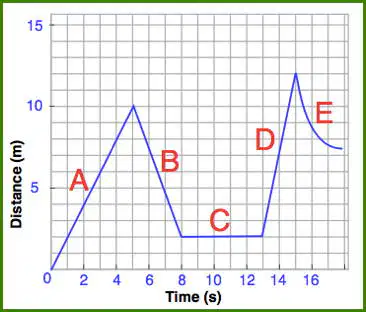
23. Using the graph above, calculate the runners' speed during segment A.
a)
10 m/s
b)
5 m/s
c)
2 m/s
d)
0 m/s
23.
24. Using the graph above, at which point was the runner going fastest?
a)
Segment A
b)
Segment B
c)
Segment C
d)
Segment D
24.
25. Distance is the ___________ of a route between two points.
a)
length
b)
smell
c)
depth
d)
direction
25.
26. The SI unit for speed is
a)
miles per hour
b)
meters per second
c)
feet per second
d)
kilometers per hour
26.
27. A vector (arrow) is a quantity that includes both ___________ and _____________.
a)
size, direction
b)
time, space
c)
sweet, sour
d)
distance, acceleration
27.
28. Average speed is
a)
speed at an instant in time
b)
slow
c)
speed over a period of time
d)
fast
28.
29. Velocity is the same as speed except that velocity also includes
a)
time
b)
direction
c)
distance
d)
force
29.
30. Frame of reference refers to something that is ______________ _____________ with respect to an observer that can be used to detect motion.
a)
always moving
b)
sometimes moving
c)
not moving
d)
barely moving
30.
31. If Maria runs at a speed of 2 m/s, how far will she run in 60 seconds?
a)
120 meters
b)
60 meters
c)
30 meters
d)
180 meters
31.
32. Instantaneous speed is
a)
fast
b)
slow
c)
overall speed
d)
speed at an instant in time
32.
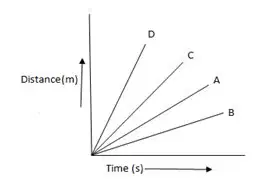
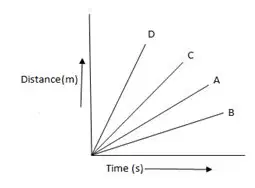
33. Which runner is faster than runner C?
a)
D
b)
A
c)
B
d)
A and B
33.
34. If there were a 5th racer and they ran slower than the other 4, where would the line for their speed be represented on the graph?
a)
Between A and B
b)
Before D
c)
Between C and A
d)
Before B
34.
35. Lexi took 2 seconds to speed 10 meters through the scooter race. What was her speed?
a)
just okay
b)
5m/s
c)
5 mph
d)
20 mph
35.
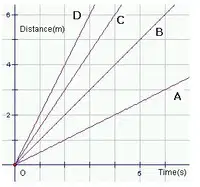
36. Which of the following lines shows the fastest speed?
a)
A
b)
B
c)
C
d)
D
36.
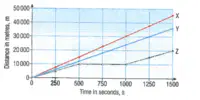
37. Which line shows an object that was moving, then stopped, then started moving again?
a)
Z
b)
Y
c)
X
d)
X and Y
37.
38. A push or pull on an object is called a(n)
a)
fun time
b)
velocity
c)
force
d)
weight
38.
39. How are forces described?
a)
time and strngth
b)
direction and time
c)
length and width
d)
direction and strength (magnitude)
39.
40. How do you find net force?
a)
by adding or subtracting all forces
b)
by dividing the large force by the small force
c)
by multiplying all of the forces together
d)
the largest force is the total
40.
41. If two equally strong dogs are playing tug of war we know that the forces are
a)
unbalanced
b)
slobbery
c)
balanced
d)
balanced and unbalanced
41.
42. A student hits a nail with a hammer. During the collision, there is a force
a)
on the hammer but not on the nail
b)
on the nail but not on the hammer
c)
on the nail and also on the hammer
d)
none of the above
42.
43. A man weighing 500 N sits on the floor. He exerts a force on the floor of
a)
1000 N
b)
500N
c)
250 N
d)
50 N
43.
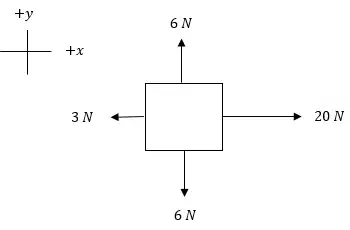
44. What is the net force on the box above?
a)
12N upward
b)
3N to the left <----
c)
20N to the right ---->
d)
17N to the right ---->
44.
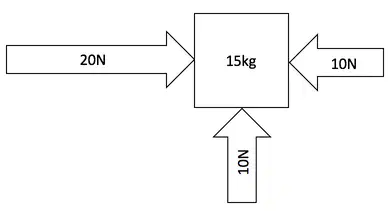
45. What is the net force on the box above?
a)
Up 10N and 20N to the left ----->
b)
Up 0N and 30N to the left ----->
c)
Up 10N and 10N to the left ----->
d)
Down 10N and 10N to the left ----->
45.
46.If an object is traveling at a constant velocity, which two forces will be equal?
a)
weight and net
b)
applied and frictional
c)
net and frictional
d)
net and applied
46.
47. In a game of Tug of War, the girls use 600 N of force to the left and the boys use 200 N of force to the right. Which describes the game?
a)
forces are balanced and there is no motion
b)
the net force is 800N and the boys win
c)
the net force is 400 N to the right
d)
the net force is 400N to the left
47.
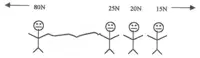
48. Who wins the tug of war with what net force?
a)
The person on the left with 20N
b)
The person on the left with 80N
c)
The people on the right with 20N
d)
The people on the right with 100N
48.
49. If the distance between 2 objects is changing then the forces must be
a)
with us
b)
activated
c)
unbalanced
d)
balanced
49.
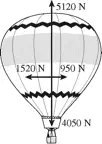
50. In the free-body diagram, which of the following is the gravitational force acting on the balloon?
a)
5120N
b)
950N
c)
4050N
d)
1520N
50.

In its orbit, Earth circles the sun once every year. This movement around the sun is called a(n) ________.

a)

rotation

b)

revolution

c)

astronomical unit

d)

satellite

51.

Rocks and pebbles that hit Earth's atmosphere and burn up are ________.

a)

meteors

b)

moons

c)

comets

d)

keplers

52.

Newton's Law of Inertia states that ________.

a)


invisible forces pull objects together based on their mass

b)

what goes up must come down

c)


an object in motion stays in motion unless acted upon by another force

d)


the distance from Earth to the sun is one astronomical unit

53.

The spinning of Earth on its axis is an example of its ________.

a)

newton

b)

gravity

c)

revolution

d)

rotation

54.

The distance from Earth to the sun is 150 million kilometers (93 million miles). We call this distance ________.

a)

escape velocity

b)

one astronomical unit (au)

c)

the Milky Way

d)

one light minute

55.

An object that orbits a planet is called a(n) ________.

a)

dwarf planet

b)

asteroid

c)

planetoid

d)

satellite

56.

The inner planets are ________.

a)

Neptune, Jupiter, Uranus and Saturn

b)

Ceres, Pluto, Eros, and Europa

c)

Mercury, Venus, Earth, Mars

d)

all objects in the Kuiper belt and Milky Way

57.

Our planets orbit around the sun because of

a)

gravity

b)

friction

c)

galaxy

d)

magic

58.
1. Magnetic fields can be seen with your eyes when
a)
you rub your foot on the carpet
b)
atoms have an equal number of protons and electrons
c)
iron filings are placed over a magnet
d)
all the electrons are spinning in the same direction
59.
2. Tell what would happen if these two magnets were lined up like so?
a)
They would Attract
b)
They would Repel
60.
3. What do the field lines tell us about the electric or magnetic force?
a)
what they are acting on
b)
how strong the force is
c)
how far apart the forces are
d)
where to find the pot of gold
61.
4. Which of the following images would NOT create a stronger magnetic force?
a)
increasing the distance
b)
adding magnets together
c)
adding more coils
d)
increase the current/voltage/battery
62.
5. The graph below shows the magnitude (strength) of the magnetic force at various distances. What can be said about the data shown below?
a)
As distance increases, the magnetic force decreases
b)
As force increases, distance increases
c)
As distance decreases, force decreases
d)
There is no correlation/relationship between force and distance
63.
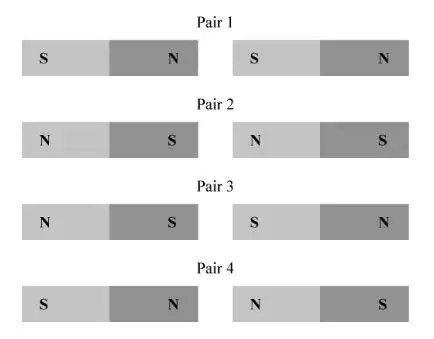
6. Which pair of magnets will demonstrate attraction
a)
Pair 1 & 2
b)
Pair 3 & 4
c)
Pair 1 & 4
d)
Pair 2 & 3
64.
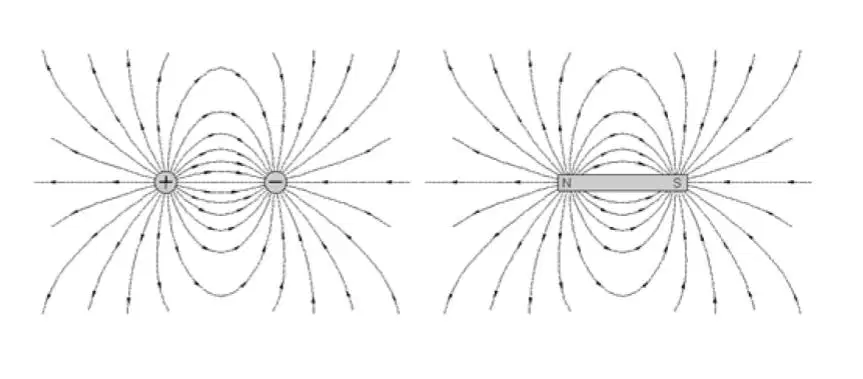
7. This magnetic field is an example of...
a)
Attractive magnetic force
b)
Repulsive magnetic force
c)
No magnetic force
d)
All of the above
65.
8. The Earth has a magnetic field that protects us from deadly ___
a)
Aliens
b)
Solar Radiation
c)
Meteors
66.
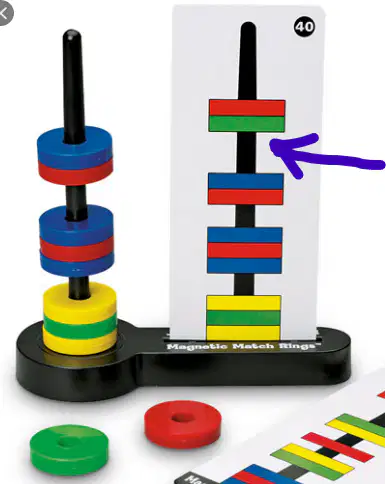
9. The picture below shows an interesting game, where you use magnetic "donuts" to create a pattern. Some of the donuts stack directly on top of each other and some have a space between them. WHY is there a space between the magnets?
a)
They are attracting (North pole facing North pole)
b)
They are repelling (south pole facing north pole)
c)
They are repelling (south pole facing south pole)
d)
The charge is neutral
67.
10. The picture below shows how the atoms in this mystery object are flowing. This object is...
a)
Magnetic
b)
Non-magnetic
68.
11. Which of the following is an example of contact force?
a)
Friction
b)
Magnetism
c)
Gravity
d)
Electricity
69.
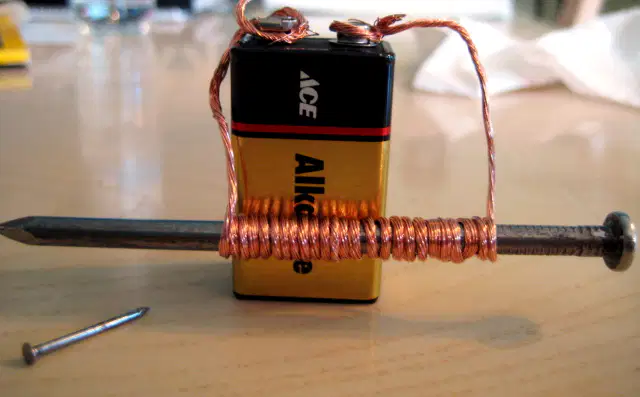
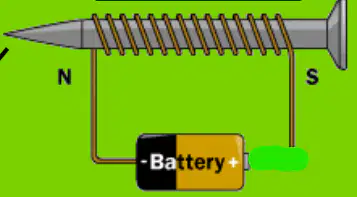
12. Iron nails are not normally magnetic. What happens inside the nail to allow it to become magnetized?
a)
all particles in the nail become positive due to protons and electrons moving through the wire
b)
the battery heats to the right temperature
c)
the atoms are neutral
d)
all the electrons in the atoms are spinning in the same direction
70.
13. If the electrical connection becomes disconnected in an electromagnet, the result is...
a)
magnetization will increase
b)
magnetization of the nail will decrease slightly
c)
magnetization of the nail will not change
d)
The nail will no longer be magnetized
71.
14. How can you make an electromagnet stronger?
a)
increase the number of coils in the wire
b)
Wrap aluminum wire around the nail
c)
reduce the amount of electrical charge
72.
15. Atoms that have a positive charge will be attracted to atoms with a _______________ charge.
a)
positve
b)
neutral
c)
negative
d)
none of the above
73.
16. Which of these forces works only by combining electric and magnetic forces?
a)
Magnetic
b)
Electromagnetism
c)
Electric
d)
None of the above
74.
17. Where is Earth's magnetic pole located?
a)
West and East ends
b)
North and South ends
c)
North and West ends
d)
West and South ends
75.
18. Which of the following is true of all magnets?
a)
They are all man made.
b)
They are made of iron.
c)
They have two poles and a magnetic field.
d)
They are magnetic only when an electric charge goes through them.
76.
19. If you have two magnets and you try to put the two north poles together, what will most likely happen?
a)
The two poles will not touch each other because of magnetic repulsion.
b)
The magnets will stick together because of magnetic attraction.
c)
The two poles will touch but not stick together.
d)
The magnets will lose their magnetism.
77.
20. Which of the following objects has polarity?
a)
the Earth, which has a magnetic north and south poles.
b)
the city of Chicago, which has a North and South side.
c)
a map of the country, which has a compass pointing north
d)
an unmagnetized block of metal, which has a top and a bottom
78.
21. A magnetic field is
a)
something used to demagnetize pieces of metal.
b)
the area in which a magnet exerts magnetic force.
c)
an open area where you are likely to find natural magnets.
d)
an electric charge that can be sent through a wire to make it magnetic.
79.
22. Which of the following works because of the Earth's magnetism?
a)
a compass
b)
a maglev train
c)
an electric clock
d)
a computer chip
80.
23. Magnetic attraction is a property that makes two magnets stick together. It occurs when
a)
a magnet is near a nonmagnetic object.
b)
two magnets' south poles are near each other.
c)
opposite poles of two magnets are near each other.
d)
a natural magnet and a man-made magnet are near each other.
81.
24. Magnetism is a type of...
a)
energy
b)
force
c)
friction
d)
car
82.
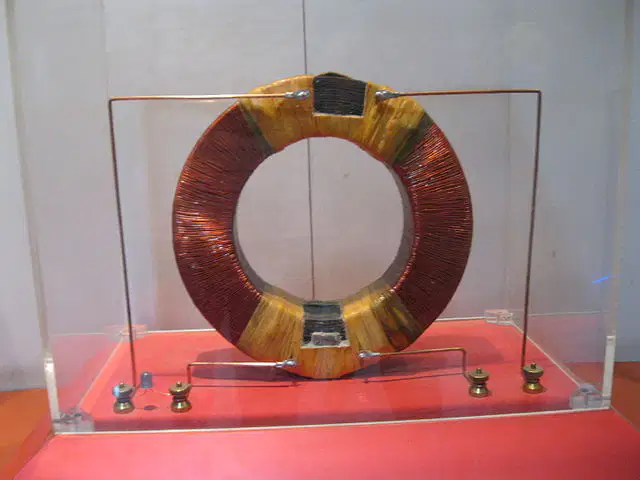
25. You can make an electromagnet stronger by...
a)
increasing the current through the wire.
b)
make the iron core bigger.
c)
increase the number of loops around the core.
d)
All of these
83.
1. How often does a full moon occur?
a)
Once every 30 days
b)
Twice a month
c)
Once every 29.5 days
d)
Once in a Blue Moon
84.
2. When the moon waxes it _____________________.
a)
A. goes from a new moon to a full moon
b)
B. seems to get bigger in size
c)
C. goes from a full moon back to a new moon
d)
A and B only
85.
3. True or False: The moon does not produce its own light.
a)
True
b)
False
86.
4. What is a way of describing how the moon looks during the quarter phase?
a)
invisible
b)
a pizza pie
c)
a half circle
d)
a thin banana
87.
5. When the moon wanes it _____________________
a)
A. goes from a new moon to a full moon
b)
B. goes from a full moon back to a new moon
c)
C. seems to get smaller in size
d)
D. B and C only
88.
6. What happens right after the full moon phase?
a)
The moon becomes new
b)
The moon goes through its phases in reverse order.
c)
The moon seems to disappear in the sky.
d)
The moon starts to wax.
89.
7. What is the correct order of the first five phases of the moon?
a)
new, crescent, quarter, gibbous, full
b)
new, crescent, gibbous, full
c)
full, crescent, quarter, new
d)
full quarter, gibbous, crescent, new
90.
8. What is true of a new moon?
a)
The moon appears invisible
b)
You can see about half of the moon
c)
The moon looks like a pizza pie
d)
It's the second phase of the moon
91.
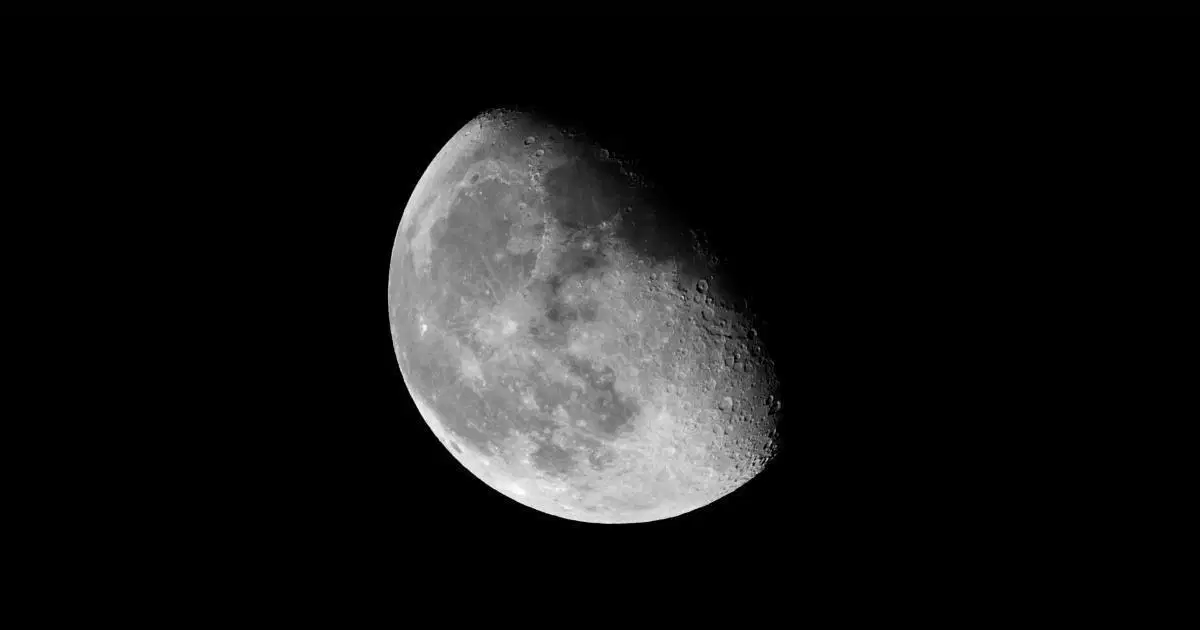
9. Which phase of the moon is shown in the picture below?
a)
new
b)
crescent
c)
quarter
d)
gibbous
92.
10. When the moon is full we experience ________
a)
a neap tide
b)
a spring tide
c)
a zombie attack
d)
no tide
93.
11. When the moon is a crescent we experience
a)
a neap tide
b)
a spring tide
c)
a zombie attack
d)
no tide
94.
12. Which phase of the moon is shown in the picture below?
a)
full
b)
gibbous
c)
quarter
d)
crescent
95.
A spring tide happens during which phases of the moon?
a)
1st and 3rd Quarter Moons
b)
Only a Full Moon
c)
Full and New Moons
d)
It could happen any time
96.
When the Sun and Moon are both pulling on Earth's oceans what do we experience?
a)
Low Tide
b)
Average Tide
c)
Our Lowest Tide
d)
Our Highest Tide
97.
When the Sun, Moon, and Earth are all in a straight line we experience what type of tide?
a)
Low tide
b)
Average tide
c)
Neap tide
d)
Spring tide
98.
When the Moon is at a right angle to the Earth what type of tide do we experience?
a)
Low tide
b)
Average tide
c)
Neap tide
d)
Spring tide
99.
Why is the Moon's gravitational pull on our ocean greater than the Sun's pull?
a)
The Sun is bigger
b)
The Moon is closer
c)
The Sun is brighter
d)
The Moon is brighter
100.
A solar eclipse happens...
a)
during a new moon
b)
during daylight
c)
when the Moon is between the Sun and the Earth
d)
All of the above
101.
What position would the Earth, Sun, and Moon be in during a solar eclipse?
a)
Sun, Moon, Earth
b)
Sun, Earth, Moon
c)
Earth, Sun, Moon
d)
Moon, Sun, Earth
102.
What position would the Earth, Sun, and Moon be in during a lunar eclipse?
a)
Sun, Moon, Earth
b)
Sun, Earth, Moon
c)
Earth, Sun, Moon
d)
Moon, Sun, Earth
103.
This image shows an unseen crater caused by a large object in the space-time dimension. You cannot see it but this is exactly how gravity causes the orbits of planetary objects in space. What would happen if you increased the mass of the object in the middle of the crater?
a)
The crater size and gravitational pull would decrease
b)
The crater size and gravitational pull would increase
c)
The crater size and gravitational pull would not change
d)
All of the above
104.
What would happen to the orbit of earth if the sun was moved WAY closer?
a)
The sun's gravity would suck the earth in and the earth would be destroyed
b)
The sun's gravity would repel the earth into outer space
c)
The earth's magnetism would cause the earth to revolve faster
d)
No observable change would happen
105.
Which factor does not change whether you are on the Earth or on the moon
a)
weight
b)
mass
c)
gravity
106.
The following data lists the Mass of each planet. On which planet will you weigh the most?
a)
Mercury
b)
Uranus
c)
Mars
d)
Venus
107.
How would the force of gravity change if the Earth doubled in size
a)
Increase
b)
Decrease
c)
Stay the same
108.
How much gravity an object has depends on its __________
a)
weight
b)
speed
c)
momentum
d)
mass
109.
What 2 things decide the amount of gravitational force on an object?
a)
mass and weight
b)
density and mass
c)
mass and distance
d)
volume and distance
110.
The force of gravity acting on an object is the object's
a)
mass
b)
weight
c)
matter
d)
velocity
111.
If Earth's mass was cut in half what would happen to your mass?
a)
Nothing, mass is not affected by gravitational force
b)
It would be cut in half because the Earth is cut in half
c)
Increase because gravitational force increases
d)
Decrease because gravitational force decreases
112.
What does the word mass mean?
a)
The amount of matter in something.
b)
The speed an object falls.
c)
How high a person can jump.
d)
How far an object can be thrown.
113.
The northern and southern halves of the Earth are called
a)
axes
b)
orbits
c)
equators
d)
hemispheres
114.
If the Southern Hemisphere is getting indirect sunlight, what kind of light is the Northern Hemisphere receiving?
a)
polar light
b)
midnight sun
c)
direct sunlight
d)
indirect sunlight
115.
Which of the following causes seasonal change?
a)
the angle of the sun's rays
b)
the tilt of the Earth's axis
c)
Earth's orbit around the sun
d)
all of the above
116.
Earth’s axis is an imaginary line that
a)
runs from pole to pole.
b)
runs around the Earth's middle.
c)
traces the Earth's path around the sun.
d)
measures the distance from the sun to the Earth.
117.
In the ________, the Northern Hemisphere receives direct sunlight.
a)
fall
b)
winter
c)
spring
d)
summer
118.
True or False: Winter is cold because the Earth is farther away from the sun.
a)
True
b)
False
119.
There isn’t any seasonal change at the equator because it
a)
always receives direct sunlight.
b)
always receives indirect sunlight.
c)
receives direct sunlight for part of the year.
d)
receives indirect sunlight for part of the year.
120.
If the Southern Hemisphere is experiencing colder temperatures and shorter days, it is receiving
a)
polar sunlight.
b)
direct sunlight.
c)
indirect sunlight.
d)
transitional sunlight.
121.
At the North and South Poles, the seasons
a)
don’t change much because the poles always receive direct sunlight.tion 1
b)
change drastically because the sun doesn’t set in the summer and doesn’t rise in the winter.
c)
change regularly but without drastic highs and lows.
d)
never change because it’s always winter at the poles.
122.
Talking about “direct” and “indirect” sunlight is a way of describing
a)
the heat of the sun.
b)
the angle of the sun's rays.
c)
the Earth's distance from the sun.
d)
the changing tilt of the Earth's axis.