wayground logo

Free Printable Worksheets

NEW

Font size

S
M
L
XL
Worksheets

Chapter 4 Review: Ecosystems and Communities

Total questions: 50

Worksheet time: 39mins

Name
Class
Date
1.
A symbiotic relationship in which one species benefits and the other is not affected.
a)
Mutualism
b)
Commensalism
c)
Parasitism
d)
Competition
2.
A symbiotic relationship in which two or more species benefit.
a)
Mutualism
b)
Commensalism
c)
Parasitism
d)
Competition
3.
Interaction in which an animal feeds on a plant.
a)
Herbivory
b)
Mutualism
c)
Commensalism
d)
Parasitism
4.
A long-lasting and physically close relationship in which at least one organism benefits.
a)
Symbiosis
b)
Fitness
c)
Adaptation
d)
Herbivory
5.
The ability of an organism to tolerate, or survive and reproduce under changing environmental conditions.
a)
Tolerance
b)
Fitness
c)
Adaptation
d)
Symbiosis
6.
Species that have strong and/or wide-reaching effects on a community; removal of this species could cause the ecosystem's food web to collapse.
a)
Invasive Species
b)
Pioneer Species
c)
Keystone Species
d)
Endemic Species
7.

No two species can occupy the same niche in the same habitat at the same time

a)

because of the interactions that shape the ecosystem.

b)

unless the species require different abiotic factors.

c)

because of the competitive exclusion principle.

d)

unless the species require different biotic factors.

8.

Which correctly describes the relationships between organisms in the table?

a)

X: Commensalism; Y: Parasitism; Z: Mutualism

b)

X: Parasitism; Y: Commensalism; Z: Mutualism

c)

X: Mutualism; Y: Parasitism; Z: Commensalism

d)

X: Commensalism; Y: Predation; Z: Mutualism

9.
An organism's use of resources and its functional role in a community is its
a)
tolerance
b)
resource partitioning
c)
symbiosis
d)
niche
10.

What type of relationship is seen here?

a)

Commensalism

b)

Competition

c)

Parasitism

d)

Mutualism

11.
A key stone species is...
a)
the top carnivore.
b)
has the largest population.
c)
has the most specialized niche.
d)
determines numbers and types of other species.
12.
A human & a Tape Worm: The tape worm gets a place to live in the intestines of the human and food from the human. The human loses weight and nutrients from the tape worm.
a)
Mutualism
b)
Commensalism
c)
Parasitism
13.

Bird & Tree: A bird builds a nest in a hole in the trunk of the tree. It is protected from the rain and predators. The tree is not harmed or helped by the bird.

a)

Mutualism

b)

Commensalism

c)

Parasitism

d)

Predation

14.
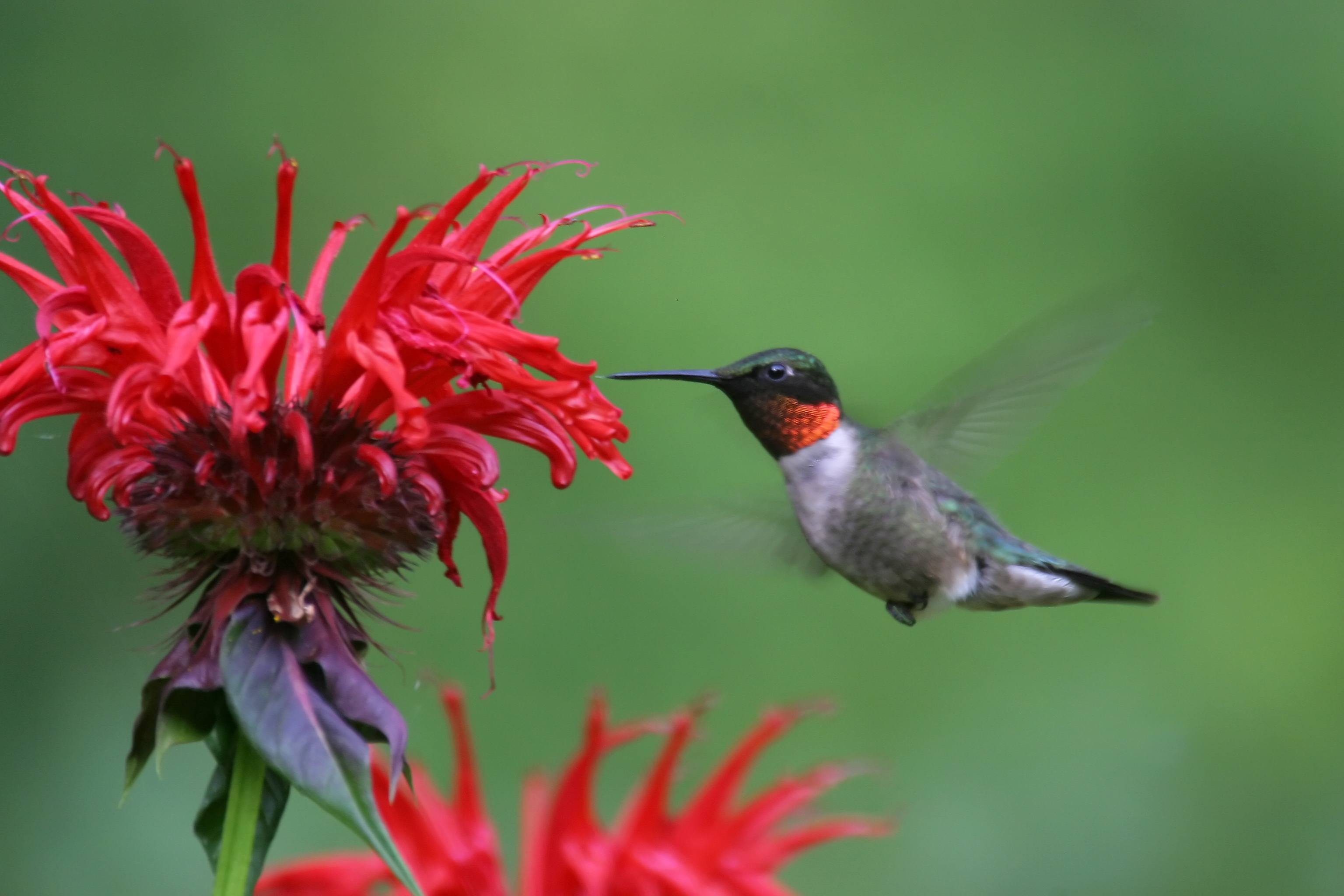
What type of symbiosis?  Hummingbirds feed on nectar from flowers.  The flowers are pollinated by hummingbirds as they move from flower to flower.
a)
commensalism
b)
mutualism
c)
parasitism
d)
predation
15.
Starfish are probably the most important predator in the shallow ecosystem because they eat basically anything that they can come across. Their feeding activities control the whole ecosystem. This is an example of the starfish ___.
a)
habitat
b)
biotic factors
c)
tolerance level
d)
niche
16.
___ states that two species cannot exist together if they compete for the same resources. One will either die out or migrate, or they will adapt to separate resources.
a)
Hardy-Weinberg Principle
b)
Limiting Nutrient Principle
c)
Competitive Exclusion Principle
d)
Tolerance Principle
17.
The concept that predators can affect the size and distribution of other animals is known as 
a)
predation
b)
herbivory
c)
tolerance
d)
limitation
18.

Competition between members of the same species as shown in the picture is called

a)

Intraspecific

b)

Interspecific

c)

Primary

d)

Secondary

19.
Which of the following are considered to be a symbiotic relationship?
a)
A. Competition
b)
B. Commensalism
c)
C. Mutualism
d)
D. Both B and C.
20.

Competition between members of different species like the organisms shown.

a)

Intraspecific

b)

Interspecific

c)

Primary

d)

Secondary

21.

When some species coexist despite apparent competition by having slightly different niches is called:

a)

Ecological Niche

b)

Competitive Exclusion

c)

Tolerance

d)

Resource Partitioning

22.
What relationship does this graph represent?
a)
Mutualism
b)
Commensalism
c)
Symbiotic
d)
Predator/Prey
23.
What type of species interaction is the following: two bears fighting over the same mate. 
a)
predation 
b)
mutualism 
c)
competition 
d)
parasitism 
24.
Name the species interaction: A decorator crab camouflages itself with sponges. Sponges are unaffected. 
a)
competition 
b)
predation
c)
commensalism
d)
mutualism 
25.
Resource partitioning is best described by which of the following statements?
a)
Competitive exclusion results in the success of the superior species.
b)
Slight variation in niche allows closely related species to coexist.
c)
Two species can coevolve and share the same niche.
d)
Species diversity is maintained by switching between prey species.
26.
Evidence shows that some grasses benefit from being grazed. Which of the following terms would best describe this plant-herbivore interaction?
a)
Mutualism
b)
Commensalism
c)
Parasitism
d)
Competition
27.

When the predator population increases what happens to the prey population size?

a)

Increases

b)

Decreases

c)

Dies

d)

Stays the same

28.

How does an area’s weather differ from the area’s climate?

a)

Weather involves temperature and precipitation and climate involves only temperature.

b)

An area’s weather depends on where it is located on Earth and the area’s climate does not.

c)

An area’s weather does not change very much and an area’s climate changes many times.

d)

Weather is the area’s day-to-day conditions and climate is the area’s average conditions.

29.

What factor(s) can impact the climate of an area?

a)

Latitude

b)

Elevation

c)

Solar energy trapped in the the biosphere

d)

All of these

30.

What type of relationship is shown here?

a)

Mutualism

b)

Parasitism

c)

Predation

d)

Commensalism

31.

This photo is showing the same ecosystem in 2 scenarios: one with the sea otter and one without the sea otter. In the ecosystem without the sea otter, the ecosystem dynamics are completely changed. What term best describes the sea otter?

a)

Niche

b)

Climax community

c)

Pioneer species

d)

Keystone species

32.
What is the first species to live in an otherwise lifeless area?
a)
extinct
b)
threatened
c)
endangered
d)
pioneer
33.
A ____ is how an organism uses the environment in which it lives.  
a)
habitat
b)
location
c)
niche
d)
resource 
34.

What is one difference between primary and secondary succession?

a)

Primary succession is slow, and secondary succession is rapid.

b)

Secondary succession begins on soil, and primary succession begins on newly exposed surfaces.

c)

Primary succession modifies the environment, and secondary succession does not.

d)

Secondary succession begins with lichens, and primary succession begins with trees.

35.
A pearlfish spends the day inside the intestines of a sea cucumber. The fish emerges from the sea cucumber at night to feed on small crustaceans. The sea cucumber is not harmed by this. 
a)
Mutualism
b)
Commensalism
c)
Parasitism
d)
Predation
36.
When put together, one organism outcompetes the other for resources.  This is an example of:
a)
competitive exclusion principle
b)
speciation
c)
biological niche
d)
evolution
37.

What are the 3 types of dispersion?

a)

Size, Density, Dispersion

b)

Groups, Couples, Single

c)

Near, Far, Wherever you are

d)

Random, Clumped, Uniform

38.

The diagram shows an example of ecological succession.


What can be inferred about the mature forest shown in the diagram?

a)

It is an intermediate community that will begin primary succession.

b)

It is an intermediate community that will give rise to new communities.

c)

It is the climax community that will never change after it forms.

d)

It is the climax community that is the last community of the succession process.

39.

Zoe is studying a mountainous region where a glacier is melting and retreating. She constructs the timeline shown below to show her prediction of how the region will change over time.


Why are the changes shown in the diagram classified as primary succession, and not secondary succession?

a)

The process results in the appearance of a climax community.

b)

Many intermediate communities appear before the climax community.

c)

The climax community appears after hundreds of years.

d)

The process begins with pioneer species growing on bare rock.

40.
What may happen as sediment and decaying organisms build up in a pond?
a)
Algae will increase.
b)
The pond  may become a forest.
c)
A swamp becomes a marsh.
d)
There is a severe drought
41.
Has permafrost; in the Arctic or Antarctic
a)
alpine tundra
b)
savanna
c)
desert
d)
polar tundra
42.
Has clumps of trees and seasonal rains
a)
temperate deciduous forest
b)
coniferous forest
c)
savanna
d)
temperate grassland
43.
Has many trees that do not change much seasonally
a)
desert
b)

coniferous forest (taiga or boreal forest)

c)
temperate deciduous forest
d)
savanna
44.
Has many trees that lose all their leaves to save water
a)
coniferous forest
b)
tundra
c)
temperate grassland
d)
temperate deciduous forest
45.
Has organisms with special adaptations to a hot, dry climate
a)
desert
b)
savanna
c)
tundra
d)
taiga
46.

What is the climate like in the Rainforest?

a)

dry and cold

b)

hot and humid (wet)

c)

cold and humid (wet)

d)

hot and dry

47.

Plants and animals in the tundra must be able to adapt to the extremely ___________ weather

a)

small

b)

cold

c)

perennials

d)

shallow

48.

Many of the animals in the desert are ______________ to avoid the extreme heat during the day.

a)

cacti

b)

chia

c)

water

d)

nocturnal

49.
What are the two main factors that determine the climate of an area?
a)
precipitation and humidity
b)
temperature and air pressure
c)
wind conditions and humidity
d)
temperature and precipitation
50.

What event likely caused the changes in species diversity in this ecosystem?

a)

A large volcanic eruption

b)

Flash flood

c)

Small tornado

d)

Migration of locusts