Wayground logo

Free Printable Worksheets

Font size

S
M
L
XL
Worksheets

Weather

Total questions: 107

Worksheet time: 2hrs 31mins

Name
Class
Date
1.
A severe storm which involves a funnel cloud forming over land is:
a)
hurricane
b)
tornado
c)
thunderstorm
d)
blizzard
2.
A severe storm that involves winds over 119mph and forms over water is:
a)
tornado
b)
thunderstorm
c)
hurricane
d)
blizzard
3.
This severe weather involves lightning, rain, and possibly hail
a)
thunderstorm
b)
tornado
c)
hurricane
d)
blizzard
4.
The boundary  between two air masses is known as:
a)
front
b)
storm
c)
climate
d)
flood
5.
When severe weather conditions are present, a _______ is issued
a)
watch
b)
warning
6.
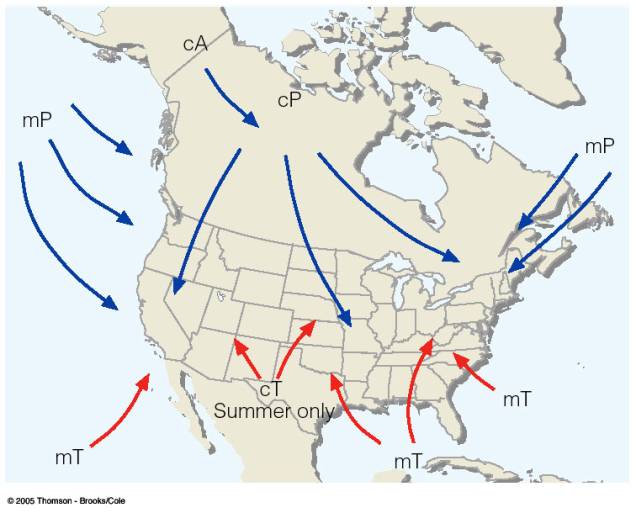
Cold air traveling south from Canada is:
a)
continental tropical
b)
continental polar
c)
maritime tropical
d)
maritime polar
7.
Warm air moving upwards from the Gulf of Mexico is:
a)
continental tropical
b)
continental polar
c)
maritime tropical
d)
maritime polar
8.
This type of front can bring strong storms
a)
cold
b)
warm
c)
stationary
d)
occluded
9.
This type of front results in the same weather for several days
a)
warm
b)
cold
c)
stationary
d)
occluded
10.
This weather tool measures wind speed and direction
a)
thermometer
b)
barometer
c)
anemometer
d)
psychrometer
11.
Which weather tool measures air pressure?
a)
thermometer
b)
barometer
c)
anemometer
d)
psychrometer
12.
This means that the conditions are right for severe weather
a)
watch
b)
warning
13.
This is the scale by which tornadoes are measured
a)
Fujita
b)
Ferrari
c)
Fermi
d)
Falling
14.
Air pressure is greatest:
a)
closer to Earth
b)
farther from Earth
15.
This is the symbol for a... 
a)
Cold Front
b)
Warm Front
c)
Stationary Front
d)
Occluded Front 
16.
This is the symbol for a... 
a)
Occluded Front
b)
Stationary Front
c)
Warm Front
d)
Cold Front 
17.
This is the symbol for a... 
a)
Stationary Front
b)
Occluded Front
c)
Cold Front
d)
Warm Front
18.
Identify the type of front that is shown in the image.
a)
Occluded Front
b)
Cold Front
c)
Stationary Front
d)
Warm Front
19.
Identify the type of front that is shown in the image.
a)
Occluded Front
b)
Cold Front
c)
Stationary Front
d)
Warm Front
20.
Which weather tool measures temperature?
a)
thermometer
b)
barometer
c)
psychrometer
d)
anememeter
21.
Cold air (RISES/ FALLS)  _________.
a)
RISES
b)
FALLS
22.
What does this symbol on a weather map indicate? 
a)
High pressure system
b)
Low pressure system
c)
Cold front
d)
Warm front
23.
Rain, snow, sleet, and hail are all forms of _____.
a)
precipitation
b)
condensation
c)
evaporation
d)
climate
24.
An isobar map measures...
a)
Temperature
b)
Wind
c)
Precipitation
d)
Air pressure
25.
An Isotherm map measures...
a)
Air pressure
b)
Temperature
c)
Winds
d)
Precipitation
26.
Atmospheric conditions on a daily basis.
a)
Climate
b)
Weather
27.
Yesterday we had tornadoes and thunderstorms, what front was responsible for that?
a)
Warm
b)
Stationary
c)
Cold
d)
Occluded
28.
A maritime polar air mass is 
a)
Dry and Cold
b)
Wet and Cold
c)
Wet and Warm
d)
Dry and Warm
29.
A body of air that has the same temperature and moisture levels throughout is called what? 
a)
Fronts
b)
Air Masses
c)
A cold front
d)
A warm front
30.
What front is moving through
Alabama and Georgia? 
a)
Warm
b)
Occluded
c)
Stationary
d)
Cold
31.
What front is moving through the NW part of the US?
a)
Stationary
b)
Warm
c)
Occluded
d)
Cold
32.
What front symbol is shown?
a)
Occluded
b)
Warm
c)
Stationary
d)
Cold
33.
The cold air mass from Canada is called what? 
a)
cT
b)
cP
c)
mT
d)
mP
34.
A front is
a)
where warm air is cooling at earth's surface
b)
a line where hot and cold air are separating
c)
a line where two different air masses meet
d)
where cold air is rising and forming rain clouds
35.
You know fair weather is most likely on the way if which of the following is moving toward your town?
a)
High Pressure Area
b)
Low Pressure Area
c)
Stationary Front
d)
Cold Front
36.
Studying weather maps helps scientists
a)
Measure ensure air temperature
b)
classify clouds by shape
c)
make weather predictions
d)
Measure air pressure
37.
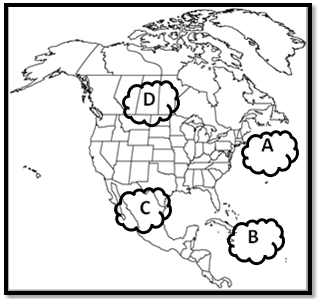
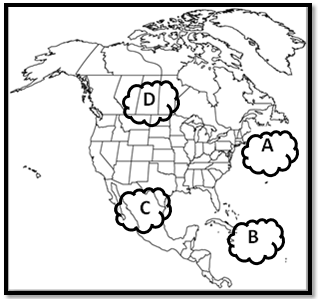
Which type of air would you find at air mass A?
a)
cold, dry
b)
warm, humid
c)
warm, dry
d)
cold, humid
38.
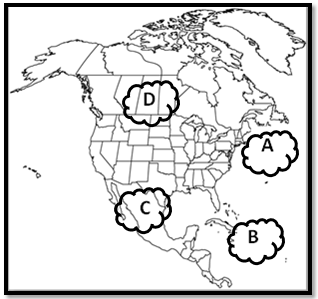
Which type of air would you find at air mass B?
a)
cold, dry
b)
warm, humid
c)
warm, dry
d)
cold, humid
39.
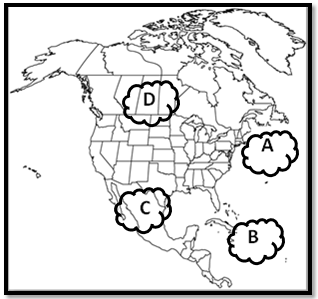
Which type of air would you find at air mass C?
a)
cold, dry
b)
warm, humid
c)
warm, dry
d)
cold, humid
40.
Which type of air would you find at air mass D?
a)
cold, dry
b)
warm, humid
c)
warm, dry
d)
cold, humid
41.
What type of storm front is this? 
a)
warm front
b)
cold front
c)
stationary front
d)
occluded front
42.
What type of storm front is this?
a)
warm front
b)
cold front
c)
stationary front
d)
occluded front
43.
What characteristics are used to classify air masses?
a)
temperature and humidity
b)
pressure and temperature
c)
latitude and longitude
d)
wind speed and location 
44.
What type of weather would you expect to see after a cold front has passed through an area?
a)
cool and clear skies
b)
warm and humid
c)
thunderstorms
d)
foggy
45.
Which abbreviation of an air mass can be identified as warm and moist?
a)
cP
b)
mP
c)
cT
d)
mT
46.
Which abbreviation of an air mass can be identified as cold and moist?
a)
cP
b)
mP
c)
cT
d)
mT
47.
what is an air mass?
a)
a large body of air that is made of the same temperature and moisuture
b)
when two air masses meet 
48.

A mixture of gases that surrounds the Earth like a blanket.

a)

atmosphere

b)

troposphere

c)

ozone

d)

nitrogen

49.

Gas in the atmosphere that protects the Earth from the Sun's rays

a)

atmosphere

b)

troposphere

c)

ozone

d)

nitrogen

50.

Occurs when air encounters a mountain and is pushed upwards

a)

lifting

b)

troposphere

c)

wind funnel

d)

nitrogen

51.

The gas that makes up most of Earth’s atmosphere

a)

lifting

b)

troposphere

c)

wind funnel

d)

nitrogen

52.

Lowest layer of the atmosphere

a)

lifting

b)

troposphere

c)

wind funnel

d)

nitrogen

53.

"atmo-" means

a)

gas or vapor

b)

water

c)

Earth or rocks

d)

life

54.

As you get farther away from the Earth, the layers of the atmosphere get

a)

colder

b)

warmer

55.

Which layer of the atmosphere contains the ionosphere?

a)

troposphere

b)

stratosphere

c)

mesosphere

d)

thermosphere

56.

Which is not a factor that influences daily weather?

a)

heat

b)

air pressure

c)

elevation

d)

moisture

57.

What is the term for the day to day conditions of the atmosphere?

a)

weather

b)

climate

c)

hurrican

d)

global wind

58.

Which prevailing wind can be found between 60 and 90 degrees latitude?

a)

trade winds

b)

horse winds

c)

polar easterlies

d)

westerlies

59.

Which three trace gasses are very important to Earth?

a)

Oxygen, Argon, Carbon dioxide

b)

Carbon dioxide, Water vapor, Ozone

c)

Ozone, Nitrogen, Water Vapor

d)

Carbon dioxide, Water vapor, Argon

60.

What two things are sometimes found in the Thermosphere?

a)

Satellites and Auroras

b)

Jet planes and Satellites

c)

Auroras and Clouds

d)

Clouds and Escaped balloons

61.
Coriolis effect
a)
caused by Earth's rotation
b)
caused by Earth's revolution
c)
caused by Earth's tilt
d)
caused by Earth's winds
62.
Radiation is transferred by ____
a)
flow of energy
b)
touch
c)
rays and waves 
d)
winds
63.
Source of all energy in our atmosphere
a)
ions
b)
water cycle
c)
The Moon
d)
The Sun
64.
Convection
a)
transfer of heat by flow
b)
transfer of heat by touch
c)
transfer of heat by waves and rays
d)
transfer of heat by wind
65.
Conduction
a)
transfer of energy by flow
b)
transfer of energy by touch
c)
transfer of energy by waves and rays
d)
transfer of energy by wind
66.

What protects the earth from harmful UV rays from the sun?

a)

clouds

b)

ionosphere

c)

nitrogen gases

d)

the ozone

67.
Earth's current atmosphere is
a)
78% nitrogen, 21% oxygen, 0.9% argon and 0.037% carbon dioxide
b)
78% oxygen, 21%nitrogen, 0.9% argon, 0.037% carbon dioxide
c)
78% nitrogen, 21% argon, 1% oxygen
d)
78% oxygen, 21% nitrogen, 1% carbon dioxide
68.

The layer of the atmosphere where meteors (shooting stars) burn up

a)

mesosphere

b)

thermosphere

c)

troposphere

d)

stratosphere

69.

A mixture of gases that surrounds the Earth like a blanket.

a)

atmosphere

b)

troposphere

c)

ozone

d)

nitrogen

70.

How does Latitude impact climate?

a)

The higher the latitude, the colder the climate

b)

The higher the latitude, the warmer the climate

c)

Latitude does not impact climate, longitude does

d)

The north latitudes are cold, the mid latitudes are warm, and the south latitudes are hot

71.

What is elevation?

a)

A song by U2

b)

the measurement for air pressure

c)

unequal heating of Earth's surface

d)

The distance above sea level

72.

What is responsible for creating the different seasons in the midlatitudes?

a)

The rotation of the Earth

b)

The revolution of the Earth around the sun

c)

The tilt of the Earth

d)

The tilt of the Earth in relation to the Sun

73.

In what months could you experience a Solstice. (2)

a)

March

b)

June

c)

September

d)

December

74.

During an Equinox...

a)

Day and night are the same amount of time

b)

The longest period of daylight is experienced

c)

The shortest period of daylight is experienced

d)

Either the longest or shortest amount of daylight are experiences

75.

During a Solstice...

a)

Day and night are the same amount of time

b)

The longest period of daylight is experienced

c)

The shortest period of daylight is experienced

d)

Either the longest or shortest amount of daylight are experiences

76.

Which warms up quickly, land or water?

a)

It's impossible to say, given the limited information.

b)

land

c)

They both warm up at the same rate.

d)

water

77.

When the air is full of water and has a relative humidity of 100% it is said to be ___.

a)

full

b)

humid

c)

saturated

d)

warm

78.

Which will hold more water, warm air or cold air?

a)

Warm Air

b)

Cold AIr

79.
The amount of water vapor in the atmosphere compared to how much it could hold.
a)
Saturation
b)
Vaporicity
c)
Absolute Humidity
d)
Relative Humidity
80.
Pressure is the effect of
a)
the weight of all the air above pressing down
b)
water vapor in the atmosphere
c)
greenhouse gases
d)
solar radiation
81.
What type of air pressure is present?
a)
High 
b)
Low
82.

Ryan is working on his science fair project. He plans to measure the amount of rainfall that has fallen in his neighborhood over the past two weeks. Which instrument should he use?

a)

anenometer

b)

thermometer

c)

wind vane

d)

rain gauge

83.

Warm air _________ because it is _______ dense than the air around it.

a)

rises, less

b)

rises, more

c)

falls, less

d)

falls, more

84.

Cold air _________ because it is _______ dense than the air around it.

a)

rises, less

b)

rises, more

c)

falls, less

d)

falls, more

85.

Temperature at which air near the ground becomes fully saturated with water

a)

Evaporation

b)

Precipitation

c)

Dew Point

d)

Humidity

86.

Violent winter storm characterized by freezing temperatures, strong winds, and blowing snow

a)

Blizzard

b)

Tornado

c)

Hurricane

d)

Flood

87.

an instrument used to measure wind speed

a)

anemometer

b)

psychrometer

c)

barameter

d)

spectrometer

88.

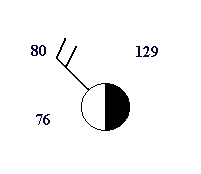
What is the temperature for the following station model?

a)

4 ºF

b)

76 ºF

c)

80 ºF

d)

129 ºF

89.

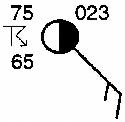
What is the dewpoint for the following station model?

a)

10 ºF

b)

23 ºF

c)

65 ºF

d)

75 ºF

90.

What is the barometric pressure?

a)

55.0 mb

b)

37.0 mb

c)

138.0 mb

d)

1013.8 mb

91.

What is the wind speed?

a)

23 mph

b)

35 kts

c)

24 mph

d)

3.5 kts

92.

What weather condition does this symbol represent?

a)

thunderstorm

b)

fog

c)

sleet

d)

hurricane

93.

What is the wind direction

a)

Northeast

b)

Northwest

c)

Southeast

d)

Southwest

94.

The percentage of shading on a station model circle represents which of the following weather variables?

a)

cloud cover

b)

dew point

c)

wind speed

d)

barometric pressure

95.

What are the basic ingredients needed to make a thunderstorm?

a)

Moisture, stable air, and lift

b)

Moisture, unstable air, and lift

c)

Dry air, unstable air, and lift

d)

Dry air, stable air, and lift

96.

What are the stages of a thunderstorm?

a)

Developing, mature, and dissipating

b)

Growing, mature, and fading

c)

Forming, active, and ending

d)

Beginning, middle, and end

97.

What causes thunder?

a)

Strong winds

b)

Hail

c)

Rainfall

d)

Lightning

98.
The type of thunderstorm that produces nearly all of the significant tornadoes is the...
a)
Thunderstorm cluster
b)
Squall line
c)
Single cell
d)
Super cell
99.
Where is the safest place to be in a tornado?
a)
basement
b)
interior closet or bathroom
c)
hallway
d)
ditch or ravine
100.

What is the strongest tornado

a)

EF1

b)

EF2

c)

EF5

d)

EF10

101.

What do the wind speeds need to reach for a storm to be classified as a hurricane

a)

39 mph

b)

74 mph

c)

105 mph

d)

200 mph

102.

What fuels a hurricane's strength?

a)

Wind

b)

Warm Water

c)

Sunlight

d)

Cold Water

103.

What is the calm area in the center of a hurricane called?

a)

Wall

b)

Arm

c)

Eye

d)

Hole

104.

The scale used to measure the size of hurricanes is called _____.

a)

Saffier-Simpson Scale

b)

Richter Scale

c)

Cal-Ripkin Scale

d)

Bart-Simpson Scale

105.

How is a tornado rated?

a)

On the Richter Scale

b)

On the Saffir-Simpsom Scale

c)

On the bathroom scale

d)

On the Enhanced Fujita Scale

106.
In what direction do hurricanes rotate in the Northern Hemisphere?
a)
Clockwise
b)
Counterclockwise
c)
Up
d)
Down
107.

Can be caused by a hurricane where the waves reach up to 20 ft. in height as it reaches the land.

a)

Storm Surge

b)

Tsunami

c)

Water Spout

d)

Tornado