Wayground logo

Free Printable Worksheets

Font size

S
M
L
XL
Worksheets

Chapter 1 TEST

Total questions: 27

Worksheet time: 3hrs 40mins

Name
Class
Date
1.

Write the equation of the line (in point-slope form) that has function values f(4)=−8 and f(−2)=4f\left(4\right)=-8\ and\ f\left(-2\right)=4  

a)

y−4=−2(x+2)y-4=-2\left(x+2\right)

b)

y−4=−12(x+2)y-4=-\frac{1}{2}\left(x+2\right)

c)

y+2=−2(x−4)y+2=-2\left(x-4\right)

d)

y+2=−12(x−4)y+2=-\frac{1}{2}\left(x-4\right)

2.

Write the equation of the line parallel to the graph of 2y - 6 = 0 and passing through (4, -1).

a)

x = 4

b)

x = -1

c)

y = -1

d)

y = 4

3.

Find the x and y intercepts of:  y−6=x2−5xy-6=x^2-5x  

a)

x-int: (-1, 0), (6, 0); y-int: (0, 6)

b)

x-int: (6, 0), (11, 0); y-int: (0, -6)

c)

x-int: (2, 0), (3, 0); y-int: (0, 6)

d)

x-int: (0, 0), (5, 0); y-int: (0, -6)

4.

Find the standard form equation of the circle whose endpoints of a diameter are at (4, 3) and (0, 1).

a)

(x−2)2+(y−1)2=5\left(x-2\right)^2+\left(y-1\right)^2=5

b)

(x−2)2+(y−2)2=5\left(x-2\right)^2+\left(y-2\right)^2=5

c)

x2+(y−1)2=5x^2+\left(y-1\right)^2=\sqrt{5}

d)

(x−4)2+(y−3)2=5\left(x-4\right)^2+\left(y-3\right)^2=\sqrt{5}

5.

What is the radius of the given circle:  x2+y2−10x+8y−23=0x^2+y^2-10x+8y-23=0 ?

a)

2

b)

4

c)

8

d)

 232\frac{23}{2}  

6.

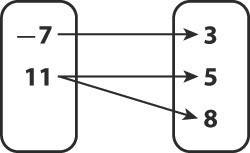
Is the relation a function? Why/Why Not?

a)

Yes, because the x-value 11 has two y-values.

b)

Yes, because each x-value has only one y-value.

c)

No, because the x-value 11 has two y-values.

d)

No, because each x-value has only one y-value.

7.

Find the domain of: g(x)=5−3xg\left(x\right)=\sqrt{5-3x}  

a)

 (−∞, 0)(0, ∞)\left(-\infty,\ 0\right)\left(0,\ \infty\right)  

b)

 [53, ∞)\left[\frac{5}{3},\ \infty\right)  

c)

 (−∞, 0]\left(-\infty,\ 0\right]  

d)

 (−∞, 53]\left(-\infty,\ \frac{5}{3}\right]  

8.

Find the domain of: f(x)=2x3x2−16x+21f\left(x\right)=\frac{2x}{3x^2-16x+21}  

a)

 (−∞, 73)(73, 3)(3, ∞)\left(-\infty,\ \frac{7}{3}\right)\left(\frac{7}{3},\ 3\right)\left(3,\ \infty\right)  

b)

 (−∞, 1)(1, 7)(7, ∞)\left(-\infty,\ 1\right)\left(1,\ 7\right)\left(7,\ \infty\right)  

c)

 (−∞, 0)(0, ∞)\left(-\infty,\ 0\right)\left(0,\ \infty\right)  

d)

 (−∞, 3)(3, ∞)\left(-\infty,\ 3\right)\left(3,\ \infty\right)  

9.

Find the domain of: h(x)=x9h\left(x\right)=\frac{x}{9}  

a)

 (−∞, ∞)\left(-\infty,\ \infty\right)  

b)

 (−∞, 0)(0, ∞)\left(-\infty,\ 0\right)\left(0,\ \infty\right)  

c)

 (−∞, 9)(9, ∞)\left(-\infty,\ 9\right)\left(9,\ \infty\right)  

d)

 [0, ∞)\left[0,\ \infty\right)  

10.

If  f(x)=3x−1f\left(x\right)=3x-1  and  g(x)=x2+2g\left(x\right)=x^2+2  
what is  (g ∘ f)(x)\left(g\ \circ\ f\right)\left(x\right) ?

a)

3x2 + 5

b)

9x2 - 6x + 3

c)

3x2 - 6x + 1

d)

3x2 + 3

11.

Given  f(x)=1+x−2x2f\left(x\right)=1+x-2x^2  , find  f(x+h)−f(x)h, h≠0\frac{f\left(x+h\right)-f\left(x\right)}{h},\ h\ne0  

a)

 1−4x−2h, h≠01-4x-2h,\ h\ne0  

b)

 1, h≠01,\ h\ne0  

c)

 2x+h−4x2−4xh−2h2h, h≠0\frac{2x+h-4x^2-4xh-2h^2}{h},\ h\ne0  

d)

 1+2x+h, h≠01+2x+h,\ h\ne0  

12.

Given f(x)=2x2−x and g(x)=3x−5f\left(x\right)=2x^2-x\ and\ g\left(x\right)=3x-5  find  3(f+g)(x)−2g(x)3\left(f+g\right)\left(x\right)-2g\left(x\right)  

a)

 2x2−4x+52x^2-4x+5  

b)

 2x2+3x−102x^2+3x-10  

c)

 6x2−56x^2-5  

d)

 6x2−256x^2-25  

13.

Find the average rate of change of the function f(x)=6−1−xf\left(x\right)=6-\sqrt{1-x}  from  x1=−3 to x2=0x_1=-3\ to\ x_2=0  

a)

 −3-3  

b)

 33  

c)

 −13-\frac{1}{3}  

d)

 13\frac{1}{3}  

14.

Find the zero(s) of:
 h(x)=2x+115−xh\left(x\right)=\frac{2x+1}{15-x}  

a)

 x=−12; x=15x=-\frac{1}{2};\ x=15  

b)

 x=−12x=-\frac{1}{2}  

c)

 x=12; x=−15x=\frac{1}{2};\ x=-15  

d)

 x=15x=15  

15.

Write the area of a circle as a function of its diameter.
 (A=πr2)\left(A=\pi r^2\right)  

a)

 A(d)=4πd2A\left(d\right)=4\pi d^2  

b)

 d=12Aπd=\frac{1}{2}\sqrt{\frac{A}{\pi}}  

c)

 A(d)=πd24A\left(d\right)=\frac{\pi d^2}{4}  

d)

 A(d)=πd2A\left(d\right)=\pi d^2  

16.

Write the height of the rectangle as a function of x.

a)

 x2+12x−2x^2+\frac{1}{2}x-2  

b)

 −2+12x−x2-2+\frac{1}{2}x-x^2  

c)

 2−12x−x22-\frac{1}{2}x-x^2  

d)

 32x−x2\frac{3}{2}x-x^2  

17.

Which piecewise function matches the graph shown?

a)
b)
c)
d)
18.

A piecewise function, f(x), is shown in the graph. What is the value of f(−4)f\left(-4\right)  ?

a)

-4

b)

-2

c)

0

d)

Does not exist

19.

Graph:

 f(x)=−[[12x]]f\left(x\right)=-\left[\left[\frac{1}{2}x\right]\right]  


a)
b)
c)
d)
20.

Determine the intervals over which the function is increasing, decreasing, or constant.

a)

Decreasing: (−∞, −4][0,1][5,8]\left(-\infty,\ -4\right]\left[0,1\right]\left[5,8\right] Constant: [−3, 0]\left[-3,\ 0\right] Increasing: [−4, −3][1, 5][8, ∞)\left[-4,\ -3\right]\left[1,\ 5\right]\left[8,\ \infty\right)

b)

Decreasing: (−∞, −3)(0, −1)(7, −2)\left(-\infty,\ -3\right)\left(0,\ -1\right)\left(7,\ -2\right) Constant: (0, 0)\left(0,\ 0\right) Increasing: (−3, 0)(−1, 7)(−2, ∞)\left(-3,\ 0\right)\left(-1,\ 7\right)\left(-2,\ \infty\right)

c)

Decreasing: (∞, −4)(5, 8)\left(\infty,\ -4\right)\left(5,\ 8\right) Constant: (−3, 0)\left(-3,\ 0\right) Increasing: (−4, −3)(1, 5)(8, ∞)\left(-4,\ -3\right)\left(1,\ 5\right)\left(8,\ \infty\right)

d)

Decreasing: (−∞, −4)(0, 1)(5, 8)\left(-\infty,\ -4\right)\left(0,\ 1\right)\left(5,\ 8\right) Constant: (−3, 0)\left(-3,\ 0\right) Increasing: (−4, −3)(1, 5)(8, ∞)\left(-4,\ -3\right)\left(1,\ 5\right)\left(8,\ \infty\right)

21.

Given f(x)=2[[x]]−7f\left(x\right)=2\left[\left[x\right]\right]-7  find  f(−52)f\left(-\frac{5}{2}\right)  

a)

-13

b)

-11

c)

-3

d)

-1

22.

Let g be a vertical stretch by a factor of 2 followed by a translation 6 units left of the graph given by f(x). Write a rule for g.
 f(x)=∣x∣−3f\left(x\right)=\left|x\right|-3  


a)

 g(x)=2∣x+6∣−6g\left(x\right)=2\left|x+6\right|-6  

b)

 f(x)=2∣x∣−9f\left(x\right)=2\left|x\right|-9  

c)

 f(x)=2∣x+6∣−3f\left(x\right)=2\left|x+6\right|-3  

d)

 f(x)=2∣x−6∣−3f\left(x\right)=2\left|x-6\right|-3  

23.

 Let f(x)=x2−1f\left(x\right)=x^2-1 . Given  g(x)=−12f(x+6)g\left(x\right)=-\frac{1}{2}f\left(x+6\right)  . Write a rule for g.

a)

 g(x)=−12x2+5g\left(x\right)=-\frac{1}{2}x^2+5  

b)

 g(x)=−12(x+6)2−1g\left(x\right)=-\frac{1}{2}\left(x+6\right)^2-1  

c)

 g(x)=−12(x+6)2+12g\left(x\right)=-\frac{1}{2}\left(x+6\right)^2+\frac{1}{2}  

d)

 g(x)=−12x2+132g\left(x\right)=-\frac{1}{2}x^2+\frac{13}{2}  

24.

Find a mathematical model to represent the statement: v varies directly as the square root of s (v = 24; s = 16).

a)

v=kx2v=kx^2

b)

v=6xv=6\sqrt{x}

c)

v=kxv=k\sqrt{x}

d)

v=3128x2v=\frac{3}{128}x^2

25.

A company has found that the daily demand x for its boxes of chocolates is inversely proportional to the price p. When the price is $5, the demand is 800 boxes. Approximate (to the nearest whole value) the demand when the price is increased to $6.

a)

667 boxes of chocolates

b)

960 boxes of chocolates

c)

4000 boxes of chocolates

d)

27 boxes of chocolates

26.
The number of kilograms of water in a person’s body varies directly as the person’s mass.  A person with a mass of 90 kg contains 60 kg of water.  How many kilograms of water are in a person whose mass is 75 kg?
a)
50 kg water
b)
72 kg water
c)
94 kg water
d)
150 kg water
27.

A passenger stranded on a lifeboat shoots a distress flare into the air. The height (in feet) of the flare above the water is given by f(x)=−16x2+128xf\left(x\right)=-16x^2+128x  , where x is the time (in seconds) since the flare was shot. What is the maximum height of the flare?

a)

4 ft.

b)

128 ft.

c)

144 ft.

d)

256 ft.