wayground logo

Free Printable Worksheets

Font size

S
M
L
XL
Worksheets

Factors of production

Total questions: 76

Worksheet time: 42mins

Name
Class
Date
1.

Land includes...

a)

The "gifts of nature" or natural resources not created by human effort.

b)

the tools, equipment, and factories used in production of goods and services

c)

people with all their efforts and abilities

d)

individuals who start a new business or bring a product to market.

2.

Capital refers to...

a)

The "gifts of nature" or natural resources not created by human effort.

b)

people with all their efforts and abilities

c)

the tools, equipment, and factories used in production of goods and services

d)

individuals who start a new business or bring a product to market.

3.

Labor refers to...

a)

people with all their efforts and abilities

b)

individuals who start a new business or bring a product to market.

c)

the tools, equipment, and factories used in production of goods and services.

d)

The "gifts of nature" or natural resources not created by human effort.

4.

Entrepreneurs are...

a)

people with all their efforts and abilities

b)

individuals who start a new business or bring a product to market.

c)

The "gifts of nature" or natural resources not created by human effort.

d)

the tools, equipment, and factories used in production of goods and services

5.
A herd of cattle is an example of ...
a)
Land
b)
Labor
c)
Entrepreneur
d)
Capital
6.
Forests are examples of...
a)
Land
b)
Labor
c)
Entrepreneurs
d)
Capital
7.
A bulldozer is an example of...
a)
Land
b)
Labor
c)
Entrepreneurs
d)
Capital
8.
Your garbage man is an example of
a)
Land
b)
Labor
c)
Entrepreneurs
d)
Capital
9.
Your Mail lady is an example of...
a)
Land
b)
Labor
c)
Entrepreneurs
d)
Capital
10.
The Chromebooks you are using are examples of
a)
Land
b)
Labor
c)
Entrepreneurs
d)
Capital
11.
A steel factory is an example of
a)
Land
b)
Labor
c)
Entrepreneurs
d)
Capital
12.

Bill Gates is an example of...

a)

Land (seriously though, come on)

b)

Labor

c)

An Entrepreneurs

d)

Capital

13.
Cashiers at McDonalds are examples of ….
a)
Land
b)
Labor
c)
Entrepreneurs
d)
Capital
14.
What resource is this?
a)
natural resource
b)
human resource
c)
capital resource
15.
What is this resource?
a)
capital resource
b)
human resource
c)
natural resource
16.
What is this resource?
a)
natural resource
b)
capital resource
c)
human resource
17.
What resource is this?
a)
capital resource
b)
natural resource
c)
human resource
18.
What is this resource?
a)
human resource
b)
capital resource
c)
natural resource
d)
human and capital resource
19.
What resource is this a picture of?
a)
natural resource
b)
capital resource
c)
human resource
20.
What resource is this?
a)
natural resource
b)
capital resource
c)
human resource
21.
What kind of resource is this?
a)
natural and capital resource
b)
natural resource
c)
capital resource
d)
human resource
22.
What resource is this?
a)
human resource
b)
capital resource
c)
natural resource
23.
What resource is this?
a)
human and capital resource
b)
human resource
c)
capital resource
d)
natural resource
24.
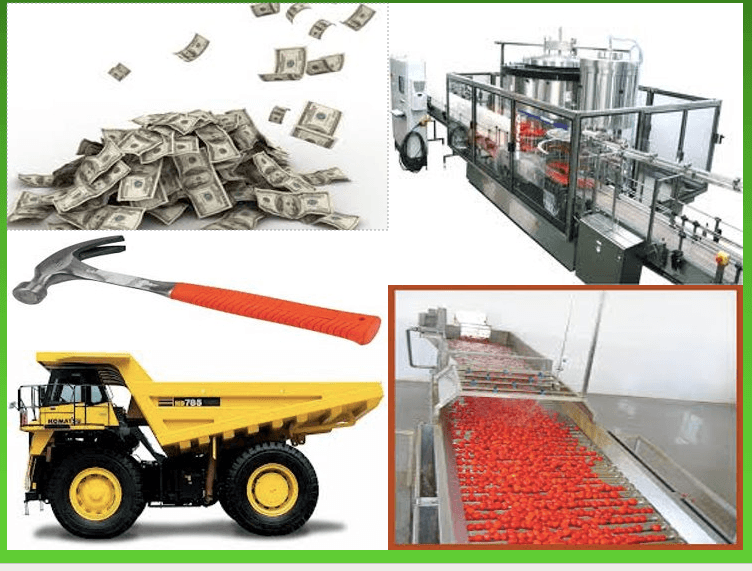
Name the capital resource.
a)
man
b)
tree
c)
can saw
25.
Name the resource.
a)
thumbs
b)
money
c)
teeth
d)
100 one dollar bills
26.
Name the capital resource.
a)
man
b)
wheels
c)
tractor
d)
farm
27.
Name the capital resource(s).
a)
truck
b)
factory
c)
factory and truck
d)
trees and grass
28.
Name the natural resource(s).
a)
wheat
b)
combine
c)
truck
d)
combine and truck
29.
Name the human resource.
a)
barn
b)
cow and chickens
c)
fence
d)
farmer
30.
Name the resource.
a)
natural resource
b)
human resource
c)
capital resource
d)
natural and capital resource
31.
What human resource is this an example of?
a)
a nurse
b)
a doctor
c)
a fisherman
d)
a farmer
32.
What part of the picture is the natural resource?
a)
rope
b)
rock mountain
c)
rock climber
33.
What resources are in the picture?
a)
natural capital and human resource
b)
natural and capital resource
c)
human and capital resource
d)
natural and human resource
34.
A garbage truck driver is an example of which Factor of Production?
a)
labor
b)
land
c)
entrepreneurship
d)
capital
35.
The following items (accountant's computer, carpenter's drill, and a tailor's sewing machine) are all examples of which factor of production?
a)
capital
b)
entrepreneurshipt
c)
land
d)
labor
36.
The term "factors of production" means:
a)
things or skills needed to produce goods or services
b)
how we spend our money
c)
the resources of the government
d)
how society creates jobs
37.
Iron, minerals, coal and plants are examples of which productive resource?
a)
land
b)
labor
c)
entrepreneurship
d)
capital
38.
The term, "capital goods" means:
a)
Goods not created for their own use, but to make other goods/services.
b)
Work the people do to produce goods and services.
c)
Person who organizes the factors of production to produce goods/services; business owners.
d)
The natural resources used to produce goods or services.
39.
The term, "entrepreneurship" means:
a)
Person who organizes the factors of production to produce goods/services; business owners.
b)
Goods not created for their own use, but to make other goods/services.
c)
Work the people do to produce goods and services.
d)
The natural resources used to produce goods or services.
40.
The term, "land" means:
a)
The natural resources used to produce goods or services.
b)
Work the people do to produce goods and services.
c)
Goods not created for their own use, but to make other goods/services.
d)
Person who organizes the factors of production to produce goods/services; business owners.
41.
The term, "labor" means:
a)
Work the people do to produce goods and services.
b)
The natural resources used to produce goods or services.
c)
Person who organizes the factors of production to produce goods/services; business owners.
d)
Goods not created for their own use, but to make other goods/services.
42.
What is a risk an entrepreneur takes in running a business? 
a)
Losing the money invested in starting the business
b)
Going bankrupt [losing everything]
c)
Not having a steady job/paycheck
d)
All of these are risks!
43.
Here are the monthly expenses for Company Z:
Labor  $30,000
Land   $40,000
Capital  $20,000
Entrepreneurship $10,000
How much does Company Z pay per month for these expenses all together?
a)
$100,000
b)
$90,000
c)
$30,000
d)
$1,000,000
44.
Company Z is selling their newest hoverboard for $125 each. Last month they sold 2000 of them.          
How much money did they make this month?
a)
$125
b)
$250,000
c)
$2000
d)
$125,000
45.
Below is a table for the monthly cost that the Generation Z company pays per month to make the latest hover-board. The company is selling them for $125 each. Last month they sold 2000 of them. Is the company making a profit or are they taking a loss, and how much?
Labor  $30,000
Land   $40,000
Capital  $20,000
Entrepreneurship $10,000 
a)
profit of $150,000
b)
profit of $10,000
c)
loss of $150,000
d)
broke even
46.
The creation of any kind of good or service is known as:
a)
Input
b)
Resources
c)
Production
d)
Entrepreneurship
47.
All of the things necessary for production are known as:
a)
Production
b)
Entrepreneurship
c)
Outputs
d)
Resources
48.
The human effort involved in the production of goods and services is known as:
a)
Capital
b)
Entrepreneurship
c)
Labor
d)
Land
49.
All natural resources that go into the production of a good or service:
a)
Capital
b)
Entrepreneurship
c)
Land
d)
Labor
50.
The enterprising spirit that allows an individual to spot gaps in the market and take risks (including starting a business):
a)
Entrepreneurship
b)
Capital
c)
Land
d)
Labor
51.
Anything within the production process, whether human or technological, that makes production more efficient
a)
Entrepreneurship
b)
Capital
c)
Land
d)
Labor
52.
Any technology/machinery involved in the production process:
a)
Human Capital
b)
Physical Capital
c)
Investment Capital
d)
Enterprise Capital
53.
Money used to re-invest in a firm and further its business objectives
a)
Human Capital
b)
Physical Capital
c)
Investment Capital
d)
Enterprise Capital
54.
An individual's knowledge or skills that make production of a good/service more efficient
a)
Human Capital
b)
Physical Capital
c)
Investment Capital
d)
Enterprise Capital
55.
In a competitive economy, which firms will have the most access to the factors of production (productive resources)?
a)
The firms that are most successful in meeting consumer demand
b)
The firms that are least successful in meeting consumer demand
c)
The firms that have the most production experience
d)
The firms that offer the greatest variety of goods/services
56.

Assembly line worker

a)

Land

b)

Labor

c)

Physical capital

d)

Human capital

e)

Entrepreneuership

57.

Nurse

a)

Land

b)

Labor

c)

Physical capital

d)

Human capital

e)

Entrepreneuership

58.

Steve Jobs

a)

Land

b)

Labor

c)

Physical capital

d)

Human capital

e)

Entrepreneuership

59.

Natural Resource

a)

Land

b)

Labor

c)

Physical capital

d)

Human capital

e)

Entrepreneuership

60.

Iron Ore

a)

Land

b)

Labor

c)

Physical capital

d)

Human capital

e)

Entrepreneuership

61.

Which of the factors of production is this?

a)

capital

b)

entrepreneur

c)

land

d)

labor

62.

Which one of the factors of production is this?

a)

capital

b)

entrepreneur

c)

land

d)

labor

63.

This factor involves money, equipment, and tools and any items to produce goods and services?

a)

capital

b)

entrepreneur

c)

land

d)

labor

64.
The people who decide to buy.
a)
Producers
b)
Consumers
c)
Economist
d)
Entreprenuers
65.
The term "factors of production" means:
a)
things or skills needed to produce goods or services
b)
how we spend our money
c)
the resources of the government
d)
how society creates jobs
66.

Land includes...

a)

The "gifts of nature" or natural resources not created by human effort.

b)

the tools, equipment, and factories used in production of goods and services

c)

people with all their efforts and abilities

d)

individuals who start a new business or bring a product to market.

67.

A lawyer is an example of a...

a)

Skilled worker

b)

Professional worker

c)

Semiskilled worker

d)

Unskilled worker

68.

Which jobs will become obsolete because of AI?

a)

Lawyer

b)

Telemarketers

c)

Factory workers

d)

Retail salespeople

e)

Accountants

69.

Canada’s labour code ensures safety for...

a)

Skilled workers

b)

Unskilled workers

c)

Professional workers

d)

Semiskilled workers

70.

These workers were in demand during the 1900's

a)

Skilled

b)

Semiskilled

c)

Professional

d)

Unskilled

71.

Labour impacts capital because...

a)

all factors of production aid each other to create economic growth

b)

it utilizes capital

c)

it ultimately contributes to capital

d)

people want to work for money

72.

Which factors affect labour practices?

a)

Politics

b)

Poverty

c)

Access to water

d)

Tsunamis

73.

Canadian labour laws ensure...

a)

more expensive goods

b)

child labour

c)

unfair treatment of workers

d)

placing workers in unsafe working conditions

74.

What is labour?

a)

the efforts exerted to create a safe working environment

b)

the efforts exerted in a factory

c)

the efforts exerted to sell your company's product

d)

the efforts exerted to produce any goods or services.

75.

Why are machines being used more and more?

a)

more cost effective

b)

they help unskilled workers

c)

more efficient

d)

they help semiskilled workers

76.

What is a company's biggest expense?

a)

Their shipping

b)

Their production process

c)

Their labour force

d)

Their extraction of raw materials