Wayground logo

Free Printable Worksheets

Font size

S
M
L
XL
Worksheets

Ch. 3 Review

Total questions: 77

Worksheet time: 2hrs 38mins

Name
Class
Date
1.
"Eureka" is greek for:
a)
Yippee!
b)
Look out!
c)
Hey you!
d)
I found it!
2.
If the weight of the water displaced is the same as the weight of the object placed in the water, the object will sink.
a)
True
b)
False
3.
The ship was able to float in the water because its weight was the same as the weight of the water it displaced.
a)
True
b)
False
4.
What was the principle Archimedes discovered?
a)
Principle of Volume
b)
Principle of Density
c)
Principle of Buoyancy
d)
Principle of Gravity
5.
What is buoyant force?
a)
An upward force exerted by fluids on an object.
b)
An downward force exerted by fluids on an object.
6.
What does buoyant mean?
a)
float
b)
push
c)
flying, yeah!!!!!!
d)
sink
7.
An empty water bottle floating on the water is an example of....
a)
positive buoyancy
b)
negative buoyoncy
8.
A water bottle filled with stones and sinking in the water is an example of.......
a)
negative buoyancy
b)
positive buoyancy
9.
pushes an ice cube to the top of a glass of water
a)
buoyant force
b)
density
c)
a sinking object
d)
compressed air
10.
What is the formula for density?
a)
density = mass x volume
b)
density = mass / volume
c)
density = mass + volume
d)
density = mass - volume
11.
This is a measurement of the amount of matter, or 'stuff', in an object or substance.
a)
volume
b)
density
c)
mass
d)
length
12.
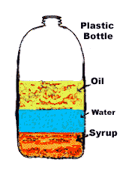
Which liquid is the least dense?
a)
oil
b)
water
c)
syrup 
d)
plastic bottle
13.
What happens when you heat a gas?
a)
It gains mass.
b)
It loses mass.
c)
It increases in volume.
d)
It decreases in volume.
14.
The density of water is 1g/cm3. A substance will float if its density is less than that of water. Which of the following substance will float?
a)
substance 1
b)
substance 2
c)
substance 3
d)
substance 4
15.
Which box has a higher density?  
a)
Box A
b)
Box B
c)
cannot be determined
d)
they are the same
16.
What is volume
a)
the amount of space an object occupies
b)
the amount of matter an object has
17.
If two objects are made of the same substance and have the same mass, the shape of the object determines whether or not it sinks or floats in a fluid.
a)
True
b)
False
18.
Hot air balloons float because hot air displaces cool air in the atmosphere.
a)
true
b)
false
19.
If the mass of an object is 6kg on earth.  what would the mass be on the moon?
a)
6kg
b)
0kg
c)
1kg
d)
13kg
20.
Buoyancy is the tendency for objects to float in a fluid. We consider buoyancy the...
a)
Un-gravity force 
b)
Anti-gravity force
c)
Gravitational pull
d)
Downwards pull on an object
21.
True or False: Buoyancy is an upwards force measured in Newtons. 
a)
True
b)
False
22.
Archimedes' Principle states that... 
a)
The buoyant force acting on an object equals the volume of the fluid displaced by the object. 
b)
The buoyant force acting on an object equals the weight (force of gravity) of the fluid displaced by the object.
c)
The buoyant force acting on an object will always be equal. 
23.
Which will result in positive buoyancy?
a)
When the buoyant force is greater than the force of gravity
b)
When the buoyant force is equal to the force of gravity
c)
When the buoyant force is less than the force of gravity
24.
How could you make plastic sink and steel float?
a)
You can't 
b)
Change the shape and therefore surface area 
c)
Remove some mass 
25.
Water is the only fluid that can provide buoyancy.
a)
true
b)
false
26.
True or false... "mass" is the exact same thing as "weight"?
a)
True
b)
False
27.
which of the following statements is true?
a)
oil floats on water because oil is less dense than water
b)
oil does not float on water because water is more dense
c)
water floats on oil because water is less dense
28.
Hot air is less dense than cold air
a)
true
b)
false
29.
has a weight of 15 N and a buoyant force of 18 N
a)
sinking object
b)
floating object
c)
buoyed up object
d)
my grandmother
30.
has a weight of 10 N and a buoyant force of 10 N
a)
density
b)
a sinking object
c)
a floating object
d)
a buoyed-up object
31.
can be decreased by making the shape hollow
a)
mass
b)
density
c)
volume
d)
weight
32.
is pumped into a submarine’s ballast tank to decrease density
a)
oil
b)
compressed air
c)
nitrogen
d)
water
33.
If an object sinks in a fluid, _____.
a)
the density of the fluid is greater than the density of the object
b)
the density of the fluid is less than the density of the object
c)
the density of the fluid is equal to the density of the object
d)
density has nothing to do with whether an object sinks or floats, only which state of matter the object is
34.
An object will will be partially submerged in a fluid if ____.
a)
the weight of an object is greater than the buoyant force
b)
the weight of an object is less than the buoyant force
c)
the weight of an object is equal to the buoyant force
d)
the weight doesn't affect if an object sinks, only its state of matter
35.
An object will NOT sink if its weight is ______ ______ _____ ______ ______ the buoyant force.
a)
Less than or equal to
b)
Greater than or equal to
c)
Similar to and almost equal
d)
Different from and almost equal
36.
Bernoulli’s principle states that the pressure in a fluid decreases as its velocity increases. 
a)
True
b)
False
37.
Daniel Bernoulli was a Swiss doctor who worked discovered life saving vaccinations.
a)
True
b)
False
38.
Bernoulli’s Principle explains how an airplane can stay aloft.
a)
True
b)
False
39.
The shape of an airplane wing causes the air above the wing to travel slower than the air below the wing.
a)
True
b)
False
40.
When air is moving quicker it's pressure is greater.
a)
True
b)
False
41.
Archimedes was the most-famous mathematician and inventor in ancient Greece.
a)
True
b)
False
42.
Archimedes Principle states that the buoyant force acting on a submerged object is equal to the density of the fluid displaced by the object.
a)
True
b)
False
43.
An object heavier than the amount of the fluid it displaces, will sink in a fluid. 
a)
True
b)
False
44.
What is this tool to get volume?
a)
triple beam balance
b)
ruler
c)
thermometer
d)
graduate cylinder
45.
What is this tool to get mass?
a)
triple beam balance
b)
ruler
c)
thermometer
d)
graduate cylinder
46.
True or False:  The density of a specific type of material never changes.  
a)
True
b)
False
47.
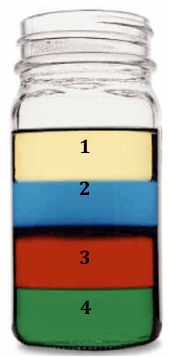
Put the liquids in order from most dense to least dense?
a)
4, 3, 2, 1
b)
1, 2, 3, 4
c)
3, 4, 2, 1, 
d)
4, 3, 1, 2
48.
Why does ice float?
a)
Liquid water is less dense than solid water.
b)
Solid water is less dense than liquid water.
c)
Gaseous water is less dense than solid water.
d)
Liquid water is less dense than gaseous water.
49.
What do we know about the density of lamp oil, rubbing alcohol, and vegetable oil?  
a)
The density is greater than 1.0 g/mL
b)
The density is less than 1.0 g/mL
c)
The density is equal to 1.0 g/mL
d)
The density can not be determined
50.
In general what is the most dense form of matter?
a)
solid
b)
liquid
c)
gas
d)
plasmas
51.
If an object has a density of .6 g/cm^3 and you put it into water, will it sink or float?  
a)
sink
b)
float
52.
If an object has a density of 3.6 g/cm^3 and you put it into water, will it sink or float?  
a)
sink
b)
float
53.
Which liquid is the least dense?
a)
oil
b)
water
c)
syrup 
d)
plastic bottle
54.
What is the formula for density?
a)
density = mass x volume
b)
density = mass / volume
c)
density = mass + volume
d)
density = mass - volume
55.
Jack has a rock. The rock has a mass of 14 g and a volume of 2 cm3. What is the density of the rock?
a)
7 mL
b)
7 g/cm3
c)
28 g/cm3
d)
1/7 g/cm3
56.
Frank has an eraser. It has a mass of 4 g, and a volume of 2 cm3. What is its density?
a)
8 g/cm3
b)
2 g/cm3
c)
1/2 g/cm3
d)
24 g/cm3
57.
Frank has a liquid. It has a mass of 6 g and a volume of 9 mL. What is its density?
a)
3 g/mL
b)
.66 g/mL
c)
1.33 g/mL
d)
54 g/mL
58.
Calculate the density of the cube.
a)
2 g/cm3
b)
4 g/cm3
c)
6 g/cm3
d)
8 g/cm3
59.
Calculate the density of the cube.
a)
2 g/cm3
b)
4 g/cm3
c)
6 g/cm3
d)
8 g/cm3
60.
Calculate the density of the cube.
a)
.33 g/cm3
b)
.4 g/cm3
c)
.6 g/cm3
d)
.5 g/cm3
61.
Calculate the density of the cube.
a)
3 g/cm3
b)
4 g/cm3
c)
2 g/cm3
d)
5 g/cm3
62.
If this substance takes up 6 ml of space, what is its mass?
a)
 6 ml
b)
6 grams
c)
0 grams
d)
4 grams 
63.
Which substance is the MOST dense?  ** Use the key
a)
A
b)
B
c)
C
d)
Cannot be determined by the data provided.
64.

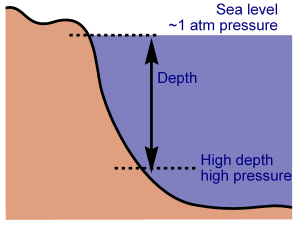
When you increase your depth under water, the water pressure on your body

a)

increases

b)

decreases

c)

stays the same

65.
Which of the following would increase the pressure on a system?
a)
Increase the Temperature
b)
Pump in more gas
c)
Decrease the volume
d)
All of these
66.
What decreases as you go up in the atmosphere?
a)
Altitude
b)
Atmosphere
c)
Meteors
d)
Air Pressure
67.

How do you Calculate Pressure

a)

Force(N)/Area(m2)

b)

Force(kg)/Area(mi2)

c)

Area(m2)/Force(N)

68.

Why won't you sink in mud if you wear boots?

a)

Because the surface area is larger creating less pressure.

b)

Has air in it to keep you floating.

c)

Because the mud won't want you.

69.

Diagram shows the design of a dam. Why does the thickness of the dam increase with its depth?

a)

The design of this structure is stronger.

b)

Water pressure increases with depth.

c)

The cost of construction is lower.

d)

Water pressure acts uniformly in all directions.

70.

What is pressure?

a)

The amount of force exerted on a surface

b)

The surface area of an object

c)

The weight of an object

71.
What is the unit of measurement for pressure?
a)
pascal
b)
grams
c)
milliters
d)
meters
72.

An object will float on water if it is

a)

less dense than water.

b)

more dense than water.

c)

the same density as water.

73.
What pressure does a 4000N horse exert on the ground if each foot is 10cm2?
a)
40 N/cm2
b)
100 N/cm2
c)
400 N/cm2
d)
10 N/cm2
74.
Pressure can be measured in Pascals (Pa) or Newtons per square metre.
1 Pa = 1N/m2
a)
True
b)
False
75.
A fluid can be...
a)
a gas
b)
a liquid
c)
a liquid or a gas
d)
a solid
76.
Buoyancy is the tendency for objects to float in a fluid. Buoyancy pushes the opposite direction of...
a)
waves push.
b)
magnetic pull.
c)
the wind.
d)
gravity's pull
77.
Car brakes and car jacks are examples of
a)
hydraulic systems
b)
archimedes' principle
c)
atmospheric pressure
d)
buoyancy