wayground logo

Free Printable Worksheets

NEW

Font size

S
M
L
XL
Worksheets

Mirror and Lens Test

Total questions: 33

Worksheet time: 8hrs 15mins

Name
Class
Date
1.

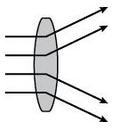
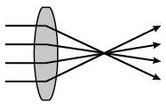
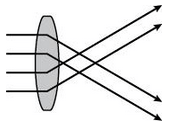
Which lens represents the path light takes through a diverging lens?

a)
b)
c)
d)
2.

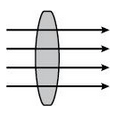
Which figure represents the path light takes through a converging lens?
a)
b)
c)
d)
3.

A shopkeeper wants to keep an eye on his store in order to prevent shoplifting. What could the shopkeeper hang on the wall in order to see a wider image of his store and his customers?

a)

a convex mirror

b)

a concave mirror

c)

a convex lens

d)

a concave lens

4.

A dentist uses a small dental mirror to help magnify teeth in your mouth. What type of mirror is this?

a)

a convex mirror

b)

a concave mirror

c)

a convex lens

d)

a concave lens

5.

Image behind the mirror is

a)

virtual

b)

real

c)

upside down

d)

upright

6.

According to the law of reflection the angle of incidence is ____________ the angle of reflection.

a)

less than

b)

greater than

c)

equal to

7.
The point where the rays meet is known as....
a)
Fire
b)
the focal point
c)
refraction
d)
Plane of the lens
8.
This image is...
a)
Inverted and smaller
b)
inverted and bigger
c)
not inverted and smaller
d)
not inverted and bigger
9.
This image is...
a)
Inverted and smaller
b)
Inverted and larger
c)
not inverted and smaller
d)
not inverted and larger
10.
Convex Mirrors produce...
a)
only virtual images
b)
virtual or real images
c)
only real images
d)
inverted images
11.
Refraction occurs when _____________
a)
the wave's speed changes by entering a new medium
b)
a wave bounces off of a boundary
c)
waves parts meet each other
d)
waves bend around a barrier
12.

Which of the following does fiber optics technology use?

a)

index of refraction

b)

critical angle

c)

total internal reflection

d)

aperture

13.
The imaginary line perpendicular to a reflecting surface is called _____.
a)
crooked line
b)
parallel line
c)
angular line
d)
normal line
14.

Which letter represents the angle of incidence?

a)

A

b)

B

c)

C

d)

D

15.

If angle of incidence is 50 degrees, what is angle of reflection?

a)

60 degrees

b)

80 degrees

c)

180 degrees

d)

50 degrees

16.

What is the size and position of an image formed by a plane mirror?

a)

same size, closer to the mirror

b)

larger size, closer to the mirror

c)

same size, same distance away from the mirror

d)

reduced, farther from the mirror

17.
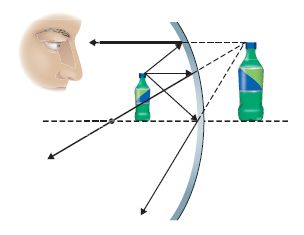
Which terms describe the reflection seen in this image?
a)
virtual, upright
b)
virtual, inverted
c)
real, upright
d)
real, inverted
18.
Light rays bend when they go from air to water  because of a change in ___________.
a)
color
b)
wavelength
c)
density
d)
speed
19.
This diagram best represents 
a)
reflection
b)
refraction
c)
absorption
d)
diffusion
20.
What is C?
a)
Angle of incidence
b)
Angle of reflection
c)
Incident ray
d)
Reflected ray
21.
What is E?
a)
Angle of incidence
b)
Angle of reflection
c)
Normal
d)
Reflect ray
22.
What is X?
a)
22.5°
b)
45°
c)
67.5°
d)
90°
23.
What does the word "converging" mean?
a)
to separate
b)
to come together
c)
parallel 
d)
perpendicular
24.
A converging lens is also known as a ____ lens.
a)
convex
b)
concave
c)
double
d)
refracted
25.

Any smooth surface that reflects light to form an image is a(n) ____.

a)

telescope

b)

microscope

c)

mirror

d)

lens

26.

This reflection is

a)

specular.

b)

diffuse.

27.

The image formed by this converging mirror is

a)

upright, same size, virtual

b)

inverted, same size, real

c)

inverted, larger, virtual

d)

upright, smaller, real

28.
What type of image is formed when rays of light actually intersect?
a)
real
b)
virtual
c)
projected
d)
curved
29.
What kind of image will you get if you put an object right at F, the focal point of this lens?
a)
Virtual, larger
b)
Real, smaller
c)
Real, larger
d)
No image
30.

This type of reflection is

a)

specular

b)

diffuse

31.

If you know the focal length of a concave mirror, where should you place an object so that its image is upright and larger compared to the object?

a)

at the focal point

b)

far away from the mirror (outside f)

c)

between the mirror and the focal point (inside f)

d)

concave mirrors can't produce upright larger images

32.

In the figure below, light is traveling from a __________ dense medium to a __________ dense medium.

a)

more, less

b)

less, more

33.

Determine the image distance an object placed 20.0 cm from a concave mirror having a focal length of 15.0 cm.

a)

5.00 cm

b)

35.0 cm

c)

60.0 cm

d)

9.00 cm