
 Worksheets
Solutions and Solubility
Total questions: 50
Worksheet time: 44mins
You can make a solute dissolve more quickly in a solvent by
adding more solute.
adding ice.
heating the solvent.
removing some solvent.
A solution that contains all of the solute it can hold at a given temperature is
diluted.
saturated.
supersaturated.
unsaturated.
The amount of solute that can be dissolved in a specific amount of solvent at a given temperature is its
concentration.
density.
dilution.
solubility.

Three 10 g samples of sugar are represented below.
Sample A dissolves in water more slowly than sample B.
Sample B dissolves more slowly than sample C.
Which of the following best explains why sample A dissolves more slowly than the other two?
It has the most volume.
It has the smallest surface area.
It has the largest number of sugar molecules.
It has the fewest bonds between sugar modules.
A technican prepared a solution by heating 100 mL of distilled water while adding KCl crystals until no more KCl would dissolve. She then capped the clear solution and set it aside on the lab counter. After several hours she noticed the solution had become cloudly and some solid had settled to the bottom of the flask. Which statement best describes what happened?
As the solution cooled, evaporation of water increased the KCl concentration beyond its solubility.
Water molecules, trapped with the KCl crystals, were released after heating.
At lower temperatures the solubility of KCl decreased and recrystallization occurred.
At increased temperatures the solubility of KCl increased and remained too high after cooling.
A student pours mineral salts into a bottle of cold water. Which of the following best explains why shaking the bottle will affect the dissolving rate of the salt?
Shaking exposes the salts to the solvent more quickly.
Shaking helps more water evaporate.
Shaking equalizes the water temperature.
Shaking causes more ions to precipitate out of solution.

Students in Ms. Martinez's science class are investigating how temperature, in degrees Celsius (C), affects the solubility of a compound in 100 milliliters (mL) of water. Ms. Martinez provides the students with a graph that shows the solubility of a certain compound, as shown below.
She then tell the students that she will demonstrate how many grams (g) of the compound will dissolve in 100 mL of water at 40 C. Based on the information in the graph, which of the following is the best prediction of how many grams of the compound will dissolve at 40 C?
40 g
65 g
85 g
100 g

The solubility graph below shows the amounts of four substances that will dissolve in 100 grams of water at various water temperatures.
Which substance has 80 grams of solute dissolved in 100 grams of water at 50 C?
Potassium Bromide
Ammonium Chloride
Potassium Chloride
Lithium Hydroxide
A solution that is able to dissolve additional solute is best described as
supersaturated.
concentrated.
saturated
unsaturated.
Is water the only solvent that can dissolve solutes?
Yes
No
Define the term soluble.
Can dissolve in water
Cannot dissolve in water
Partially dissolves in water
Define the term insoluble.
Can dissolve in water.
Cannot dissolve in water.
Partially dissolves in water.

Water is the universal solvent
true
false


Which of the following techniques will allow for more solute than normal to be dissolved in a solvent?
Freezing the solution
Shaking the solute
Cooling the solution
Heating the solution

Which of the following should be done to make the solute dissolve faster in the solvent?
Stir the solute
Freeze the solute
Decrease the temperature of the solvent
Increase the particle size of the solute
Which would NOT increase the rate at which a sugar cube dissolves?
Reducing the amount of solvent
Crushing the sugar cube
Stirring the solution
Heating the solvent


How many grams are soluble in 100 g of water at 100 ºC?
300 grams
250 grams
100 grams
50 grams
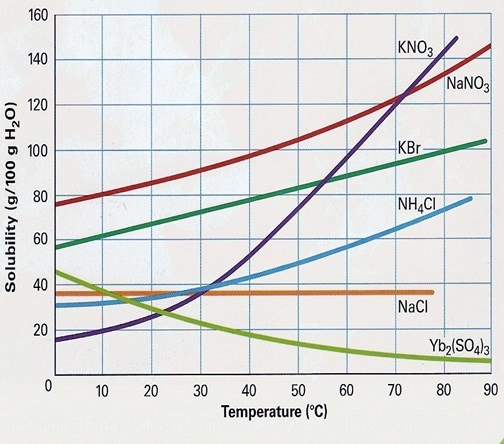
Identify how many grams of KNO3 are required to make a saturated solution at 40'C.
50 g
45 g
60 g
33 g

Which of the following refers to substances that do not mix together and look different throughout?
homogeneous mixture
solution
heterogeneous mixture
solubility curve


This is an example of a
Solution
Mixture

Sugar dissolved in water is an example of a
Homogeneous Mixture
Heterogeneous Mixture

Which substance is MOST soluble at 90 ºC?
Solid A
Solid B
Solid C

Which solute is least soluble at 90 ⁰C?
solid A
solid B
solid C

Which is an example of a solution?
Chex Mix
Mixed fruit
Gatorade
milk and cereal

According to the table how many of the solutes are nonpolar?
1
2
3
4

