wayground logo

Free Printable Worksheets

Font size

S
M
L
XL
Worksheets

Test ch 8.1-3 Covalent Bonds

Total questions: 47

Worksheet time: 58mins

Name
Class
Date
1.
Single covalent bonds are also referred to as ___________.
a)
sigma bonds
b)
pi bonds
c)
delta bonds
d)
hydrogen bonds
2.
The side-on (parallel) overlap of atomic orbitals is also referred to as_______?
a)
sigma bonds
b)
pi bonds
c)
delta bonds
d)
hydrogen bonds
3.
Hydrogen gains stability as the H2 molecule by forming the noble-gas configuration of ________.
a)
oxygen
b)
helium
c)
neon
d)
xenon
4.
What is the number of valence electrons in each of the molecules shown in the diagram (H2O, NH3, CH4)?
a)
5
b)
6
c)
7
d)
8
5.
Hydrogen needs _____ electrons in its valence shell to be stable.
a)
4
b)
6
c)
8
d)
2
6.
Determine the type of bond in an oxygen molecule: O2
a)
Double covalent
b)
Single covalent
c)
Ionic
d)
Triple covalent
7.
Which of the following is the correct Lewis structure for the compound PBr3?
a)
structure A
b)
structure B
c)
structure C
d)
structure D
8.
Draw the Lewis structure for OF2 and determine the number of unshared e- pairs are on the central atom.
a)
none
b)
1
c)
2
d)
it's ionic
9.

Which is the correct structure for ammonia (NH3)?

Pictures correspond with a-d.

a)

Option A.

b)

Option B.

c)

Option C.

d)

Option D.

10.
What kind of bond occurs between the carbons in C2H2?
a)
single
b)
double
c)
triple
d)
quadruple
11.

What is the chemical formula for dintrogen hexoxide?

a)

NO3

b)

NO2

c)

N2O5

d)

N2O6

12.

What is the name of the aqueous solution of H2SO4?

a)

hydrogen persulfide

b)

sulfuric acid

c)

sulfurous acid

d)

hydrogen persulfate

13.

Explain why HCl is hydrochloric acid while HClO3 is chloric acid.

a)

Chloric acid contains no hydrogen.

b)

Chloric acid does not dissolve in water.

c)

Chloric acid contains oxygen, and so is an oxyacid. Hydrogen in an oxyacid is not part of the name.

d)

HCl is more commonly used, and so it is given the name hydrochloric acid over the less common HClO3

14.

What is the correct name for HBr in an aqueous solution?

a)

hydrobromic acid

b)

hydrogen bromide

c)

bromic acid

d)

bromous acid

15.

The correct molecular compound name for H2O2 is ________.

a)

hydrogen oxide

b)

dihydrogen dioxide

c)

dihydrogen monoxide

d)

hydrogen dioxide

16.
How do covalent bonds form?
a)
Donating & receiving valence e- between atoms.
b)
Opposite slight charges attract each other between compounds.
c)
Scientists are still not sure how they form.
d)
Sharing valence e- between atoms.
17.
What two types of atoms make a covalent bond?
a)
2 Nonmetals
b)
1 Nonmetal and 1 Metal
c)
2 Metals
d)
2 Noble Gases
18.

Which of the following is NOT formed by a covalent bond?

a)

K2S

b)

H2O

c)

I2

d)

CO2

19.

Name the following compound:

CCl4

a)

monocarbon tetrachloride

b)

carbon (IV) chloride

c)

carbon chloride

d)

monocarbon quadchloide

20.
Name the following compound:
NF3
a)
nitrogen triflouride
b)
mononitrogen triflouride
c)
nitrogen flouride
d)
tetranitroflouide
21.
Name the following compound:
H2O
a)
hydrogen oxide
b)
dihydrogen oxide
c)
trihydroxide
d)
dihydrogen monoxide
22.

Write the formula for:

nitrogen (V) oxide

a)

NO

b)

N2O5

c)

2NO5

d)

O5N

23.
Write the formula for:
disulfur decafluoride
a)
2SF10
b)
SF5
c)
S2F10
d)
F10S2
24.
Write the formula for:
chlorine trifluoride
a)
ClF3
b)
ClF
c)
Cl3F
d)
3ClF
25.
In an electron dot diagram, two pairs of shared electrons represents a ...
a)
single bond
b)
double bond
c)
triple bond
d)
quadruple bond
26.

A Nitrogen molecule (N2) has one triple bond. How many electrons do the nitrogen atoms share?

a)

1

b)

3

c)

4

d)

6

27.
Compared to ionic compounds, molecular compounds generally have...
a)
good conductivity
b)
greater densities
c)
more chemical bonds
d)
a low boiling point
28.
Compared to ionic compounds, molecular compounds generally have...
a)
stronger chemical bonds
b)
poor conductivity
c)
a high melting point
d)
lower densities
29.

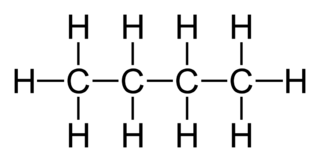
How many hydrogens does butane have?

a)

6

b)

8

c)

10

d)

12

30.
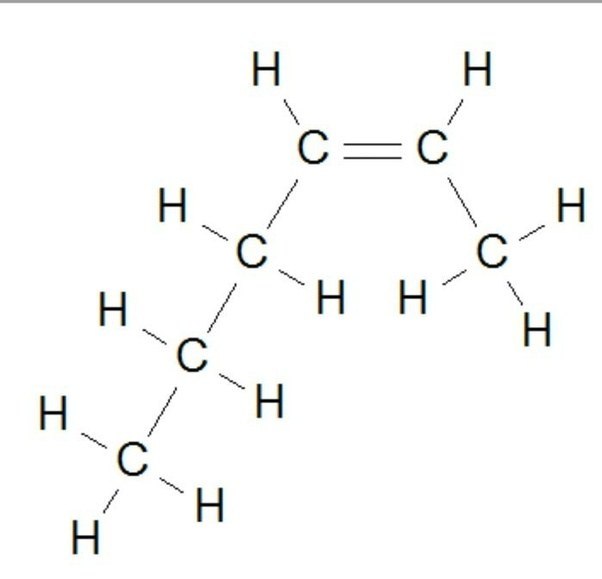
How many hydrogens does hexene have?
a)
10
b)
12
c)
14
d)
16
31.
How many hydrogens does propyne have?
a)
4
b)
6
c)
8
d)
10
32.
Which compound is inorganic?
a)
Glucose (C₆H₁₂O₆)
b)
Ethane (C₂H₆)
c)
Carbon Dioxide (CO₂)
d)
Stearic Acid (C₁₈H₃₆O₂)
33.
How many carbon atoms are in propane?
a)
1
b)
2
c)
3
d)
4
34.
Hydrocarbons are compounds that contain
a)
  Carbon and Nitrogen
b)
Carbon and Hydrogen 
c)
  Carbon, and Oxygen
d)
Carbon, Oxygen, and  Hydrogen 
35.
Which is an organic compound?
a)
Carbon Dioxide
b)
Carbon Monoxide
c)
Carbonates
d)
Ethane
36.
Name this alkane
a)
Methane
b)
Ethane
c)
Propane
d)
Butane
37.

Name the following hydrocarbon

a)

butane

b)

hexane

c)

heptane

d)

hexene

38.

What is the correct name for the alkyne shown?

a)

butyne

b)

1-butyne

c)

2-butyne

d)

1-methyl-1-propyne

39.
Which of the following is the correct Lewis dot structure for the molecule fluorine (F2)?
a)
A
b)
B
c)
C
d)
D
40.
How many valence electrons are in Phosphorus?
a)
15
b)
4
c)
5
d)
31
41.

How many total valence electrons are participating in bonding in the molecule above?

a)

8

b)

4

c)

2

d)

3

42.

CCl4 has how many double bonds?

a)

0

b)

1

c)

2

d)

3

43.

CH2O has which of the following?

a)

Multiple double bonds

b)

Multiple single bonds

c)

One double bond

d)

One single bond

e)

A lone pair

44.
Select the correct formula for sulfur hexachloride
a)
S2Cl6
b)
S6Cl
c)
SCl6
d)
SF6
45.
Name the compound CaF2
a)
calcium difluoride
b)
calcium (II) fluoride
c)
calcium fluorite
d)
calcium fluoride
46.

How many sigma and how many pi bonds are present in the ethene molecule (C2H4)?

a)

4 sigma and 2 pi

b)

5 sigma and 2 pi

c)

4 sigma and 1 pi

d)

5 sigma and 1 pi

47.

Which of the following statements is true?

a)

Nitrogen's triple bond is shorter than oxygen's double bond, so it is stronger.

b)

Nitrogen's triple bond is longer than oxygen's double bond, so it Is weaker.

c)

Nitrogen's triple bond is longer than oxygen's double bond, so it is stronger.

d)

Nitrogen's triple bond is shorter than oxygen's double bond so it is weaker.