wayground logo

Free Printable Worksheets

NEW

Font size

S
M
L
XL
Worksheets

Chapter 4: Musculoskeletal System

Total questions: 75

Worksheet time: 40mins

Name
Class
Date
1.

Which of the following is NOT a type of muscle?

a)

smooth

b)

rough

c)

cardiac

d)

skeletal

2.

What is it called where two or more bones connect

a)

Joint

b)

Tendon

c)

ligaments

d)

cartilage

3.

Which part of the skeletal system protects the brain?

a)

pelvis

b)

ribs

c)

scapula

d)

cranium/skull

4.

Which part of the skeletal system protects the heart and lungs?

a)

cranium/skull

b)

pelvis

c)

scapula

d)

ribs

5.

Which body system is responsible for our movement, energy, and for moving food from one organ to another?

a)

muscular

b)

circulatory

c)

nervous

d)

skeletal

6.

This is a tissue that connects the ends of bones together to form a joint...joins bone to bone

a)

tendon

b)

nerve

c)

epithelial

d)

ligament

7.

Muscles that you have NO conscious control over, such as the muscles that line the digestive system, are classified as ___________.

a)

voluntary

b)

involuntary

c)

skeletal

d)

cardiac

8.

The type of involuntary muscle that lines the heart is the ___________ muscle.

a)

skeletal

b)

cardiac

c)

smooth

d)

bicep

9.

The location where two or more bones meet

a)

joint

b)

tendon

c)

wrist

d)

knee cap

10.

This type of voluntary muscle is responsible for the movement of the skeleton.

a)

skeletal

b)

cardiac

c)

smooth

d)

heart

11.

This tough band of connective tissue connects muscles to bones.

a)

ligament

b)

tendon

c)

cartilage

d)

femur

12.

The muscles that line the digestive system are _____________ muscles.

a)

cardiac

b)

skeletal

c)

smooth

d)

intestinal

13.

Muscles that move an arm or leg contract and relax. These muscles are called _________________ muscles.

a)

cardiac

b)

skeletal

c)

connective

d)

smooth

14.
What is  a tissue?
a)
A group of similar cells working together
b)
A group of similar organs working together
c)
A specific structure inside of an organism
d)
The largest structure in a eukaryotic organism
15.
Smooth muscle and cardiac muscle are considered _____ muscles because we can’t control them consciously.
a)
Immovable
b)
Involuntary
c)
Skeletal
d)
none of the above
16.
TRUE or False: Blood cells are produced in the bone marrow.
a)
True
b)
False
17.
Smooth muscle is .........
a)
voluntary and striated in appearance
b)
voluntary and non-striated in appearance
c)
involuntary and striated in appearance
d)
involuntary and non-striated in appearance
18.
Cardiac muscle is .........
a)
voluntary and striated in appearance
b)
voluntary and non-striated in appearance
c)
involuntary and striated in appearance
d)
involuntary and non-striated in appearance
19.
The main function of the musculoskeletal system is to.......
a)
Provide movement and support for the body
b)
protect internal organs
c)
provide attachment sites for muscles
d)
all of the above
20.
Tendons and ligaments are what type of tissue.
a)
Muscle
b)
Nerve
c)
Connective
d)
Epithelial
21.

Name the "Green Color" bone (jawbone)

a)

Hyoid

b)

Mandible

c)

Maxilla

d)

Clavicle

22.

AXIAL SKELETON consists of

a)

Pectoral Girdle

b)

Metatarsal

c)

Vertebral Column

d)

Pelvic Girdle

23.

Red Bone Marrow is the main production for:

a)

Fat cells

b)

Red blood cells

c)

Adipocytes

d)

Osteocytes

24.

Function of Osteoclast

a)

As bone-forming cells

b)

A mature bone cells

c)

As bone-destroying cells

d)

A primary bone cell

25.

'A' is _______ bone

a)

Femur

b)

Humerus

c)

Fibula

d)

Ulna

26.

The root word for "stiff joint" is:

a)

arthr/o

b)
synovi/o
c)
spondyl/o
d)
ankyl/o
27.
The root word "chondr/i" or "chondr/o" means:
a)
cartilage
b)
arthritis
c)
joint
d)
rib
28.
The root word for bone is:
a)
cost/o
b)
lord/o
c)
chondr/o
d)
oste/o
29.
The root word for curved, swayback or bent is:
a)
synovi/o
b)
lord/o
c)
scoli/o
d)
spondyl/o
30.
The suffix "-algia" means:
a)
pain
b)
cartilage
c)
crooked
d)
away from
31.
The root word for bent or hump is:
a)
scoli/o
b)
lord/o
c)
kyph/o
d)
arthr/o
32.
The suffix "-desis" means:
a)
loosening, setting free
b)
bind, tie together
c)
crooked, bent
d)
without, lack of
33.
The root word for "rib" is:
a)
chondr/o
b)
cost/o
c)
arthr/o
d)
ankyl/o
34.
"Scoli/o" means:
a)
curved, bent
b)
crooked, stiff
c)
cartilage
d)
tie together
35.
"Arthr/o" means:
a)
pain
b)
curved
c)
bone
d)
joint
36.

What action is being performed here?

a)

Adduction

b)

Abduction

c)

Flexion

d)

Extension

37.
The noise that bones can make when they rub against each other or on cartilage.
a)
exostosis
b)
callus
c)
crepitation
d)
friction
38.
A Podiatrist would see you as a patient if you had an injured_______________.
a)
hand
b)
knee
c)
foot
d)
back
39.
An injury to a ligament is called a:
a)
sprain
b)
strain
c)
contusion
d)
subluxation
40.
Bones of the wrist could be classified as 
a)
Short Bones
b)
Long Bones
c)
Irregular Bones
d)
Flat Bones
41.
A break in bone that does not penetrate the skin
a)
stress fracture
b)
closed fracture
c)
compound fracture
d)
open fracture
42.
What is the name given to the end of a long bone?
a)
Compact bone
b)
Epiphysis
c)
Diaphysis
d)
Periosteum
43.
When a vertebrae does not fully close around the spinal cord to protect it that condition is called ____________
a)
Lumbago
b)
Rheumatoid arthritis
c)
Spina Bifida
d)
Ankylosing spondylitis
44.
The partial displacement of a bone from a joint is a:
a)
dislocation
b)
subluxation
45.
The mass of bone tissue that forms at a fracture site during healing is:
a)
callus
b)
chondromalacia
c)
exotosis
d)
tumor
46.
Spondyl/o means:
a)
vertebrae
b)
bone
c)
crooked
d)
broken
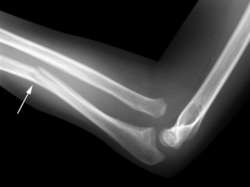
47.
a)
Compound Fracture
b)
Greenstick Fracture
c)
Transverse fracture displaced
d)
Compression fracture
48.
The root word for "crooked, bent or stiff" is:
a)
scoli/o
b)
synovi/o
c)
spondyl/o
d)
ankyl/o
49.

ARTHRALGIA MEANS

a)

THE CONDITION OF BEING SHORT

b)

PERTAINING TO THE KNEE

c)

JOINT PAIN

d)

MUSCLE WEAKNESS

50.
Which combining form means movement?
a)
kinesi/o
b)
tax/o
c)
ton/o
51.
Which term means breaking down of muscle tissue?
a)
atrophy
b)
myolysis
c)
myomalacia
52.
Which term means the surgical suturing of a muscle? 
a)
myorrhaphy
b)
myectomy
c)
myotomy
53.
Dystonia is an inability to coordinate the muscles in the execution of voluntary movement.
a)
True
b)
False
54.
Which term means weakness or slight paralysis of a muscle?
a)
hemiparesis
b)
hemiplegia
c)
myoparesis
55.
Which term means lacking normal tone or strength?
a)
atonic
b)
ataxia
c)
atrophy
56.
Inflammation of the fascia is called fasciitis.
a)
True
b)
False
57.
fibr/o
a)
fiber
b)
muscle
c)
skeleton
58.
my/o
a)
muscle
b)
skeleton
c)
tendon
59.
fibromyalgia
a)
chronic muscle pain
b)
sudden involuntary jerking of a muscle
c)
abnormal muscle tone
60.
myocele
a)
hernia of a muscle; protrusion of a muscle through its fascia
b)
study of movement
c)
excessive movement; hyperactivity
61.

Softening of bone

a)

osteocyte

b)

osteomalacia

c)

osteopathy

d)

ostealgia

62.

Pain in bones

a)

osteocyte

b)

osteomalacia

c)

osteopathy

d)

ostealgia

63.

Disease of bones

a)

osteocyte

b)

osteomalacia

c)

osteopathy

d)

ostealgia

64.

Surgical repair of muscle

a)

myoplasty

b)

myorrhexis

c)

myorraphy

d)

myalgia

65.

Suture a muscle

a)

myoplasty

b)

myorrhexis

c)

myorraphy

d)

myalgia

66.

Muscle rupture

a)

myoplasty

b)

myorrhexis

c)

myorraphy

d)

myalgia

67.

Abnormal tone

a)

hypertonia

b)

hypotonia

c)

atonia

d)

dystonia

68.

Lack of tone

a)

hypertonia

b)

hypotonia

c)

atonia

d)

dystonia

69.

Fracture at an angle

a)

comminuted

b)

greenstick

c)

oblique

d)

transverse

70.

Scar tissue in the fascia around a muscle

a)

contracture

b)

adhesion

c)

atrophy

d)

torticollis

71.

Abnormal shortening of muscle fibers

a)

contracture

b)

adhesion

c)

atrophy

d)

torticollis

72.

Turning the palm of the hand upward

a)

pronation

b)

supination

c)

opposition

d)

eversion

73.

Relaxes muscle spasms, also called antispasmodics

a)

Boniva

b)

Citracal

c)

Predinisone

d)

Flexeril

74.

Treats conditons that result in weak and fragile bones like osteoporosis

a)

Boniva

b)

Citracal

c)

Predinisone

d)

Flexeril

75.

Correcting a fracture by realigning the bone fragments

a)

fixation

b)

reduction

c)

traction

d)

arthroscopy