
NEW
Font size
 Worksheets
EP 025 Paper 1 SET 1 KMKK
Total questions: 40
Worksheet time: 40mins

Three charges + q, + Q and – Q are placed at the corners of an equilateral triangle as shown in FIGURE 1 below. The net force on charge + q due to the other two charges is
vertically up
vertically zero
horizontal to the left
horizontal to the right

FIGURE 2 below shows a charge 2Q is located at the origin while a second charge – Q is located at x= a . Where should a third positive charge be placed so that the net force on the charge is zero?
x<0
0< x <a
x > a
x < 0 OR 0 < x < a

A positive charge that is in an electric field E experiences a force that is
perpendicular to E .
zero because the speed is zero.
in the opposite direction to E .
in the same direction as E .
In a uniform electric field, a proton has
a constant velocity in the direction of the field.
a constant velocity in the direction opposite to that of the field.
a constant acceleration in the direction of the field.
a constant acceleration in the direction opposite to that of the field.
As the voltage in the circuit is increased, the capacitance
does not change
decreases
increases
none of these.
The capacitance of a parallel–plate capacitor
decreases if a dielectric is placed between its plates.
is independent of the charge on the capacitor.
is independent of the distance between the plates.
has units of J C−1 .
If 4.70 × 10¹⁶ electrons pass a point in a wire every second, what is the current in the wire?
A. 4.70 mA
B. 3.67 mA
C. 2.95 mA
D. 7.52 mA
The resistivity of any given metal, ρ
depends on its temperature.
varies linearly with temperature.
has units of Ohm–meter.
is described by all of the above.

The graph in FIGURE 3 below shows the potential difference across a resistor as a function of the current through the resistor. The slope of the resulting curve represents
power
resistance
e.m.f.
charge

The circuit in FIGURE 4 below contains a battery and a resistor in series. Which one of the following statements is FALSE?
The current in the circuit is 2 A.
The battery is supplying energy to the circuit at the rate of 6 W.
The battery is being discharged.
Internal resistor is 0.5 Ω
In a circular loop of wire lying on a horizontal floor, the current is constant and, to a person looking downward, has a clockwise direction. The accompanying magnetic field at the centre of the circle is directed
vertically downward.
horizontally and to the east.
horizontally and to the north.
parallel to the floor.

When the positive current in a long wire is flowing in a direction from South to North, it creates a magnetic field below the wire that is directed
from East to West.
from North to South.
from South to North.
rom West to East.

Two wires lying in the plane of this page carry equal currents in the opposite direction as shown in FIGURE 5 below. At a point midway between the wires, the magnetic field is
zero
into the page
out of the page.
towards the top of the page.
According to Faraday's law, a necessary and sufficient condition for an electromotive force to be induced in a closed circuit loop is the presence in the loop of
a magnetic field.
magnetic materials.
an electric current.
a time–varying magnetic flux.
The instantaneous induced e.m.f. in a coil of wire located in a magnetic field
depends on the time rate of change of flux through the coil.
depends on the instantaneous value of flux through the coil...
is independent of the area of the coil...
is independent of the number of turns of the coil...
Which law does the following statement express?
In all cases of electromagnetic induction, the induced voltages have a direction such that the currents they produce oppose the effect that produces them.
Coulomb’s law
Fleming's rule
Lenz's law
Ampère's law
The self–inductance of a wire coil is a proportionality constant that relates
electric field to current.
electric force to current.
magnetic flux to current.
magnetic field to current.
When an object is closer to a concave mirror than the mirror's focal point, thee
the magnification is less than one.
the image is inverted.
the magnification is equal to one.
the image distance is negative.

What type of lens creates the image seen in the eyeglasses?
convex
concave
reflection
plane
An image that is formed at the back of the mirror is said to be
real image
virtual image
inverted image
magnified image
When a parallel beam of light is diffracted at a single slit,
the shadow is always sharp...
the narrower the slit, the wider the central diffraction maximum...
the width of the central diffraction maximum is independent of the width of the slit.
none of these is correct.

What is the condition for destructive interference to occur for the soap film shown?
2nt = mλ
2nt = (m+¼)λ
2nt = (m+½)λ
2nt = (m+¾)λ
Two light sources are said to be coherent if they
are of the same frequency.
are of the same frequency, and maintain a constant phase difference.
are of the same amplitude, and maintain a constant phase difference.
are of the same frequency and amplitude.
The combination of two or more waves that result in a single wave
diffraction
resonance
reflection
interference
'Every points on the wave front of light are the sources of smaller waves called wavelets.' This is the statement of
Huygen
Hubble
Ronaldo
Germer
Which diagram best represents the shape and direction of a series of wave fronts after they have passed through a small opening in a barrier?
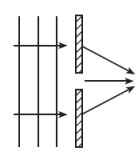
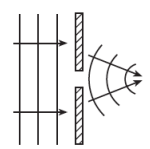
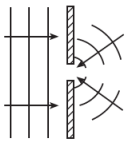
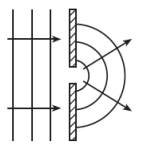
In the photoelectric effect, the work function depends on
the incident wavelength.
the applied voltage.
the light intensity.
the metal that the light strikes.
Which of the following changes occur?
Energy of electrons: increase.
Energy of electrons: no change.
Energy of electrons: increase.
Energy of electrons: no change.

Plank's constant is determined by:
The Davisson–Germer experiment verified that
the velocity of light in a vacuum is a universal constant.
the waves have a particle aspect.
the electrons show wave characteristics.
the neutron does not have a charge.
If a baseball, an electron and a photon all have the same momentum, which one has the longest wavelength?
Baseball
Electron
Photon
All have the same wavelength
The sodium atom has an atomic number of 11 and an mass number of 23. The neutral atom contains
11 neutrons and 12 protons.
11 protons and 12 neutrons.
12 electrons and 11 neutrons.
23 protons and 12 electrons.
Which one of the following radioactive decay products has the largest electric charge?
Alpha particles
Beta particles
Gamma rays
Neutrons
A particle and its antiparticle must have
opposite spins.
opposite charges.
opposite masses.
opposite forces
Leptons
are less massive than the lightest hadron.
include electrons, muons and neutrinos.
participate in the weak interaction.
all of these are correct.
Extra distance travelled by one of waves compared with other is called
path.
displacement.
phase difference.
path difference.

