wayground logo

Free Printable Worksheets

NEW

Font size

S
M
L
XL
Worksheets

Colision Theory and factors Quiz

Total questions: 25

Worksheet time: 18mins

Name
Class
Date
1.

What criteria must be met for reactant collisions to result in a successful product?

a)

The reactants must collide with each other

b)

The reactants must collide with enough energy and be in the right positions

c)

The reactants must have enough energy to form the activated complex

2.
Why does a higher temperature increase the rate of a reaction?
a)
it increases both the frequency and energy of particle collisions
b)
it only increases the frequency of particle collisions
c)
it only increases the energy of particle collisions
d)
it reduces the activation energy of the reaction
3.
If the reactant particles collide with less than the activation energy, the particles will be rebound, and no reaction will occur.
a)
True
b)
False
4.
The collisions which bring about a chemical reaction are called: 
a)
Consistent collisions
b)
 Normal collisions 
c)
Effective collisions 
d)
None of the above
5.

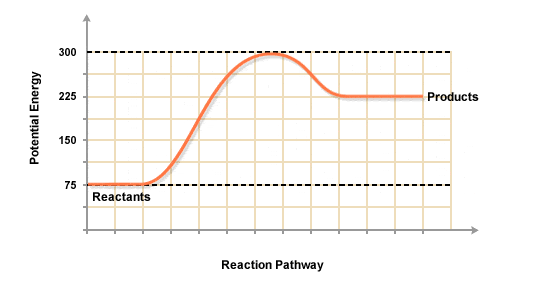
Did a chemical reaction take place based on the the diagram? How do you know?

a)

Yes, a new substance is formed

b)

No, no new substances were formed

c)

More information needed

6.
What are the two factors to look for when determining if the reaction is at equilibrium?
a)
Forward reaction rate is faster than the reverse and concentrations are equal
b)
Forward and reverse reaction rates are equal and concentration is conctant
c)
Forward and revers reaction rates are equal and concentration is equal
d)
Forward reaction rate is faster than the reverse and concentration is equal
7.
At what time the reaction reached equilibrium?
a)
t1
b)
t2
c)
t3
d)
t4
8.
Identify the labels (a) and (b) on the graph.
a)
a is concentration of reactants and b is the concentration of product
b)
a is concentration of product and b is the concentration of reactant
c)
a is the volume of reactants and b is the volume of product
d)
a the mass of reactants and b is the mass of product
9.
At what time (in seconds) is equilibrium established?
a)
0 seconds
b)
1 second
c)
5 seconds
d)
10 seconds
10.
Which of the two graphs reaches equilibrium?
a)
The left one.
b)
The right one.
c)
Both of them.
d)
Neither.
11.
What is the Kc expression for this reaction?
   2 NO(g)  +  O2(g) ⇌  2 NO2(g)
a)
K= [NO2]2 / [NO][O2]
b)
K=  [NO][O2] / [NO2]2
c)
K= [NO][O2] [NO2]2
d)
K= [NO2]2 / [NO]2 +  [O2]
12.
Le Chatelier's Principle states that.... 
If a (dynamic) equilibrium is disturbed by changing the conditions, the position of equilibrium................
a)
moves to increase the change
b)
moves to counteract the change
c)
does not change
13.
What are [A] and [B]?
a)
concentration of reactants
b)
concentration of products
c)
energy of reactants
d)
energy of products
14.
What is the equilibrium expression for:
Fe3O4(s) + 4H2(g) <=> 3Fe(s) + 4H2O(g)
Kc =
a)
[Fe][H2O]4  / [Fe3O4] [H2]4
b)
[Fe3O4] [H2]/  [Fe][H2O]4
c)
[H2O]4 / [H2]4
d)
[Fe] [H2O] / [Fe3O4] [H2]
15.

Which letter represents the PE of reactants?

a)

A

b)

B

c)

C

d)

D

e)

E

16.

Which letter represents the heat of reaction?

a)

A

b)

B

c)

C

d)

D

e)

E

17.

Which letter represents the activation energy for the forward reaction?

a)

A

b)

B

c)

C

d)

D

e)

E

18.

If a catalyst were added, which letters would change?

a)

A, B, and C only

b)

B, C, and D only

c)

B and C only

d)

All letters would change

19.

How much energy does it take to start this reaction?

a)

20 kJ

b)

100 kJ

c)

60 kJ

d)

-60 kJ

20.

What is the heat of reaction for the reaction shown in this PE diagram?

a)

50kJ

b)

-50 kJ

c)

200 kJ

d)

-200 kJ

21.

An endothermic reaction is

a)

A reaction that absorbs heat, and the products have less PE than the reactants

b)

A reaction that releases heat, and the products have more PE than the reactants

c)

A reaction that absorbs heat, and the products have more PE than the reactants

d)

A reaction that releases heat, and the products have more PE than the reactants

22.

What is the activation energy for the catalyzed reaction?

a)

75 kJ

b)

90 kJ

c)

25 kJ

d)

10 kJ

23.

What is the heat of reaction for the uncatalyzed reaction?

a)

25 kJ

b)

10 kJ

c)

15 kJ

d)

50 kJ

24.
What is the energy of the activated complex?
a)
75 kJ
b)
225 kJ
c)
300 kJ
d)
225 kJ
25.

Were you able to submit all assignments from this past unit and I am ready for the test.

a)

Yes, bring on the test

b)

I finished the work, but I need some time to prep for the test.

c)

I have completed 3 of the four assignments.

d)

I just access to the assignments.