
Font size
 Worksheets
Geological Time Scale!
Total questions: 32
Worksheet time: 27mins

Finding the age of a rock or event WITH OUT using an exact date?
relative dating
carbon dating
uranium dating
absolute dating
In which time period are we currently living?
Precambrian Time
Paleozoic Era
Mesozoic Era
Cenozoic Era
Jellyfish are one of the oldest species on Earth. In what time period did they first appear?
Precambrian Time
Paleozoic Era
Mesozoic Era
Cenozoic Era
In what time period did Pangaea, the super continent, appear?
Precambrian Time
Paleozoic Era
Mesozoic Era
Cenozoic Era
Dinosaurs, small mammals, and birds are found in this time period.
Precambrian Time
Paleozoic Era
Mesozoic Era
Cenozoic Era

Which fossil is the youngest?
fossil A
fossil B
fossil C
fossils A and B are the same age
What is the importance of studying fossils?
to provide information about how current life forms would exist in previous environmental conditions
to provide information about how life and environmental conditions may have changed
to provide information about how previous life forms would exist in current environmental conditions
6. A branch of geology dealing with the arrangement of sedimentary rock layers or strata?
Stratigraphy
Geography
Photography
Biography
Geologists assume the newest rock layers are on top of the older ones, unless some type of disturbance occurs, in known as …
Law of Inclusions
Law of Crosscutting
Law of Conservation
Law of Superposition
Determines the “relative” order of past events but not the absolute age.
Absolute age
Relative age
Real age
New age


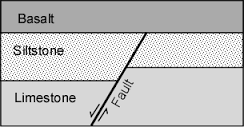


Which rock strata is the youngest?
A
B
C
D
E

Which rock strata is the oldest?
A
B
C
D
E

Which relative rock dating law(s) are shown in the image?
Law of superposition only.
Law of superposition and crosscutting.
Law of inclusion and superposition.
Law of inclusion only.

Putting laundry in the basket over time best illustrates which rocking dating law?
Radioactive dating.
Law of superposition.
Law of crosscutting.
Law of inclusion.
What is the principle that states Earth's processes occurring today are similar to those that occurred in the past?
Index fossils
Unconformities
Uniformitaianism
Superposition
What is an unfonformity in rock strata?
a missing interval in the strata record.
an interruption in rock strata by weather and erosion.
an interruption in rock strata by earthquakes or magma.
All of the above.
Dinosaurs and early human ancestors coexisted at one time.
True
False

Which statement(s) are true about the rock strata shown?
Fossils 2 and 4 lived around the same time.
Fossils 3 and 6 lived around the same time.
Fossil 1 is younger than fossil 4.
Fossil 5 is younger than fossil 2.
Which image best shows the law of inclusion?


Which type of rock do fossils form in?
Sedimentary
Intrusive igneous
Extrusive igneous
Metamorphic
Which of the following does NOT preserve fossils?
Amber (tree sap)
Tar
Ice
Magma
A majority of the fossil record we have is of
dinosaurs.
marine creatures.
plant specimens.
insects.

