wayground logo

Free Printable Worksheets

Font size

S
M
L
XL
Worksheets

OCEANOGRAPHY - Physical Oceans Practice Test

Total questions: 74

Worksheet time: 46mins

Name
Class
Date
1.
Which best describes the continental shelf?
a)
a flat underwater valley 
b)
a region of mountains in the deep ocean 
c)
a shallow area of sediment near the shore 
d)
a region with high water pressure 
2.
Salinity means
a)
how many fish are in the water
b)
how much salt is in the water
3.
The ocean floor 
a)
is always a flat bed of sand 
b)
has mountains, plains, and ridges like land surfaces
c)
is covered by the same amount of water everywhere
d)
covers less area than land
4.
The ocean covers 50% of Earth's surface.
a)
True
b)
False
5.
A coral reef is 
a)
a rock 
b)
an ecosystem
c)
an underground cave
d)
a hydro-thermal vent
6.
Where is the ocean deepest?
a)
ocean trench
b)
volcanic island
c)
abyssal plain 
d)
mid-ocean ridge
7.
Plankton are microscopic single-celled oragnisms. 
a)
True
b)
False
8.
The main difference between ocean water and lake water is that ocean water contains
a)
oxygen
b)
salt
c)
algae
d)
plants
9.
As you go deeper in the ocean, the _______ decreases. 
a)
water
b)
salinity
c)
temperature
d)
water pressure 
10.
What do the arrows represent in the picture?
a)
waves
b)
currents
c)
tides
11.
What causes the tides to change?
a)
rotation of the Earth
b)
magic
c)
gravitational pull from the moon
d)
ocean currents
12.
The large flat region of the ocean floor is called the 
a)
ocean trench
b)
continental shelf
c)
abyssal plain
d)
seamount 
13.
The Gulf Stream is 
a)
a stream behind the school 
b)
a current in the Atlantic Ocean that flows on the eastern coast of North America 
c)
a boat 
d)
part of the ocean floor 
14.
What is the only part of the ocean floor without tectonic activity?
a)
continental slope
b)
continental margin
c)
seamount
d)
abyssal plain
15.
Why is there high salinity in the Mediterranean Ocean?
a)
precipitation
b)
evaporation
c)
volcanoes
d)
deposition
16.
Sea levels rise when glacial ice caps-
a)
grow
b)
melt
c)
migrate
d)
hit the Titanic
17.
Ocean currents are caused by-
a)
underwater earthquakes
b)
human influence
c)
sun moon and Earth interaction
d)
density differences
18.
Upwelling is most likely to occur in what area?
a)
in a deep sea trench
b)
in a shallow gulf
c)
along a coastline
d)
in open ocean
19.
Why does an ice shelf float?
a)
it is more dense
b)
it is less dense
c)
the ice is melting faster than it can sink
d)
vegetation is sinking below and causing it to float
20.
Seawater is typically denser than freshwater due to seawaters-
a)
greater depth
b)
smaller mass
c)
higher salinity
d)
lower freezing point
21.
What part of the ocean floor would be most affected by sea level change?
a)
abyssal plain
b)
continental shelf
c)
continental slope
d)
trench
22.
What major feature of the ocean floor circumnavigates the Earth?
a)
mid oceanic ridge
b)
continental slope
c)
trench
d)
sea mount
23.
A trench is formed at what zone?
a)
subduction
b)
divergent
c)
convergent
d)
strike-slip
24.
What first accurately mapped the ocean floor?
a)
The Spanish armada
b)
Chinese army
c)
Magellan
d)
sonar
25.
An estuary is an area where-
a)
there is only fresh water
b)
there is only salt water
c)
pond water and river water mix
d)
fresh water and salt water mix
26.
What causes surface currents to move in circular paths?
a)
strong winds
b)
the Coriolis effect
c)
salinity
d)
the Global Ocean Conveyor
27.
Deep currents are caused by differences in the _______________ ocean water.
a)
 eutrophication of
b)
sun's effect on
c)
density of
d)
 salinity of 
28.
Warm ocean currents generally come from
a)
The North Pole
b)
The South Pole
c)
The Equator
d)
Both A and B
29.
Cold ocean currents generally come from
a)
The North Pole 
b)
The South Pole
c)
The Equator
d)
Either Pole
30.
A measure of the amount of dissolved salts in a given amount of liquids is called: 
a)
salinity
b)
density
c)
deflection
d)
upwelling
31.
The gently sloping submerged surface extending from the shoreline
a)
Seamounts
b)
Continential Shelf
c)
Continential Rise
d)
Continental Slope
32.
Cities closer to water most likely will be
a)
more dry
b)
more humid
c)
hotter
d)
colder
33.
As you go deeper in the ocean, the water is warmer and less salty.
a)
True
b)
False
34.

Name feature B

a)

guyot

b)

seamount

c)

abyssal plain

d)

volcanic island

35.

A mountain rising from the ocean floor that does not reach water's surface.

a)

volcanic island

b)

continental shelf

c)

seamount

d)

guyot

36.

Name feature C

a)

guyot

b)

seamount

c)

abyssal plain

d)

continental shelf

37.

This trench is the deepest part of the world's ocean and the deepest location on the surface of the earth.

a)

trench

b)

guyot

c)

Mariana Trench

d)

seamount

38.

Seamounts that reach the surface of the ocean.

a)

guyot

b)

continental slope

c)

abyssal plain

d)

volcanic island

39.

Seamounts with a flat top.

a)

seamount

b)

volcanic island

c)

guyot

d)

volcanic arc

40.

Name the feature for D

a)

volcanic arc

b)

volcanic island

c)

mid-ocean ridge

d)

continental shelf

41.

Name the feature for E

a)

volcanic island

b)

volcanic arc

c)

seamount

d)

mid-ocean ridge

42.

Name the feature for F

a)

continental slope

b)

continental shelf

c)

abyssal plain

d)

trench

43.

Name the feature for G

a)

seamount

b)

trench

c)

mid-ocean ridge

d)

continental shelf

44.

Tsunamis are caused by

a)

underwater disturbances such as earthquakes, landslides, and volcanoes.

b)

wind and the gravitational pull of the moon.

45.
What can cause a tsunami?
a)
earthquake
b)
underwater volcanoes
c)
landslides
d)
all of these
46.
What natural phenomena happens right before an tsunami?
a)
the ocean water retreats
b)
animals act strangely
c)
you can hear a loud train-like sound
d)
all of these
47.

How fast can tsunamis travel?

a)

400 mph

b)

100 mph

c)

1,000,000 mph

d)

500 mph

48.
What are some ways that people can protect themselves from tsunamis?
a)
build protective walls
b)
use tsunami warning devices (buoys and signals)
c)
live / retreat to higher elevations
d)
all of these
49.
True or False...meteors can cause tsunamis?
a)
True
b)
False
c)
Maybe
d)
What's a meteor
50.
The trough is the...
a)
the peak of the tsunami
b)
low point of a tsunami
c)
the crest
d)
place where pigs eat
51.
The 2011 Japanese tsunami was caused by:
a)
Mt. Fuji erupted
b)
a 9.0 underwater earthquake
c)
a meteorite crashing in the Pacific
d)
none of the above
52.
Which of the following was an outcome of the 2011 Japanese tsunami?
a)
there was a nuclear power plant disaster
b)
18,000 people died
c)
300 billion dollars in damage
d)
all of these
53.

What is the most common cause for tsunamis?

a)

underwater earthquakes

b)

meteor crashes

c)

underwater volcanoes

d)

land slides in the ocean

54.

What is the best way to survive a tsunami?

a)

float on debris

b)

get to higher ground

c)

stay and watch and film this crazy storm

d)

climb a tree

55.

Which of the following shows the correct order of events for a tsunami?

a)

Water recedes back into the ocean carrying all the debris, tsunami waves hit, tide retreats as a warning

b)

Tide retreats as a warning, water recedes back into the ocean carrying all the debris, tsunami waves hit

c)

Tide retreats as a warning, tsunami waves hit, water recedes back into the ocean carrying all the debris

d)

I have NO idea

56.

True or False? When you are out in the ocean, you might not even be able to detect a tsunami wave.

a)

True

b)

False

c)

Wait, what?

57.

The top part of a tsunami wave is called the

a)

trough

b)

crest

c)

shoal

d)

tidal wave

58.

What should you do if you think a tsunami is coming?

a)

Go to higher ground

b)

Go to the beach

c)

Find a boat

d)

Hide in your house

59.

Before a tsunami the coastal sea depth normally

a)

Rises suddenly

b)

falls suddenly

c)

gets really hot

d)

fills with fish

60.

1. What is a tsunami?

a. A large storm with very high speed winds

b. A tropical cyclone that occurs in the Pacific Ocean

c. A large and powerful ocean wave

d. A type of tornado

e. Any earthquake that causes significant damage

a)

a

b)

b

c)

c

d)

d

e)

e

61.
The huge pieces of the earth's crust are called ____________________________. 
a)
crust
b)
plates
c)
directions
d)
seismos
62.

What is the deadliest tsunami ever recorded?

a)

The 1782 South China Sea tsunami

b)

The 1868 northern Chile tsunami

c)

The 1883 South Java Sea tsunami

d)

The 2004 Indian Ocean tsunami

63.

How does the image relate to tsunamis? (may be more than one)

a)

It measures the wave height

b)

It is part of the tsunami warning system

c)

It is a seismograph

d)

It is a life raft

64.

In a tsunami warning system, what is represented by #2?

a)

The earthquake

b)

A seismograph that detects the earthquake

c)

A mooring/buoy that transfers the earthquake data to shore

d)

A satellite used for communication

65.

Tsunamis have occurred in the last 50 years in all of the following areas, except

a)

Indonesia

b)

Japan

c)

Chile

d)

New York City

66.
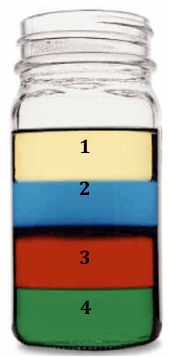
Put the liquids in order from most dense to least dense?
a)
4, 3, 2, 1
b)
1, 2, 3, 4
c)
3, 4, 2, 1, 
d)
4, 3, 1, 2
67.

______ causes surface currents.

a)

The Coriolis Effect

b)

gravity

c)

density differences

d)

wind

68.
The large, circular surface-current pattern found in each ocean.
a)
California Current
b)
Surface Current
c)
Gyre
d)
Global Conveyor Belt
69.
Which represents the distribution of water on Earth?
a)
3% freshwater, 97% salt water
b)
97% freshwater, 3% salt water
c)
71% freshwater, 29% salt water
d)
29% freshwater, 71% salt water
70.
What happens to pressure as you go deeper into the ocean? 
a)
increases
b)
decreases
c)
stays the same
d)
doubles
71.
The ocean floor is made of a rock called _____. 
a)
Granite
b)
Conglomerate 
c)
Andesite 
d)
Basalt 
72.
3.5% of the ocean's weight comes from dissolved salt. 
a)
True
b)
False
73.
What is the scientific name for salt? 
a)
Sodium Acetate 
b)
Sodium Chloride 
c)
Chloride sodium 
d)
Hydroxide sulfate 
74.
As we go deeper into the ocean, salinity ___________. 
a)
Doubles
b)
Decreases 
c)
Increases
d)
Remains the same