
 Worksheets
Transport in Mammals
Total questions: 76
Worksheet time: 29mins
The majority of CO2 transport is in the form of
hydrogen carbonate (bicarbonate)
carbomino haemoglobin
CO2 in solution
What enzyme is required for CO2 to be combined with water to make carbonic acid?
carbonic anhydrase
carbonic acid
carbonase
Blood returning from the body enters the
right atrium
left atrium
left ventricle
right ventricle
as the left ventricle contracts, the blood moves to the
aorta
vena cava
arteries
veins
blood returning to the heart from the lungs enters the
right atrium
left atrium
right ventricle
left ventricle
the excitation wave begins at the
sinoatrial node
atrioventricular node
perkyne fibers
the pacemaker region of the heart
SA node
AV node
During atrial systole, the pressure of the blood s __________ in the atrium than the ventricle.
higher
lower
the same
In an ECG, the QRS complex signals the
contraction of the ventricles
relaxation of the atrium
the repolarization of the Ventricle
The T wave in an ECG indicates...
repolarization
depolarization
excitation
P wave of an ECG indicates...
depolarization
repolarization
excitation
During ventricular systole forces the ___________ valves open.
semilunar
atrioventricular
Heart muscle unlike skeletal muscle is said to be
myogenic
neurogenic
cardiogenic
Erythrocyte
red blood cell
white blood cell
platelets
normal blood pressure
120/80
130/60
120/50
150/90
oxygen saturated protein in blood
oxyhaemoglobin
carbomino haemoglobin
haemoglobin
What is the partial pressure of O2 at respiring tissues?
high
low
what is the partial pressure of CO2 in the lungs?
high
low
what color is haemoglobin
red
violet
What sort of circulatory system is the human circulatory system?
An open circulatory system
A single circulatory system
A double circulatory system
A colloidal osmotic circulation index
Which type of blood vessel has a 'pulse'?
Artery
Capillary
Vein
Caliber


Veins carry blood to your heart.
True
False
In pulmonary circulation blood is taken from...
the heart to the lungs, and back again.
the heart to the rest of the body.
the lungs to the rest of the body.

Which is 2?
Veins
Arteries
Capillaries
what happens in systemic circulation
circulation for the entire body
circulation in the heart only
circulation heart and lungs
circulation to digestion system only
Oxyhaemoglobin gives up O2 when …
CO2 concentrations are high.
Body temperature is lowered.
pH values are high.
O2 concentrations are higher.
The acidity due to the accumulation of H+ in erythrocytes is buffered by …
Haemoglobin.
Plasma proteins.
Carbon dioxide.
Oxygen.
Carbonic anhydrase in the erythrocytes …
Catalyzes the removal of oxygen from the erythrocytes.
Catalyzes the conversion of carbon dioxide into water.
Catalyzes the reaction of carbon dioxide with water to form carbonic acid.
Catalyzes the increase in blood pH.
Which of the following is NOT the structure of haemoglobin?
Each haemoglobin molecule contains 4 haem group
Haemoglobin is a quaternary structure
Every each haem group in haemoglobin can bind with 4 molecule of oxygen
Each haemoglobin has 2 α-chain and 2 β-chain polypeptide subunits

The ion found in the haem group is what
Mg2+
O2-
Fe2+
Fe3+
Carbon dioxide and water combine to form
hydrogen carbonate ions
hydrogen ions
carbonic acid
hydrogen bicarbonate
The Bohr Effect/Shift moves the oxygen saturation curve in what direction
up and left
down and right
down and left
up and right
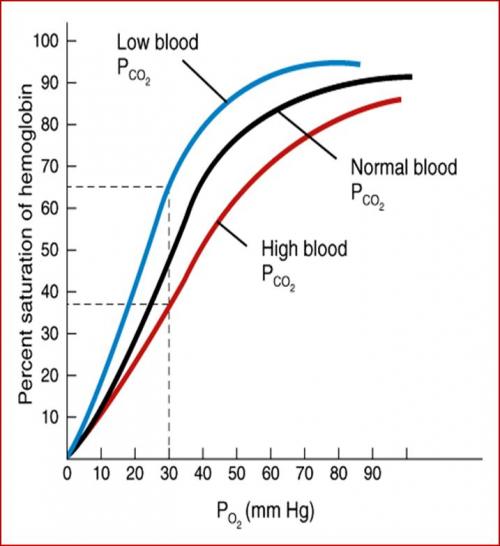
What colour line represents the oxygen saturation curve during intense exercise?
blue
black
red
What are the main things responsible for causing the Bohr Shift?
increased H+ ions
increased carbon dioxide partial pressure
increased oxygen requirements
carbon monoxide's high affinity for haemoglobin
The chamber of the heart with the thickest layer of muscle is
right atrium
left atrium
left ventricle
left atrium
When carbon dioxide binds directly with haemoglobin it forms
carbaminohaemoglobin
carboxyhaemoglobin
carbon diooxyhaemoglobin
carboglobin
The enzyme responsible for catalysing the conversion of water and carbon dioxide into carbonic acid is
carbonyl hydroxylase
carbonic anhydrase
carbonic hydrolase
carbon dioxylase

#1
superior vena cava
inferior vena cava
aorta
pulmonary artery

#14
superior vena cava
inferior vena cava
pulmonary veins
apex

#2
pulmonary artery
pulmonary veins
aorta
superior vena cava

#13
right atrium
left atrium
left ventricle
right ventricle

#8
left ventricle
right ventricle
right atrium
left atrium

#3
pulmonary artery
pulmonary veins
aorta
inferior vena cava

#12
tricuspid valve
mitral/bicuspid valve
aortic valve
pulmonary valve

#7
mitral/bicuspid valve
tricuspid valve
aortic valve
pulmonary valve

#4
pulmonary valve
aortic valve
mitral/bicuspid valve
tricuspid valve

#9
left ventricle
right ventricle
septum
apex

#10
right ventricle
apex
septum
left ventricle

#15
superior vena cava
inferior vena cava
aorta
septum

#5
right ventricle
left ventricle
right atrium
left atrium

#11
right ventricle
left ventricle
left atrium
right atrium

#6
pulmonary valve
aortic valve
mitral/bicuspid valve
tricuspid valve

In the diagram below, which part of the tracing represents the contraction of the atria?
P
T
R
S


The innermost layer of a blood vessel is called ___________.
tunica intima
tunica media
tunica adventitia
tunica externa
The middle layer of a blood vessel is called ___________.
tunica intima
tunica media
tunica adventitia
tunica externa
The outer layer of a blood vessel is called ___________.
tunica intima
tunica media
tunica adventitia
tunica externa

Identify the leukocyte
eosinophil
basophil
monocyte
lymphocyte

What type of leukocyte is this?
eosinophil
neutrophil
lymphocyte
monocyte

neutrophil
basophil
eosinophil
lymphocyte

bacteria
platelets
megakaryocytes
basophils
These cells eventually become macrophages that engulf pathogens
monocytes
erythrocytes
lymphocytes
eosinophils
These cells release histamines and other chemicals that increase inflammation
monocytes
basophils
lymphocytes
platelets

What type of blood cell is this?
Basophil
Neutrophil
Monocyte
Eosinophil
fight allergic reactions, parasitic infections and inflammation in the body.
Basophil
Monocyte
Lymphocyte
Eosinophil
Neutrophil

