wayground logo

Free Printable Worksheets

Font size

S
M
L
XL
Worksheets

1st semester final

Total questions: 75

Worksheet time: 4hrs 45mins

Name
Class
Date
1.
The independent variable is the
a)
one you measure.
b)
one you change.
2.
You can have more than one independent variable in a controlled experiment.
a)
True
b)
False
3.
An experiment is performed on plants to see how different liquids affect plant growth. Each plant in the experiment is given a different liquid; water, apple juice, or milk. Each plant has the same amount of soil, sunlight, and listens to the same music. In this investigation, the independent variable is ...
a)
The type of plant
b)
The amount of sunlight
c)
The type of music
d)
The type of liquid
4.

A student wants to test how different amounts of UV light affect the growth of the bacteria, Staphylococcus aureus. She wants to grow the bacteria in petri dishes for her experiment. Which of the following variables should NOT be held constant in this experiment?

a)

amount of UV light bacteria is exposed to

b)

amount of time to grow bacteria

c)

location of petri dishes while growing bacteria

d)

type of bacteria (Staphylococcus aureus)

5.

A possible explanation for why something happens is called ___.

a)

a variable

b)

an experiment

c)

a hypothesis

d)

an assumption

6.

The variables you keep the same in the experiment are called

a)

independent variables

b)

dependent variables

c)

controlled variables

d)

hypothesis

7.

Experiment: Does changing the wing shape to make it more narrow affect the distance a paper airplane will fly?


The wing shape is the ___________ variable.

a)

independent

b)

dependent

8.
Experiment: How does watching TV during studying affect a student’s test grades?

The students grades are the ___________ variable.
a)
independent
b)
dependent
9.
Experiment: Do roses grow more in height in partial or direct sunlight?
The growth height is the ____________  variable.
a)
independent
b)
dependent
10.

How does the amount of light affect the growth of a plant? What's the Independent Variable?

a)

The amount of plant growth

b)

The amount of light

c)

The type of light

d)

The type of plant

11.
What term best describes this group of bison?
a)
Species
b)
Community
c)
Ecosystem
d)
Population
12.
What term best describes all the plants and animals in this image?
a)
Species
b)
Population
c)
Ecosystem
d)
Community
13.
This image shows both living and non living things in an area.  What term best describes this?
a)
species
b)
community
c)
population
d)
ecosystem
14.
Which term best describes these golden tamarin monkeys?
a)
Abiotic
b)
Producer
c)
Biotic
d)
Community
15.
What term describes the ocean water in this image?
a)
Biotic
b)
Abiotic
c)
Ecosystem
16.
One individual living thing
a)
organism
b)
population
c)
community
d)
ecosystem
17.

Which contribute to a positive population growth?

a)

immigration

b)

positive birth rate

c)

emigration

d)

positive death rate

18.

What type of factor has an increasing impact as the population size increases?

a)

density-independent

b)

density-dependent

c)

cohort effect

d)

survivorship factor

19.

Which of the following are density independent factors?

a)

competition for resources

b)

predation

c)

disease

d)

natural disasters

20.

Which of the following are examples of a density dependent factors?

a)

forest fire

b)

pollution

c)

storms

d)

disease

21.

Factors like predation can have a positive benefit to the population of prey organisms because predators tend to keep prey populations below their ___________.

a)

carrying capacity

b)

sustainibility number

c)

exponential growth point

d)

competition level

22.

As a population of a species increases within a territory, which of the following most likely also increases?

a)

Immigration

b)

Food supply

c)

Carrying capacity

d)

Competition

23.

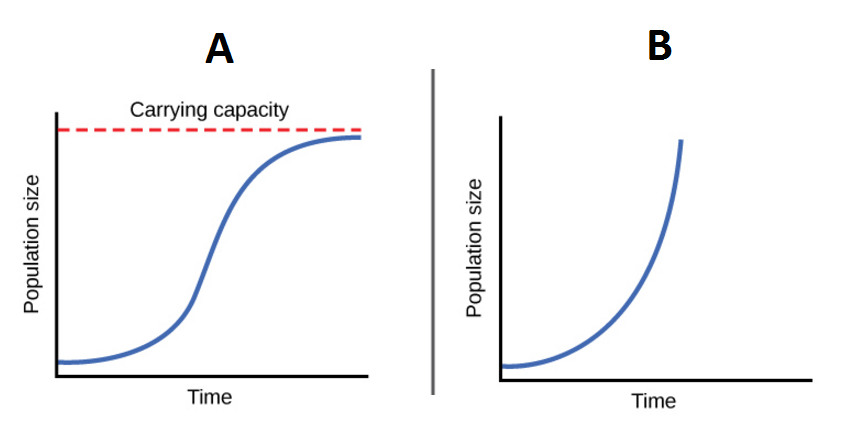
What type of growth model is shown in image A?

a)

Exponential

b)

Logistic

24.

What type of growth model is shown in image B?

a)

Exponential

b)

Logistic

25.

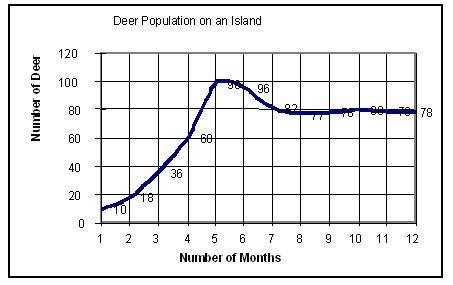
Which choice most closely approximates the deer population's carrying capacity based on the graph?

a)

100

b)

80

c)

60

d)

10

26.

Which population growth model most closely describes the human population in the modern age?

a)

logistic growth

b)

exponential growth

c)

upward growth

d)

tumor growth

27.
What will happen to the population when the death rate is larger than the birth rate?
a)
grow
b)
shrink
c)
stay the same
d)
None of these
28.
What factor describes when populations decrease because animals are moving out of a population?
a)
Emigration
b)
Limiting Factors
c)
Immigration
d)
Exponential Growth
29.
Which kind of dispersion is #1?
a)
clumped
b)
random
c)
uniform
30.

Which of the following would cause a population to increase in size?

a)

Emigration

b)

Decreased Birthrate

c)

Immigration

d)

Increased Deathrate

31.

In a given area, if the population of predators increases, the population of prey will _____________.

a)

increase

b)

decrease

c)

remain about the same

d)

go extinct

32.

The maximum amount of organisms of a species that can be supported by an environment is:

a)

exponential growth

b)

logistic growth

c)

population growth

d)

carrying capacity

33.

A density-independent factor happens:

a)

depending on the number of predators hunting prey

b)

depending on the size of the population

c)

if there are no resources left in a habitat

d)

regardless of the size of the population

34.

A biotic or abiotic resource in the environment that causes population size to decrease is a

a)

growth factor

b)

limiting factor

c)

carrying capacity

d)

limiting nutrient

35.

Factor that limits a population and is dependent on the number of organisms in the population.

a)

Density-dependent

b)

Density-independent

c)

Abiotic factors

d)

Biotic factors

36.

what does reactants mean in the following question? "What are the reactants for photosynthesis?"

a)

Inputs

b)

outputs

37.

what's the meaning of products in the following question? "What are the products of photosynthesis?"

a)

Inputs

b)

outputs

38.
What gas is released by plants from the process of photosynthesis?
a)
air
b)
carbon dioxide
c)
oxygen
d)
hydrogen
39.
What are the products  (what is made)  of photosynthesis?
a)
Glucose and oxygen
b)
sunlight energy
c)
carbon dioxide and water
d)
chlorophyll 
40.

What is the energy molecule produced from cellular respiration?

a)
ATP
b)
ADP
c)
DNA
d)

Sugar

41.

What are the products of cellular respiration?

a)
Glucose and oxygen
b)

Carbon dioxide, water. & ATP

c)
Lactic acid
d)
Carbon monoxide
42.
Cellular respiration is called an aerobic process because it requires
a)
light
b)
exercise
c)
oxygen
d)
glucose
43.
Which of the following statements is true?
a)
Animal cells use cellular respiration and plant cells only use photosynthesis
b)
Animal cells use photosynthesis and cellular respiration and plants just use photosynthesis
c)
Animal cells use cellular respiration, plant cells use both cellular respiration and photosynthesis
d)
Animal and plant cells both use cellular respiration and photosynthesis
44.
Which is correct?
a)
Chloroplasts do photosynthesis, mitochondria do respiration
b)
Chloroplasts do both respiration and photosynthesis
c)
Mitochondria do both respiration and photosynthesis
d)
Mitochondria do photosynthesis and chloroplasts do respiration
45.

What is the purpose of photosynthesis?

a)

To release energy

b)

To create glucose

c)

To grow

d)

To get oxygen for respiration

46.
Which of the following is an example of an AUTOTROPH?
a)
Appletree
b)
Dog
c)
Mushroom
d)
Human
47.
Which choice correctly shows the gases that enter and exit plants during photosynthesis?
a)
Enter: Oxygen
Exit: Carbon dioxide
b)
Enter: Water vapor
Exit: Glucose
c)
Enter: Carbon dioxide
Exit: Oxygen
d)
Enter: Light
Exit: Water vapor
48.
What is this called?
a)
Food Web
b)
Food Chain
c)
Abiotic Factors
49.
What is this called?
a)
Food Web
b)
Food Chain
c)
Abiotic Factors
50.
What does a Primary Consumer eat?
a)
Tertiary Consumers
b)
Secondary Consumers
c)
Producers
51.
What does a food web represent?
a)
All connections of energy flow throughout all organisms in a ecosystem.
b)
The specific ways that mutualism is carried out.
c)
A single pathway or energy flow between organisms. 
d)
How carnivores get their food. 
52.
Which organism in this food chain is a tertiary consumer?
a)
Fish
b)
Grass
c)
Grasshopper
d)
Hawk
53.
When humans burn fossil fuels, most of the carbon quickly enters the                       as carbon dioxide.
a)
Water
b)
Atmosphere
c)
Sun
d)
Air
54.
Which one of these does not add CO2 to the atmosphere?
a)
cooking with gas
b)
planting trees
c)
burning wood
d)
riding in a bus
55.
What does not produce carbon dioxide?
a)
Photosynthesis
b)
Burning Fossil Fuels
c)
Animal respiration
d)
Plants decaying
56.
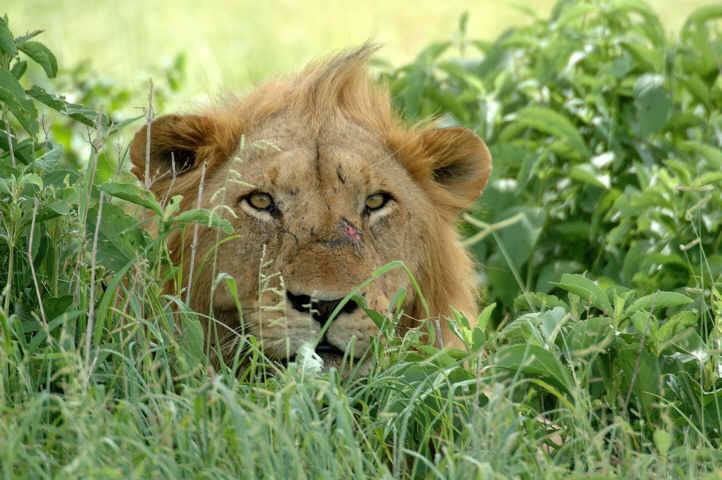
How does the carbon in grass become part of a lion?
a)
The lion eats the grass
b)
Carbon from grass doesn't end up in a lion. 
c)
The carbon ends up in the lion's food chain. 
d)
The lion breathes in carbon given out by the plant
57.
All of the carbon in existence is continually recycled in the carbon cycle
a)
True
b)
False
58.
Carbon can be found in...
a)
The atmosphere
b)
Soil
c)
Fossil fuels
d)
All of the above
59.
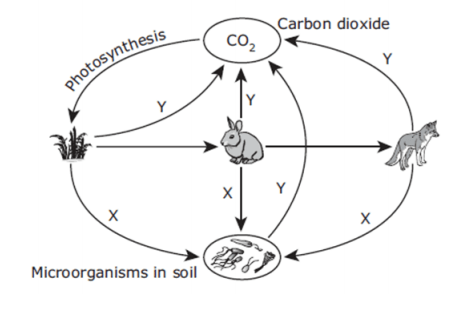
The diagram shows the flow of organic molecules through an ecosystem. What two processes are identified by the labels X and Y?
a)
X : Respiration
Y : Predation
b)
X : Adaptation
Y : Decomposition
c)
X : Fermentation
Y : Nitrogen Fixation
d)
X : Decomposition
Y : Respiration
60.
Which of the following is an example of a decomposer?
a)
Owl
b)
Fish
c)
Tree
d)
Mushroom
61.

Which of the following are fossil fuels?

a)

Coal, water, oil

b)

Oxygen, coal, oil

c)

Coal, Oil, Natural Gas

d)

None of the above

62.

How does carbon become locked inside the earth?

a)

Tree roots expel carbon into the soil as they grow.

b)

Humans use machines to pump carbon dioxide into large underground rocks.

c)

Rocks become richer in carbon as time goes by.

d)

The carbon-rich bodies of plants and animals decay into the earth after they die.

63.

How do carbon emissions lead to global warming?

a)

By trapping the sun's heat in the atmosphere.

b)

By causing very hot volcanic eruptions.

c)

Rocks become richer in carbon as time goes by.

d)

By increasing the amount of carbon in the earth's crust

64.
What causes wind to blow?
a)
Differences in longitude 
b)
Shock waves from clouds 
c)
Differences in air temperature and pressure 
d)
The rotation of the earth
65.

What are the main difference between weather and climate?

a)

Consist of long-term changes in the atmosphere

b)

Depends on the location

c)

Consist of short-term changes in the atmosphere

d)

Depends on the distance between the equator

66.

What earth subsytem does a plant belong to?

a)

Hydrosphere

b)

Geosphere

c)

Atmosphere

d)

Biosphere

67.

What earth subsytem does limestone belong to?

a)

Hydrosphere

b)

Geosphere

c)

Atmosphere

d)

Biosphere

68.

What earth subsytem does air belong to?

a)

Hydrosphere

b)

Geosphere

c)

Atmosphere

d)

Biosphere

69.

What earth subsytem does a river belong to?

a)

Hydrosphere

b)

Geosphere

c)

Atmosphere

d)

Biosphere

70.

Where do the carbon atoms in your body come from? (one word answer)

(a)  

71.

Through which subsytems does carbon travel trough? Click all the apply

a)

Hydrosphere

b)

Geosphere

c)

Atmosphere

d)

Biosphere

72.

Can carbon go from the atmosphere to the hydrosphere?

a)

yes

b)

no

73.

Can carbon go from the atmosphere to the biosphere?

a)

yes

b)

no

74.

Can carbon atoms be destroyed?

a)

yes

b)

no

75.

A carbon sink stores _ carbon than it releases

a)

more

b)

less