wayground logo

Free Printable Worksheets

NEW

Font size

S
M
L
XL
Worksheets

Ecology Test

Total questions: 34

Worksheet time: 3hrs 50mins

Name
Class
Date
1.

The diagram shows a food web for a community. Which organisms are carnivores?

a)

hare and fox

b)

hare and shrew

c)

spruce and hare

d)

hawk and fox

2.

The diagram shows a food web for a community. Which organisms are herbivores?

a)

hawk and fox

b)

willow and spruce

c)

shrew and lynx

d)

hare and insect

3.

The diagram is a food web. Which organisms are competing for the same food?

a)

shrew, fox, and lynx

b)

spruces, hare, and hawk

c)

willow, hare, and lynx

d)

hawk, lynx, and fox

4.

What is the original source of energy in most ecosystems?

a)

carbohydrates

b)

sunlight

c)

water

d)

carbon

5.

symbiotic relationship in which both organisms benefit

a)

competition

b)

Mutualism

c)

Commensalism

d)

Parasitism

6.
A living organism that puts materials from dead  plants and animals back to the soil is called a ____________?
a)
carnivore
b)
decomposer
c)
herbivore
d)
omnivore
7.

Which is NOT an abiotic factor:

a)

Temperature

b)

Carbon Dioxide

c)

Herbivores

d)

Water

8.
The largest amount of plants and animals an ecosystem can support is called ___________ _____________.
a)
Biotic Factor
b)
Abiotic Factor
c)
Carrying Capacity
d)
Non-Living Factor
9.
A group of the same species living in an ecosystem is referred to as a ____________.
a)
Community
b)
Population
c)
Ecosystem
d)
Organism
10.
Humans are omnivores.  This means that
a)
humans can only eat plant based foods
b)
humans are at the top of the food chain
c)
humans are only capable of digesting other animal products
d)
humans eat both meat and plants
11.
Which level of an ecological pyramid has the largest number of individuals and biomass?
a)
primary consumers
b)
the level that contains producers
c)
secondary consumers
d)
top predators
12.

All the populations that live together in an area make up a

a)

species

b)

population

c)

community

d)

ecosystem

13.

Occurs when 2 or more organism fight for the same resource

a)

Competition

b)

Mutualism

c)

Commensalism

d)

Parasitism

14.

A symbiotic relationship where one organism benefits and the other is neither harmed nor helped

a)

Commensalism

b)

Parasitism

c)

Mutualism

d)

Competition

15.

A symbiotic relationship where one organism benefits and another is harmed

a)

Commensalism

b)

Parasitism

c)

Mutualism

d)

Competition

16.
a place an organism lives. 
a)
habitat 
b)
niche
17.
The ecological niches of three bird species are shown in the diagram. What is the advantage of each bird species having a different niche?
a)
As more birds feed higher in the tree, available energy increases.
b)
More abiotic resources are available for each bird.
c)
Predators are less likely to feed on birds in a variety of locations.
d)
There is less competition for food.
18.

When a population grows past the ecosystem's carrying capacity, what happens to the population?

a)

It continues to grow higher and higher.

b)

The population starts to die off and returns to the carrying capacity.

c)

The population will go extinct due to lack of resources.
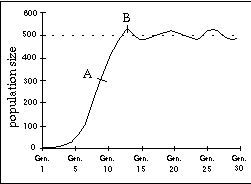
19.

What is the carrying capacity of the graph?

a)

around 500

b)

more than 800

c)

less than 300

d)

around 700

20.
Which of the following would INCREASE the carrying capacity of an ecosystem?
a)
increase in predators
b)
disease
c)
increase in available food
d)
drought
21.
What is the order of succession shown in this figure?
a)
A, B, C, D
b)
B, A, D, C
c)
C, D, A, B
d)
D, A, B, C
22.
After a volcanic eruption, lava covers the land. What is the order that plants grow to repopulate the area?
a)
Lichens → Shrubs → Grasses → Trees
b)
Lichens → tree → shrubs→Grasses
c)
Grasses → Lichens → Shrubs → Trees
d)
Lichens → Grasses → Shrubs → Trees
23.

___ are the first organisms to colonize an area and begin the process of ecological succession.

a)

foundational organisms

b)

introductory organisms

c)

primary organisms

d)

pioneer species

24.

The Final stage of ecological succession is...

a)

Mature Tree Growth

b)

Climax Community

c)

Pioneer Community

25.
The diagram below depicts the water cycle.  Which process is represented by the number 2?
a)
precipitation
b)
evaporation
c)
surface runoff
d)
condensation
26.
Abiotic factors in the environment are all __________. 
a)
living
b)
nonliving
27.
Which organism would be at the top of the energy pyramid?
a)
shark
b)
algae
c)
fish
d)
shrimp
28.
Which organism would be at the bottom of the energy pyramid?
a)
bugs
b)
grass
c)
rabbit
d)
wolf
29.

A species’ role in its ecosystem is called its

a)

competition

b)

energy level

c)

niche

d)

habitat

30.
Which of the following is a herbivore?
a)
cricket
b)
frog
c)
hawk
d)
shrew
31.
Use the diagram to answer the question.
The Mayfly is a food source for which 3 organisms?
a)
Frog, Dragon Fly and snake
b)
Frog, trout and dragon fly
c)
Frog, salamander and trout
d)
Frog and phytoplankton
32.
Bacteria and fungi typically serve what role in an ecosystem?
a)
herbivore
b)
carnivore
c)
omnivore
d)
decomposer
33.

If the grasshopper were to be removed completely from the food web, what organism would be most negatively affected?

a)

The squirrel

b)

The shrew

c)

The deer

d)

The rabbit

34.

The diagram below depicts the water cycle. Which process is represented by the number 4?

a)

precipitation

b)

evaporation

c)

surface runoff

d)

condensation