wayground logo

Free Printable Worksheets

Font size

S
M
L
XL
Worksheets

PS-Test review ch.8 Chemical Bonds

Total questions: 76

Worksheet time: 1hrs 21mins

Name
Class
Date
1.
Ionic bonds form between metals and ____.
a)
metalloids
b)
metals
c)
nonmetals
2.
which types of elements become cations?
a)
nonmetals
b)
all metals
c)
only transition metals
d)
some metals and some metalloids
3.
Nonmetals tend to 
a)
gain electrons
b)
lose electrons
4.
Ionic Bonding involves...
a)
The transfer of protons
b)
The transfer of nuetrons 
c)
The transfer of electrons
d)
None Of the above
5.

What is the charge of iron (III)?

a)

+3

b)

+2

c)

+6

d)

+4

6.

Classify the following molecule.

a)

polar

b)

nonpolar

7.
Which elements are found on the left to middle of The Periodic Table? 
a)
Metals
b)
Nonmetals
c)
Metalloids
d)
Candles
8.
Which elements are found on the right side of The Periodic Table?
a)
Metals
b)
Nonmetals
c)
Metalloids
d)
Water
9.
How do covalent bonds form?
a)
Donating & receiving valence e- between atoms.
b)
Opposite slight charges attract each other between compounds.
c)
Scientists are still not sure how they form.
d)
Sharing valence e- between atoms.
10.
What two types of atoms make a covalent bond?
a)
2 Nonmetals
b)
1 Nonmetal and 1 Metal
c)
2 Metals
d)
2 Noble Gases
11.
How many Hydrogen are in 4H2O?
a)
6
b)
8
c)
2
d)
4
12.
How many atoms are there TOTAL in:
H2SO4
a)
6
b)
5
c)
7
d)
3
13.
How many Sodium (Na) are in 6NaCl?
a)
1
b)
12
c)
6
14.
How many Elements are in the compound C2H8O ?
a)
2
b)
1
c)
3
d)
0
15.
A subscript is the small number below a(n) ________ that tells the number of _______ of that element.
a)
element symbol; atoms
b)
atom; element symbol
c)
subscript; protons
d)
compound; elements
16.
What is a coefficient?
a)
The small number on the right of the chemical symbol.
b)
The large number to the left of a formula.
17.
What is the oxidation number of Fe in FeO?
a)
+1
b)
-1
c)
+2
d)
-2
18.
The sum of all oxidation numbers in a neutral compound is ___.
a)
0
b)
1
c)
-1
d)
depends on the compound
19.

What elements don't have oxidation numbers? (Hint- they are group 18.)

a)

alkali metals

b)

noble gases

c)

halogens

d)

alkaline earth metals

20.

K (group 1) oxidation number is ??

a)

1+

b)

1-

c)

3+

d)

2-

21.

Ca (group 2)

a)

2+

b)

2-

c)

3+

22.

How many hydrogen atoms are in (NH₄)₂CrO₄?

a)

1

b)

2

c)

8

d)

16

23.

What is the goal of the Lewis Dot Structure?

a)

To determine the electron position.

b)

To show the element's valence electrons & bonding capabilities.

c)

To find the atomic mass of an element.

d)

To search for the number of electrons in an individual atom.

24.

How many valence electrons should Lithium have in its Lewis dot model?

a)

1

b)

2

c)

3

d)

4

25.

How many valence electrons should Magnesium have in its Lewis dot model?

a)

1

b)

2

c)

3

d)

4

26.

This is a correct dot diagram for nitrogen (N)

a)

true

b)

false

27.
This type of model shows only the valence electrons of an element? 
a)
Bohr diagram 
b)
Childers model
c)
Lewis-dot diagram 
d)
What is a valence electron again?
28.

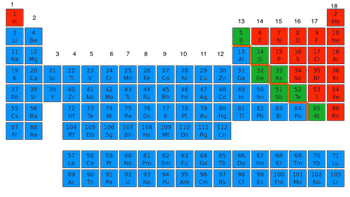
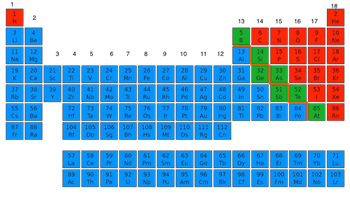
What color shows where metals are located on the periodic table?

a)

blue

b)

green

c)

red

d)

the colors do not indicate metals

29.

What color indicates the nonmetals?

a)

blue

b)

red

c)

green

d)

the colors do not indicate nonmetals

30.
 Li2O
a)
Dilithium oxideDilithium oxide
b)
Lithium oxide
c)
Lithium dioxide
31.
CsCl
a)
Monocesium monochloride
b)
Cesium monochloride
c)
Cesium Chloride
32.
MgS 
a)
Magnesium sulfide
b)
Monomagnesium monosulfide
c)
Magnesium monosulfide
33.
Na2S
a)

Disodium sulfide

Disodium sulfide

b)
Sodium sulfide
c)
Sodium monosulfide
34.
Al2S3
a)
Dialuminum Trisulfide
b)
Aluminum sulfide
35.
What is the formula for magnesium phosphide?
a)
Mg3P2
b)
Mg2P3
c)
Mg2PO3
d)
Mg3(PO3)2
36.
The chemical formula for an ionic compound of potassium and oxygen is
a)
KO.
b)
K2O.
c)
K2O2.
d)
KO2.
37.
Which is most likely to form a negative ion?
a)
an element from group 17
b)
a metal
c)
an element from group 1
d)
an element with atoms that have eight valence electrons
38.
Name this compound: 
NaBr
a)
Bromide sodide
b)
Sodium bromide
c)
Sodium bromate
d)
Sodium bromite
39.
Name this compound: 
KF
a)
Potassium fluoride
b)
Potassium fluorite
c)
Fluorine potasside 
d)
Potassium fluorate
40.
What is the correct formula for Sodium Oxide?
a)
NaO
b)
NaO2
c)
Na2O
d)
Na2O2
41.

Name this compound:

KI

a)

potassium iodide

b)

potassium iodite

c)

iodine potasside

d)

potassium iodine

42.

Li2O

a)

dilithium oxide

b)

lithium oxide

c)

lithium dioxide

d)

lithium lithium oxide

43.
What is the name of N2O3
a)
Nitrogen trioxide
b)
Dinitrogen oxide
c)
Dinitrogen trioxide
d)
Nitrogen oxide
44.
What is the chemical formula for Tetrasulfur pentoxide?
a)
SO
b)
S4O
c)
S4O5
d)
S5O4
45.
What is the name of CO
a)
Carbon oxide
b)
Carbon dioxide
c)
Carbon monoxide
d)
Carbon II oxide
46.
diphosphorus pentoxide
a)
P2O5
b)
PO5
c)
P5O2
d)
P2O6
47.
Name the following ionic compound: MgSO4
a)
magnesium sulfoxide
b)
magnesium sulfide
c)
magnesium sulfate
d)
magnesium oxide
48.
The proper formula for magnesium hydroxide:
a)
MgOH
b)
Mg2OH
c)
Mg(OH)2
d)
Mg2OH2
49.
When naming ionic compounds with transition metals you need to include roman numerals to show the _____ of the metal..
a)
atomic number
b)
mass number
c)
charge
d)
ionization energy
50.

How many atoms total are in AlPO4?

a)

4

b)

5

c)

6

d)

7

51.

How many atoms total are in NaOH?

a)

1

b)

2

c)

3

d)

4

52.
What is the formula for copper(I) sulfate?
a)
CuSO3
b)
CuSO4
c)
Cu2SO3
d)
Cu2SO4
53.
Where are the transition metals found on the periodic table?
a)
The first 5 elements
b)
The bottom two rows
c)
Group 3-12
d)
Row 3-12
54.
Name the compound using appropriate rules:
FeCl3
a)
Chloride Iron
b)
Iron III Chloride
c)
Chloride III Iron
d)
I have no clue
55.
Write formulas for the following compound:
tin (II) fluoride
a)
SnF2
b)
Sn2F
c)
FeF2
d)
Fe2F
56.
Manganese II
a)
Mg +2
b)
Mg -2
c)
Mn +2
d)
Mn -2
57.
Cobalt III
a)
Cu +3
b)
Co +3
c)
Cu -3
d)
Co -3
58.
In the compound TiO2, titanium has a charge of
a)
4+
b)
2+
c)
2-
d)
4-
59.

 CrI3CrI_3  

a)

chromium (II) iodide

b)

chromium (III) iodide

c)

chromium (I) iodide

d)

chromium iodide

60.

 NiONiO  

a)

nickel (II) oxide

b)

nickel (I) oxide

c)

nickel (III) oxide

d)

nickel oxide

61.

The name of FeCl₂ is

a)

iron chloride

b)

iron (II) chloride

c)

iron (I) chloride

d)

iron dichloride

62.
Beryllium will ____ valence electrons when forming an ionic bond.
a)
lose 4
b)
gain 4
c)
lose 2
d)
gain 2
63.
Magnesium bromide is an ionic compound with the chemical formula MgBr₂.  What does the "2" tell you?
a)
There are 2 bromide ions for every magnesium ion
b)
Bromide has a 2- charge
c)
Bromide has a 2+ charge
d)
There are 2 magnesium ions to every bromide ion
64.

Name the following ionic compound: MgSO4

a)

magnesium (II) sulfide

b)

magnesium sulfide

c)

magnesium sulfate

d)

magnesium (II) sulfate

65.

Which formula is for hydrochloric acid

a)

HCl

b)

H2Cl

c)

H2SO4

d)

HNO3

66.

What is the name for this acid HNO2

a)

hydronitric acid

b)

nitrous acid

c)

nitric acid

d)

nitrate acid

67.

what is the name for this acid HF

a)

fluoric acid

b)

hydrofluoric acid

c)

fluorous acid

68.
How do the following two elements bond together?
K1+  S2- 
a)
KS
b)
K8S
c)
K6S3
d)
K2S
69.
How do the following two elements bond together?
Al3+  O2-         
a)
AlO
b)
Al2O3
c)
Al3O6
d)
Al3O2
70.
How do the following two elements bond together?
Pb4+  O2-       
a)
PbO
b)
Pb2O3
c)

PbO2

d)
Pb3O2
71.
How do the following two elements bond together?
Al3+  O2-       
a)
AlO
b)
Al2O
c)
Al3O2
d)
Al2O3
72.
How many valance electrons are in group 2?
a)
4
b)
6
c)
1
d)
2
73.
NH+  and  OH -
a)
NH(OH)4
b)
NH4OH
c)
OHNH4
d)
correct answer not given
74.
Cu +2  and  OH -
a)
CuOH2
b)
Cu2OH
c)
Cu(OH)2
d)
correct answer is not given
75.
Fe +2  and  SO4 -2
a)
FeSO4
b)
Fe4(SO4)2
c)
FeSO2
d)
correct answer is not given
76.
NH4 +1  and  C2O4 -2
a)
NH4C2O4
b)
(NH4)2C2O4
c)
NH4(C2O4)2
d)
correct answer is not given