wayground logo

Free Printable Worksheets

NEW

Font size

S
M
L
XL
Worksheets

Sun's apparent path and Moon phases

Total questions: 49

Worksheet time: 1hrs 3mins

Name
Class
Date
1.

If the moon is roughly 3/4 illuminated we say it is in the _________________________ stage.

a)

Crescent

b)

New

c)

Gibbous

d)

Quarter

2.

If the moon is fully illuminated it is said to be a____________ moon.

a)

New

b)

Full

c)

Crescent

d)

Gibbous

3.

If the illuminated side of the moon is on the right, the moon is said to be:

a)

Waxing

b)

Shrinking

c)

Waning

d)

Not moving

4.

When the moon is between the sun and the earth, we basically do not see it. What is this phase called?

a)

Full Moon

b)

Waning Crescent

c)

Waning Gibbous

d)

New Moon

5.

Rotation describes an objects motion:

a)

Around the sun

b)

On it's own axis

c)

Around Earth

d)

Around Mars

6.

Why does the moon appear to shine?

a)

Because it reflects it's on light

b)

Because it makes it's own light

c)

Because it reflects light from the sun

d)

Because it reflects light from Earth

7.

What is the moon mostly made of?

a)

Green Cheese

b)

Hot gases

c)

Lava

d)

Rock

8.

Which phase below is NOT a phase of the moon?

a)

New Moon

b)

Waxing Crescent

c)

Old Moon

d)

Waning Gibbous

9.

As the moon continues it's journey around the Earth, the portion we see will begin to grow smaller or ___________?

a)

Wane

b)

Grow

c)

Stay the same

d)

Wax

10.

A satellite is defined as something that orbits a planet. How many NATURAL satellite(s) does Earth have?

a)

Five

b)

Sixteen

c)

One

d)

Three

11.

The Lunar Cycle is a fancy term for:

a)

The phases of the moon

b)

First cousin to the water cycle

c)

Second cousin to the rock cycle

d)

Chemical change

12.

We always see the same side of the moon because?

a)

We can only look at night

b)

We have low power telescopes

c)

The moon rotates and revolves at roughly the same rate the Earth does

d)

We don't know where to look

13.

This phase of the moon is just a small sliver. There is a waxing one and a waning one on each side of the new moon.

a)

Full Moon

b)

Crescent

c)

New Moon

d)

Gibbous

14.
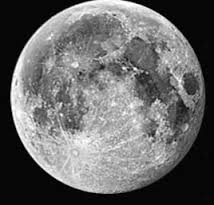
Name the moon phase
a)
First Quarter
b)
Last Quarter
c)
New Moon
d)
Full Moon
15.
Which of the following statements is most accurate about the Movement of Earth and the Sun?
a)
The Sun revolves around the Earth
b)
The Earth rotates around the Sun
c)
The Earth revolves around the Sun
d)
The Earth rotates and revolves around the Sun 
16.
What is a lunar month?
a)
The time from one new moon to the next new moon.  
b)
The time from one full moon to the next full moon. 
c)
The time it takes the moon to orbit the earth.
d)
The month of October .
17.
Why do we experience the changing of the season on the earth?
a)
distance from the sun
b)
rotation of the earth
c)
change in solar output
d)
tilt of the earth's axix
18.
What season is when the north pole is tilted toward the sun?
a)
summer
b)
winter
c)
fall
d)
spring
19.
When is the winter solstice?
a)
December
b)
June
c)
March
d)
September
20.
What is the longest day of the year?
a)
winter solstice
b)
summer solstice
c)
fall equinox
d)
spring equinox
21.
When are the equinoxes?
a)
June & December
b)
July & January
c)
April & October
d)
March & September
22.
If in the southern hemisphere is winter, what is the northern hemisphere?
a)
Shimoneta
b)
Winter
c)
Autumn
d)
Summer
23.
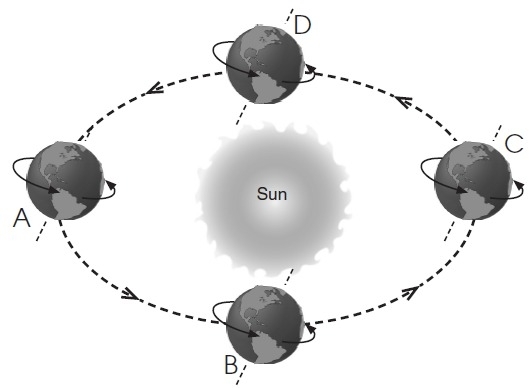
At position A, which hemisphere would have summer?
a)
Northern hemisphere
b)
Southern hemisphere
24.
Very cold climates occur at Earth’s North and South Poles because the polar regions
a)
are usually farthest from the Sun
b)
absorb the greatest amount of insolation
c)
receive the most hours of daylight
d)
receive low-angle insolation
25.
Locations in the Northern Hemisphere are warmest in summer because sunlight in summer is
a)
least intense and of shortest duration
b)
least intense and of longest duration
c)
most intense and of shortest duration
d)
most intense and of longest duration
26.
The term equinox means....
a)
equal amount of day light and equal amount of night
b)
Equal amount of winter and summer
c)
Equal amounts of hot dogs for everyone
d)
The longest day of the year
27.
Earth's axis is tilted at - 
a)
23.5 degrees
b)
33.5 degrees
c)
28 degrees
d)
90 degrees
28.
How long does it take the Earth to make one REVOLUTION around the Sun?
a)
12 hours
b)
24 hours
c)
365 1/4 days
d)
29.5 days
29.
The Earth's _______ is an imaginary line that goes from the North Pole to the South Pole.
a)
vernal equinox
b)
axis
c)
solar eclipse
d)
solar flare
30.
How long does Earth take to rotate once? 
a)
90 hours
b)
about 1 hour
c)
24 hours
d)
48 hours
31.
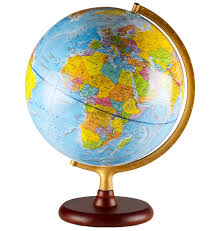
Why do globes lean sideways?
a)
To allow them to spin easier.
b)
To demonstrate the tilt of Earth's axis.
c)
To demonstrate the effects of gravity.
d)
To demonstrate day and night.
32.
What causes more heat,  indirect sunlight or direct sunlight?
a)
indirect
b)
direct
33.
What is the name of the force that keeps planets on there orbit?
a)
orbit
b)
stars
c)
planets
d)
gravity
34.
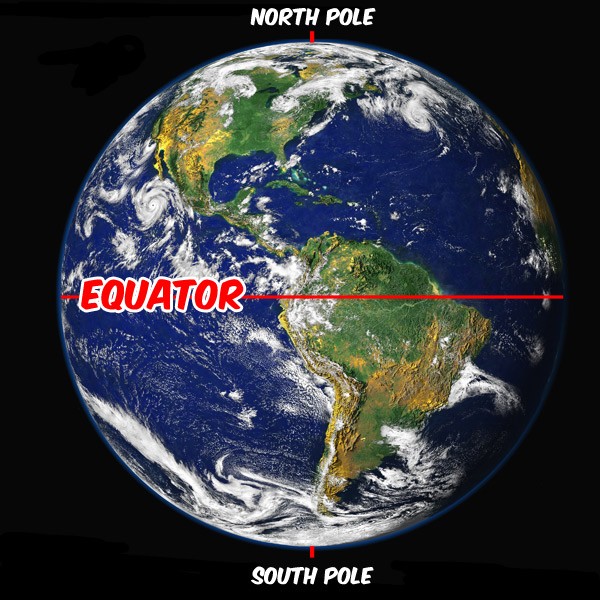
Why does the area around the equator stay the same temperature all year?
a)
The equator rotates slower than the poles.
b)
The equator remains the same distance from the sun.
c)
The equator always receives direct sunlight.
d)
The equator has 18 hour days.
35.

When Earth is closest (at perihelion) to the Sun, which season is occurring in the Northern Hemisphere?

a)

summer

b)

winter

c)

fall

d)

spring

36.

Which location (letter) represents March 21?

a)

A

b)

B

c)

C

d)

D

37.

Approximately how many degrees per day does Earth revolve in its orbit around the Sun?

a)

15 degrees

b)

360 degrees

c)

23.5 degrees

d)

one degree

38.

Which factor is a primary cause of seasonal changes on Earth?

a)

change in earth's distance from the sun

b)

wobble of Earth's axis

c)

tilt of Earth's axis

d)

change in the rate of earth's rotation

39.

Identify the season when the earth is at aphelion?

a)

winter

b)

fall

c)

summer

d)

spring

40.

Which diagram represents the apparent path of the Sun on March 21 for an observer at the equator?

a)
b)
c)
d)
41.

Which location receives 24 hours of daylight on December 21?

a)

90 degrees North

b)

90 degrees South

c)

41 degrees North

d)

0 degrees- Equator

42.

Which location on earth receives 12 hours of day and 12 hours of night all year long?

a)

90 degrees North

b)

90 degrees South

c)

41 degrees North

d)

0 degrees- Equator

43.

Which diagram correctly shows the directions of Earth's revolution and rotation?

a)
b)
c)
d)
44.

What is the primary reason each city's duration of daylight hours changes throughout the year?

a)

Earth's rotation rate is 15° per day

b)

Earth's axis is tilted 23.5° to the plane of its orbit.

c)

The cities are located at different elevations.

d)

The cities are located at different longitudes

45.
The earth is tilted on its _____
a)
line
b)
equator
c)
axis
d)
core
46.
The earth rotates every
a)
24 hours
b)
15 hours
c)
365 days
d)
hour
47.
Day and night are caused by - 
a)
Rotation
b)
Revolution
48.
In this diagram, the motion of the EARTH can best be described as -
a)
Rotation
b)
Revolution
49.

Which of these cycles does the spinning motion of Earth cause?

a)

the cycle of the tides

b)

the cycle of the seasons

c)

the day-and-night cycle

d)

the phases-of-the-moon cycle