
NEW
Font size
 Worksheets
Cells Review
Total questions: 35
Worksheet time: 32mins
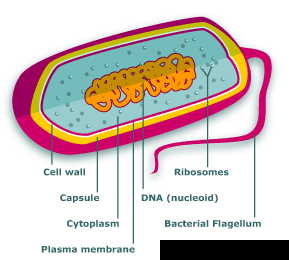
Is bacteria an example of a prokaryote or a eukaryote?
Prokaryote
Eukaryote
Plant and animal cells are examples of ___ cells
prokaryotic
eukaryotic
A flexible boundary that controls the movement of substances into and out of the cell.
Golgi
Chloroplast
Cell Wall
Cell membrane
A membrane bound organelle that makes ATP energy available to the rest of the cell (cellular respiration).
Golgi
Chloroplast
Cell Wall
Mitochondria
A cell has the following: Nucleus, mitochondria, cytoskeleton, cytoplasm, cell wall, chloroplast, ribosomes, & more. What cell type is it?
Animal cell
Plant Cell
Bacteria Cell
Which of the following is NOT found in ALL cells?
Ribosomes
Cell membrane
Cytoplasm
DNA
Cell wall
The element _______is found in all organic compounds.
Iron
Nitrogen
Carbon
Oxygen
The organic compounds that have many structural purposes and are used in many processes within the cell. They are also what most enzymes are made of.
Carbohydrates
Lipids
Proteins
Nucleic Acids
What are the four macromolecules?
proteins, nucleic acids, carbohydrates, and lipids
monosaccharides, lipids, polysaccaharides, and proteins
RNA, DNA, proteins, and carbohydrates
Each enzyme only has 1 substrate that will fit its active site. What is this called?
reusablility
denaturation
specificity
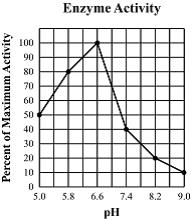
Which of the following conclusions can be drawn from this graph?
The optimum pH of the enzyme is 6.6.
The optimum pH of the enzyme is 5.8
The enzyme’s activity increases as pH increases 5.0 to 9.0
Any substance that is acted upon by an enzyme is called a(n)?
Coenzyme
Substrate
Vitamin
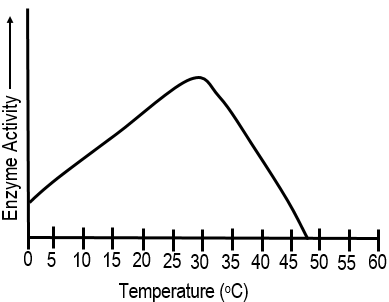
What is the function of an enzyme?
enzymes speed up chemical reactions
enzymes slow down chemical reactions
What type of transport requires energy?
Active Transport
Facilitated Diffusion
Simple Diffusion
Passive Transport
The diffusion of water is known as _________
active transport
facilitated diffusion
osmosis
A cell in an isotonic solution will
swell (get bigger)
shrink (get smaller)
stay the same size
A membrane that allows some substances to pass across and others not is called ______________.
non-permeable
completely-permeable
semi-permeable


Which cell is in an hypotonic environment?
A
B
C
What are the products of photosynthesis?
water and carbon dioxide
oxygen and glucose
oxygen and carbon dioxide
What is the purpose of cellular respiration?
to break down food
to create water in the body
to release energy (ATP) from the glucose in food
Where does chemosynthesis usually take place?
Near deep sea volcanic vents and inside tube worms.
In soil and roots of some plants
Near volcanic vents and in soil

