
 Worksheets
Electrochemistry
Total questions: 25
Worksheet time: 3620secs

In a redox reaction, the species that loses electrons
is called the cathode
is oxidized
gains mass at the electrode
decreases in oxidation number

As an element is oxidized, its oxidation number
decreases as electrons are lost
increases as electrons are lost
decreases as electrons are gained
increases as electrons are gained

Mg + PbCl2 → MgCl2 + Pb
Which statement correctly describes the oxidation and reduction that occur?
Mg is oxidized and Pb+2 is reduced
Mg is oxidized and Cl- is reduced
Mg is reduced and Cl- is oxidized
Mg is reduced and Pb+2 is oxidized
What is reduction?
It is the gain of electrons.
It is the loss of electrons.
It is the creation of electrons.
It is the destruction of electrons.
What is a half-reaction?
It is a reaction at equilibrium where half of the substances are reactants and half of the substances are products.
It is the reaction that occurs when the switch of a galvanic cell is open.
It shows EITHER the reduction component or the oxidation component of a redox reaction.
It shows BOTH the reduction and oxidation components of a redox reaction.

Table shows information about three chemical cells.
What is the possible potential difference of the chemical cell when metal Z is paired with W ?
0.3 V
1.2 V
1.5 V
2.1 V

Diagram shows the electrolysis of concentrated copper(II) chloride solution using carbon as electrodes.
Which of the followings is the correct half equations represents the reactions at the anode?
4OH- → 2H2O + O2 + 4e
2Cl- → Cl2 + 2e
Cu → Cu2+ + 2e
Cu2+ + 2e → Cu
What occurs to the mass of copper electrode in the following reaction?
Zn/Zn2+ // Cu2+/Cu
increases
decreases
remains the same
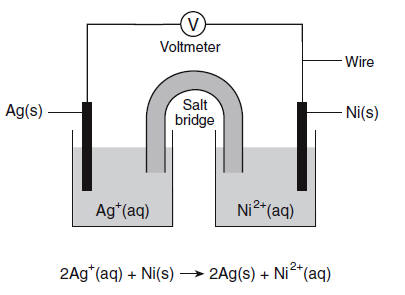
What reaction occurs at the anode?
Ag+/Ag = 0.80V
Ni2+/Ni = -0.25V
Ag+ + e- →Ag
Ag → Ag+ + e-
Ni2+ + 2e- → Ni
Ni → Ni2+ + 2e-
What would be the theoretical cell potential of the previous electrochemical cell?
Ag+/Ag = 0.80V
Ni2+/Ni = -0.25V
1.05V
-1.05V
0.55V
-0.55V
What is oxidation number of Cr in Cr2O72-?
-2
+2
+6
+12

Which statement best describes how a salt bridge maintains electrical neutrality in the half-cells of an electrochemical cell?
It prevents the migration of electrons.
It prevents the reaction from occurring spontaneously.
It permits the migration of ions.
It allows for the reaction from occurring spontaneously.
Table shows information about three chemical cells.
What is the possible potential difference of the chemical cell when metal Z is paired with W ?
0.3 V
1.2 V
1.5 V
2.1 V
Diagram shows the electrolysis of concentrated copper(II) chloride solution using carbon as electrodes.
Which of the followings is the correct half equations represents the reactions at the anode?
4OH- → 2H2O + O2 + 4e
2Cl- → Cl2 + 2e
Cu → Cu2+ + 2e
Cu2+ + 2e → Cu
Electrons always flow from
cathode to anode
anode to cathode
Oxidation occurs at the
anode
cathode

Given their standard reduction potentials, which of the species is going to be oxidized?
Cu2+/Cu = 0.34V
Zn2+/Zn = -0.76V
Cu
Zn
CuSO4
ZnSO4
What are the oxidation numbers of elements in phosphoric acid, H3PO4?
H = +1, P = +1, O = -2
H = +1, P = +5, O = -2
H = +3, P = +1, O = -4
H = +3, P = +5, O = -8
During an oxidation-reduction reaction, the number of electrons gained is
equal to the number of electrons lost
equal to the number of protons gained
less than the number of electrons lost
less than the number of protons gained

What is happening at the Fe electrode/Half Cell 2
Fe atoms are being reduced to Fe+2 ions
Fe+2 ions are being oxidized to Fe atoms
Fe+2 ions are being reduced to Fe atoms
Fe atoms are being oxidized to Fe+2 ions
What is happening at the Mg electrode/Half Cell 1
Electrode mass decreases
Electrode mass increases
Ion concentration increases
Ion concentration decreases
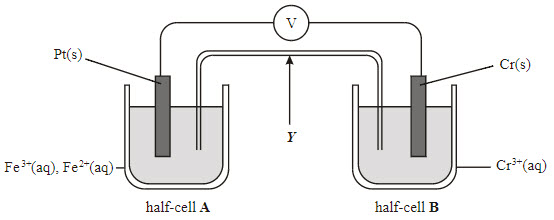
What is the function of Y in cell below?
To complete the circuit
To allow flow of electrons between both cells
To allow flow of ions
To connect both half cells

