
NEW
Font size
 Worksheets
Day and Night and Rotation
Total questions: 50
Worksheet time: 46mins
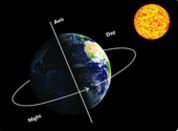
How does Earth’s rotation cause day and night?
As Earth rotates toward the east, the sun appears to rise in the west and set in the east.
As Earth rotates toward the east, the sun appears to rise in the east and set in the west.
Earth rotates in a clockwise direction, which makes the sun appear in the sky during the day.
Earth’s rotation does not cause day and night; its revolution does.
When the sun gets higher in the sky, shadows get ______.
longer
gone
shorter
darker
When the sun gets lower in the sky, shadows get______.
longer
gone
shorter
darker
Shadows are longest during _______.
morning and evening
noon
night
The sun is at it's ____________ point when a shadow is is it's shortest.
lowest
highest
farthest
nearest

What time is it in picture A
12 P.M.
8 A.M.
4 P.M.
12 A.M.
What time is it in picture B
12 P.M.
8 A.M.
4 P.M.
12 A.M.
What time is it in picture C
12 P.M.
8 A.M.
4 P.M.
12 A.M.

Which of the pictures presents the pattern of shadows in the summer?
A
B
Neither A or B
Both A and B
Which of the pictures presents the pattern of shadows in the winter?
A
B
Neither A or B
Both A and B
When the sun rises in the morning, your shadow is _______ and points ________
short, west
long, west
short, east
long, east
In the morning a shadow will point in a different direction than it will in the afternoon
True
False

Which position of the sun will make the longest shadow?
A
B
C
What do shadows on Earth help show?
Earth's rotation
Earth's revolution
Earth's equator
Earth's axis

the imaginary line running through the earth from the north pole to the south pole
axis
equator
prime meridian
Which of the following is the best explained by understanding that Earth rotates on its axis once each day?
The change in the appearance of the Moon during the month
The difference in seasonal temperatures during the year
The apparent motion of the Sun through the sky
The movement of water through the water cycle

The diagram above suggests that the next event that can be expected in Houston in a couple of hours is–
sunrise
noon
sunset
midnight

Which of the students gave a correct explanation?
Student 1 only
Students 2 and 4
Student 2 only
Student 1 and 3 only
Approximately how wide is each time zone, in degrees?
5o
10o
15o
20o
Why does the sun appear to move across the sky over the course of a day?
The Earth is stationary and the sun orbits around it.
The Sun is stationary and the Earth rotates upon its axis.
The Sun is stationary and the Earth orbits around it.
Both the Sun and the Earth are revolving around each other.


True or False: The sun sets in the east.
True
False

Which number most likely shows the position of the Sun at noon? The picture shows an event that happens every day.
1
2
3
4

What time is at position 1?
12 p.m. (noon)
9 a.m.
3 p.m.
6 a.m.
What time is at position 3?
12 p.m. (noon)
9 a.m.
3 p.m.
6 p.m.
How many degrees per hour does the Sun appear to move across the sky?
41 degrees
23.5 degrees
90 degrees
15 degrees

Identify the Earth motion that causes the daytime-nighttime boundary to appear to move.
Earth's rotation
Earth's revolution
Earth's tilt
Earth's plate tectonics
What is Earth's rate of rotation?
1° per hour
15° per hour
1° per day
15° per day

Which location has the longest period of daytime?
A
B
C
D

Which location has the SHORTEST period of daylight?
A
B
C
D

During which season is the sun's path higher in the sky from our perspective in Buffalo?
Summer
Fall
Winter
Spring

Which point represents the sunrise in Summer?
D
E
F

Which point is closest to 12 noon?
1
2
3
4

At which point will the observer have the LONGEST shadow?
1
2
3
4

If point D is experiencing midnight, which point is closest to 12 noon?
A
B
C
D

