wayground logo

Free Printable Worksheets

NEW

Font size

S
M
L
XL
Worksheets

Taxonomy Quiziz

Total questions: 40

Worksheet time: 56mins
Name
Class
Date
1.
A scientific name consists of 
a)
Genus and Order
b)
Genus and Domain
c)
Genus and species
d)
Kingdon and Phylum
2.
The most general in the order of classification is?
a)
Kingdom 
b)
Phylum 
c)
Class 
d)
Order
3.
The most specific of the classifications is?
a)
class 
b)
order 
c)
genus 
d)
species
4.
Binomial Nomenclature means?   
a)
classification
b)
characteristics
c)
2 name system
5.
Which of the following organisms are LEAST closely related?
a)
organisms that share a domain
b)
organisms that share a family 
c)
organisms that share a genus 
d)
organisms that share a species 
6.
The scientific name for an organism is made from the:
a)
class and family name
b)
genus and species name
c)
domain and kingdom name
d)
kingdom and phylum name
7.
The 8 levels of classification, most broad to most specific.
a)
Domain, Genus, Family, Order, Class, Phylum, Kingdom, Species
b)
Domain, Species, Kingdom, Genus, Phylum, Family, Class, Order
c)
Domain, Kingdom, Phylum, Class, Order, Family, Genus, Species
d)
Order, Kingdom, Species, Domain, Phylum, Family, Class, Genus
8.
Term given to describe the 2 name naming system is:
a)
dichotmous key
b)
binomial nomenclature
c)
2 scientific names
d)
binomial key
9.
Who first proposed binomial nomenclature as a way of classifying organisms?
a)
Carl Linnaeus
b)
Carl's Jr.
c)
Charles Darwin
d)
Henry Groseclose
10.
Which organisms are most closely related?
a)
Equus caballas (Horse) & Equus burchellii (Zebra)
b)
Cyanea artica (Jellyfish) &
Ctenodiscus crispatus (Mud Starfish)
c)
Naja naja (cobra) & Glycine max (soya bean)
d)
Ophiocomina nigra (black brittle star) & Brassica nigra (black mustard)
11.
The science of describing, classifying, and naming living things is called:
a)
Geology
b)
Biology
c)
Taxonomy
d)
Chemistry
12.
The scientific name for an organism is made from the:
a)
class and family name
b)
genus and species name
c)
domain and kingdom name
d)
kingdom and phylum name
13.
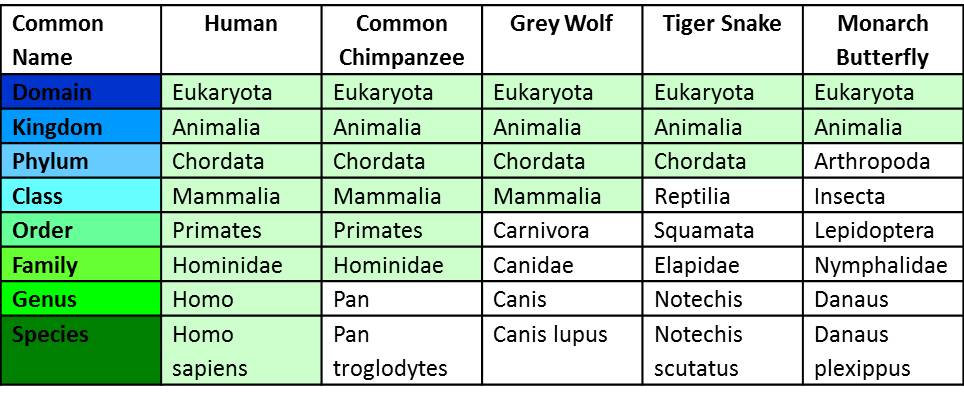
Which organism in the table is least closely related to the chimpanzee?
a)
human
b)
grey wolf
c)
tiger snake
d)
monarch butterfly
14.
An illustration and a dichotomous key are given. What is the correct classification for this organism?
a)
Class Insecta
b)
Order Amblygygi
c)
Order Araneae
d)
Order Scorpiones
15.

Which 2 organisms would be able to reproduce and produce fertile offspring?

a)

2 organisms in the same class

b)

2 organisms in the same family

c)

2 organisms in the same genus

d)

2 organisms in the same species

16.
A tool used by a taxonomist to identify an unknown organism is known as a __________.
a)
dichotomous key
b)
binomial nomenclature
c)
scientific name
d)
binomial key
17.
An illustration and a dichotomous key are given. What is the correct classification for this organism?
a)
Class Insecta
b)
Order Amblygygi
c)
Order Araneae
d)
Order Scorpiones
18.
The taxon with the largest amount of organisms grouped together...
a)
Species
b)
Phylum
c)
Kingdom
d)
Domain
19.
Which of the following is not true when comparing scientific and common names?
a)
Scientific names vary from place to place.
b)
Common names can vary from place to place.
c)
Scientific names are written in Latin.
d)
Common names can inaccurately describe the organism and be confusing.
20.
Smallest taxonomic group with many similar characteristics...
a)
domain
b)
kingdom
c)
species
d)
class
21.
A student discovers an arachnid with a segmented abdomen, long legs, and a tail with no stinger. The student uses the dichotomous key below to identify it. Which arachnid has the student found?
a)
Whip Scorpion
b)
Wind Scorpion
c)
Daddy long legs
d)
Scorpion
22.
Which organism in the table shown is most closely related to the common dolphin?
a)
human
b)
killer whale
c)
giant kelp
d)
bat star
23.

In the English language, dogs have many different names to describe them. For example, canine, puppy, dog, hound, etc. In science around the world we use a naming system called what to make it uniform across the world?

a)

binomial nomenclature

b)

polynomial nomenclature

c)

taxonomy

d)

none of the above

24.

Which organisms are most closely related?

a)

A and B

b)

B and C

c)

C and A

d)

not enough info given

25.
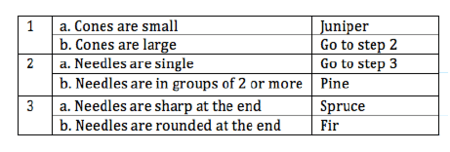
A dichotomous key for trees is provided. Hikers found a tree that has large brown cones and single sharp needles. What species of tree have the hikers found?
a)
Juniper
b)
Pine
c)
Spruce
d)
Fir
26.
The first part of a scientific name is an organism's _______________ and the second part is its ________________.
a)
species, genus
b)
phylum, order
c)
class, spices
d)
genus, species
27.

There are many different species of big cats around the world. Why is having a scientific name for each species of an organism important?

a)

to prevent existing named organisms from having their name changed as they become extinct

b)

to keep the classification system from being altered as new organisms are discovered

c)

to allow organisms to be placed in many classification levels at the same time

d)

to standardize the naming and organization of organism to avoid confusion between scientist across the world

28.
What is the importance of a standardized taxonomic system to the scientific
community?
a)
To have many different common names for one species.
b)
To organize species cells, tissues, organs, and organ systems.
c)
To have a universal scientific naming system.
d)
To analyze species genetic information.
29.

Canis lupus, the scientific name for a wolf, is in which genus?

a)

Canis

b)

lupus

c)

Animalia

d)

Mammalia

30.

Which category of classification has the largest variety of organisms?

a)

genus

b)

phylum

c)

species

d)

kingdom

31.

Aristotle is said to be the first to classify organisms. Into which two groups did he classify all living things?

a)

fungi and bacteria

b)

humans and animals

c)

living and nonliving

d)

plants and animals

32.

Which is the best prediction regarding the current classification system?

a)

The system may change as new information and organisms are discovered.

b)

Scientists will become bored with the current system and develop a new one.

c)

Over time, organisms will become extinct, so classification will become simpler.

d)

The system is set in stone and most likely will not change.

33.

Which taxonomic category is higher than the others?

a)

Class

b)

Genus

c)

Family

d)

Phylum

34.
"Pinus taeda" is an example of what?
a)
Adaptations
b)
Common name
c)
Scientific name
d)
Food
35.
"Lion" is an example of what?
a)
Scientific name
b)
Common name
c)
Adaptations
d)
Food
36.
Vertebrates can be classified in......
a)
5 groups: Mammals, Birds, Fish, Reptiles and Amphibians
b)
5 Groups: Dogs, Birds, Fish, Reptiles, and Amphibians
c)
4 Groups: Mammals, Birds, Fish and Ampbibians
37.
Vertebrate have:
a)
Fur and Gills
b)
Cold-Blood
c)
A spine and an internal skeleton
38.
Which of the following pairs is most closely related?
a)
snake & alligator
b)
Kangaroo and snapper fish
c)
Penguin and snake
39.
Which of the following vertebrate is not a mammal?
a)
Koala
b)
Kangaroo
c)
Giant Salamander
d)
Whale
40.
From the table, which two animals are MOST CLOSELY related
a)
House Cate and Red Fox
b)
Red Fox and Dog
c)
Dog and Wolf
d)
Wolf and Gopher