wayground logo

Free Printable Worksheets

Font size

S
M
L
XL
Worksheets

DNA STRUCTURE, REPLICATION AND MUTATIONS

Total questions: 45

Worksheet time: 44mins

Name
Class
Date
1.
Which of the following is NOT a base found in DNA?
a)
Adenine
b)
Thymine
c)
Glycogen
d)
Cytosine
2.
Which sequence of DNA bases would pair with this partial strand?
ATG TGA CAG
a)
ATG TGA CAG
b)
TAC ACT GTC
c)
GTA AGT GAC
d)
CAT TCA CTG
3.
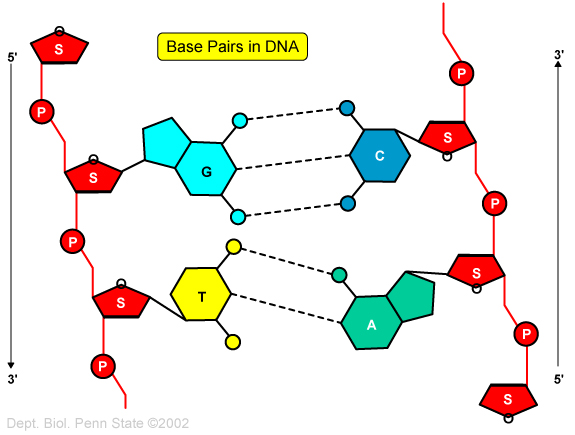
Adenine forms hydrogen bonds with which base?
a)
Guanine
b)
Thymine
c)
Cytosine
d)
Adenine
4.
Guanine forms hydrogen bonds with which base?
a)
Adenine
b)
Guanine
c)
Cytosine
d)
Thymine
5.
Which enzyme unzips the DNA to prepare for replication?
a)
Helicase
b)
DNA Polymerase
c)
Ligase
d)
Primase
6.
Which enzyme is responsible for adding nucleotides?
a)
Single-stranded binding proteins
b)
DNA Polymerase
c)
Ligase
d)
Primase
7.
Which enzyme is responsible linking together newly created strands of DNA using the Okazaki fragments?
a)
Single-stranded binding proteins
b)
DNA Polymerase
c)
Ligase
d)
Primase
8.
A process in which DNA makes an exact copy of itself is called...
a)
Replication
b)
Translation
c)
Transcription
d)
Copying
9.
Nitrogenous bases are joined by which type of bond?
a)
Polar bonds
b)
Ionic bonds
c)
Covalent bonds
d)
Hydrogen bonds
10.
In a molecule of double-stranded DNA, the amount of Adenine present is always equal to the amount of which base?
a)
Cytosine
b)
Guanine
c)
Thymine
d)
Uracil
11.
When DNA replication is complete, which is true about the products?
a)
Each one has two original strands
b)
Each one has two new strands
c)
Each one has one new strand and one original strand
d)
One has two new strands and the other with two original strands
12.
After analyzing a sample of DNA, a scientist recorded the data shown in the table. What percentage of the DNA sample is cytosine?
a)
22%
b)
25%
c)
28%
d)
56%
13.

Which of the following correctly states Chargaff's Rule (base pairing rule)?

a)

A=T, C=G, A+T+C+G=100%

b)

A=C, T=G, A+T+C+G=50%

c)

A=T, C=G, A+T+C+G=200%

d)

A=C, T=G, A+T+C+G=100%

14.
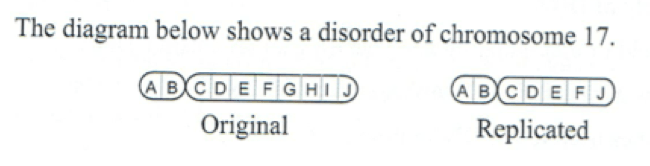
What type of chromosomal mutation has occurred?
a)
Substitution
b)
Insertion
c)
Deletion
d)
Nondisjunction
15.

DNA is an example of which type of macromolecule?

a)

Protein

b)

Nucleic Acid

c)

Lipid

d)

Carbohydrate

16.
Why is DNA important?
a)
it is very small and very complicated
b)
it's in everything
c)
it serves as the blueprint for traits of all living things
d)
because we eat it every day for energy
17.
What does DNA stand for?
a)
Deoxyribonucleic acid
b)
Denitrogenous acid
c)
Deribonucleic acid
d)
Diribonucleic acid
18.
What is the shape of DNA?
a)
Double helix
b)
Triple helix
c)
Flat, bilayer
d)
Three-pronged rigid ladder
19.
Which organelle is DNA usually found in?
a)
cell membrane
b)
vacuole
c)
ribosome
d)
nucleus
20.
A monomer of DNA is called a(n)
a)
Monosaccharide
b)
Amino Acid
c)
Triglyceride
d)
Nucleotide
21.

What are the nucleotides made of?

a)

Sugar, Phosphate, nitrogenous base

b)

Phosphate, Adenine, nitrogenous base

c)

Thymine, Adenine, Cytomine

d)

Phosphate, Nitrogen, Adenine

22.
What is the sugar in the DNA molecule?
a)
deoxyribose
b)
ribose
c)
glucose
d)
fructose
23.
Which 2 molecules form the sides (backbone) of the DNA ladder?
a)
deoxyribose sugar and adenine
b)
deoxyribose sugar and a hydrogen bond
c)
deoxyribose sugar and the nucleus
d)
deoxyribose sugar and phosphate
24.
Nitrogenous bases are joined by which type of bond?
a)
polar bonds
b)
ionic bonds
c)
covalent bonds
d)
hydrogen bonds
25.

order of replication

a)

3, 2, 1, 4

b)

2, 1, 4, 3

c)

2, 3, 1, 4

d)

3, 4, 1, 2

26.

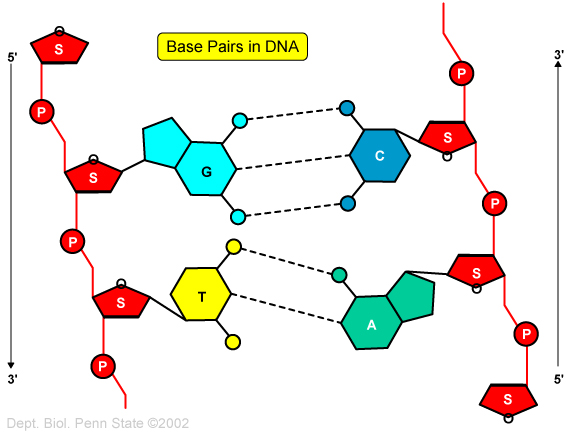
Name this structure

a)

covalent bond

b)

nucelotide

c)

deoxyribose

d)

hydrogen bond

27.
DNA polymerase is a(n)
a)
lipid
b)
enzyme
c)
sugar
d)
starch
28.
Which of the following would result in a frameshift mutation?
a)
Insertions only
b)
Substitution only
c)
Deletion only
d)
Insertions and Deletions
29.
ATTTGAGCC- Original
ATTGAGCC - Mutated
The example above is an example of a 
a)
Insertion- Frameshift
b)
Deletion- Substitution
c)
Deletion -Frameshift
d)
All of the above
30.
Which of the following is not a Mutagenic factor(causes mutations).
a)
X-rays
b)
Chemicals we smoke or eat
c)
Drinking water
d)
Tanning
31.
If you are missing or have an extra base  at the end of your mutated DNA . What type of mutation occurred?
a)
Substitution
b)
Frameshift
c)
Duplication 
d)
Insertion
32.

DNA molecule segment is : TTACGCAAG

The mutated DNA segment is TTCCGCAAG. This is an example of ___ mutation.

a)

Substitution

b)

Deletion

c)

Insertion

d)

Inversion

33.
A five-carbon sugar found in DNA.
a)
ribose
b)
guanine
c)
deoxyribose
d)
helicase
34.
What are the 4 nitrogenous bases in DNA?
a)
adenine, thymine, cytoplasm, and guanine
b)
adenine, thymine cytosine, and guanine
c)
adenine, thymine, cytosine, and gylcerol
d)
adenine, thymine, cytosine, and glucose
35.
Which pairing below is correct?
a)
thymine-cytosine
b)
cytosine-adenine
c)
adenine-guanine
d)
cytosine-guanine
36.
Tightly wound DNA is called a
a)
chromatin
b)

centromere

c)

chromosome

d)
protein
37.

The nucleotides in one strand of DNA are joined or conncted by :

a)

Covalent bonds

b)

Hydrogen bonds

c)

Peptide bonds

d)

Ionic bonds

38.
Which enzyme lays down small sections of RNA in order to conduct DNA replication?
a)
Helicase
b)
DNA Polymerase
c)
Ligase
d)
Primase
39.
In what phase of the cell cycle does DNA replication take place?
a)
G1
b)
S
c)
G2
d)
M
40.
Any change in the sequence of DNA is...
a)
Transgenic shift
b)
Single Genotype
c)
Evolution
d)
Mutation
41.

A mutation can sometimes be helpful. If a mutation helps a creature survive in its environment, the mutation could be passed on to future generations, repeatedly over many year. This is how new species evolve.

a)

True!

b)

No way! / False

42.

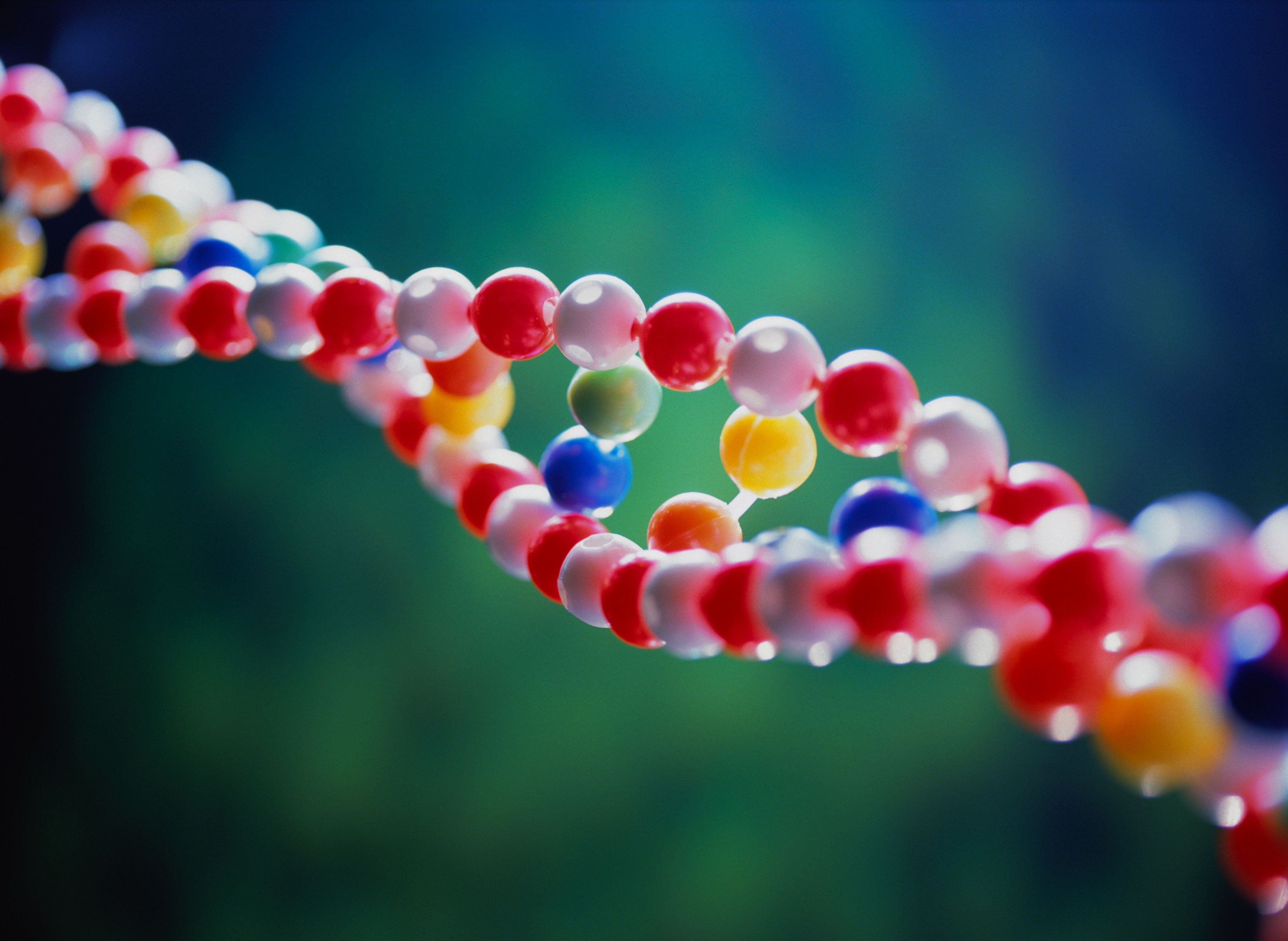
Which of the following represents the structure of DNA?

a)
b)
c)
d)
43.

Deletion

a)

a different base or pair takes the place of what should have there

b)

a base or segment is added to the strand

c)

a base or segment has been deleted

44.

insertion

a)

a different base or pair takes the place of what should have there

b)

a base or segment is added to the strand

c)

a base or segment has been deleted

45.

The picture above represents

a)

insertion

b)

deletion

c)

substitution