wayground logo

Free Printable Worksheets

Font size

S
M
L
XL
Worksheets

Blood and Blood Spatter Review

Total questions: 82

Worksheet time: 1hrs 5mins

Name
Class
Date
1.
What blood spatter pattern is seen in the picture?
a)
Transfer/Contact
b)
Swipe
c)
Wipe
d)
Saturation
2.
What type of blood spatter is typically created from a gunshot?
a)
Medium Velocity
b)
High Velocity
c)
Cast-Off
d)
Void
3.
What blood spatter pattern is seen in the picture?
a)
Cast Off
b)
Medium Velocity
c)
Void
d)
High Velocity
4.
The drop shown above would have more than likely been dropped from an angle of 
a)
90
b)
50
c)
30
d)
10
5.
The following indicates:
a)
cast off
b)
walking drip
c)
splash
d)
medium velocity impact 
6.
What pattern of blood spatter is this?
a)
arterial gushes
b)
splash
c)
smear
d)
pool
7.
The lines in the picture are referred to as lines of ___.
a)
convergence
b)
agreement
c)
tangents
d)
credit
8.
Based upon this picture, what test was done to determine whether or not a stain was blood (the picture shows a positive and negative test). 
a)
Kastle-Meyer presumptive blood test
b)
Leukomalachite green presumptive blood test
c)
Luminol presumptive blood test
9.
What would cause medium velocity blood spatter?
a)
Baseball bat
b)
Human hand
c)
Hand grenade
d)
Gunshot
10.
What is the original drop of blood that casts or gives off a satellite or wave called?
a)
Parent Drop
b)
Void
c)
Satellite drop
d)
Spine
11.
Which letter best shows the convergence point (origin point)?
a)
A
b)
B
c)
C
d)
D
12.
Which of the following CANNOT be determined from blood spatter?
a)
Exact Weapon Used
b)
Manner of Death
c)
Velocity
d)
Area of Origin
13.
What bloodstain pattern is created when blood is released or thrown from a blood-bearing object?
a)
Cast-Off
b)
Walking Drip
c)
Medium Velocity
d)
Void
14.
What type of spatter creates the largest blood droplets?
a)
Low velocity impact
b)
Medium velocity impact
c)
High velocity impact
15.
What type of blood-spatter creates the smallest blood drops?
a)
Low velocity impact
b)
Medium velocity impact
c)
High velocity impact
16.
What type of pattern is created when blood is blown out of the nose, mouth, or a wound as a result of air pressure?
a)
Expirated blood pattern
b)
Cast - Off Pattern
c)
High Velocity Pattern
d)
Wipe Pattern
17.
What blood stain pattern is created or formed by the force of gravity acting alone?
a)
Passive Drop
b)
Low Velocity Impact Spatter
c)
Flow Pattern
d)
Drip Pattern
18.
What blood spatter pattern is created when a source of blood remains stationary over a surface causing an accumulation of blood?
a)
Saturation
b)
Flow
c)
Pool
d)
Drip Pattern
19.
What blood spatter pattern is seen in the picture?
a)
Low Velocity
b)
Cast-Off
c)
Arterial Spurting
d)
Medium Velocity
20.
What blood spatter pattern is seen in the photo?
a)
Low Velocity
b)
Expirated Blood
c)
High Velocity
d)
Medium Velocity
21.
Which one of these was dropped from the biggest angle?
a)
1 (top left)
b)
4 (top right)
c)
7 (bottom left)
d)
9 (bottom right)
22.
What pattern of blood spatter is this?
a)
arterial gushes
b)
splash
c)
smear
d)
pool
23.
How does the velocity of impact change the blood stain pattern?
a)
Higher velocity, larger diameter
b)
higher velocity, smaller diameter
c)
lower velocity, smaller diameter
d)
Medium velocity, small diameter
24.
The shape of blood drops is cause by a natural_______________ of blood. 
a)
cohesiveness
b)
satellite drops
c)
adhesiveness
d)
lines of convergence
25.
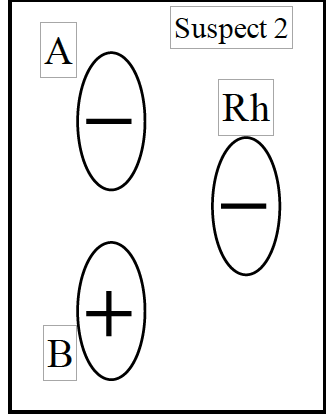
What is suspect 2's Blood Type?
a)
A-
b)
B-
c)
A+
d)
B+
26.
What blood type has anti-A antibodies?
a)
Type A
b)
Type B
c)
Type AB
d)
Type O
27.
What blood type has anti-B antibodies?
a)
Type A
b)
Type B
c)
Type AB
d)
Type O
28.
Which test is used to detect invisible blood stains?
a)
Kastle-Meyer
b)
Luminol
c)
Precipitin
d)
Huminal
29.
Blood Typing is considered what type of evidence?
a)
Indiviual
b)
Class
c)
Trace
d)
Physical
30.
Small secondary droplets around the main blood spatter drop are called:
a)
Spikes
b)
Splats
c)
Satellites
d)
Gushes
31.
What determines blood type?
a)
Proteins on red blood cells
b)
Proteins on white blood cells
c)
Proteins in the plasma
d)
Proteins on platelets
32.
Blood is made up of __ % blood cells. 
a)
45
b)
55
33.
Plasma makes up about __ % of blood. 
a)
45
b)
55
34.
What does blood transport?
a)
Nutrients
b)
Oxygen 
c)
Carbon Dioxide
d)
All of the above
35.

Mackenzie has blood type B+, she can receive blood from which blood donors?

a)

B+, B-, O+, O-

b)

B+, A-, O+, O-

c)

B+

d)

O-

36.
At what angle does a "tail" start to form on a blood stain?
a)
75 degrees
b)
30 degrees
c)
60 degrees
d)
90 degrees
37.
What is the acute angle formed between the directon of a blood drop and the surface it strikes called?
a)
Cast - off
b)
Wipe
c)
Medium Velocity Impact
d)
Angle of Impact
38.
Which test uses antibodies that react to human blood to tell if mammal blood is from a human?
a)
Kastle-Meyer 
b)
Luminol
c)
ELISA
d)
Fluorescein
39.
Mike has type O blood. Mike can receive blood from someone who has Type A or Type B.
a)
True
b)
False
40.
If you have the rH factor then your blood is +.
a)
False
b)
True
41.
Which of the following is NOT a component of whole blood?
a)
Red Blood Cells
b)
Spinal Fluid
c)
Plasma
d)
Platelets
42.
A majority of the population is Rh+
a)
True
b)
False
43.

As the angle of impact gets smaller, what happens to the tail?

a)

Gets longer

b)

Gets shorter

c)

Stays the same

44.

We use string/lines and see where the lines cross to figure out location of blood.

a)

Area of Convergence

b)

Point of Origin

c)

Blood Come From Here Spot

45.

As blood drops from increasing heights, what happens to the size of the blood stain?

a)

Gets larger.

b)

Gets smaller.

c)

Stays the same size.

46.

Hemastick and Kastle-Meyer tests are both examples of

a)

blood volume test

b)

blood typing test

c)

presumptive blood test

d)

species test

47.

Luminol is used to

a)

determine if blood is human

b)

determine blood type

c)

make blood you can't see visible

d)

determine blood volume lost

48.

Why does blood tend to stay in the shape of a sphere?

a)

surface tension

b)

antigens hold the blood cells together

c)

platelets cause the blood to clot

d)

antigens and antibodies cause agglutination

49.

The arrow is pointing to a

a)

satellite

b)

spine

c)

parent drop

50.

The arrow is pointing to a

a)

satellite

b)

spine

c)

parent drop

51.

The arrow is pointing to a

a)

satellite

b)

spine

c)

parent drop

52.

If a blood drop hits a smooth surface such as glass, one would expect to see

a)

A round drop with many spines and satellites

b)

An irregular shaped drop with many spines and satellites

c)

A round drop with few spines and satellites

d)

An irregular shaped drop with few spines and satellites

53.

If a blood drop hit a rough surface such as asphalt one would expect to see

a)

A round drop with many spines and satellites

b)

An irregular shaped drop with many spines and satellites

c)

A round drop with few spines and satellites

d)

An irregular shaped drop with few spines and satellites

54.

As the height of a vertical drop increases we would expect to see

a)

The diameter increase and fewer spines and satellites

b)

The diameter decrease and fewer spines and satellites

c)

The diameter increase and more spines and satellites

d)

The diameter decrease and more spines and satellites

55.

What is a reasonable estimate for the angle of impact for this blood drop?

a)

0 degrees

b)

30 degrees

c)

90 degrees

d)

180 degrees

56.

When crime scene investigations trace all the angles back to one location, they refer to this as..

a)

the area of convergance

b)

the origin story

c)

diameter of the blood drops

57.

The blood spatter pattern from a gunshot would be considered

a)

Passive blood drops

b)

Low velocity spatter

c)

Medium velocity spatter

d)

High velocity spatter

58.

Blood dripping off a weapon would be considered

a)

Passive blood spatter

b)

Projected blood spatter

c)

Transfer blood

59.

As the velocity of blood increases the size of the droplets.....

a)

Increases

b)

Decreases

60.
Can blood spatter evidence be presented in a courtroom?
a)
Yes, but it is circumstantial evidence
b)
No, you can only use it to help prove other theroies
c)
Yes, It is evidence that can stand alone in court and win the case
d)
No, Blood spatter isn't evidence
61.
Investigators can individualize blood evidence by:
a)
Determining the blood group
b)
Observing the blood cells
c)
Comparing the DNA from the cells
d)
Using the Kastle-Meyer test
62.
The directon of blood travel can be determined by:
a)
The size of the drop
b)
The distance and angle it has to travel
c)
The shape of the blood drop
d)
All of the above
63.
A gunshot wound close to the head would produce 
a)
low velocity spatter
b)
high velocity spatter
c)
medium velocity spatter
d)
none of these
64.
What is the common area in a three-dimensional space to which the trajectories of several blood drops can be retraced to called?
a)
Transfer or contact 
b)
Point of origin
c)
Angle of impact
d)
Low velocity impact
65.
What is the acute angle formed between the directon of a blood drop and the surface it strikes called?
a)
Cast - off
b)
Wipe
c)
Medium Velocity Impact
d)
Angle of Impact
66.
What is the transfer of blood from a moving source onto an unstained surface called?
a)
Wipe Pattern
b)
Void Pattern
c)
Transfer or Contact Pattern
d)
Swipe Pattern
67.
The drop shown above would have more than likely been dropped from an angle of around
a)
90
b)
50
c)
30
d)
10
68.

If one of your parents is blood type A and the other is type B, which of the following blood types would you likely be?

a)

A

b)

B

c)

O

d)

AB

e)

any of the above

69.

If a person has type A– blood, then they have

a)

only the A protein

b)

both A and the Rh proteins

c)

all three blood proteins

d)

can not be determined

70.

If a person has type O+ blood, then they have

a)

the A and the B protein, but lack the Rh protein

b)

an O protein but no Rh protein

c)

none of the ABO nor Rh proteins

d)

Rh protein but not the A or B proteins

71.

The universal blood donors for the ABO system are type____________

a)

A

b)

B

c)

O

d)

AB

72.

What would happen if you gave a person with AB blood a type A blood transfusion?

a)

the person would die

b)

they would also need B blood

c)

nothing, they can accept A blood

d)

it would need to be mixed with O blood

e)

all of the above

73.

How many antigen proteins(A, B, or Rh) does O- blood type have?

a)

3

b)

2

c)

1

d)

6

e)

0

74.
I am the 'liquid' portion of blood.
a)
Erythrocytes
b)
Thrombocytes
c)
Leukocytes
d)
Plasma
75.
Antibodies are shaped like
a)
The letter T
b)
Cirlces
c)
The letter Y
d)
The a infected cell
76.
What types of antibodies are found in a person with AB- blood?
a)
None
b)
Anti-Rh, only
c)
Anti-A and Anti-B
d)
Anti-A, 
77.
The process of antibodies binding to antigens causing erythrocytes to clump:
a)
aplastic anemia
b)
polycythemia
c)
agglutination
d)
coagulation
78.
If blood is found at a crime scene, doing a blood typing test would help eliminate potential suspects. 
a)
True
b)
False
79.
If blood were found at a crime scene, which test is more cost effective? 
a)
Blood typing
b)
DNA profile
80.
What type of surface did this blood most likely fall on?
a)
Semi-porous surface
b)
Smooth surface
c)
Carpet
d)
Rough surface
81.
Blood will stick to a surface due to ___.
a)
Adhesion
b)
Cohesion
82.
Which of these would be the correct order of tests to perform if blood is found at a crime scene? 
a)
ELISA, Kastle-Meyer, Blood Type
b)
Kastle-Meyer, Blood Type, ELISA
c)
Kastle-Meyer, ELISA, Blood Type
d)
ELISA