
 Worksheets
A&P Exam Review - Endocrine & Immune Systems
Total questions: 85
Worksheet time: 56mins


Which of the following are considered internal defenses? (there may be more than one correct answer)
Mucus
Inflammation
Tears
Hair
Tcells

True/False: Your body cannot make antibodies for pathogens that you have never been in contact with.
True, because your body needs to encounter the pathogen at least once in order to create the antibodies.
False, because you can make antibodies via immunizations given by a doctor.

What is the function of antibodies within the immune system?
Antibodies kill off any antigen that enters the body.
Antibodies are only made when you are given a vaccination for specific antigens.
Antibodies bind to specific antigens to flag for destruction.
Antibodies are part of an external defense mechanism.

Which of the following statements are TRUE about vaccinations?
Allow B cells to make antibodies for any type of antigen the body comes in contact with.
Triggers the body to make memory cells for specific pathogens.
They are substances prepared from killed or weakened pathogens.
Always allows the body to resist an infectious disease any time it comes into contact with it.

What happens after the second time you are exposed to a pathogen?
The body will not be able to fight off the pathogen quickly, because it knows how to get into the body easier.
The body's immune system will react the same was as it did during the first exposure.
The body can only be exposed to a pathogen a second time if you do not have a vaccine.
The body will know how to fight off the pathogen quickly, because memory cells have been created after the first encounter.
Some examples of external defenses are...
Skin
Mucus
Inflammation
Saliva
Sweat
How do T cells differ from B cells?
T cells fight pathogens by killing pathogens directly, while B cells fight pathogens by making antibodies.
T cells only make memory cells, and B cells only make antigens
T cells fight pathogens by making antibodies, while B cells fight pathogens by killing pathogens directly.
T cells can only fight off pathogens the body has encountered once, and B cells can fight off any pathogen the body comes across.


What is the term for a strong response to a harmless antigen in the environment?
An allergy
Cell-mediated immunity
An autoimmune disease
Inflammatory response
This type of immunity can be called nonspecific and refers to the bodies defenses that are present since birth.
resistance
adaptive immunity
acquired immunity
innate immunity
This type of immunity is acquired during one's lifetime. It is induced by antigens that invade the body.
innate immunity
adaptive immunity
nonspecific immunity
normal microbiota
The body regards this as foreign:
antibody
antigen
T-Cells
Cytotoxic T-Cells
When an individual encounters the same pathogen for a second time, The adaptive immune response is faster because of ....................
NK and Macrophages
B and Dendritic Cells
B and T memory cells
T cells
What are the two arms of the immune system?
Active and Passive
Innate and Adaptive
Anatomic and Physical
Complement and Phagocytes


Which of the following are chemicals that travel in the blood and cause changes in different parts of the body?
Hormones
Glands
Parathyroid
Adrenal Gland
The response to stress is called
Stay or Stray Response
Fight or Stay Response
Flee or Stray Response
Fight or Flight Response
Which term refers to the body's use of energy for energy and growth?
Excretion
Metabolism
Digestion
Respiration
Hormone regulation operates under which type of feedback mechanism?
positive feedback
negative feedback
zero feedback
Hormones are not regulated
Feedback loops are important because they allow organisms and the environment to
change based on new inputs
fall apart
change based on new outputs
maintain balance

Type I diabetes is caused by:
tumor on the adrenal gland
increased parathyroid hormone
decreased calcitonin
autoimmune reaction


Identify this gland.
Adrenal
Thyroid
Pancreas
Testes
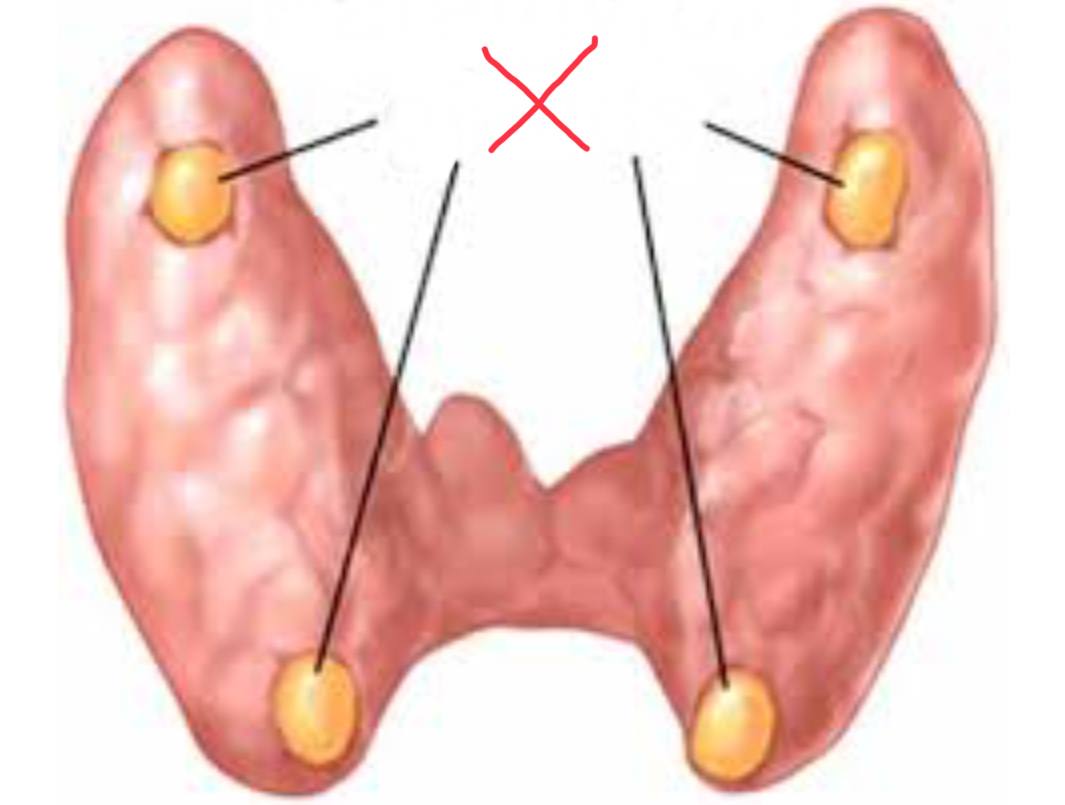
Identify the glands labeled “X.”
Pancreas
Testes
Tyroid
Parathyroid

Identify glands “A” and “B.”
A: pancreas B: adrenal gland
A: testes B: ovaries
A: thyroid B: parathyroid
A: pituitary B: hypothalamus


The gland labeled 4 in the diagram is?
the thymus gland
the thyroid gland
the parathyroid glands
the adrenal glands


Letter E is pointing to
Thymus
Pineal Gland
Adrenal
Parathyroids

What structure(s) shown in the picture above the kidneys?
Thyroids
Adrenal glands
Testes
Parathyroids

What structure is this?
Pancreas
Thyroid
Parathyroid
Adrenal glands



