wayground logo

Free Printable Worksheets

Font size

S
M
L
XL
Worksheets

End of Year Review

Total questions: 68

Worksheet time: 51mins

Name
Class
Date
1.
Any factor that can change in an experiment, observation, or model.
a)
constant
b)
predict
c)
variable
d)
investigation
2.
How many variables should be changed in a simple experiment?
a)
5
b)
3
c)
1
d)
6
3.
How many elements are represented in the compound?
Na2CO3
a)
1
b)
2
c)
3
d)
4
4.
Salt water boils and the water completely evaporates, salt (NaCl) is left in the bottom of the beaker. Which of the following is left in the beaker?
a)
Compound
b)
Element
c)
Mixture
d)
None of the Above
5.

Baking Cookies

a)

Physical Change

b)

Chemical Change

6.

Evaporating Water

a)

Physical Change

b)

Chemical Change

7.

Burnt toast

a)

Physical Change

b)

Chemical Change

8.

Bending a metal rod

a)

Physical Change

b)

Chemical Change

9.
Differences in the moon's and sun's pull on different sides of the Earth cause _________.
a)
gravity
b)
lunar phases
c)
tides
d)
dabbing
10.

What is the biggest difference between the Geocentric Model and the Heliocentric Model?

a)

the shape of the planets' orbits

b)

the movement of the moon

c)

the center of the solar system

11.
Why did people believe in the Geocentric vs the Heliocentric solar system?
a)
Geocentric system had been around for a LONG time.
b)
People don't like change.
c)
There wasn't enough proof  to support the Heliocentric system.
d)
all of these answers are correct.
12.

What moon phase is this picture?

a)

This is the waning crescent phase.

b)

This is the new moon phase.

c)

This is the waning gibbous phase.

13.
How long does it take the Moon to move around the Earth?
a)
29.5 days
b)
27.5 days
c)
23.5 days
d)
30 days
14.
How long is the lunar cycle?
a)
29.5 days
b)
23.5 days
c)
27.5 days
d)
Answer not shown
15.
 A large cloud of gas and dust in interstellar space; a region in Space where stars are born.
a)
Protostar 
b)
Nebula
c)
Galaxy 
d)
Star
16.
What does the Big Bang theory suggest?
a)
The universe was just there
b)
The Milky Way is the only solar system
c)
The universe is continually expanding
d)
The universe started as a point, expanded, and will return to a point
17.
Gravity is the force objects put on each other because of their ______.
a)
mass
b)
friendliness
c)
acceleration
d)
speed
18.
In the diagram given, what happens as we move to the left?
a)
Stars get larger
b)
Stars get colder
c)
Stars get hotter
d)
Stars get smaller
19.
Which has the LONGEST wavelength and, therefore, the lowest frequency/energy
a)
Gamma Rays
b)
Radio Waves
c)
Visible Light
d)
Infrared rays
20.
What type of galaxy is this?
a)
Spiral
b)
Elliptical
c)
Irregular 
d)
Irrational
21.
What type of galaxy is this?
a)
Spiral
b)
Elliptical
c)
Irregular
d)
Irrational
22.
The hottest planet
a)
Mars
b)
Venus
c)
Mercury
23.

Liquids have a [fixed, varible] volume and but a [fixed, variable] shape.

a)

fixed, fixed

b)

fixed, variable

c)

variable, fixed

d)

variable, variable

24.

One major difference between crystalline and amorphous solids is that

a)

crystalline solids have a precise melting point.

b)

amorphous solids have a lattice structure.

c)

amorphous solids always behave consistently and uniformly.

d)

crystalline solids break unpredictably and can produce curved fragments.

25.

Examples of this are glass, butter, rubber

a)

amorphous

b)

crystalline

26.

Liquids with very high viscosity flow very _______________________.

a)

fast

b)

not at all

c)

slow

d)

whenever it wants

27.

The best example of high viscosity would be?

a)

Honey

b)

Soap

c)

Marbles

d)

Water

28.
What is matter?
a)
a pure substance
b)
anything that occupies space and possesses mass
c)
an element
d)
a compound
29.

The atomic mass of an element is the ___.

a)

average of the mass number and the atomic number for the element

b)

weighted average of the masses of the isotopes of the element

c)

total mass of the isotopes of the element

d)

total number of subatomic particles in the nucleus

30.
Which group of the periodic table is composed of inert (not reactive)  gases?
a)
alkali metals
b)
alkaline earth metals
c)
halogens
d)
noble gases
31.
Elements which are shiny, conduct electricity and heat are called
a)
metal
b)
nonmetal
c)
metalloid
d)
nonexistent
32.
A proton is....
a)
A negatively charged subatomic particle
b)
A positively charged subatomic particle
c)
A neutrally charged subatomic particle
d)
The only subatomic particle located in the nucleus
33.
A neutron has a charge of
a)
+2
b)
No charge
c)
-1
d)
+1
34.
What does the atomic mass tell you? 
a)
Basically,the number of electrons and protons
b)
The number of neutrons
c)
Basically, the number of protons and neutrons
d)
The number of protons.
35.
How many neutrons are in a Gold atom?
a)
79
b)
196
c)
118
d)
275
36.
The electrons of an atom are found...
a)
in the outer "cloud" surrounding the atom.
b)
in the nucleus of the atom.
c)
in the cloud and in the nucleus.
37.
The subatomic particle with a negative charge is the
a)
electron
b)
proton
c)
neutron
d)
nucleus 
38.

Carbon is important for

a)

Conducting electricity.

b)

The chemistry of life. Proteins, DNA and fats all contain carbon.

c)

High strength and light weight.

d)

Shiny metal with a high melting point.

39.
a)
2
b)
8
c)
3
d)
13
40.
a)
2
b)
3
c)
5
41.
a)
7
b)
8
c)
9
d)
10
42.

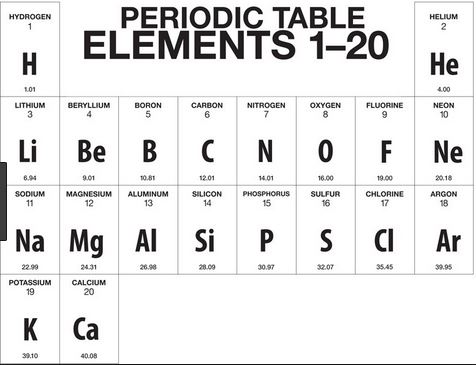
How many valence electrons does Nitrogen Have?

a)

1 Valence electron

b)

2 Valence electron

c)

3 Valence electron

d)

4 Valence electron

e)

5 Valence electron

43.
Capable of being shaped, formed, or rolled into flat sheets.
a)
ductile
b)
corrosive
c)
malleable
d)
reactive
44.
Look at the periodic table that is provided. Where would nonmetals be located? 
a)
to the left of the table 
b)
to the right of the table 
c)
in the zigzag line 
45.

At constant pressure, when the temperature of a gas is decreased, what happens to its volume?

a)

it decreases

b)

it will vary

c)

it increases

d)

it remains constant

46.

At constant volume, when the temperature of a gas decreases, the pressure _______.

a)

decreases

b)

increases

c)

does nothing

d)

explodes

47.
measures average kinetic energy (energy from motion)
a)
temperature
b)
volume
c)
pressure
d)
moles
48.
Atoms joined together by SHARING electrons are?
a)
Ionic bonds
b)
Covalent bonds
c)
Metallic Bonds
d)
James Bonds
49.

Which type of bond has a transfer of an electron from on atom to another?

a)

Polar Covalent

b)

Non Polar Covalent

c)

Ionic

d)

Metallic

50.
If I gain electrons I become
a)
Positive because I've added to my atom
b)
negative because I've added electrons
c)
same because i'm balanced
d)
equal because now I have electrons
51.
A covalent bond is a bond between a _____ and a ______
a)
metal, nonmetal
b)
metal, metal
c)
nonmetal, nonmetal
52.
Ionic bonds form between metals and ____.
a)
metalloids
b)
metals
c)
nonmetals
53.
Bases are located where on the pH scale?
a)
any number can be a base
b)
below 7
c)
above 7
d)
number 7 is a base
54.
Which of the following is neutral?
a)
milk
b)
eggs
c)
gummy worms
d)
pure water
55.

According to the pH scale, which item is more acidic than lemons?

a)

battery

b)

vinegar

c)

milk

d)

blood

56.
Which of the following are PRODUCTS?
H2O + CO→ HCO + HO
a)
H2O and CO2
b)
HCO and HO
c)
H2O ONLY
d)
HCO ONLY
57.
This type of system requires interaction with the environment around it
a)
Closed System
b)
Open System
58.

Which organelle is responsible making food (Glucose) using sunlight?

a)

Cell Membrane

b)

Nucleus

c)

Chloroplast

d)

Mitochondria

59.

Select all that are products of Photosynthesis.

a)

Water

b)

Carbon Dioxide

c)

Oxygen

d)

Sunlight (Light Energy)

e)

Glucose (Sugar/food)

60.

What is the difference between natural and synthetic resources?

a)

Natural are man-made, synthetic are found in nature

b)

Natural occur in nature, synthetic are man-made

c)

There is no difference

d)

We don't use natural resources but we use synthetic resources

61.

Large molecules made up of small monomers are called

a)

polymers

b)

peptides

c)

peptones

d)

monomers

62.
Cellular Respiration's goal is to
a)
make water
b)
make ATP
c)
make glucose
d)
make  oxygen
63.

Which of the following equation explains cellular respiration?

a)

sugar+water -> salt+sunlight

b)

sugar+oxygen -> water+carbon dioxide+energy

c)

water+carbon dioxide+sunlight -> sugar+oxygen

d)

Sugar+energy -> water+carbon dioxide+oxygen

64.

Which of the following organelles is responsible for cellular respiration?

a)

Mitochondria

b)

Nucleus

c)

Endoplasmic Reticulum

d)

Ribosome

65.
If the plant population decreased, the amount of carbon would _________.
a)
Stay the same
b)
Increase
c)
Decrease
66.

Organisms that need nitrogen to survive.

a)

only plants

b)

only animals

c)

only bacteria

d)

all living things

67.

How is nitrogen "fixed" into a usable form for plants?

a)

Through action of bacteria only

b)

Through lightning only

c)

Through action of bacteria and lightning

d)

Through photosynthesis

68.

Plants and animals cannot use nitrogen directly from the air.

a)

True

b)

False