wayground logo

Free Printable Worksheets

NEW

Font size

S
M
L
XL
Worksheets

Physics 7 Reviewer

Total questions: 75

Worksheet time: 1hrs 2mins

Name
Class
Date
1.

Sound is produced by -----

a)

Heat energy

b)

Low temperatures

c)

Vibrations

d)

Friction

2.

True or False: Sound needs a medium.

a)

True

b)

False

3.

Sound waves are also known as ----- waves.

a)

Compression

b)

Longitudinal

c)

Neither

d)

Both longitudinal and compression

4.

True or False: Sound waves are faster than light.

a)

False

b)

True

5.

Areas of increased pressure on a sound wave are known as a ----

a)

Rarefaction

b)

Compression

c)

Frequency

d)

Amplitude

6.

The distance from the beginning of one compression to the beginning of the next compression is called a -----

a)

Rarefaction

b)

Frequency

c)

Wavelength

d)

Compression

7.

Spread out areas or areas of decreased pressure on a sound wave are known as a ---

a)

Rarefaction

b)

Amplitude

c)

Compression

d)

Hertz

8.

The number of wavelengths that pass a fixed point each second is known as ----

a)

Hertz

b)

Amplitude

c)

Frequency

9.

The unit for measuring frequency is the ---

a)

Joule

b)

Hertz

c)

Gram

d)

Newton

10.

The speed of sound depends on these two things:

a)

The type of medium and the temperature of the medium

b)

Speed of the medium and temperature of the medium

c)

Temperature of the medium and sound of the medium

d)

None of the above

11.

Sound waves travel the fastest through ---

a)

Liquids

b)

Gases

c)

Solids

12.

Sound waves that are beyond the range of human ear are known as ----

a)

Infrasonic waves

b)

Ultrasonic waves

13.

Sonar and echolocation use ----- to detect objects under water.

a)

Refraction

b)

Reflection

14.
Sound moves in a _________.
a)
Transverse wave
b)
Longitudinal wave
15.
How is sound produced?
a)
By the vibration of particles
b)
By the transfer of particles 
16.
Which device measures sound waves?
a)
Oscilloscope
b)
Stethoscope 
c)
Radio
d)
I don't know
17.
The reflection of sound waves off of a hard surface can create ______.
a)
A wave
b)
An echo 
18.
Soft surfaces _______ sound waves. 
a)
Reflect
b)
Absorb
19.
________ describes how LOUD a sound is. 
a)
Amplitude
b)
Frequency 
20.
____________ is determined by sound wave's frequency. 
a)
Compression
b)
Pitch 
21.
Sound waves travel farther through ________ media, like water or steel. 
a)
Dense 
b)
Light
22.
_______ is how high or low we listen/perceive  a sound. 
a)
Pitch
b)
Frequency
c)
Amplitude
d)
I don't know
23.

These waves require a medium through which to travel.

a)

electromagnetic

b)

mechanical

c)

light

d)

vibration

24.

_____________________ is transferred by waves from one place to another.

a)

vibration

b)

energy

c)

disturbance

d)

mechanical

25.

Which of these is NOT a medium?

a)

light

b)

air

c)

wood

d)

metal

26.

The loudness of a sound is directly related to the wave's _____.

a)

wavelength

b)

frequecy

c)

rest position

d)

amplitude

27.

When a wave has less energy the sound will be _________.

a)

quieter

b)

silent

c)

louder

d)

higher

28.

The unit Hertz is used to measure the waves _______.

a)

frequency

b)

wavelength

c)

loudness

d)

amplitude

29.

______________ of waves is measured in decibels. (dB)

a)

frequency

b)

pitch

c)

wavelength

d)

loudness

30.

Headphones change a(an) ______ signal into a(an) ____ wave.

a)

sound/heat

b)

electrical/sound

c)

sound/electrical

31.

This illustration demonstrates which wave property? (Notice that the number of waves is the same for each example)

a)

frequency

b)

amplitude

c)

Doppler Effect

d)

diffraction

32.
Which diagram of a sound wave represents the sound with the highest pitch?
a)
A
b)
B
c)
C
d)
D
33.
Reflection occurs when...
a)
light bends
b)
light shines in your eyes
c)
light goes through a surface
d)
light strikes a surface and bounces back
34.
Which of these processes does the picture illustrate?
a)
reflection
b)
refraction
c)
absorption
d)
scattering
35.
We see colors of objects because they...
a)
Absorb and reflect light
b)
Transmit and reflect light
c)
Refract and reflect light
d)
Absorb and refract light
36.
Which would describe a sheet of glass?
a)
Opaque
b)
Translucent
c)
Transparent
d)
Mirrored 
37.
Light strikes a mirrored surface at point X. It reflects to point C. Where did the light shine?
a)
A
b)
B
c)
C
d)
D
38.
What happens to light when it strikes a prism?
a)
It is heated. 
b)
It is absorbed.
c)
It is refracted. 
d)
It is straightened. 
39.
Which of these should you use to demonstrate how light is reflected off a smooth surface?
a)
Convex lens
b)
Mirror
c)
Laser
d)
Concave lens
40.
Which diagram BEST illustrates the reflection of light from the surface of a mirror?
a)
A
b)
B
c)
C
d)
D
41.
You stand in front of your friend. Why can't people see your friend behind you?
a)
You are transparent.
b)
You are translucent.
c)
You are opaque. 
d)
You are concave. 
42.
Why can you see light shining through a lampshade?
a)
Opaque
b)
Radiant
c)
Translucent
d)
Transparent
43.
You and your father inspect an empty house with the hopes of buying it. You walk through the rooms talking to one another, and you notice that your voices and footsteps are echoing in the big, empty house. What causes the echo?
a)
sound waves reflecting off smooth, flat surfaces throughout the house
b)
sound waves moving around the large rooms
c)
sound waves moving slowly through air
d)
sound waves refracting around corners in the empty rooms
44.
Cletus wants to make ear protectors for people who work around loud jet engines at Hartsfield Airport in Atlanta. Which of the following materials should he experiment with for the best results?
a)
a material that produces sound
b)
a material that absorbs sound
c)
a material that transmits sound
d)
a material that amplifies sound
45.
Which surface is the best reflector of sound? 
a)
bumpy and soft
b)
smooth and soft
c)
smooth and hard
d)
bumpy and hard
46.
A tuning fork with a frequency of 404 Hertz is struck with a soft hammer. The fork is struck a second time by the same hammer with twice as much force, and the volume, or amplitude, increases by a factor of two. What will the frequency of the second sound be? 
a)
101 Hz
b)
202 Hz
c)
404 Hz
d)
808 Hz
47.

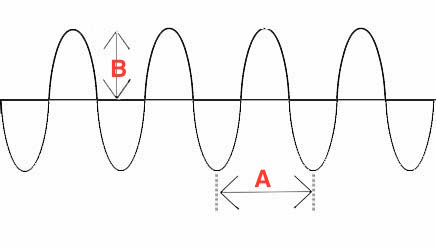
What property of this wave is represented by the letter "A"

a)

amplitude

b)

crest

c)

trough

d)

wavelength

48.
The type of waves that require medium to pass:
a)
Mechanical Waves
b)
Electromagnetic Waves
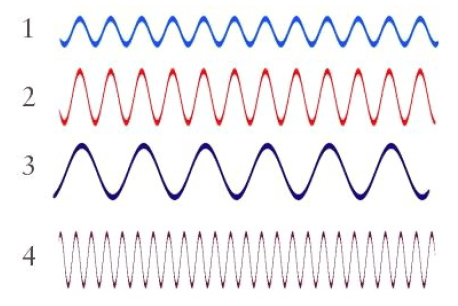
49.
Which wave in the diagram has the greatest frequency?
a)
1
b)
2
c)
3
d)
4
50.

2. WHICH OF THE FOLLOWING IS A SOURCE OF LIGHT?

a)

the moon

b)

our eyes

c)

fire

d)

a mirror

51.

3. Mrs. Smith’s class will be outside for several hours on Friday. The temperature is to be in the 90’s. What color clothing should students wear to stay cooler?

a)

black

b)

white

c)

red

d)

blue

52.

Why is light able to travel through space when sound cannot?

a)

Light is able to be reflected by objects.

b)

Light is able to travel through gas.

c)

Light is able to travel through a vacuum.

d)

Light is able to travel through translucent objects.

53.

When all of the colors of light are absorbed, we see the color _______.

a)

white

b)

green

c)

black

d)

red

54.

Why do you feel warm when you stand in the sunlight?

a)

You are warmed by the sunlight that reflects off your clothes.

b)

The sunlight refracts through your body, warming it up.

c)

The sunlight is transmitted through your body, warming it up.

d)

Your clothes absorb some of the sunlight and convert it to heat.

55.

7. When light bounces off a mirror, it is __________.

a)

Absorbed

b)

Reflected

c)

Corrected

d)

Refracted

56.

8. Which statement best explains why you can see yourself when you look at a mirror?

a)

Light is refracted as it passes through the mirror.

b)

Light is refracted, bouncing off the mirror.

c)

Light is reflected, bouncing off the mirror.

d)

Light is reflected as it passes through the mirror.

57.

How does light affect the pupil?

a)

The pupil gets larger as light decreases.

b)

The pupil gets larger as light increases.

c)

The pupil’s color depends on the amount of light.

d)

The pupil isn’t affected by light.

58.

Where does light come from?

a)

The fish

b)

The clouds

c)

A coral reef

d)

The sun

59.

What is the source of the light from the moon?

a)

The light is sunlight reflecting off the moon.

b)

The light comes from glowing rocks.

c)

The light is from Earth reflecting off the moon.

d)

The light is from the ice on the moon.

60.

How many colors is white light from the sun made of?

a)

Three

b)

Twelve

c)

Seven

d)

Five

61.

A lemon appears yellow when light is shone on it because the lemon _________ yellow light.

a)

Bends

b)

Refracts

c)

Absorbs

d)

reflects

62.

How is light energy transmitted? Light energy is transmitted as _________.

a)

Cells

b)

Waves

c)

Circles

d)

wires

63.
What three things may happen to light that strikes an object? 
a)
The light may be reflected, transmitted or absorbed.
b)
The light may be reflected and refracted.
c)
The light may be absorbed and transmitted.
64.
What are the primary colors of the pigment?
a)
cyan, yellow and magenta
b)
Red, green and blue
c)
black and white
65.
An actorś red shirt and blue pants both appear black. What color is the stage light shining on the actor?
a)
Blue 
b)
Red
c)
Magenta
d)
Green
66.
The two kinds of reflection are 
a)
transparent and translucent
b)
opaque and translucent
c)
regular and diffuse
67.
______ is a copy of the object formed by reflected or refracted rays of light
a)
reflection
b)
refraction
c)
object
d)
image
68.
A plane mirror produces a/an 
a)
a small, real image
b)
a large, real image
c)
 a small, virtual image
d)
a same sized, virtual image
69.

When light hits an area and bounces back it is called:

a)

echo

b)

refraction

c)

reflection

d)

absorbing

70.

Light travels through air, water, glass and many other materials. What path does it travel to get from one place to another?

a)

sideways

b)

back and forth

c)

straight

d)

up and down

71.

When light hits a barrier that is solid/opaque what is usually created?

a)

a hot object

b)

a shadow

c)

nothing

72.

When light goes from one material(medium) to another it becomes bent, what term means bent?

a)

reflected

b)

refracted

c)

absorbed

d)

turned

73.

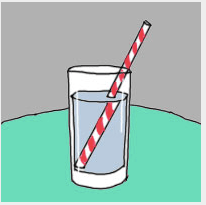
Why does the straw appear to be bent?

a)

light is reflected

b)

light is absorbed

c)

light is turned

d)

light is refracted

74.

When light passes from air to water, what happens to the speed of the light?

a)

speeds up

b)

slows down

c)

stays the same

75.
Why do we see objects as white?
a)
They absorb all light
b)
They reflect all light
c)
They absorb some light and reflect some light