wayground logo

Free Printable Worksheets

Font size

S
M
L
XL
Worksheets

Geomorphology 2

Total questions: 80

Worksheet time: 3hrs 43mins

Name
Class
Date
1.

How many levels are there to the Mercalli scale.

a)

12

b)

10

c)

8

d)

11

2.

This is the slowest wave picked up by the seismograph

a)

P Wave

b)

S Wave

c)

Surface Wave

3.

The San Andreas Fault is an example of this fault line.

a)

Reverse

b)

Tear

c)

Normal

d)

Overthrust

4.

Name the fault line in the image

a)

Reverse

b)

Tear

c)

Normal

d)

Anticline

5.

When the crust is stretched by rock moving in opposite directions, compression occurs.

a)

True

b)

False

6.

How does folding affect Earth's surface?

a)

Folding causes the crust to buckle, and over time, to rise up and form mountains.

b)

Folding causes the crust to sink.

c)

Folding causes the crust to bend in half.

d)

Folding has no effect on Earth's surface.

7.

Why is it dangerous to live along a fault line?

a)

It's not dangerous at all!

b)

The plates are sliding past each other here and this can cause serious changes to the landscape, including a fracture in the crust.

8.

Which type of stress occurs at divergent boundaries where plates pull apart?

a)

tension

b)

compression

c)

shear

9.

Which type of stress occurs at convergent boundaries where plates push into each other?

a)

tension

b)

compression

c)

shear

10.

When magma keeps coming up below the surface and eventually solidifies and creates igneous rock, what is formed?

a)

An earthquake.

b)

A volcano.

c)

A pile of rocks.

d)

Nothing, that doesn't happen.

11.
Which type of boundary produces large Mountain Ranges as a result of compression between two plates
a)
divergent
b)
convergent
c)
transform
d)
optional
12.
Which type of boundary produces rift valleys and ridges as a result of tension pulling two plates apart
a)
divergent
b)
convergent
c)
transform
d)
optional
13.
Which type of boundary produces strike-slip faults as a result of sideways motion between plates
a)
divergent
b)
convergent
c)
transform
d)
optional
14.
When rock layers get warped or bent as a result of compression we call this 
a)
tilting
b)
folding
15.
When the rocks arch upward we call this
a)
anticline
b)
syncline
c)
monocline
16.
When the rocks arch downward we call this
a)
anticline
b)
syncline
c)
monocline
17.

What are earthquakes?

a)

The shaking that results from the movement of rock beneath Earth's surface

b)

Masses of earth sliding down cliffs or mountains

c)

A rotating column of air causing mass destruction

d)

A gigantic wave

18.

What causes earthquakes?

a)

Millions of people jumping at once

b)

The earth rotating

c)

The movement of plate tectonics

d)

Gravity

19.

What is the scale used to measure the strengths of earthquakes?

a)

Fujita scale

b)

Richter scale

c)

Damage scale

d)

NASA scale

20.

How to prepare for an earthquake

a)

Have a first aid kit

b)

Have canned foods

c)

Have enough water for everyone

d)

Flashlights

21.

How are earthquakes recorded?

a)

Seismographs

b)

Human eyes

c)

Data charts

d)

Circle Graphs

22.

Where do earthquakes occur near?

a)

Edge of Continental Plates

b)

Edge of Oceanic Plates

c)

Mid Ocean Ridges

d)

Pangea

23.
What is directly above the focus?  
a)
Epicenter
b)
Fault
c)
Seismograph Station
24.
Which wave has the highest amplitude on a seismograph?  
a)
P Wave
b)
S Wave
c)
Surface Wave
25.
Which seismic wave does a seismograph detect first?  
a)
P Wave
b)
S Wave
c)
Surface Wave
26.
Where is the point at which the first movement occurs during an earthquake?
a)
Epicenter
b)
Focus
c)
Fault
d)
Plate
27.
Which body wave squeezes and stretches rock materials as they pass through the Earth?
a)
Body Waves
b)
P Waves
c)
S Waves
d)
Surface Waves
28.
Which body waves cause particles of rock material to move at right angles to the direction in which the waves are traveling?
a)
Body Waves
b)
P Waves
c)
S Waves
d)
Surface Waves
29.
What is the measure of the amount of energy released in an earthquake?
a)
Earthquake
b)
Epicenter
c)
Magnitude
d)
Seismogram
30.
Which scale rates earthquakes based on the amount of damage done?
a)
Mercalli Scale
b)
Richter Scale
c)
Seismogram Scale
d)
Bernoulli Scale
31.
Which scale measures the intensity of the ground movement?
a)
Mercalli Scale
b)
Richter Scale
c)
Seismogram Scale
d)
Bernoulli Scale
32.
What is a smaller earthquake that follows a larger earthquake?
a)
Aftershock
b)
Liquefaction
c)
Seismic Gap
d)
Tsunami
33.
What is a large ocean wave that results from an underwater earthquake, landslide, or volcanic eruption?
a)
Aftershock
b)
Liquefaction
c)
Seismic Gap
d)
Tsunami
34.
What is the definition of dormant?
a)
sleeping
b)
extinct
c)
active
d)
invisible
35.
What is the opening that extends from the magma chamber to the top of the volcano called?
a)
magma
b)
lava
c)
vent 
d)
crater
36.
What is Magma when it reaches the surface of Earth?
a)
Lava
b)
Mafic Magma
c)
Felsic Magma
d)
None of these
37.
A volcano that has gentle sloping sides and is formed from runny lava
a)
Shield volcano
b)
Cinder cone
c)
Composite
d)
None of these
38.
When an explosive eruption  forms a mixture of hot rock, ash, and gas, this material is called a...?
a)
Land slide
b)
Lava
c)
Eruption trail
d)
Pyroclastic flow
39.
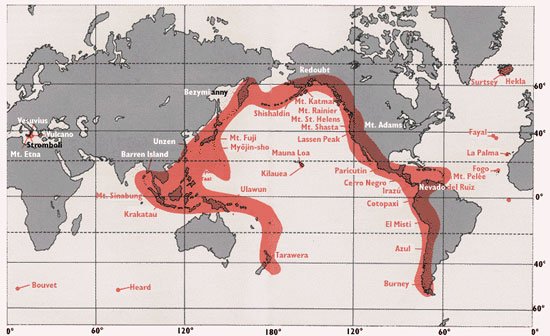
This is the name for the chain of volcanos around the edge of the Pacific Plate.
a)
Circle of Fire
b)
Ring of Lava
c)
Ring of Fire
d)
Circle of Magma
40.
A volcano that is made from layers of both runny lava and lava chunks is called 
a)
a shield volcano
b)
a cinder cone volcano
c)
a composite volcano
41.
Dormant volcanoes might erupt in the future.
a)
True
b)
False
42.
Volcanoes are found...
a)
on land
b)
under water
c)
on islands
d)
all of the above
43.
What is letter B in the picture?
a)
Magma Chamber
b)
Crater
c)
Vent
d)
Conduit
44.
What is letter C in the picture?
a)
Vent
b)
Crater
c)
Caldera
d)
Tephra
45.
What is letter D in the picture?
a)
Crater
b)
Vent
c)
Conduit
d)
Tephra
46.
Volcanoes that have recently erupted are known as:
a)
Extinct Volcano
b)
Dormant Volcano
c)
Active Volcano
d)
What's a volcano?
47.

Which theory helped scientists understand how and where volcanoes erupt?

a)

Theory of Plate Tectonics

b)

Theory or Relativity

c)

Theory of the Rock Cycle

d)

Big Bang Theory

48.

Which type of volcano is built by alternating layers of lava flows and ash flows? It can

be very explosive.

a)

Cinder Cone

b)

Composite

c)

Lava Dome

d)

Shield

49.

Which type of volcano has steep angled sides, throws blobs of lava in the air that fall as cinders, and is built over a short period of time?

a)

Cinder Cone

b)

Composite

c)

Lava Dome

d)

Shield

50.

Which type of volcano spills thick lava which cools and piles up around the vent? These fragments spill down the sides of the volcano.

a)

Cinder Cone

b)

Composite

c)

Lava Dome

d)

Shield

51.

Magma is found above the earth surface?

a)

True

b)

False

52.
What type of volcano is Kilauea, which is located in Hawaii?
a)
Caldera
b)
Cinder Cone
c)
Composite Volcano
d)
Shield Volcano
53.
What is molten rock that has reached the Earth's surface?
a)
Aa
b)
Lava
c)
Magma
d)
Pahoehoe
54.
Where do volcanoes come from?
a)
Places where plates move apart
b)
Places where plates are moving together
c)
Hot Spots
d)
All of these options
55.
Tall, cone-shaped mountains in which layers of lava alternate with layers of ash are called
a)
shield volcanoes
b)
cinder cone volcanoes
c)
composite volcanoes
d)
lava plateaus
56.
Which volcano is a wide, gently sloping mountains made of layers of lava and is formed by quiet eruptions?
a)
Composite
b)
Cinder-Cone
c)
Shield
d)
Stratovolcano
57.
Shield volcanoes have:
a)
gently sloping sides
b)
a steep cone shape
c)
moderately sized sides
d)
long cracks along plate boundaries
58.
When a volcano erupts, empties the magma chamber, and collapses the top leaving a huge hole.
a)
Dike
b)
Caldera
c)
Silica
d)
Geyser
59.
A chain of volcanic islands formed where two oceanic plates collide is called:
a)
island arc
b)
hot spot
c)
Hawaii
d)
geyser
60.
These volcanoes form in long cracks where plates are pulled apart.
a)
Shield volcano
b)
Composite / Stratovolcano
c)
Cinder cone
d)
Fissure volcano
61.
As magma rises towards the surface it collects in a 'room' called a _____ _____ . 
a)
magma chamber
b)
side vent
c)
main vent
d)
lava chamber
62.
The volcanoes on the Hawaiian Islands form due to which of the following?
a)
Divergent Boundary
b)
Hot Spot
c)
Subduction Boundary
d)
Transform Boundary
63.
5. This image is of....
a)
Convergent Boundary
b)
Transform Boundary
c)
Divergent Boundary
64.
4. This image is of...
a)
Transform Boundary
b)
Convergent Boundary
c)
Divergent Boundary
65.
What was the name given to all the continents when they were joined as one super continent? 
a)
Supreme Continent
b)
Eurasia
c)
Plate tectonics
d)
Pangea
66.
Which fault forms from compression forces?
a)
Normal Faults
b)
Reverse Faults
c)
Strike Slip Faults
d)
Transform Fault
67.
A normal fault forms from what kind of forces?
a)
Compression
b)
Tension
c)
Shear Stress
d)
Deformation
68.
Waves move out through the ground from the ..........
a)
rift
b)
hypocenter
c)
epicenter
d)
fault line
69.
Which travels fastest, always being the first detected by seismic stations?
a)
P waves
b)
S waves
70.
An earthquake scored high on the Richter scale but low on the Mercalli scale. Why?
a)
it probably happened in an area with no people
b)
it was a fast earthquake
c)
because it damaged a lot
d)
impossible to tell
71.
How much bigger is a magnitude 8 earthquake compared to magnitude 7 one on the Richter Scale?
a)
1 time bigger
b)
10 times bigger
c)
100 times bigger
d)
1000 times bigger
72.

What type of fault is the San Andreas in California?

a)

Convergent

b)

Transform

c)

Optimus Prime

d)

Divergent

73.

A tsunami is caused by underwater

a)

Fish

b)

Explosions

c)

Earthquakes

d)

Exploration

74.

1. What is a tsunami?

a. A large storm with very high speed winds

b. A tropical cyclone that occurs in the Pacific Ocean

c. A large and powerful ocean wave

d. A type of tornado

e. Any earthquake that causes significant damage

a)

a

b)

b

c)

c

d)

d

e)

e

75.
Strange animal behavior, such as toads fleeing an area, could be an indicator that ____________ is about to occur. 
a)
a volcanic eruption 
b)
a tsunami
c)
a hurricane
d)
an earthquake
76.
Scientists can predict exactly when a volcanic eruption will occur. 
a)
True
b)
False
77.
Which statement is true of earthquakes?
a)
All of them can be prevented
b)
Weak ones can be prevented
c)
Some of them can be prevented
d)
None of them can be prevented
78.
Earthquakes are caused by all of the following EXCEPT...
a)
movement of tectonic plates.
b)
tsunamis.
c)
volcanic activity. 
d)
underground collapses. 
79.
This city was destroyed in 79 A.D. by the eruption of Mt. Vesuvius.
a)
Rome
b)
Munich
c)
Pompeii
d)
Naples
80.
Volcanoes that are NOT found at plate boundaries occur in the middle of plates in areas called ___________. 
a)
hot spots
b)
mid-ocean ridges
c)
fissure volcanoes
d)
shield volcanoes