wayground logo

Free Printable Worksheets

NEW

Font size

S
M
L
XL
Worksheets

Nuclear Physics

Total questions: 40

Worksheet time: 27mins

Name
Class
Date
1.
The protons and neutrons are inside of the nucleus, and contain almost all of _____
a)
the charge of the atom
b)
the volume of the atom
c)
the mass of the atom
d)
the kinetic energy of the atom
2.
In terms of matter, the atom is almost entirely filled with _____
a)
orbiting electrons
b)
charged protons
c)
heavy neutrons
d)
empty space
3.
Takes two small nuclei and combines them into a larger nucleus
a)
fission
b)
fusion
4.
The splitting of a nucleus into smaller nuclei is
a)
fusion
b)
fission
c)
half-life
d)
gamma radiation
5.
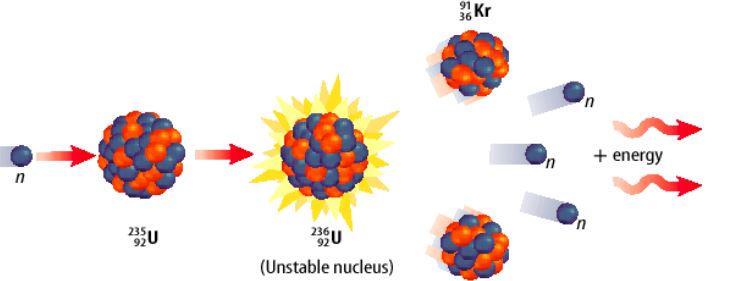
This is an example of...
a)
Fission  reaction
b)
Fusion reaction
c)
Decomposition reaction
d)
Decay
6.
Where does fusion occur naturally?
a)
Underwater
b)
All around us
c)
In the radioactive waste
d)
On the sun
7.
Which atoms combine together during fusion reaction on the sun?
a)
Helium and Hydrogen atoms
b)
Hydrogen atoms
c)
Hydrogen and Lithium atoms
d)
Hydrogen and Carbon atoms
8.
Very high temperature and pressure is required for:
a)
Fission
b)
 Fusion
c)
Radioactive Decay
9.

What is the nucleon number of this carbon atom

a)

12

b)

6

c)

2

d)

1

10.

The "nucleon number" is another name for...

a)

mass number

b)

atomic number

c)

neutron number

d)

proton number

11.

What is the nucleon number of this carbon atom

a)

12

b)

6

c)

2

d)

1

12.

To find the number of neutrons in an atom you

a)

nucleon number - proton number

b)

proton number - nucleon number

c)

nucleon number + proton number

d)

nucleon number x proton number

13.
What is the name of the pictured isotope?
a)
Chlorine-Schmorine
b)
Chlorine-17
c)
Chlorine-35
d)
Chlorine-18
14.

In a correctly written symbol what would be located in the "A" position?

a)

number of neutrons

b)

proton number (atomic number)

c)

number of electrons

d)

nucleon number (mass number)

15.
The alpha particle scattering experiment by Rutherford
a)
gave rise to the nuclear model of the atom
b)
is the reason we think electrons have a negative charge
c)
was carried out using thick metal foils
d)
lead to the idea that all matter was made of indivisible atoms
16.

In Rutherford's famous experiment, the vast majority of alpha particles passed straight through the gold foil. What does that tell us?

a)

The nucleus is very small and atoms are mostly empty space

b)

The plum pudding model was correct

c)

Atoms are tiny

d)

The nucleus is positive

17.

Solve the nuclear fusion reaction 42He+21H→

a)

63Li

b)

73C

c)

104Li

d)

113Ne

18.

Solve the nuclear fusion reaction 105B+126C→

a)

3211Na

b)

2211Na

c)

2311Ca

d)

3211Ge

19.

What is the missing element in the nuclear fusion reaction? 105B+____→ 3216S

a)

3216S

b)

3216S

c)

2211Na

d)

126C

20.

What radioactive particle was fired at the gold foil in Rutherford's famous experiment?

a)

Alpha

b)

Beta

c)

Gamma

d)

Electrons

21.

In Rutherford's experiment, a very small number of alpha particles bounced straight back off the gold foil.

a)

True

b)

False

22.

The unit of activity is...

a)

Becquerel

b)

Seconds

c)

Metres

d)

Sievert

23.

The most penetrating form of nuclear radiation is...

a)

alpha

b)

beta

c)

gamma

d)

heat

24.

Which best describes the structure of a beta particle?

a)

helium nucleus

b)

slow moving proton

c)

fast moving electron

d)

high frequency light wave

25.

What is the half-life of this radioactive substance?

a)

5700 years

b)

11400 years

c)

17100 years

d)

22800 years

26.

The overall charge on an alpha particle is...

a)

-1

b)

0

c)

+1

d)

+2

27.

A hydrogen atom has an atomic number of 1, mass number of 1. The first isotope of hydrogen has an atomic number of...

a)

0

b)

1

c)

2

d)

3

28.

A radioactive source has an initial activity of 200kBq and a half-life of 15 days. How many days would it take for the activity to fall to 25kBq?

a)

15

b)

30

c)

45

d)

60

29.

What is a beta particle made of?

a)

One proton

b)

A helium particle

c)

One electron

d)

One proton and one neutron

30.

Of the main types of radiation emitted from naturally radioactive isotopes, which is the hardest to block?

a)

Alpha deca

b)

Gamma Decay

c)

Beta decay

d)

They are all blocked using the same method
31.
What is emitted during Alpha Radiation?
a)
A helium nuclei.
b)
A helium atom
c)
Gamma Rays.
d)
Positrons
32.
What is radioactive decay?
a)
The spontaneous breakdown of an atomic nucleus resulting in only energy release
b)
The spontaneous breakdown of an atomic nucleus resulting in only matter release
c)
The spontaneous breakdown of an atomic nucleus resulting in a release of energy and matter
d)
The decay of the use of radios and the increased use of televisions.
33.
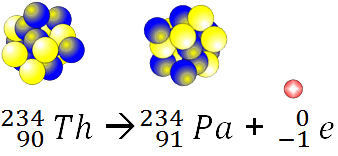
Which type of nuclear radiation is being emitted here?
a)
Alpha
b)
beta
c)
gamma 
d)
none
34.
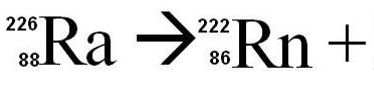
Complete the nuclear equation and determine the type of decay that is occurring in this reaction. 
a)
alpha
b)
beta
c)
gamma
d)
none
35.

If there are 146 neutrons in 238U, how many neutrons

are found in the nucleus of 235U?

a)

141

b)

143

c)

145

d)

147

36.
What is an alpha particle?
a)
1 high speed electron
b)
2 protons
c)
2 neutrons
d)
2 protons + 2 neutrons
37.
If radiation is detected through paper, which 2 types could it be?
a)
Alpha & beta
b)
Beta & gamma
c)
Alpha & gamma
38.
Which is the most highly ionizing?
a)
Alpha
b)
Beta
c)
Gamma
39.
Iodine-131 has a half life of 8 days.  A sample starts with 3000 counts per second.  How many days will it take to have a count rate of 94 days?
a)
32 days
b)
40 days
c)
375 days
d)
16 days
40.
What happens during beta decay?
a)
Neutron turns into a proton; proton number goes up by 1, mass number stays the same.
b)
Neutron turns into a proton; proton number stays the same, mass number goes up by 1.
c)
It releases 2 protons + 2 neutrons; mass number decreases by 4, proton number decreases by 2
d)
Proton turns into a neutron; proton number goes up by 1, mass number stays the same.