wayground logo

Free Printable Worksheets

NEW

Font size

S
M
L
XL
Worksheets

3rd trim

Total questions: 60

Worksheet time: 38mins

Name
Class
Date
1.
A possible explanation to a problem that has not yet been tested. 
a)
data
b)
theory
c)
hypothesis
d)
fact
2.
This part of the experiment serves as a basis of comparison; the one variable being tested has been omitted. 
a)
experimental group
b)
control group
c)
data
d)
variables
3.
Testing a hypothesis often involves a(n):
a)
answer
b)
experiment
c)
problem
d)
safety check
4.
Which is NOT a step in the scientific method?
a)
Make observation
b)
Form a theory
c)
Collect data
d)
Form a hypothesis
5.

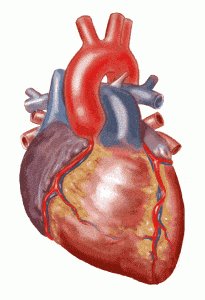
What takes blood back to the heart?

a)

arteries

b)

veins

c)

capillaries

6.

When you go to the doctor and they want to see how hard your heart is pumping, they take your...

a)

blood pressure

b)

temperature

c)

pulse

d)

name and address

7.

What color is oxygenated blood?

a)

bright red

b)

bright blue

c)

dark, dark red

d)

orange

8.

What color is blood that is oxygen poor? (little or no oxygen)

a)

purple

b)

red

c)

dark, dark red ( almost maroon)

d)

pink

9.
5?
a)
Aorta
b)
Pulmonary Valve
c)
Atrium
d)
Ventricle
10.
2?
a)
Right Atrium
b)
Right Ventricle
c)
Left Atrium
d)
Left Ventricle
11.
3?
a)
Superior Vena Cava
b)
Right Pulmonary Vein
c)
Right Ventricle
d)
Right Atrium
12.
9?
a)
Left Ventricle
b)
Left Atrium
c)
Left Pulmonary Vein
d)
Left Pulmonary Artery
13.
Pumps oxygen-poor blood to the lungs
a)
Right Ventricle
b)
Right Atrium
c)
Left Ventricle
d)
Left Atrium
14.
Receives oxygen-rich blood from the lungs
a)
Right Ventricle
b)
Left Ventricle
c)
Right Atrium
d)
Left Atrium
15.
Carries the blood from the ventricle to the body
a)
Aorta
b)
Atrium
c)
Valve
d)
Septum
16.
What are areas where freshwater meets saltwater called?
a)
wetlands
b)
estuaries
c)
coastal byways
d)
intertidal zones
17.
Aquatic ecosystem that has a thin layer of water covering soil that is wet most of the time is called ____.
a)
wetland
b)
estuary
c)
lake
d)
puddle
18.
Why does photosynthesis not occur in the deep ocean? 
a)
Lack of nutrients
b)
Low oxygen levels
c)
Excess sunlight
d)
Sunlight does not penetrate
19.
Deep ocean technology has discovered organisms in hydrothermal vents that do not rely on sunlight to survive. What do these organisms use as their energy source?
a)
chemosynthesis
b)
electrical charge
c)
hydropower
d)
thermal heat
20.

Salinity refers to

a)

how many plants are in the water

b)

how many organisms live in the water

c)

how much salt in is water

21.
An area in which fresh water from a river mixes with salt water from the ocean
a)
Mangrove Swamp
b)
Estuary
c)
Marshes
d)
Wetland
22.
Which is NOT example of freshwater ecosystems
a)
Coral Reef
b)
Lake
c)
Pond
d)
Stream
23.

A pond...

a)

is bigger than a lake

b)

is deeper than a lake

c)

is wider than a lake

d)

sunligth approaches the soil

24.

Coral bleaching is due to global warming...

a)

true

b)

false

c)

sometimes

25.

Corals are...

a)

animals

b)

rocks

c)

plants

d)

non living things

e)

mushrooms

26.

Mangroovers grow in...

a)

freshwater ecosystems

b)

wetlands

c)

estuaries

d)

oceans

27.

Open oceans have 3 zones. Which one is the deepest?

a)

deep zone

b)

sunlit zone

c)

twilight zone

d)

dark zone

28.

Which aquatic ecosystem are streams?

a)

estuaries

b)

freshwater ecosystem

c)

ocean

d)

wetland

29.

This aquatic ecosystem is a ...

a)

estuary

b)

pond

c)

wetland

d)

Open ocean

e)

coral reef

30.

This image belongs to a ...

a)

coral reef

b)

estuary

c)

lake

d)

ocean

31.

Differences between stream and river:

a)

streams are wider than rivers

b)

rivers are rich in oxygen

c)

streams have fast-moving water

d)

rivers are shallower than streams

32.
What type of organisms are the first step in a food chain?
a)
Consumers
b)
Predators
c)
Producers
33.
What's a food web?
a)
A representation of all the feeding relationships within a community.
b)
A way of showing how matter and energy pass from one organism to another.
c)
A food chain provides a more complete model of feeding relationships within a community.
34.
Examples of producers:
a)
flies, fungus, and termites
b)
plants and organisms capable of chemo or photosynthesis
c)
lions, deer, and shrubs
35.
A food web is made up of 
a)
one food chain.
b)
only producers.
c)
many different food chains.
36.
What is indicated by the diagram?
a)
Food web
b)
Food chain
c)
Food map
d)
Food menu
37.
What do the arrows indicate in a food web?
a)
What eats what
b)
Where the energy is being transferred
c)
How the animals are related
38.
An organism that eats both plants and animals are know as a 
a)
Carnivore
b)
Omnivore
c)
Herbivore
d)
Decomposer
39.
Autotrophs are organisms that produce their own food. Which do scientist classify as autotrophs?
a)
Chordates
b)
Fungi
c)
Plants
d)
Molds
40.

Organisms that obtain energy by feeding on other organisms

a)

Producer

b)

Consumer

c)

Decomposer

41.

Organisms that break down wastes and dead organisms and return the raw materials to the environment

a)

Producer

b)

Consumer

c)

Decomposer

42.

Consumers that eat only animals

a)

Carnivores

b)

Omnivores

c)

Herbivores

d)

Scavengers

43.

A food _______ is a series of events in which one organism eats another and obtains energy.

a)

chain

b)

web

c)

pyramid

d)

plate

44.

In the food web above, what eats the rabbit?

a)

Fox

b)

Hawk

c)

Vole

d)

Grass

45.

A living thing that is made up of organ systems.

a)

cell

b)

tissue

c)

organ

d)

organ system

e)

organism

46.

2 or more organs that work together.

a)

cell

b)

tissue

c)

organ

d)

organ system

e)

organism

47.

Groups of similar cells that work together.

a)

cell

b)

tissue

c)

organ

d)

organ system

e)

organism

48.
This is a example of ........
a)
cell
b)
organ system
c)
organ
d)
tissue
49.
Multiple organisms of the same species describes a
a)
organism
b)
population
c)
community
d)
ecosystem
50.
What do ecosystems have that the other three levels of organization do not have?
a)
living things
b)
biotic factors
c)
abiotic factors
d)
organisms
51.
A forest full of many kinds of trees and grasses is an example of a
a)
group
b)
organism
c)
population
d)
community
52.
Which is an example of an organism?
a)
a beetle
b)
a lake
c)
a rock
d)
a shell
53.
Which level of organization is more complex than a population and less complex than an ecosystem?
a)
organism
b)
population
c)
community
d)
ecosystem
54.
Which is the definition of a community
a)
multiple organisms of the same species
b)
all the living and nonliving things in an area
c)
a living thing
d)
multiple organisms of different species
55.
One single organism is known as an ___________.
a)
Individual
b)
Population
c)
Community
d)
Ecosystem
56.
The study of the interaction between living things and their environment is know as ________. 
a)
Biology
b)
Meterology
c)
Ecology
d)
Geology
57.
A group of organisms in the same species an in the same location is known as a ___________.
a)
Individual
b)
Population
c)
Community
d)
Ecosystem
58.
Which of the following is a biome?
a)
an elephant
b)
a clownfish
c)
the savannah
d)
pack of wolves
59.
Which of the following is a population?
a)
an elephant
b)
a forest
c)
the savannah
d)
pack of wolves
60.
A group of ecosystems with similar climate and organisms located globally is known as a ___________.
a)
Biome
b)
Biosphere
c)
Community
d)
Ecosystem