wayground logo

Free Printable Worksheets

NEW

Font size

S
M
L
XL
Worksheets

action potential

Total questions: 40

Worksheet time: 27mins

Name
Class
Date
1.
Which ions are involved in an action potential?
a)
Na; Cl
b)
Na; K
c)
K; Cl
d)
Na; Ca
2.
What is the normal resting potential of a neuron cell membrane?
a)
+40mV
b)
-30mV
c)
+55mV
d)
-70mV
3.
Which is the correct order of events in depolarisation then repolarisation? 
a)
Sodium channels close, potassium channels open
b)
Sodium channels open, potassium channels open, 
c)
Sodium channels open, potassium channels close
d)
Potassium channels open, sodium channels open
4.
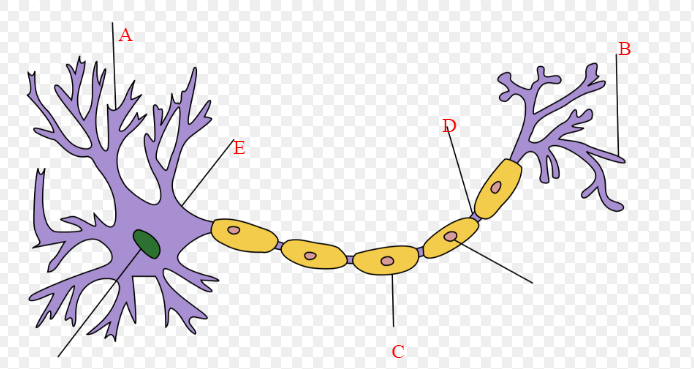
At which point on the diagram does depolarisation of the axon occur? 
a)
A
b)
B
c)
C
d)
D
5.
The sodium potassium pump restores the resting potential. By which process does this work? 
a)
Osmosis
b)
Diffusion
c)
Facilitated diffusion
d)
Active transport
6.
What is the insulating membrane that surrounds parts of the axon that helps to protect & propagate action potential?
a)
Axon
b)
Dendrites
c)
Node of Ranvier
d)
Myelin Sheath
7.
When a neuron is not engaged in an impulse.
a)
Resting potential
b)
Action potential
c)
Neural potential
d)
Synaptic potential
8.
When a neuron is resting, the inside of the axon has a ____________ charge.
a)
positive
b)
negative
9.
A membrane potential becoming less negative is called
a)
hyperpolarization
b)
depolarization
c)
repolarization
d)
polarization
10.
In resting potential, neurons have more _________ on the outside of the cell membrane.
a)
K+
b)
NaCl
c)
Na+
d)
Cl-
11.
In resting potential, neurons have more ____________ on the inside of the cell membrane.
a)
NaCl
b)
Na+
c)
K+
d)
Cl-
12.
Describes the fact that a neuron fires at the same intensity despite the intensity of the stimulus.
a)
Threshold
b)
Repolarization
c)
All or None Principle
d)
Action Potential
13.

What number(s) on the graph represents the THRESHOLD level of stimulus?

a)

1 and 5

b)

2

c)

3

d)

6

14.
Neurotransmitters are released from the
a)
Dendrites
b)
Post-synaptic neuron
c)
Presynaptic neuron
d)
Axon
15.
In order for a neuron to have an action potential, the neuron must receive more
a)
excitatory neurotransmitters
b)
inhibitory neurotransmitters
c)
agnostic neurotransmitters
d)
antagonistic neurotransmitters
16.
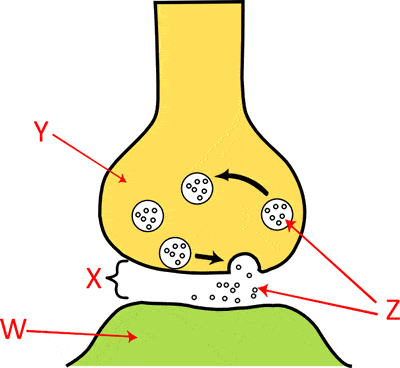
W
a)
Axon Terminal Button
b)
Neurotransmitters
c)
Dendrite
d)
Synapse
17.

What do we call a nerve cell that is the basic working unit of the brain and nervous system?

a)

axon

b)

neuron

c)

dendrite

d)

neurotransmitter

18.

B

a)

Dendrite

b)

Axon

c)

Axon Terminal

d)

Cell Body

19.
What is the chemical used by a neuron to transmit an impulse across a synapse to another nerve cell?
a)
Neurotransmitters
b)
Synapse
c)
Threshold
d)
Impulse
20.
-70 mV is the measure of a
a)
Threshold Potential
b)
Action Potential
c)
Resting Potential
d)
End Point Potential
21.
When a membrane potential reaches +30mV, ________ channels open, ________ occurs, and ________ channels close.
a)
Sodium, depolarization, potassium
b)
Potassium, depoloarization, sodium
c)
sodium, repolarization, potassium
d)
postassium, repolarization, sodium
22.
The area between the pre-synaptic cell and the post-synaptic cell is termed the synaptic cleft.
a)
True
b)
False
23.
Nerve impulses within the neuron are sent in _____ form
a)
Electrical
b)
Chemical
c)
Electro-chemical
d)
Petrochemical
24.

Depoloarization Occurs as ________ moves into the cell

a)

Cl-

b)

K+

c)

Na+

25.

Voltage gated Na+ channels open and an Action Potential occurs when

a)

Na+/K+ pump brings in Na+

b)

enough + charges enter the neuron to bring it to threshold (-55mv)

c)

any Na+ enters the neuron

26.

Repolarization _______ the voltage inside the cell

a)

Increases

b)

Decreases

27.

What is the name of A?

a)

P wave

b)

PR Interval

c)

QRS complex

d)

ST segment

28.

What is the name of B?

a)

P wave

b)

QRS complex

c)

PR Interval

d)

ST segment

29.

What is the name of C?

a)

P wave

b)

PR Interval

c)

QRS complex

d)

T wave

30.

What is the name of All of A + the area up to B?

a)

P wave

b)

PR Interval

c)

QRS complex

d)

T wave

31.

What is Happening during the P wave?

a)

AV node fires

b)

Atrial Repolarization

c)

Atrial Contraction

d)

Ventricular Systole

32.

What is Happening during the QRS complex?

a)

SA node fires

b)

Atrial Depolarization

c)

Ventricular Systole

d)

Ventricular Diastole

e)

All of the answer choices

33.

What is Happening during the P wave?

a)

SA node fires

b)

Atrial Repolarization

c)

Atrial Relaxation

d)

Ventricular Systole

34.

What is Happening during the QRS complex?

a)

SA node fires

b)

Atrial Depolarization

c)

Ventricular Depolarization

d)

Ventricular Diastole

e)

All of the answer choices

35.

What is Happening during the T wave?

a)

SA node fires

b)

Atrial Repolarization

c)

Ventricular Diastole

d)

Ventricular Systole

36.

What is Happening during the P wave?

a)

SA node fires

b)

Atrial Depolarization

c)

Atrial Contraction

d)

Atrial Systole

e)

All of the answer choices

37.

What is the name for an abnormal heart rhythm?

a)

Arrythmia

b)

Beats per minute

c)

Pacemaker

d)

All of the options are true

38.

What is the name of the flat line in between cardiac cycles?

a)

ST segment

b)

PR interval

c)

QT interval

d)

Isoelectric line

39.

When sodium moves into the cell and potassium leaves the cell, this causes a discharge of electricity. This electrical wave then courses from cell to cell, spreading throughout the heart. This is called

a)

Repolarization

b)

Refractory Period

c)

Depolarization

d)

All options are true

40.

During cell recovery, sodium and potassium are shifted back to their original places by way of the _______________, An active transport system that returns the cell to its negative charge. This is called ____________________.

a)

Repolarization, Sodium Potassium Pump

b)

Refractory Period, Repolarization

c)

Sodium Potassium Pump, Depolarization

d)

Sodium Potassium Pump, Repolarization